Superannuation in Australia: What It Is, How It Works and When You Can Access It
Learn how Australian super works in 2026–27: 12% employer payments, Payday Super, investments, fees, tax and when you can withdraw.
Superannuation Calculator Australia · · 11 min read
Superannuation (super) is money saved and invested for retirement in Australia. Most employees receive compulsory employer contributions and individuals can also contribute their own money. A super fund invests those contributions and deducts applicable taxes, fees and insurance premiums. You usually access your benefits after meeting a legal retirement or release condition.
This guide explains who receives super, how the 12% super guarantee works in 2026–27, how investments and tax affect balances and how to find your account.
What Is Superannuation?
A super fund holds and invests contributions to build retirement savings, with access generally restricted until a legal condition of release is met. Employer payments, personal contributions and investment returns affect the balance.
Super is not a separate tax on employees. It is a retirement benefit held through a regulated fund. ASIC MoneySmart, Superannuation (14 September 2026), explains that employer contributions enter a super account and are invested over time.
Most accounts are accumulation funds: their value changes with contributions, investment performance, fees, taxes and insurance premiums. A defined benefit scheme instead uses rules in the scheme to calculate benefits, so its entitlement does not always equal an investment account balance.
How Does Superannuation Work?
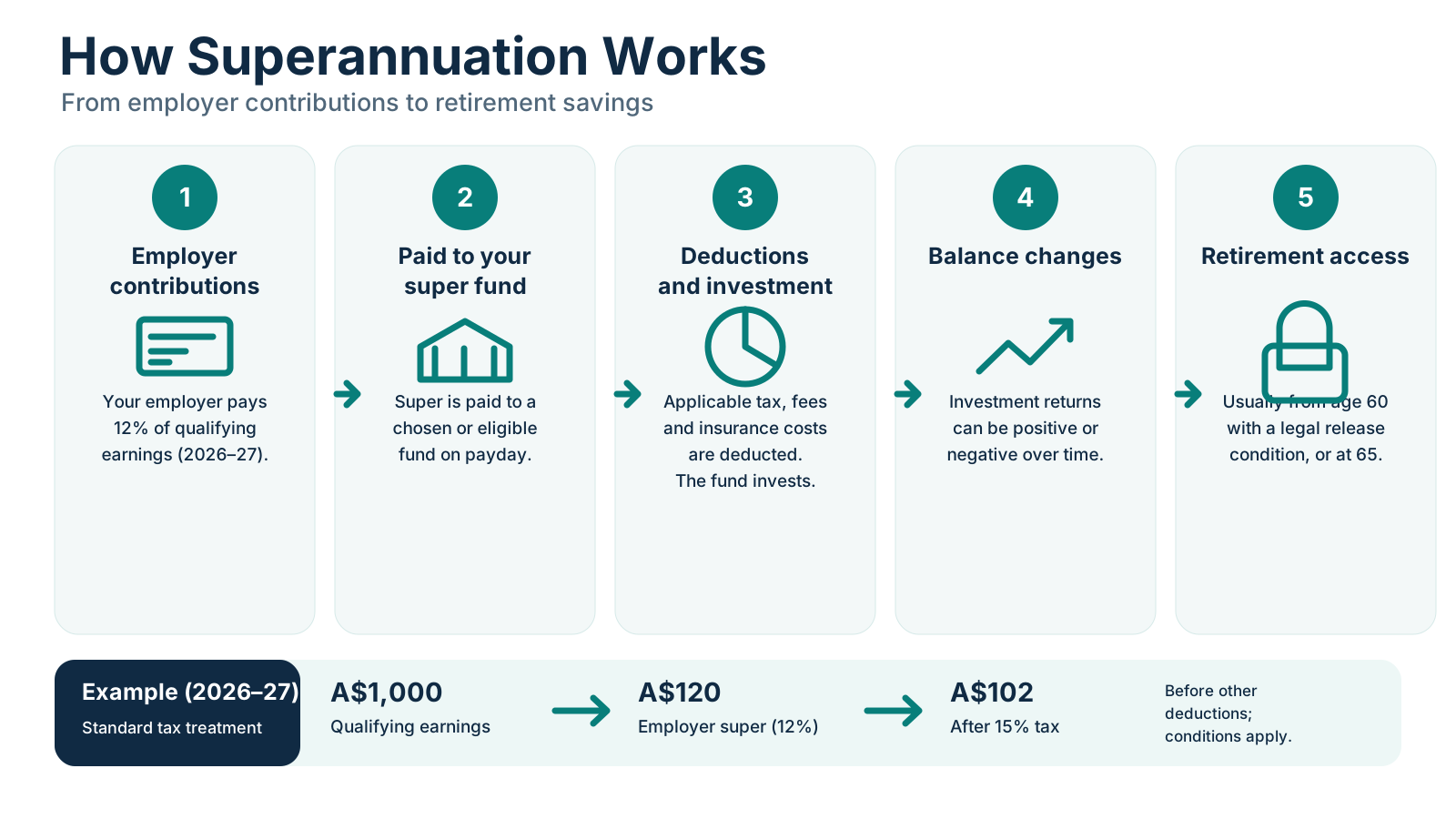
Australian super generally works in five stages:
- Your employer calculates compulsory super on qualifying earnings for each payday.
- The employer transfers contributions to your chosen, stapled or default complying fund.
- The fund allocates the payment to your account, applies relevant tax and invests the balance.
- Contributions, investment returns, fees, insurance premiums and taxes change your balance.
- After meeting a condition of release, you can withdraw money, start an eligible income stream or leave benefits invested.
A concessional contribution of $120 ordinarily incurs $18 in contributions tax (15%), leaving $102 before other deductions, assuming the standard tax treatment applies. See how super is paid for payment details. Use superannuation Calculator Australia to estimate the employer contribution on your salary.
Who Gets Superannuation in Australia?
Most employees aged 18 or over are eligible for compulsory employer super, including full-time, part-time and casual workers. Employees younger than 18 generally qualify when they work more than 30 hours in a week.
Some contractors paid principally for their labour are covered by super guarantee rules despite using an ABN. Special rules can apply to domestic workers and other employment categories. The former $450 monthly earnings threshold was removed in July 2022.
How Much Super Does Your Employer Pay?
The minimum super guarantee (SG) rate is 12% of qualifying earnings in 2026–27, subject to applicable rules and the maximum contribution base. Under Payday Super, qualifying earnings cover ordinary time earnings (OTE), commissions, salary sacrifice amounts and certain other payments specified in the rules. Genuine overtime outside ordinary hours generally does not become qualifying earnings merely because it is paid with wages. Check the payment type and the applicable employment arrangements rather than relying on a payslip label.
Source: Australian Taxation Office, What payments are qualifying earnings (2026) and How to work out and pay super (2026).
| Qualifying earnings for a payday | Minimum SG at 12% |
|---|---|
| $1,000 | $120 |
| $2,000 | $240 |
| $3,500 | $420 |
These examples assume every dollar is qualifying earnings and no special rule changes the calculation. An award or contract can provide for higher contributions. For a pay-specific estimate, use super Contributions Calculator Australia.
When Must Employers Pay Super in 2026–27?
From 1 July 2026, Payday Super requires employers to pay super on each payday rather than following the former quarterly schedule. In the ordinary case, the contribution must reach the fund within seven business days of payday.
Specific exceptions and extended timeframes apply, including certain first payments to new employees and some fund changes. The deadline is based on fund receipt, not simply when a payment appears on a payslip.
Source: Australian Taxation Office, Payday Super (2026); ASIC MoneySmart, What is Payday Super (30 September 2026). See payday Super deadlines and payment checks.
Is Super Paid on Top of Your Salary?
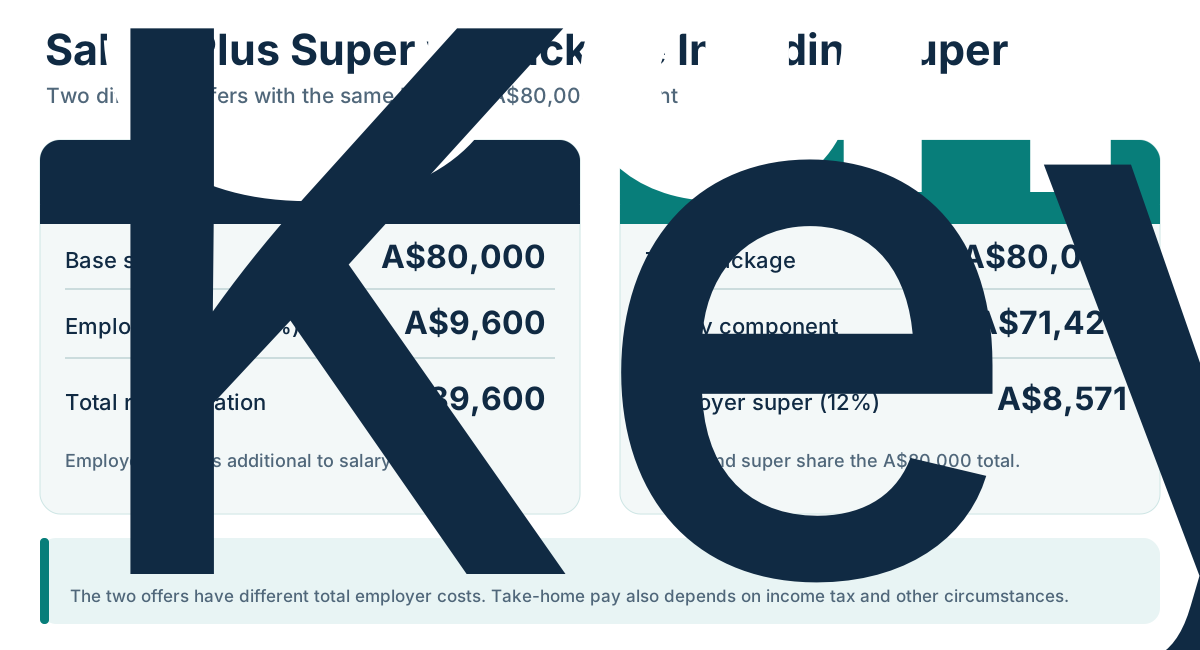
YES, an advertised base salary plus super means compulsory employer super is additional to that base salary. However, an advertised total remuneration package inclusive of super includes both salary and employer contributions within the quoted package.
For example, a base salary of $80,000 plus 12% super produces $9,600 in employer contributions if all salary qualifies. By contrast, an $80,000 package including 12% super equates to approximately $71,428.57 salary ($80,000 ÷ 1.12) and $8,571.43 super ($80,000 − $71,428.57), assuming all salary is qualifying earnings and no other packaged benefits. Check whether the employment agreement describes a base salary or a total package.
How Are Super Funds Chosen?
Most employees can choose the complying super fund to receive their employer contributions. If no choice is made, the employer generally checks for an existing stapled fund before using an eligible default option.
- Compare appropriate investment options, fees, risk and insurance with the ATO's YourSuper comparison tool and fund disclosures.
- Check existing accounts through myGov-linked ATO services.
- Provide your selected fund's details to your employer.
- Check that contributions arrive in the intended account.
Compare returns over equivalent periods and investment risk levels. Examine the fund's Product Disclosure Statement (PDS) for fees, insurance, investment risks and eligibility. Check the same category of investment option across providers; a growth option and a conservative option are not like-for-like comparisons. Past performance is not a reliable guarantee of future returns. Source: ASIC MoneySmart, Choosing a super fund (29 September 2026).
How Does Your Super Balance Grow?
Your super balance grows when contributions and investment gains exceed fees, tax, insurance premiums and losses. Funds typically invest in combinations of shares, property, fixed interest and cash, with an asset allocation matching the selected investment option.
For example, a balance of $20,000, plus $3,000 in contributions, equals $23,000 before returns and deductions. A hypothetical 5% gain on the opening $20,000 adds $1,000, giving an illustrative $24,000 balance before any fees, tax or insurance costs. This is not a projected annual return: the timing of contributions, market performance and deductions alter the result. Investment losses can reduce the balance. Explore super investment returns or model longer-term scenarios with super Projection Calculator Australia.
How Do Fees and Insurance Affect Your Super?
Administration fees, investment costs, transaction costs and insurance premiums can reduce an accumulation balance. Some products also apply other disclosed costs, including advice fees or buy-sell spreads.
Funds may offer death cover, total and permanent disability (TPD) cover and income protection insurance. According to ASIC MoneySmart, Insurance through super (17 September 2026), premiums reduce retirement savings and existing cover can be lost when changing accounts. Review the premiums, exclusions and coverage before transferring or consolidating. Compare fees for the same balance and comparable investment options, rather than comparing a cash option with a growth portfolio.
Can You Make Extra Contributions to Super?
YES, eligible members can contribute extra money through salary sacrifice, deductible personal contributions or after-tax personal contributions. The category determines tax treatment and which annual cap applies.
Check the current contribution caps and your total super balance before making large payments. Carry-forward concessional provisions and bring-forward non-concessional provisions depend on eligibility. Self-employed super contributions follow additional practical considerations.
How Is Superannuation Taxed?
Most concessional contributions, including employer super, incur 15% contributions tax in a complying fund. Investment earnings in the accumulation phase generally attract up to 15% tax, with different treatment for eligible capital gains and retirement-phase pensions.
After-tax non-concessional contributions generally do not incur contributions tax on entry. Additional Division 293 tax applies to some higher-income individuals. The tax on a super withdrawal depends on age, fund type, benefit components and whether a condition of release is met. For the distinctions, read superannuation tax explained.
When Can You Access Superannuation?
Most Australians can access preserved super from age 60 after meeting the relevant retirement or employment-cessation condition. At age 65, preserved benefits are generally accessible regardless of whether the person has retired.
| Circumstance | General access position |
|---|---|
| Under 60 | Usually preserved; a recognised early-release condition is required |
| Age 60–64 | A relevant retirement or other condition of release is required for unrestricted access |
| Age 65 or older | Generally available regardless of employment status |
A transition-to-retirement income stream can provide restricted access from age 60 while continuing work. Exceptional early-release grounds include specific compassionate and financial-hardship circumstances. See when you can access super for the full conditions.
How Can You Find and Combine Your Super?
You can find multiple super accounts through ATO online services linked to myGov and request eligible rollovers to consolidate accounts.
- Sign in to myGov and open ATO online services.
- Review active, inactive and lost super accounts.
- Compare investment options, fees and any insurance coverage.
- Request a rollover and confirm it has been completed.
Before moving an account, establish whether existing insurance would be lost, whether a replacement policy has exclusions or waiting periods and whether the transfer affects investments or defined benefits. Consolidating solely to reduce the number of accounts is not always the best choice. Source: ASIC MoneySmart, Switching super funds (2026).
How Can You Check Whether Your Employer Paid Super?
Compare the amount recorded on your payslip with contributions actually received by your fund. A payslip entry is not conclusive proof of fund receipt.
- Identify the payday and the earnings that qualify for SG.
- Multiply qualifying earnings by 12%, subject to any applicable maximum contribution base or special rules.
- Check the fund transaction history for the amount and receipt date, not just the payslip liability.
- Allow for the usual seven-business-day receipt timeframe and any applicable extension. Fund allocation or app display can take additional processing time.
- Ask payroll which fund was paid, on what date and for what amount. Report unresolved unpaid super to the ATO.
For 2026–27, apply the Payday Super receipt deadline and check for any applicable statutory extension. Source: ASIC MoneySmart, What is Payday Super (30 September 2026).
What Happens to Super When You Change Jobs?
Changing jobs does not automatically close or withdraw an existing super account. The same fund can generally receive payments from your next employer, including through the stapled-fund process.
Review fees, insurance and investments before opening another account or transferring your existing balance. A stapled fund's existing insurance may no longer suit a different occupation. Update beneficiary details and your contact information after employment changes. Source: ASIC MoneySmart, Stapled super fund (29 September 2026).
Is superannuation compulsory for most employees in Australia?
YES, compulsory employer super applies to most eligible employees aged 18 or over and to eligible younger workers who work more than 30 hours in a week. Some contractor and domestic employment arrangements require separate assessment.
Can casual employees receive superannuation?
YES, eligible casual employees receive compulsory employer super. Casual status does not remove a super guarantee entitlement. The special more-than-30-hours weekly test generally applies to employees under 18.
Does superannuation belong to the employee?
YES, super held for an individual member is intended to provide that member's retirement benefit. A super trustee holds and manages assets subject to the applicable laws and fund rules. Withdrawals and death-benefit payments follow legal release and beneficiary rules.
Can your super balance go down?
YES, investment losses and deductions can reduce a super balance even when an employer has paid contributions. Examine investment performance, insurance premiums, fees and transaction history before concluding a payment is missing.
Can you withdraw super whenever you want?
NO, super is ordinarily preserved until you meet a legal condition of release. Unauthorised early-access arrangements can attract serious tax or regulatory consequences.
Does changing employers mean changing super funds?
NO, changing employers does not generally require you to change funds. A stapled account can continue across jobs, though eligible employees can usually nominate a different complying fund.
Can self-employed people make super contributions?
YES, self-employed people can generally make voluntary personal super contributions within applicable caps. Sole traders are not ordinarily required to pay themselves employer super, although some labour-only contractors qualify for compulsory contributions from the business engaging them.
Sources and verification (October 2026)
- Australian Taxation Office (ATO): What payments are qualifying earnings (2026); How to work out and pay super (2026); Payment deadlines for Payday Super (2026).
- Australian Taxation Office (ATO): What is super (2 August 2023); Work out if you have to pay super; Payday Super (2026).
- ASIC MoneySmart: Superannuation (14 September 2026); What is Payday Super (30 September 2026); Choosing a super fund (29 September 2026); Insurance through super (17 September 2026).
- ASIC MoneySmart: Getting your super (6 August 2026); Defined benefit super explained (14 August 2026).
- Fair Work Ombudsman: Tax and superannuation.
Check annual contribution caps, maximum contribution bases and exceptional Payday Super deadlines against current ATO information before acting.
Written by
Superannuation Calculator Australia
Calculation guidance and general information; independent financial advice is not provided.