Super Contribution Caps: 2026–27 Limits, Types and Eligibility
Super contribution caps limit certain amounts paid into Australian superannuation funds in each financial year. For 2026–27, the general concessional cap is $32,500 and the general non-concessional cap is $130,000. The amount a person can contribute without exceeding a cap depends on contribution type, existing payments and eligibility rules.
The figures below apply from 1 July 2026 to 30 June 2027. A personal cap check must include payments received across all relevant super funds.
What are super contribution caps?
Super contribution caps are annual limits on concessional (generally before-tax) and non-concessional (generally after-tax) amounts counted under Australia's super tax rules. A cap is not the same as a fund's contribution acceptance rules or an employer's super guarantee obligation.
The Australian Taxation Office (ATO) assesses relevant contributions against the applicable financial-year cap. Some individuals have extra concessional cap space from earlier years or non-concessional bring-forward arrangements.
What are the concessional and non-concessional caps for 2026–27?
The general Australian super contribution caps for 2026–27 are $32,500 concessional and $130,000 non-concessional. The Australian Taxation Office confirms these figures in Concessional contributions cap (updated 2 July 2026) and Non-concessional contributions cap (updated 7 May 2026).
| Contribution type | 2026–27 | 2025–26 |
|---|---|---|
| Concessional (before-tax) | $32,500 | $30,000 |
| Non-concessional (after-tax) | $130,000 | $120,000 |
These are general limits rather than personal entitlements. Your non-concessional cap is nil if your total super balance on 30 June 2026 was at least $2.1 million. A valid bring-forward period can instead permit more than the annual limit.
What contributions count towards each cap?
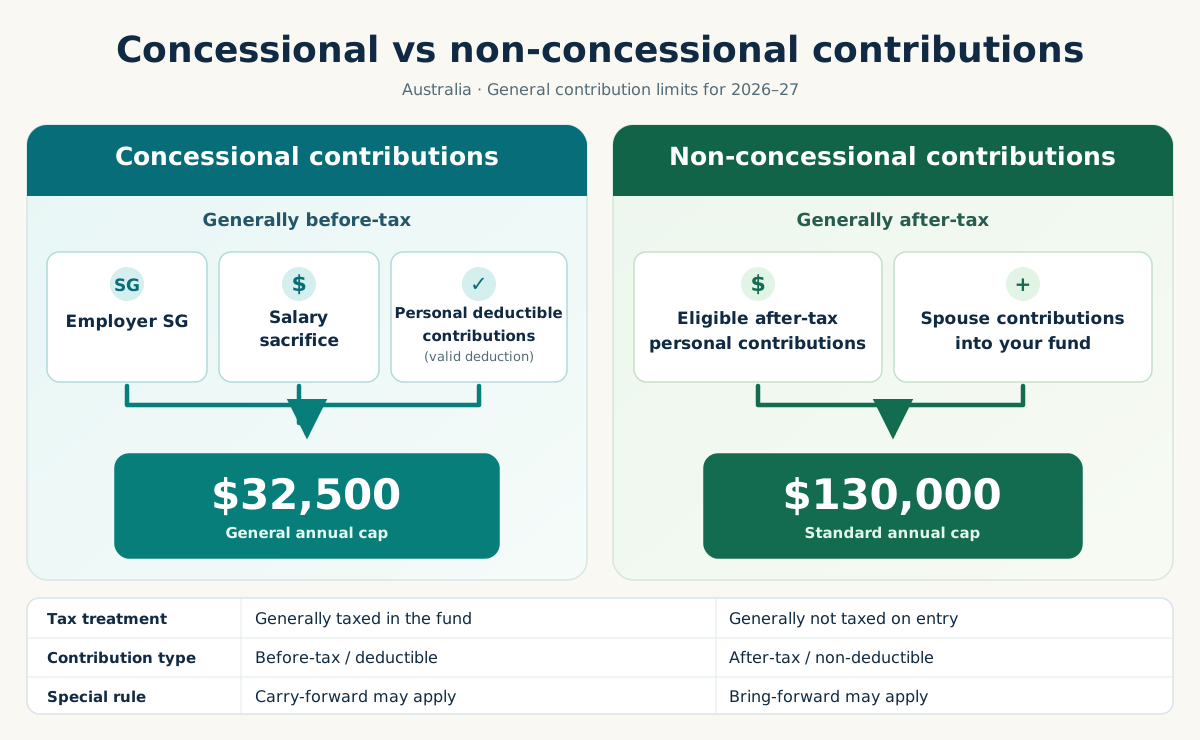
Concessional contributions include employer super guarantee (SG) payments, salary sacrifice and personal contributions for which a valid tax deduction is claimed. Non-concessional contributions generally include personal after-tax amounts where no deduction is claimed.
| Contribution | Usually counts as |
|---|---|
| Employer SG | Concessional |
| Salary sacrifice | Concessional |
| Personal contribution with valid deduction | Concessional |
| Personal contribution without deduction | Usually non-concessional |
| Spouse contribution paid into your fund | Generally non-concessional for you |
| Government super co-contribution | Excluded from the non-concessional cap |
A personal contribution generally becomes concessional only to the extent that a tax deduction is validly claimed and allowed, including a valid notice of intent acknowledged by the fund. Unreleased excess concessional contributions can count towards the non-concessional cap. According to the ATO, Understanding concessional and non-concessional contributions (updated 15 January 2026), specific exclusions also apply, including eligible downsizer contributions and government co-contributions.
How do concessional and non-concessional contributions differ?
Concessional contributions generally receive concessional tax treatment in the fund and use the smaller annual cap. Non-concessional contributions usually come from after-tax money and use a separate, larger annual cap subject to eligibility restrictions.
| Attribute | Concessional | Non-concessional |
|---|---|---|
| 2026–27 standard annual cap | $32,500 | $130,000 |
| Typical source | Employer SG, salary sacrifice, deductible personal | After-tax money without a deduction |
| Typical fund tax treatment | Generally 15%; exceptions apply | Generally no contributions tax at entry |
| Special rule | Unused cap carry-forward | Bring-forward depending on eligibility |
The caps are separate. An after-tax personal payment without a claimed deduction generally uses non-concessional space, not concessional space. Use the Super Contributions Calculator Australia to estimate both categories together.
How can you calculate your remaining cap space?
Estimate remaining standard concessional cap space by subtracting counted concessional contributions from the annual cap: $32,500 minus total relevant contributions received in 2026–27. Include employer SG, salary sacrifice, deductible personal contributions and other counted concessional amounts.
For example, $12,000 employer SG + $5,000 salary sacrifice + $2,000 deductible personal contributions = $19,000 counted contributions. The standard remaining cap is $32,500 − $19,000 = $13,500. For an estimate of employer SG based on earnings, use Superannuation Calculator Australia before entering the amount here.
Estimate your remaining concessional cap
Enter the combined amounts received and expected for the whole 2026–27 year across every fund, without double-counting payments. Use actual SG amounts where available; salary alone is not an SG contribution amount.
Estimate only. The calculator uses the $32,500 general 2026–27 concessional cap; it does not include eligible unused carry-forward amounts, defined benefit adjustments or other individual exceptions. Count payments by the year each fund receives them and verify reported amounts with your funds and ATO online services.
The result is an estimate, not an ATO-confirmed cap balance. Distinguish amounts already received from projected contributions in your records. If your total exceeds $32,500, unused carry-forward caps may cover some or all of the difference when eligibility conditions are met.
How do contribution dates and multiple funds affect your cap?
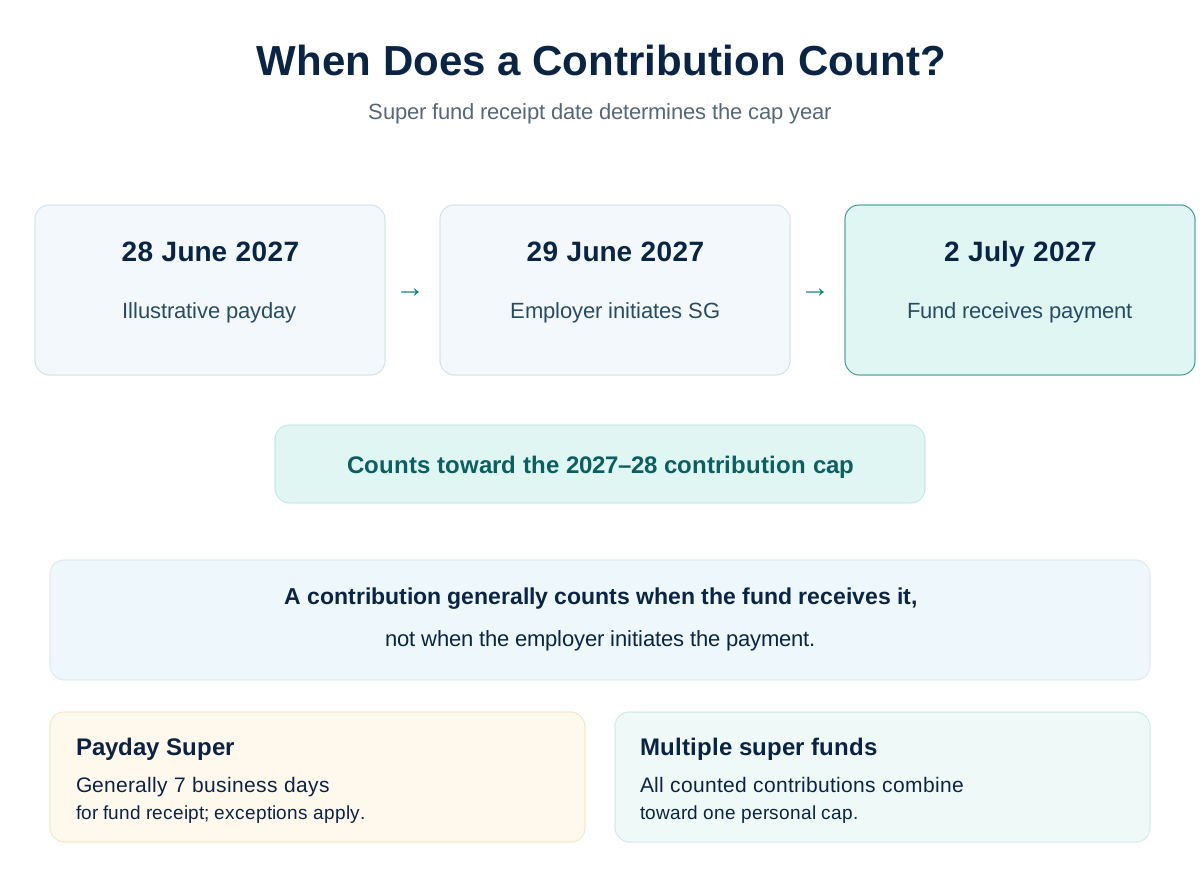
A contribution generally counts in the financial year the super fund receives it, not necessarily the period in which salary was earned or the date an employer initiated payment. Relevant contributions across multiple super funds count toward the same individual cap.
Example: SG relating to June wages but received by a fund on 3 July 2027 generally counts in 2027–28, not 2026–27. From 1 July 2026, Payday Super generally requires SG to reach the fund within seven business days after payday, subject to exceptions. The ATO's Payday Super guidance (2026) distinguishes the employer payment deadline from the financial year in which the fund receives a contribution.
Who can use unused concessional caps from prior years?
Individuals with a total super balance below $500,000 on 30 June of the preceding financial year can use available unused concessional cap amounts from the previous five financial years, subject to the ATO's carry-forward rules. The current year's general cap is used first.
For 2026–27, unused amounts potentially available arise from 2021–22 through 2025–26. Those years had different annual caps, so simply multiplying $32,500 by five gives an incorrect carry-forward estimate.
The current-year cap is used first, followed by unused amounts from earlier years, oldest first. Unused amounts expire after five years. For example, eligible unused space from 2021–22 expires after 30 June 2027 if not used. The ATO explains the order in Concessional contributions cap (updated 2 July 2026). Check your available amounts in ATO online services via myGov instead of estimating from past salaries.
When can the non-concessional bring-forward rule apply?
The non-concessional bring-forward rule permits an eligible person to use up to two future years' caps early. To start a bring-forward period in 2026–27, you must be under age 75 at some point during that financial year, meet the total super balance test and not already be subject to an earlier bring-forward period. Separate fund acceptance rules apply around age 75. The ATO sets out these conditions in Non-concessional contributions cap (updated 7 May 2026).
| Total super balance at 30 June 2026 | 2026–27 first-year potential |
|---|---|
| Below $1.84 million | Up to $390,000 (3 years) |
| $1.84m to below $1.97m | Up to $260,000 (2 years) |
| $1.97m to below $2.1m | $130,000 standard annual cap |
| $2.1m or more | Nil |
Example: a person eligible for the three-year $390,000 cap who contributes $200,000 in 2026–27 has $190,000 of that arrangement left across the following two years, subject to continuing rules. If the arrangement began before July 2026, the amount and cap period are based on the earlier start year; later cap indexation does not increase that existing bring-forward amount. A total super balance at or above the general transfer balance cap on a later 30 June can reduce a remaining year's non-concessional cap to nil.
How can you check unused contributions in ATO online services?
ATO online services through myGov show reported contribution totals, carry-forward amounts and bring-forward arrangements. To check the relevant records:
- Sign in to myGov and open the linked Australian Taxation Office service.
- Choose Super → Information → Concessional contributions to view reported before-tax amounts.
- Open Carry forward concessional contributions for unused prior-year cap amounts.
- Use Non-concessional contributions and Bring-forward arrangement when planning after-tax payments.
ATO reporting can lag recent receipts. Confirm the latest fund-received amounts directly with each fund and do not treat an unreported payment as available cap room.
What happens if you exceed a super contribution cap?
Excess concessional contributions are generally included in your assessable income and taxed at your marginal rate, with a 15% tax offset reflecting contributions tax already paid by the fund. The ATO generally permits release of up to 85% of the excess. Amounts left in super also count towards your non-concessional cap. According to the ATO, Concessional contributions cap (updated 2 July 2026), the outcome depends on any available carry-forward amounts and the excess contributions determination.
For excess non-concessional contributions, an ATO determination provides options and generally requires an election within 60 days. Choosing not to release the excess can result in 47% excess non-concessional contributions tax; the release option has separate associated-earnings treatment. Follow the ATO notice rather than asking a fund to release money before the ATO issues its authority. See the ATO, Non-concessional contributions cap (updated 7 May 2026). Obtain registered tax advice for an individual determination.
How do other super limits and Division 293 differ?
Contribution caps control annual amounts entering super. The $2.1 million general transfer balance cap in 2026–27 concerns transfers to tax-free retirement-phase income streams, not annual contributions; an individual's personal transfer balance cap can differ. Use the Super Projection Calculator Australia for a separate illustration of long-term savings growth, which is not a contribution-cap eligibility assessment.
Division 293 imposes an additional 15% tax on the lesser of taxable super contributions and the amount by which combined Division 293 income and contributions exceed $250,000. For example, $240,000 of Division 293 income plus $15,000 of relevant contributions produces $255,000 combined; the extra tax is 15% × $5,000 = $750. The maximum SG contributions base instead limits earnings used for an employer's minimum SG calculation. Source: Australian Taxation Office, Division 293 tax on concessional contributions by high-income earners (updated 24 August 2026).
How can you verify your contributions before 30 June?
Verify contribution receipts before 30 June by reconciling each fund's transaction record with payslips, employer SG payments, salary sacrifice and personal contribution confirmations. Allow time for processing because initiating a transfer does not establish its receipt date.
- Download contribution transaction histories from every super fund.
- Separate concessional from non-concessional payments and identify deductions claimed.
- Add contributions received in the financial year.
- Compare with ATO online services and ask funds about any missing or pending transactions.
- Check carry-forward or bring-forward eligibility before adding a payment.
Check fund receipt dates rather than only payroll or bank transaction dates. ATO online services can lag fund reporting, particularly for self-managed super funds; confirm any unreported June payment directly with the fund before relying on the calculator.
Do employer SG contributions count towards the cap?
YES, employer super guarantee payments count towards the employee's concessional cap when received by the fund. The SG rate for 2026–27 is 12% of qualifying earnings, subject to applicable employer rules; the contribution counted against the employee's cap is the actual reportable amount.
Can salary sacrifice and personal deductible contributions share a cap?
YES, salary sacrifice and personal contributions claimed as tax deductions generally share the concessional contribution cap. Both must be added to employer SG and any other concessional amounts before comparing the total with the annual cap.
Can unused concessional caps be carried forward?
YES, eligible individuals can carry forward unused concessional cap space from the previous five financial years. A total super balance below $500,000 at the preceding 30 June is a key eligibility condition.
Does total super balance affect bring-forward eligibility?
YES, total super balance affects bring-forward eligibility and the available non-concessional cap. For 2026–27, a balance of $2.1 million or more on 30 June 2026 means a nil non-concessional cap under the general balance test.
Can contributions to two funds exceed a single annual cap?
YES, contributions paid into two super funds can together exceed one annual cap, but the ATO adds the relevant amounts across all funds. Splitting an amount between funds never creates an extra concessional or non-concessional cap.
Does paying an employer in June guarantee that year's cap?
NO, an amount deducted from an employer's payroll in June is not guaranteed to count in the year ending 30 June. Generally, it counts when received by the super fund; check the fund's transaction date.
Is the transfer balance cap the same as the contribution cap?
NO, the transfer balance cap and contribution caps serve different purposes. The former limits retirement-phase transfers, while the latter limits specified annual contributions and associated tax treatment.
Sources and verification
Primary sources used to verify the 2026–27 figures and rules:
- Australian Taxation Office, Concessional contributions cap, updated 2 July 2026: $32,500 limit, carry-forward eligibility, fund receipt dates and excess concessional contributions.
- Australian Taxation Office, Non-concessional contributions cap, updated 7 May 2026: $130,000 standard limit, age eligibility, total super balance thresholds, bring-forward tiers and excess contribution elections.
- Australian Taxation Office, Understanding concessional and non-concessional contributions, updated 15 January 2026: contribution types, aggregation across funds and specific exclusions.
- Australian Taxation Office, Division 293 tax on concessional contributions by high-income earners, updated 24 August 2026: $250,000 threshold and additional tax calculation.
- Australian Taxation Office, Payday Super (2026): SG rate and employer fund-receipt timeframes.
The figures are general financial-year rules, not an assessment of any individual's eligibility. This guide does not cover defined benefit calculations or every statutory exclusion.