Super contributions are payments into Australian super funds from employers, individual members or government programs. In 2026–27, the standard employer super guarantee (SG) rate is 12%, the general concessional contribution cap is $32,500 and the general non-concessional cap is $130,000. The right contribution method depends on its tax treatment, your annual cap space and eligibility. This guide covers contribution types, limits, payments, government incentives and how to check amounts received by your fund. It does not assess individual retirement investment products.
What are super contributions in Australia?
Super contributions are amounts paid into an eligible superannuation account to build savings for retirement. Their classification determines whether tax generally applies when the fund receives the payment and which annual contribution cap counts it.
- Employer contributions: compulsory SG and any additional employer-funded amounts.
- Salary sacrifice: extra employer payments made under an arrangement using pre-tax salary.
- Personal deductible contributions: personal payments claimed as an income tax deduction after completing the ATO notice process.
- Personal non-deductible contributions: payments from after-tax money without a deduction claim.
- Government contributions: eligible co-contributions and low-income super tax offsets, administered separately from ordinary personal payments.
A contribution must be classified by its actual tax treatment. Money transferred from a bank account is not automatically non-concessional if a valid deduction is subsequently claimed.
Who pays super contributions and when?
Employers, individual members and government agencies can make super contributions. From 1 July 2026, employers calculate compulsory SG at 12% of qualifying earnings for each payday under Payday Super. Contributions generally must be received by the employee’s fund within seven business days after payday, subject to specified exceptions. Payday Super replaced routine quarterly SG payment timing for the new regime. Employers should not assume every item of gross pay is qualifying earnings. Source: Australian Taxation Office, About Payday Super; Payment deadlines for Payday Super, 2026.
Members can make voluntary deposits when the fund accepts them, subject to age, eligibility and cap rules. For annual contribution-cap purposes, the fund’s receipt date is important, particularly close to 30 June. The ATO sets the rules; fund transaction statements show the payments actually received.
What types of super contributions are available?
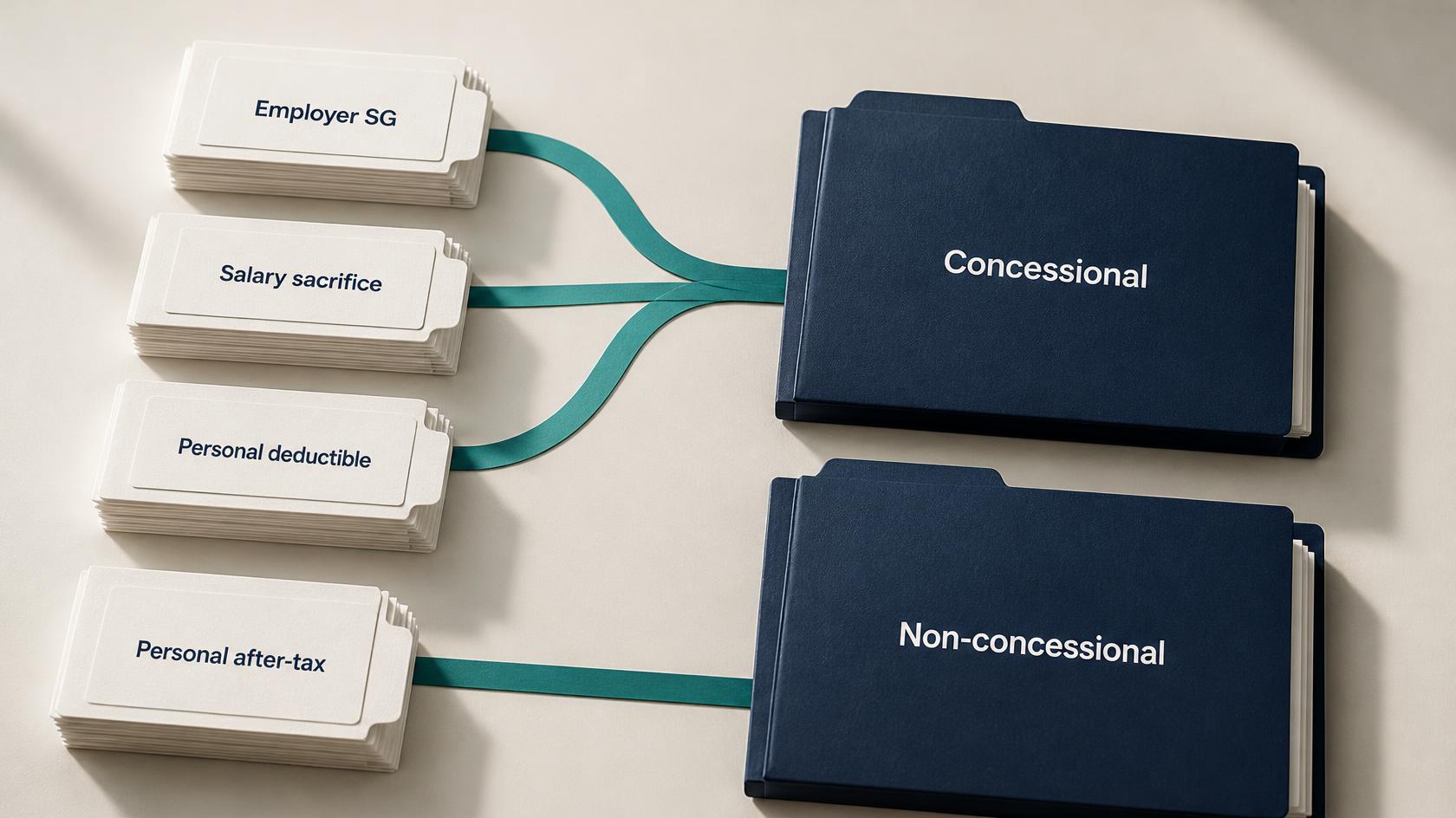
Super contributions fall into concessional, non-concessional and specific government payment categories. The distinction affects tax, caps and which action is required to make the payment.
| Contribution route | Who initiates it | Usual cap treatment | General tax treatment |
|---|---|---|---|
| Employer SG | Employer | Concessional | Generally 15% contributions tax in fund |
| Salary sacrifice | Employee and employer | Concessional | Generally 15% contributions tax in fund |
| Personal contribution with valid deduction | Member | Concessional | Generally 15% contributions tax in fund |
| Personal after-tax contribution without deduction | Member | Non-concessional | Generally no contributions tax on receipt |
| Government co-contribution or LISTO | ATO | Special government contribution treatment | Not treated as a personal concessional contribution |
Spouse contributions, contribution splitting and specialised exemptions have separate conditions. The comparison above addresses the principal contribution routes for an accumulation account.
What counts as a concessional contribution?
A concessional contribution is an amount treated as a before-tax super contribution, including employer SG, salary sacrifice and eligible personal contributions claimed as a tax deduction. These amounts generally count together towards the member’s concessional cap. The fund ordinarily deducts 15% contributions tax, with special treatment for certain higher-income members and super funds. A personal contribution changes category only when the deduction requirements are satisfied.
What counts as a non-concessional contribution?
A non-concessional contribution generally means an amount contributed from after-tax money for which no income tax deduction is claimed. Examples include a personal bank transfer and certain spouse contributions. These payments count towards the member’s non-concessional cap, with restrictions based on age, previous bring-forward arrangements and total super balance. They ordinarily do not attract contributions tax when received by the fund.
How much can you contribute to super in 2026–27?
According to the Australian Taxation Office, Contributions caps (2026–27), the general super contribution caps are $32,500 for concessional contributions and $130,000 for non-concessional contributions. These are separate limits, not a single allowance. The concessional cap includes employer SG; the non-concessional cap applies to qualifying after-tax payments without a deduction claim.
| Contribution cap | 2026–27 amount | Key condition |
|---|---|---|
| Concessional | $32,500 | Combines employer SG, salary sacrifice and deductible personal contributions |
| Non-concessional | $130,000 | Reduced or nil at certain total super balances |
| Maximum possible bring-forward | $390,000 | Eligibility, age and total super balance tests apply |
| Eligible unused concessional cap amounts | Additional to general cap | Five-year carry-forward and prior-year balance test |
The general transfer balance cap is $2.1 million in 2026–27 and is relevant to non-concessional eligibility, although the amount available under the bring-forward rule begins reducing before that limit. Special contribution rules exist outside these general caps. Source: Australian Taxation Office, Contributions caps; Non-concessional contributions cap, 2026–27.
How does the $32,500 concessional cap apply to employer and personal contributions?
The $32,500 cap counts all ordinary concessional contributions for the financial year, rather than allowing $32,500 for each payment method.
- Add the employer SG amounts received by all your super funds for the financial year.
- Add salary sacrifice and other employer concessional payments.
- Add personal contributions validly claimed as deductions.
- Subtract that total from $32,500, then assess any eligible unused carried-forward cap amounts separately.
For example, $14,000 in SG, $6,000 in salary sacrifice and $4,000 in deductible personal contributions produce $24,000 of concessional contributions and $8,500 of ordinary annual cap space. Use the fund-received dates and check all super accounts; the employer’s payroll deductions alone do not prove fund receipt.
When can unused concessional caps be carried forward?
Eligible members can generally carry forward unused concessional cap amounts for up to five financial years if your total super balance at the preceding 30 June was less than $500,000. The oldest unused amounts are applied first when eligible. A prior-year unused amount does not automatically increase the current cap for everyone. Check the ATO’s unused concessional contributions information through myGov before relying on an additional amount. Source: Australian Taxation Office, Concessional contributions cap, carry-forward unused concessional contributions.
How does the non-concessional bring-forward rule work?
The bring-forward rule allows an eligible person to use up to three years of general non-concessional caps, potentially $390,000 in 2026–27. Actual eligibility depends on age, prior bring-forward use and the total super balance at the preceding 30 June.
- Check whether an earlier bring-forward period remains active.
- Check age eligibility and the ATO’s recorded total super balance at 30 June 2026.
- Determine the applicable annual, two-year or three-year amount before paying.
- Account for payments already received across every super fund.
For 2026–27, a person with a total super balance of $2.1 million or more at 30 June 2026 generally has a nil non-concessional cap. The full $390,000 amount is not available at every balance below $2.1 million.
For 2026–27, the general bring-forward thresholds based on total super balance at 30 June 2026 are:
| Total super balance | Potential non-concessional cap | Period |
|---|---|---|
| Less than $1.84 million | Up to $390,000 | Three years |
| $1.84 million to less than $1.97 million | Up to $260,000 | Two years |
| $1.97 million to less than $2.1 million | Up to $130,000 | Current financial year |
| $2.1 million or more | Nil | Current financial year |
These are general thresholds, not automatic personal allowances. Existing bring-forward arrangements and age eligibility may change the outcome. Source: Australian Taxation Office, Non-concessional contributions cap, 2026–27.
What happens when you exceed the super contributions caps?
Excess super contributions can trigger an ATO excess contributions determination and additional tax consequences. Excess concessional amounts are generally included in assessable income with an offset for tax already paid in the fund; the rules also address potential release. Excess non-concessional contributions have a different release and associated-earnings process. Do not treat all excess amounts as subject to the same flat tax. Review the ATO determination before electing a remedy.
How are super contributions taxed?
Concessional contributions generally attract 15% contributions tax within the fund. Personal non-concessional contributions ordinarily attract no contributions tax on receipt, because the member is not claiming a deduction. These are contribution-entry rules, not a complete description of earnings tax or withdrawal tax.
| Payment | Typical tax outcome | Important exception |
|---|---|---|
| Employer SG and salary sacrifice | Generally 15% in fund | Division 293 for certain higher earners |
| Deductible personal contribution | Generally 15% in fund | Valid deduction notice and eligibility needed |
| Personal non-deductible contribution | Generally no fund contributions tax | Excess non-concessional cap consequences |
The tax effect of salary sacrifice also depends on the individual’s marginal income tax rate and the amount of salary redirected. Tax savings are not identical for all earners.
When does Division 293 tax apply?
Division 293 tax generally applies when a person’s Division 293 income plus specified concessional super contributions exceeds $250,000 in a financial year. It imposes an additional 15% tax on the relevant taxable contributions, limited under the statutory calculation. The ATO assesses liability using tax return and fund-reported data. This is separate from the ordinary 15% contributions tax already applied within the fund. Source: Australian Taxation Office, Division 293 tax on concessional contributions by high income earners.
How do you make additional super contributions?
Additional super contributions can be made through an employer’s salary sacrifice arrangement or a direct payment to your fund. The payment route and intended deduction determine the tax classification.
- Check your cap space: include contributions from all employers and funds.
- Choose the route: request salary sacrifice through payroll or obtain BPAY, bank transfer or other payment instructions from your fund.
- Identify the tax treatment: an after-tax personal payment remains non-concessional unless the valid deduction process is completed.
- Allow for processing: ensure the fund receives the payment before the intended financial year’s deadline.
- Verify the receipt: review the fund transaction record and preserve acknowledgement documents.
A salary sacrifice agreement generally applies to prospective earnings rather than salary already earned.
How does salary sacrifice affect take-home pay?
Salary sacrifice reduces the salary paid as taxable cash and increases employer-paid super contributions. For example, redirecting $100 per fortnight transfers $2,600 over 26 fortnights into super before fund contributions tax. The reduction in take-home pay is not necessarily $2,600 because lower taxable salary changes PAYG withholding. Salary sacrifice counts towards the concessional cap and cannot replace the employer’s compulsory SG obligation.
How do you claim a tax deduction for personal super contributions?
Eligible members claim a personal super contribution deduction by lodging a valid notice of intent to claim or vary a deduction with the super fund and receiving its acknowledgement before making the tax-return claim.
- Pay the contribution to the fund and verify receipt.
- Lodge the prescribed notice within the applicable deadline and before an event that invalidates the notice.
- Obtain the fund’s acknowledgement.
- Claim no more than the eligible acknowledged amount in the relevant return.
Age and other conditions apply. A claimed personal contribution counts towards the concessional cap, not the non-concessional cap.
Which government super contributions and offsets are available?
The two main government-supported payments are the super co-contribution and the low-income super tax offset (LISTO). They have different eligibility rules and payment triggers.
| Government support | Who it targets | Main trigger | Payment route |
|---|---|---|---|
| Super co-contribution | Eligible lower- and middle-income earners | Personal non-concessional contribution plus income and other tests | ATO pays eligible amount to super fund |
| LISTO | Eligible low-income earners | Concessional contributions and statutory income test | ATO pays eligible offset to super fund |
The government co-contribution can be up to $500. Eligibility is determined from tax return and fund information. The ATO generally handles payment automatically when its requirements are met; the amounts are not a substitute for employer SG.
How do you qualify for the government co-contribution?
Eligible individuals generally qualify for a government co-contribution by making an eligible personal non-concessional contribution and satisfying income, age, residency and tax return tests. For 2026–27, the lower income threshold is $49,293 and the upper threshold is $64,293. An eligible $1,000 personal payment can attract a maximum $500 co-contribution at or below the lower threshold. The amount tapers at higher eligible incomes. Salary sacrifice and personally deducted contributions do not qualify as the necessary non-concessional payment. Source: Australian Taxation Office, Government contributions, co-contribution income thresholds, 2026–27.
Who qualifies for the low-income super tax offset?
LISTO is generally available to an eligible person with adjusted taxable income of $37,000 or less who has concessional contributions and meets the relevant residency and income tests. The ATO’s offset is generally 15% of eligible concessional contributions, up to $500. Unlike the co-contribution, LISTO does not require a separate voluntary after-tax payment. Confirm eligibility through the ATO rather than assuming salary alone determines the assessment. Source: Australian Taxation Office, Government contributions, Low income super tax offset (LISTO).
How do super contributions work for sole traders and self-employed people?
A sole trader generally does not pay compulsory SG to themselves merely because they earn business income. They can make voluntary personal payments to a complying super fund, including eligible deductible contributions.
- Identify the legal structure: sole trader, partnership, company director or employee arrangements have different obligations.
- Check whether the business employs other workers. SG can be required for eligible employees and certain contractors paid primarily for labour.
- Decide whether personal payments will be deducted or left as non-concessional.
- Check personal age restrictions, cap space and notice-of-intent rules.
- Verify the contributions in fund records after receipt.
A company paying wages to an owner-director is not the same as a sole trader paying themselves business drawings. Source: Australian Taxation Office, Super for sole traders and partnerships.
How can you calculate your available super contribution cap space?
Concessional contribution cap headroom is calculated by subtracting all counted concessional payments for the financial year from your $32,500 general 2026–27 cap, then checking eligibility for unused carry-forward amounts. Calculate non-concessional headroom separately using the applicable personal cap and payments already received.
Concessional headroom = $32,500 − employer SG received − salary sacrifice received − personal contributions validly deducted − other counted concessional amounts.
Non-concessional headroom = applicable non-concessional cap − counted after-tax contributions received.
| Step | Evidence | Why it matters |
|---|---|---|
| Identify all funds | Fund accounts and ATO records | Avoid missing a second account |
| Confirm fund receipt dates | Transaction statements | Assign contributions to the correct financial year |
| Classify each payment | Employer report or deduction acknowledgement | Separate concessional from non-concessional |
| Check ATO cap and balance details | myGov linked to ATO | Account for carry-forward or bring-forward restrictions |
These formulas are an initial reconciliation, not an assessment of every specialised contribution category.
What does a $100,000 salary example show about concessional cap headroom?
On an illustrative $100,000 of qualifying earnings, employer SG calculated at 12% equals $12,000, leaving $20,500 against the ordinary $32,500 concessional cap, before salary sacrifice and other counted contributions.
| Item | Illustrative amount |
|---|---|
| Qualifying earnings | $100,000 |
| Employer SG at 12% | $12,000 |
| General concessional cap | $32,500 |
| Remaining general cap space | $20,500 |
This assumes all $12,000 is received in the same financial year, no other concessional amounts apply and no maximum-earnings-base adjustment is relevant. Actual cap space follows payments received, not simply the annual salary printed on an employment contract.
How can you check contributions received by your super fund?
Super fund transaction records provide the starting point for checking contributions against payslips and ATO records. A payslip can show an employer’s super liability even before the payment arrives in your fund.
- Open the member portal and download contributions by transaction or receipt date.
- Compare each fund receipt with employer payroll records and any voluntary deposits.
- For periods under Payday Super, check the payday and the fund receipt deadline, generally seven business days unless an exception applies.
- Sign in to myGov and check ATO super information, allowing for reporting delays.
- Ask payroll or the fund to investigate any missing, duplicated or misclassified amount. Report unresolved unpaid super to the ATO when appropriate.
A practical reconciliation lists payday, qualifying earnings, expected SG, payment date, fund receipt date and received amount. This exposes timing gaps that a single annual total can conceal.
Which super contribution option suits your circumstances?
The appropriate contribution option depends on tax treatment, available cap space, cash flow and eligibility, rather than a single universally preferable method.
| Situation | Option to assess | Key decision point |
|---|---|---|
| Receiving employment income | Existing employer SG plus optional salary sacrifice | Concessional cap and take-home pay |
| Have savings and taxable income | Eligible personal deductible contribution | Notice of intent and cap space |
| Want to contribute after-tax savings | Non-concessional personal payment | Balance-based cap and bring-forward availability |
| Eligible lower-income earner | Non-concessional payment for co-contribution | Income and contribution eligibility |
| Sole trader | Voluntary deductible or non-deductible payments | Business structure, taxable income and fund rules |
Contributed super is generally preserved until a condition of release is met. This means access to cash before retirement is an important part of deciding the amount contributed. The following short answers clarify common eligibility points.
Can you contribute to super without an employer?
YES, eligible people can contribute directly to their own super fund without an employer. Sole traders, self-employed people and individuals using savings commonly make personal deposits. A valid tax deduction requires a separate notice-of-intent process; without that claim the payment generally remains non-concessional. Age restrictions and caps still apply.
Can you contribute after tax and claim a deduction later?
YES, an eligible personal payment made from after-tax money can become a deductible personal contribution after the fund acknowledges a valid notice of intent and the deduction is claimed correctly. Timing matters: the notice must remain valid and be lodged within the ATO deadline. The amount then counts towards the concessional cap.
Are after-tax super contributions normally taxed again when received?
NO, personal non-concessional contributions for which no deduction is claimed generally do not attract fund contributions tax on receipt. Earnings later generated by investments in the fund have separate tax treatment. Exceeding contribution caps or changing a payment’s classification by claiming a deduction can also change the outcome.
Does the maximum non-concessional cap apply to everyone?
NO, the maximum non-concessional cap depends on the member’s total super balance, age and any active bring-forward period. For 2026–27, the maximum possible three-year amount is $390,000, but a total super balance of $2.1 million or more at 30 June 2026 generally results in a nil non-concessional cap.
Can employers make additional super contributions above the minimum guarantee?
YES, an employer can pay additional contributions above the compulsory 12% SG under an employment arrangement or salary sacrifice agreement. These additional payments generally count towards the employee’s concessional contributions cap. Salary sacrifice does not permit the employer to reduce the compulsory minimum SG payable on qualifying earnings. To estimate the compulsory employer amount from eligible earnings, use the Superannuation Calculator Australia.
Do government co-contributions count as personal concessional contributions?
NO, an ATO government co-contribution is a separate government super payment, not a personal deductible concessional contribution. It is triggered by an eligible personal non-concessional contribution and the other statutory conditions. Do not include the government payment as salary sacrifice or personal tax-deductible super when calculating concessional cap headroom.
Official guidance and further reading
Source: Australian Taxation Office — Contributions caps, 2026–27. General concessional and non-concessional contribution caps and applicable financial years.
Source: Australian Taxation Office — Non-concessional contributions cap, 2026–27. Total super balance thresholds, bring-forward arrangements and eligibility restrictions.
Source: Australian Taxation Office — Concessional contributions cap. Carry-forward rules and the prior 30 June balance test.
Source: Australian Taxation Office — About Payday Super; Payment deadlines for Payday Super, 2026. Compulsory employer super payment timing and exceptions.
Source: Australian Taxation Office — Government contributions, 2026–27. Co-contribution income thresholds and the low-income super tax offset.
Source: Australian Taxation Office — Division 293 tax on concessional contributions by high income earners. Additional contributions tax and the $250,000 threshold.
These source titles identify the official guidance without external hyperlinks. Rules and thresholds are financial-year specific and should be checked again before making contributions.