How Is Super Taxed in Australia? Contributions, Earnings
How super is taxed in Australia: contributions, earnings, withdrawals, Division 293, caps, retirement phase and death benefits.
Superannuation Calculator Australia · · 10 min read
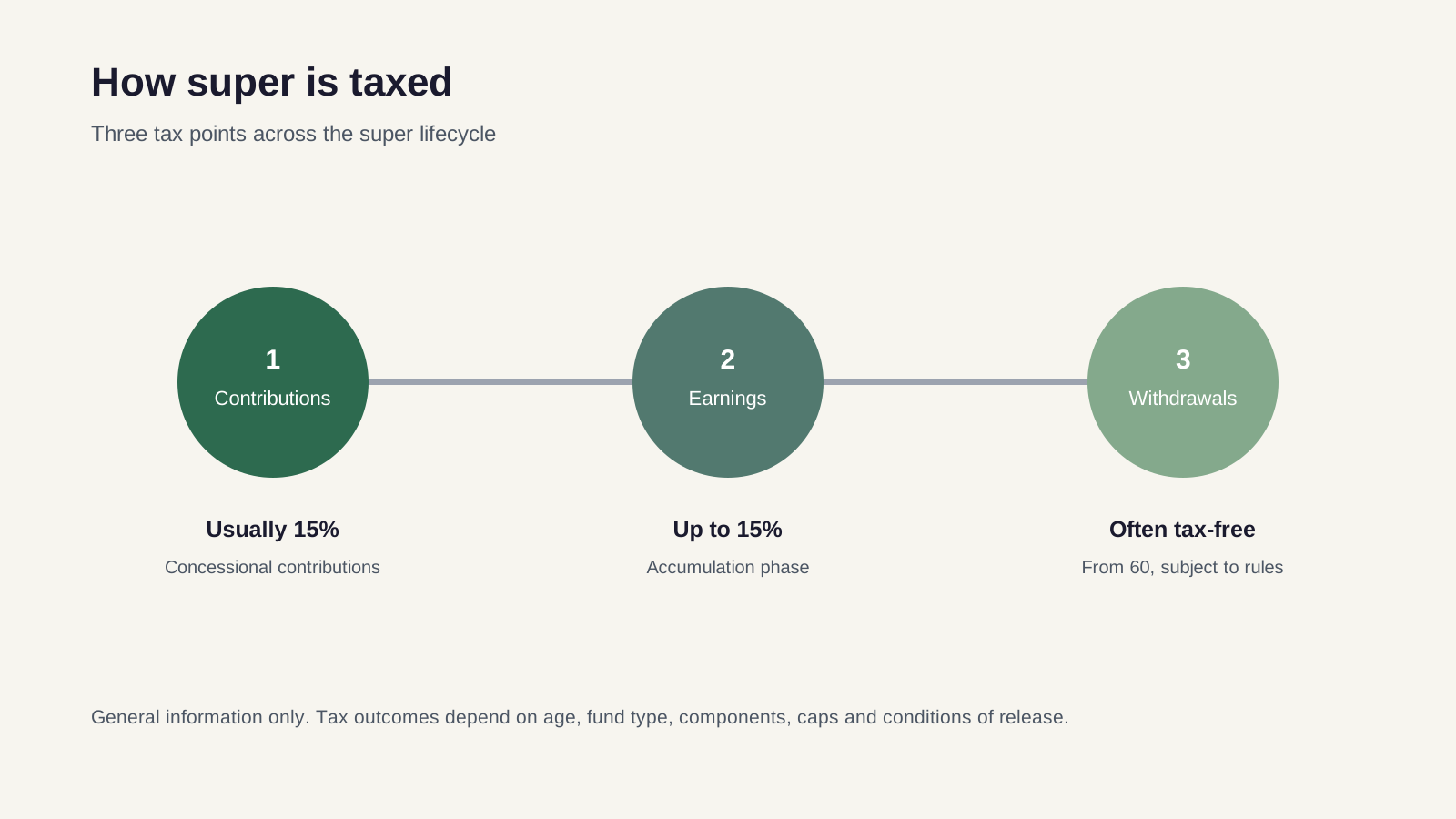
Super can be taxed at three points: when money enters your fund, while the fund earns investment income and when you withdraw the money. Most concessional contributions are taxed at 15%, accumulation-phase investment earnings are generally taxed at up to 15% and withdrawals from a taxed super fund after age 60 are generally tax-free when a condition of release is met.
The result depends on the contribution type, your income, contribution caps, age, preservation rules, withdrawal method and whether the super fund is taxed or untaxed. This guide explains the general Australian rules; it is not personal tax advice.
How is super taxed in Australia?
Super tax generally applies to contributions, investment earnings and withdrawals. The tax treatment changes between the accumulation phase and retirement phase.
| Stage | What is taxed? | General treatment |
|---|---|---|
| Contributions | Employer and salary-sacrifice payments | Usually 15% contributions tax for concessional contributions |
| Investment earnings | Interest, dividends, rent and capital gains inside super | Generally up to 15% in accumulation phase; retirement-phase earnings are generally tax-free within the transfer balance rules |
| Withdrawals | Lump sums and income streams | Depends on age, component, withdrawal type and fund status; after age 60, taxed-fund payments are generally tax-free |
According to the Australian Taxation Office, Tax on super benefits, some super is taxed at more than one stage, while tax-free components and retirement-phase earnings receive different treatment.
How are super contributions taxed?
Employer Super Guarantee payments, salary-sacrifice contributions and personal contributions for which you claim a tax deduction are generally concessional contributions. A super fund generally taxes these contributions at 15% when received.
The general concessional contributions cap is $32,500 for 2026–27. Employer contributions, salary sacrifice and deductible personal contributions across all your funds count towards the same cap.
| Contribution type | General tax treatment |
|---|---|
| Employer Super Guarantee | 15% contributions tax in the fund |
| Salary sacrifice | 15% contributions tax in the fund |
| Personal contribution claimed as a tax deduction | 15% contributions tax in the fund |
| After-tax personal contribution | Usually no contributions tax |
| Spouse contribution | Usually no contributions tax |
| Government co-contribution | No contributions tax |
For an estimate of tax and contribution amounts, use the super Contributions Calculator Australia.
How is salary sacrifice taxed?
Salary sacrifice into super is generally taxed at 15% in the fund instead of your marginal income-tax rate on that amount. The contribution still counts towards your concessional contributions cap.
For example, a $1,000 salary-sacrifice contribution generally leaves $850 invested after 15% contributions tax. The personal tax outcome depends on your income, eligibility, employer arrangement and whether Division 293 tax applies.
Salary sacrifice does not replace the employer's minimum Super Guarantee obligation. The arrangement also needs to be made before the salary is earned under the applicable employment terms. If a bonus forms part of your remuneration, see does a Bonus Attract Super? for the tax and contribution rules.
What happens if I exceed the concessional contributions cap?
Excess concessional contributions are included in your taxable income and taxed at your marginal rate, with a tax offset reflecting the 15% contributions tax already paid by the fund. The ATO may also apply an excess concessional contributions charge.
Eligible members can use unused concessional cap amounts from up to five previous financial years if their total super balance was below $500,000 at the previous 30 June. Unused amounts expire after five years.
Check all funds when calculating cap use. Contributions paid by different employers are added together. For the payment process and fund-receipt deadlines, see how Super Is Paid in Australia.
What is Division 293 tax on super?
Division 293 tax is an additional 15% tax on some concessional contributions when your income plus concessional contributions exceeds $250,000. It applies to the relevant portion of concessional contributions, not automatically to every dollar of super.
The ATO calculates Division 293 tax using your income and relevant concessional contributions. The assessment is separate from the 15% contributions tax deducted by the fund.
Are after-tax super contributions taxed?
After-tax personal contributions are generally non-concessional contributions and do not receive a tax deduction. The fund generally does not charge contributions tax on the amount because you have already paid personal income tax before contributing it.
The general non-concessional contributions cap is $130,000 for 2026–27, subject to total super balance and other eligibility rules. An eligible member may use the bring-forward arrangement to contribute up to $390,000 over three years.
Exceeding the cap can create excess non-concessional contributions tax. Check your total super balance and contribution history before making a large after-tax contribution.
How are super investment earnings taxed?
Investment earnings in an accumulation super account are generally taxed at up to 15%. Earnings can include interest, dividends, rent and capital gains. Capital gains may receive a tax discount when the fund holds an asset for the required period, so the effective tax on a qualifying gain can be lower.
The fund generally pays this tax internally. It may be reflected in the investment option's crediting rate or deducted from investment income rather than appearing as a personal tax bill.
A retirement-phase income stream can receive tax-free investment earnings, subject to the transfer balance cap and the requirements of the retirement-phase rules. An accumulation account and a retirement-phase pension do not receive identical tax treatment.
Is super tax-free when you withdraw it?
Super withdrawals are generally tax-free from age 60 when paid from a taxed super fund and the applicable condition of release has been met. Before age 60, the tax depends on your preservation age, the taxable and tax-free components and whether you receive a lump sum or income stream.
| Situation | General treatment |
|---|---|
| Aged 60 or older, taxed fund | Lump sums and retirement income payments are generally tax-free |
| Between preservation age and 60 | Some taxable benefits may be taxed; low-rate thresholds and offsets can apply |
| Below preservation age | Tax can apply to taxable components and early-release payments |
| Retirement-phase earnings | Generally tax-free within the transfer balance rules |
| Untaxed fund | Different tax treatment can apply |
The ATO's current tax tables should be used for an actual withdrawal calculation because age, component type and payment method change the result.
How are super lump sums taxed before age 60?
Before age 60, tax on a super lump sum depends on the taxable component, whether it is a taxed or untaxed element, your preservation age and the low-rate cap. The maximum tax rate for some taxed-element lump sums is generally the lower of your marginal tax rate or 22% including Medicare levy, but the exact result depends on the circumstances.
Early release under severe financial hardship, compassionate grounds, terminal illness or another condition of release has its own rules. Do not apply the ordinary retirement withdrawal rule to an early-release payment without checking the ATO guidance.
Is super taxable after age 60?
YES, some exceptions remain. Payments from a taxed fund after age 60 are generally tax-free when the payment meets a condition of release, but untaxed elements and some defined benefit income streams can be taxed differently. Death benefits also follow separate rules.
How is super taxed in retirement phase?
Retirement-phase investment earnings are generally tax-free when the income stream meets the retirement-phase requirements and remains within the transfer balance rules. Withdrawals from a taxed fund after age 60 are generally tax-free.
The transfer balance cap limits how much can be moved into retirement phase. A personal transfer balance account tracks the amount transferred into retirement-phase pensions. Exceeding the cap can create additional tax and a requirement to commute excess amounts.
Account-based pension minimum drawdown rules can also affect how much must be paid from an income stream each year. Tax-free earnings do not mean the retirement account is exempt from every reporting or transfer-balance obligation.
How are super death benefits taxed?
The tax on a super death benefit depends on whether the recipient is a tax dependant, whether the payment is a lump sum or income stream, the tax-free and taxable components and whether an untaxed element is present.
A tax dependant who receives a death benefit lump sum generally does not pay tax on the benefit. A non-dependant generally receives the benefit as a lump sum and can pay tax on the taxable component, with offsets applying under the tax rules.
A surviving spouse, former spouse, child, financial dependant or person in an interdependency relationship can have different tax treatment depending on the facts. Super death-benefit nominations and estate planning need separate legal and tax advice.
How can I reduce tax on my super legally?
You can manage super tax by checking contribution caps, keeping your tax file number with the fund, using eligible salary sacrifice, checking Division 293 exposure and planning the timing and form of retirement withdrawals.
- Track all concessional contributions from employers and salary sacrifice across every fund.
- Check cap space before making a large deductible or salary-sacrifice contribution.
- Review carry-forward eligibility when your total super balance is below $500,000.
- Compare salary sacrifice with after-tax contributions using your marginal tax rate and contribution caps.
- Confirm preservation age and release conditions before planning a withdrawal.
- Check the taxable and tax-free components before taking a lump sum.
- Review death-benefit nominations with appropriate legal and tax advice.
The super Projection Calculator Australia can model future balances.
Frequently Asked Questions About Super Tax
Is super taxed at 15%?
YES, most concessional contributions and many accumulation-phase investment earnings are generally taxed at 15%. The rate does not apply to every contribution, every investment gain or every withdrawal. Division 293 tax, excess contributions tax and retirement-phase rules can change the outcome.
Is super better taxed than salary?
YES, super is often taxed at a lower rate than employment income, especially for concessional contributions. The comparison depends on your marginal tax rate, contribution type, Division 293 exposure, contribution caps and when you access the money.
Do I pay tax on super after age 60?
NO, not usually when a taxed super fund pays a benefit after age 60 and the release condition is satisfied. Untaxed funds, defined benefit income streams and death benefits can have different rules.
Is salary sacrifice into super tax-deductible?
NO, salary sacrifice is generally not claimed as a personal tax deduction. It is an employer contribution arrangement taxed as a concessional contribution in the fund. Personal deductible contributions are a separate category.
Are super fund investment returns tax-free?
NO, accumulation-phase investment earnings are generally taxed at up to 15%. Retirement-phase earnings can be tax-free when the pension meets the requirements and stays within the transfer balance rules.
Is super taxed when transferred to another fund?
NO, a normal rollover between complying super funds is generally not taxed because the money remains within the super system. An untaxed fund rollover can have different treatment.
Sources and verification
- Australian Taxation Office, Tax on super benefits (current guidance reviewed October 2026).
- Australian Taxation Office, Contributions caps and Division 293 tax (current 2026–27 guidance).
- ASIC Moneysmart, Tax and super (current guidance reviewed October 2026).
- Parliamentary Budget Office, Budget Explainer: How is super taxed? (27 April 2023), used for the three-stage tax lifecycle framework.
- Australian Retirement Trust, Tax on superannuation (current guidance), used as a secondary explanation of contribution, earnings, withdrawal and death-benefit categories.
Tax rules change and individual outcomes depend on personal circumstances, fund type, age, component and payment method. This article is general information, not personal tax or financial advice.
Written by
Superannuation Calculator Australia
Calculation guidance and general information; independent financial advice is not provided.