Super Investment Returns and Fees in Australia
Learn how super investment returns, fees, tax and compounding affect your balance, and how to compare calculator assumptions.
Superannuation Calculator Australia · · 7 min read
Super investment returns are the gains or losses produced by the assets in your fund. Your final balance depends on the starting balance, contributions, investment return, investment and administration fees, insurance premiums, tax and the time your money remains invested. A calculator should show these assumptions rather than present one return as guaranteed.
How do super investment returns work?
Super funds invest member money across assets such as shares, property, fixed interest, cash and infrastructure. The return reflects changes in asset values and income such as dividends and interest. It may be reported before or after specified fees and tax, so check the stated convention.
A positive annual return increases the balance. A negative annual return reduces it. Returns vary by investment option and year, so a single year's result does not describe the long-term outcome.
What is the difference between gross and net super returns?
A gross return is investment growth before specified fees and tax. A net return is the amount remaining after the costs included in the calculation have been deducted.
| Return measure | What it means |
|---|---|
| Gross investment return | Growth before specified costs and tax |
| Net investment return | Growth after the costs and tax included in the assumption |
| Member balance change | Net investment result plus contributions less separately charged fees, premiums and withdrawals |
According to ASIC Moneysmart's Superannuation calculator assumptions, investment-return assumptions are generally presented net of investment fees and investment earnings tax, while administration fees, advice fees and insurance premiums can be modelled separately. Do not subtract the same fee or tax twice.
How much do super fees reduce your balance?
Super fees reduce the money available to compound. A fund can charge administration fees, investment fees, performance fees, advice fees and insurance premiums. The effect depends on whether a fee is a fixed dollar amount, a percentage of the balance or already included in the stated net return.
| Cost | How it affects a projection |
|---|---|
| Administration fee | Reduces the account by a fixed annual amount or a balance-based charge |
| Investment fee | Reduces investment performance or is already reflected in the quoted return |
| Performance fee | Applies only under the fund's stated performance-fee conditions |
| Insurance premium | Deducted from the account and reduces the amount left invested |
| Advice fee | May be deducted from super where the rules and arrangement allow it |
A fee comparison is meaningful only when the investment option, insurance cover, risk level and return convention are comparable.
Are low fees always the best choice for super?
NO, the lowest fee is not automatically the best option. Compare the fee with the investment option, long-term performance evidence, insurance cover, services and risk level. A cheaper option with a different asset mix is not a like-for-like comparison.
How does compound growth affect super?
Compound growth occurs when investment earnings remain invested and generate further earnings. The effect becomes larger as the investment period increases, but actual returns are not constant and can be negative in some years.
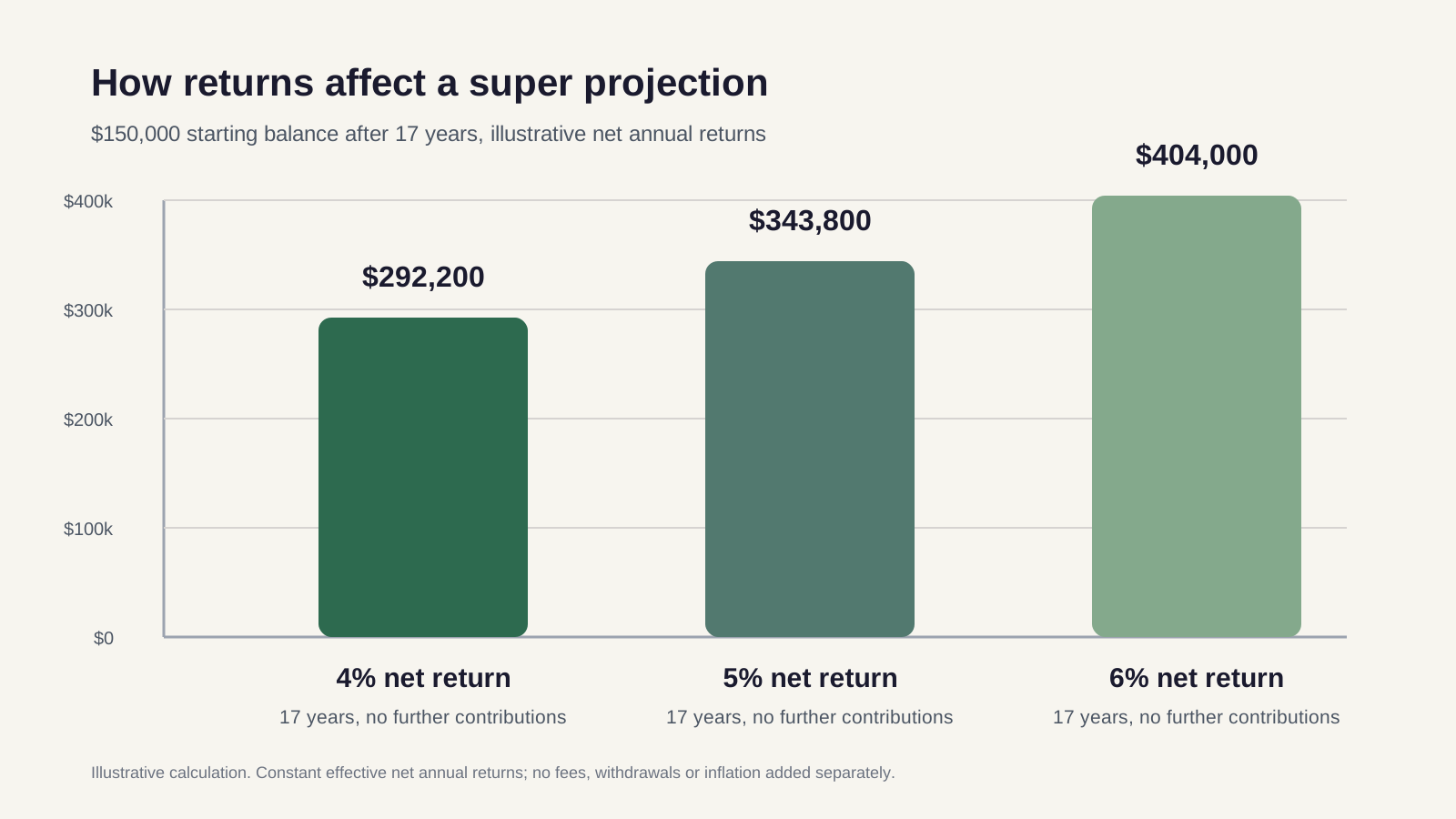
For illustration, a $150,000 balance with no further contributions grows to approximately:
| Net annual return | Value after 17 years |
|---|---|
| 4% | ~$292,200 |
| 5% | ~$343,800 |
| 6% | ~$404,000 |
These are mathematical scenarios, not forecasts. They assume a constant effective annual net return, no additional fees and no withdrawals. The super Projection Calculator Australia can model a starting balance, contributions, fees and retirement age together.
How do super calculators estimate investment growth?
A super projection calculator combines an opening balance with future contributions and investment growth, then subtracts costs according to its assumptions. A simplified month-end model is:
next balance = current balance × (1 + monthly return) + net contribution − separate fees
A calculator should identify:
- current age and retirement age
- starting super balance
- employer and voluntary contributions
- contribution tax
- investment return assumption
- investment and administration fees
- insurance premiums
- inflation treatment
- contribution timing
- withdrawal assumptions after retirement
ASIC Moneysmart's calculator uses its own published assumptions, including investment options, returns, fees, insurance and inflation. A result from one calculator can differ from another because the assumptions and timing conventions differ.
How is super tax connected to investment returns?
Accumulation-phase investment earnings are generally taxed at up to 15%, while retirement-phase earnings can be tax-free when the pension meets the applicable requirements and stays within the transfer balance rules. Contributions tax and withdrawal tax are separate parts of the super tax lifecycle.
Read how Is Super Taxed in Australia? for the contribution, earnings, withdrawal and death-benefit tax rules. When comparing returns, confirm whether the stated return is before or after investment earnings tax.
How do contribution timing and fees change the projection?
A contribution invested earlier has more time to receive investment earnings than a contribution invested later. Fees also compound in the opposite direction because the amount deducted is no longer available to earn future returns.
For a consistent comparison:
- Use the same starting balance.
- Use the same contribution amount and payment frequency.
- Use the same return convention, either gross or net.
- Deduct fees only once.
- State whether amounts are nominal dollars or today's dollars.
- Test lower and higher return scenarios.
The super Contributions Calculator Australia can help estimate contribution amounts before they are included in a projection.
How should I compare super fund investment performance?
Compare investment options with the same time period, asset mix, risk level and fee convention. A five-year return comparison is more informative than one strong year, but past performance does not guarantee future results.
Check the fund's product disclosure information, investment option description, fees, insurance and performance methodology. A return displayed after investment fees is not directly comparable with a return displayed before those fees.
What information should I check before choosing a super investment option?
Check the option's strategic asset allocation, risk label, suggested investment timeframe, fees, performance history, liquidity, insurance interaction and any lifecycle changes. Your age alone does not determine the appropriate option; retirement timing, risk tolerance and capacity to tolerate losses also matter.
A high-growth option can experience larger short-term falls than a conservative option. The comparison should therefore focus on the full risk-and-return profile, not the highest recent percentage.
Frequently Asked Questions About Super Returns and Fees
Is super interest guaranteed?
NO, super investment returns are not generally guaranteed. Cash and term-deposit-style options have different risk characteristics from share and property options, but every investment option has its own terms, costs and risks.
Do super fees come out of my investment return?
YES, investment fees are commonly reflected in the net return or deducted from investment earnings. Administration fees and insurance premiums may be charged separately. Check the fund's fee disclosure before subtracting costs in a projection.
Does a higher super balance mean higher fees?
YES, a percentage-based fee generally produces a larger dollar charge as the balance grows. A fixed administration fee does not automatically rise with the account balance, although the fund may index or change its fee schedule.
Should I use the highest return assumption in a calculator?
NO, do not choose a return assumption only because it produces the highest projected balance. Use the calculator's stated investment-option assumptions, test a range of outcomes and treat every projection as an estimate.
Are super investment returns taxed?
YES, accumulation-phase investment earnings are generally taxed at up to 15%. Retirement-phase earnings can be tax-free when the retirement-income account meets the applicable rules.
Can fees make two super calculators show different results?
YES, calculators can produce different results because they use different returns, fees, contribution timing, inflation assumptions and tax conventions. Compare the assumptions before comparing the final balances.
Sources and verification
- ASIC Moneysmart, Superannuation calculator (current assumptions reviewed October 2026).
- ASIC Moneysmart, Tax and super (last updated 29 September 2026).
- Australian Taxation Office, Tax on super benefits (current guidance reviewed October 2026).
- Parliamentary Budget Office, Budget Explainer: How is super taxed? (27 April 2023), used for the three-stage tax lifecycle framework.
- The worked balance projections are illustrative calculations using constant effective net annual returns. They are not forecasts or personal financial advice.
Investment returns, fees, tax and insurance costs change over time. Check current fund disclosure documents and consider personal financial advice before making an investment decision.
Written by
Superannuation Calculator Australia
Calculation guidance and general information; independent financial advice is not provided.