How Much Super Should I Have at 40 in Australia?
Aim for about $178,000 in super at 40 for a comfortable retirement. Compare average and median balances and the catch-up rules.
Superannuation Calculator Australia · · 8 min read
According to the Association of Superannuation Funds of Australia (ASFA), a 40-year-old needs roughly $168,000 to $178,000 in super to stay on track for a comfortable retirement at 67. This guide sets out that target, compares it with the average and median balance, explains the gender super gap and lists the catch-up rules that close the gap before 67.
How much super should I have at 40?
Current ASFA-based retirement projections used by Australian super funds put the target for a 40-year-old at about $178,000 in super. Earlier Super Guru calculator material lists $168,000 for the same age, so $168,000 to $178,000 is a historical working range rather than a universal requirement. The projection assumes a pre-tax wage near $65,000, retirement at 67 and a part Age Pension.
A comfortable retirement funds more than the basics. According to ASFA's Retirement Standard (June 2026 quarter), a comfortable retirement costs $56,166 a year for a single and $78,998 a year for a couple. A modest retirement costs $36,548 a year for a single and $52,690 a year for a couple.
These targets assume home ownership. Renters require a higher balance, covered later in this guide.
What is the average super balance at 40–44?
The average super balance for Australians aged 40 to 44 sits between $106,900 and $134,000, depending on the source. ATO Taxation Statistics 2023–24 put the average near $134,000. APRA data show about $115,600. ASFA and ATO figures show $106,900 to $123,400.
| Source | Average balance, age 40–44 |
|---|---|
| ATO Taxation Statistics 2023–24 | ~$134,000 |
| APRA, March 2026 | ~$115,600 |
| ASFA / ATO, June 2023 | ~$106,900–$123,400 |
The figures differ because each source uses a different sample, date and method, and averages skew upward when a small number of large balances lift the mean. Most 40-year-olds hold less than the $178,000 target.
Average vs median: which should you compare against?
Compare against the median, not the average. A current median estimate for Australians aged 40 to 44 is about $100,000, below the average of $134,000, according to Hudson Financial Planning's age-40 analysis. Averages skew upward because a small number of very large balances pull the mean above most people's actual balance.
A balance near $100,000 puts you in line with most Australians your age. The average marks where the top end sits, not where most people are.
Why do women have less super at 40?
According to current UniSuper tables based on ASFA and ATO data, women aged 40 to 44 hold about $109,209 in super against $140,680 for men, a gap near $31,000. Deloitte figures show the same pattern: $132,300 for women against $197,100 for men.
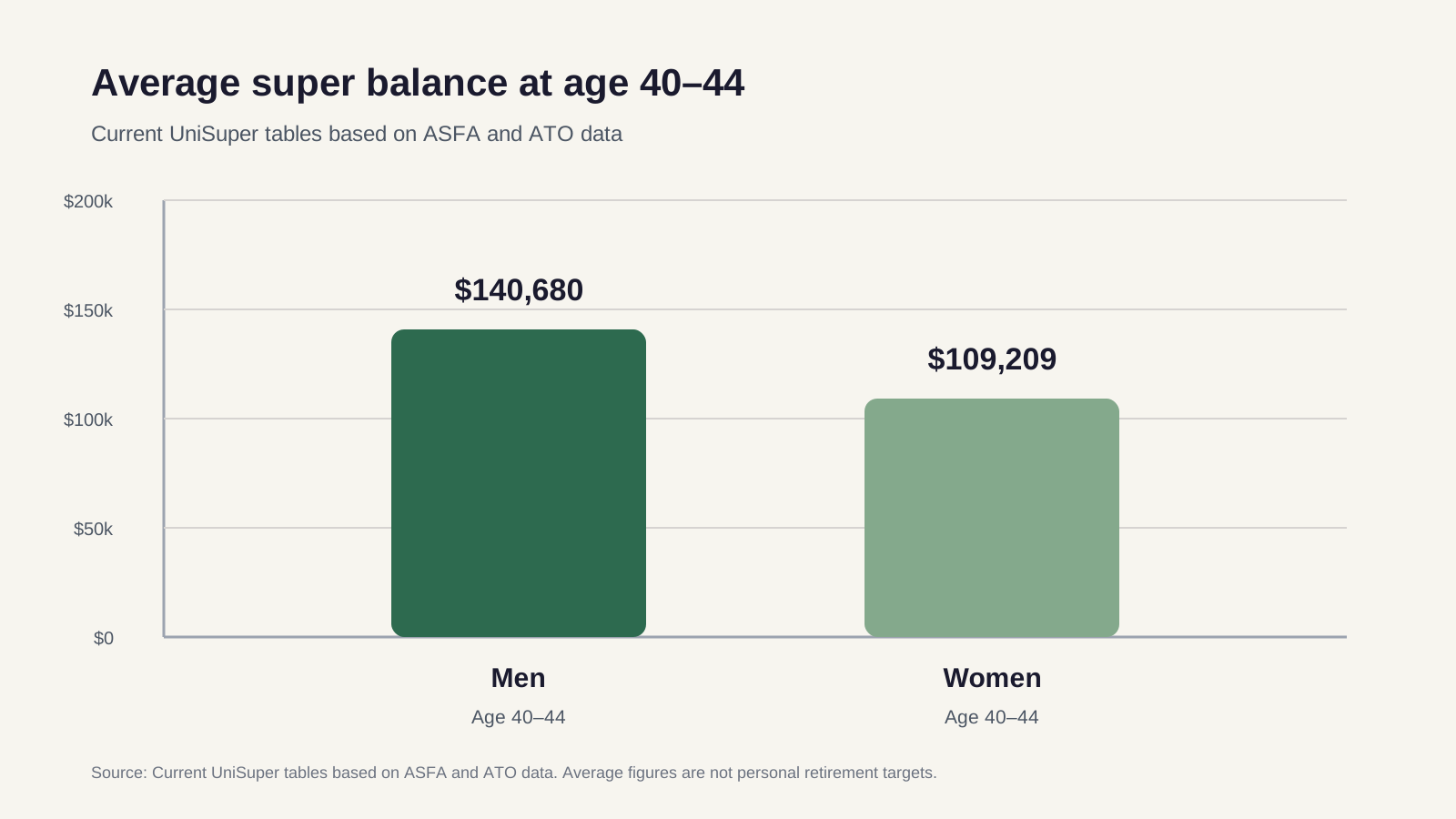
Three causes drive the gap:
- lower average pay across a working life
- more part-time work
- career breaks for caring responsibilities
The gap is structural, not a reflection of individual choices. The catch-up rules in this guide help close it.
How does the five-year carry-forward rule work?
The five-year carry-forward rule lets a member use unused concessional cap from the previous five financial years, provided their total super balance was under $500,000 on 30 June. According to the Australian Taxation Office, the concessional cap is $32,500 for 2026–27, up from $30,000 in 2025–26.
Unused amounts expire after five years. A member who contributed below the cap for several years holds unused cap to contribute in one year, taxed at the concessional rate of 15%.
This is one of the most substantial levers for a 40-year-old behind target, because a large pre-tax lump sum enters super in one year. Estimate the impact with the super Contributions Calculator Australia.
How much does waiting to top up super cost?
The extra contributions a 40-year-old starts today compound for 27 years to age 67. The same amount started at 50 compounds for only 17 years. At a 7% net return, $300 a month grows as follows:
| Start age | Years to 67 | Projected value at 67 |
|---|---|---|
| 40 | 27 | ~$268,000 |
| 45 | 22 | ~$176,000 |
| 50 | 17 | ~$111,000 |
Starting at 40 instead of 50 adds about $157,000 to the final balance from the same monthly amount. Starting at 40 instead of 45 adds about $92,000.
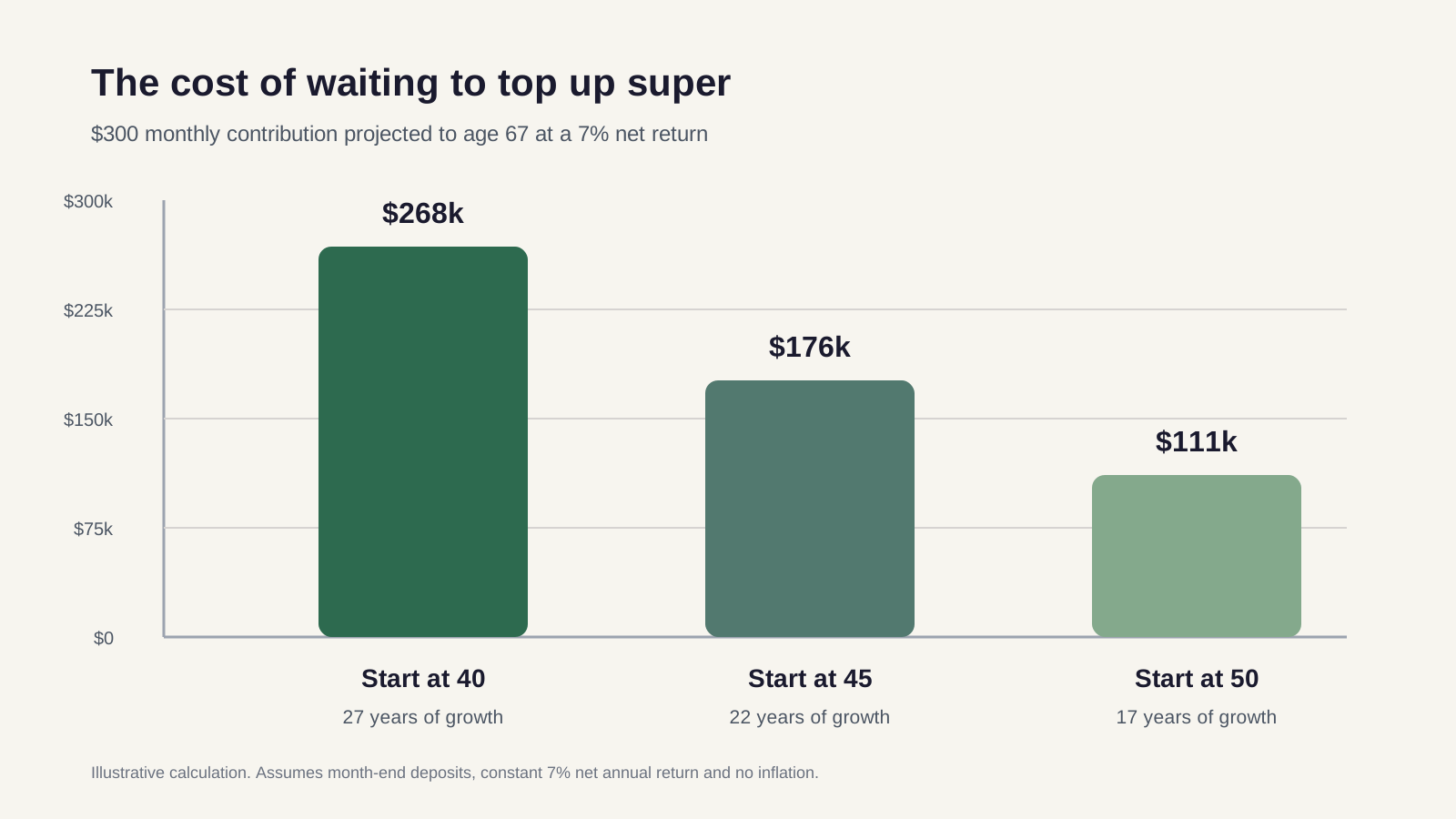
Figures are illustrative. They assume a 7% net return after fees and tax and ignore inflation. Model your own balance with the super Projection Calculator Australia.
What can I do if my super is below average at 40?
Being behind target at 40 is common and fixable, with 27 years left to age 67. Six actions close the gap:
- Check your balance against the $178,000 benchmark with the superannuation Calculator Australia.
- Find and consolidate lost accounts through myGov or the ATO.
- Salary sacrifice within the $32,500 concessional cap.
- Use the five-year carry-forward rule if eligible.
- Review your investment option and fund fees.
- Consider financial advice after a career break, with multiple funds or on an inheritance.
Can I use my super to buy a home?
YES, through the First Home Super Saver Scheme for a first-home deposit, or through a self-managed super fund for investment property. Super cannot be withdrawn directly to buy a home to live in. The First Home Super Saver Scheme lets first-home buyers release voluntary contributions plus earnings toward a deposit.
Should I consolidate all my super into one fund?
YES, in most cases. One account removes duplicate fees and simplifies tracking. Check first whether an old fund holds insurance you want or a defined benefit you lose on transfer. Find lost accounts through myGov before combining.
Is $178,000 enough if I want to retire before 67?
NO. The $178,000 target assumes retirement at 67 with a part Age Pension. Retiring earlier means more years of drawdown and fewer years of compounding, so the required balance is higher. Model an earlier retirement age with the super Projection Calculator Australia.
Does my super count towards the Age Pension assets test?
YES. According to current Age Pension guidance, super in accumulation or drawdown counts in the Age Pension assets test, and income from it is deemed. This is why ASFA's target figures assume only a part Age Pension. The family home is generally exempt from the assets test.
Can I access my super before age 60?
NO, except on limited early-release grounds such as severe financial hardship, terminal illness or specific compassionate grounds. According to the Australian Taxation Office, super is preserved until preservation age 60 for most people born after 30 June 1964. Preservation age 60 is separate from Age Pension age 67.
Do I need more super if I'm renting in retirement?
YES. The comfortable-retirement targets assume home ownership. ASFA's modest standard for a private renter is $340,000 (single) and $385,000 (couple), against $110,000 and $120,000 for homeowners. Renters therefore require substantially more super.
A 40-year-old on track for a comfortable retirement at 67 holds roughly $168,000 to $178,000 in super. Comparing against the median and applying the catch-up rules, from salary sacrifice to the five-year carry-forward, moves a balance toward that target.
Sources and verification
- Association of Superannuation Funds of Australia (ASFA), ASFA Retirement Standard (June 2026 quarter). Supports the comfortable and modest budgets and the modest private-renter lump sums ($340,000 single, $385,000 couple).
- ASFA Super Balance Detective and Super Guru Super Balance Detective. List $178,000 and $168,000 respectively for age 40. The exact current figure depends on the calculator's assumptions and vintage; confirm the preferred single figure before relying on it.
- ATO Taxation Statistics 2023–24, APRA (March 2026) and ASFA / ATO (June 2023). The average-balance figures for ages 40–44 span $106,900–$134,000 across these datasets; each is a different sample and date.
- Current UniSuper, How much super should I have? tables, based on ASFA and ATO data, support the 40–44 gender figures ($109,209 women, $140,680 men).
- Hudson Financial Planning, Average Super Balance at Age 40 in Australia (2026), reports a median estimate near $100,000 for ages 40–44. This is a specialist estimate, not an official ATO age-40 statistic.
- Australian Taxation Office, Concessional contributions cap and Carry-forward unused concessional contributions (2026–27). Confirms the $32,500 concessional cap and the under-$500,000 total super balance test with a five-year window.
- Services Australia, Age Pension income and assets test guidance. Supports the treatment of super and the general principal-home exemption; individual circumstances and exemptions apply.
- Australian Taxation Office, Accessing your super to retire. Confirms preservation age 60 for those born after 30 June 1964.
- The compounding projections are illustrative calculations at a 7% net return, not figures published by any of the sources above.
Information reviewed on 11 October 2026. Historical averages, retirement benchmarks and projected balances measure different things. Figures are not personalised financial advice.
Written by
Superannuation Calculator Australia
Calculation guidance and general information; independent financial advice is not provided.