When Can I Access My Super? Ages and Release Rules
Find out when you can access super in Australia: rules at 60 and 65, early release, retirement, withdrawals, tax and how to apply.
Superannuation Calculator Australia · · 10 min read
In Australia, you can generally access your preserved super from age 60 after meeting a condition of release, or from age 65 whether or not you retire. Earlier access requires another recognised release condition. Your age, employment arrangements and the type of benefit held determine which money is available.
When Can I Access My Super Under Australian Rules?
You can normally withdraw preserved super from 60 when a full condition of release applies, or from 65 without retiring. Reaching age 60 by itself does not make every preserved benefit available.
| Situation | General access rule |
|---|---|
| Under 60 | A recognised early-release condition or another applicable exception is required |
| 60–64, still employed | Age alone does not unlock all preserved super; a transition-to-retirement pension may be available |
| 60–64, an employment arrangement has genuinely ended | Eligible benefits may become unrestricted, subject to fund assessment |
| 65 or older | Generally able to withdraw preserved super whether working or retired |
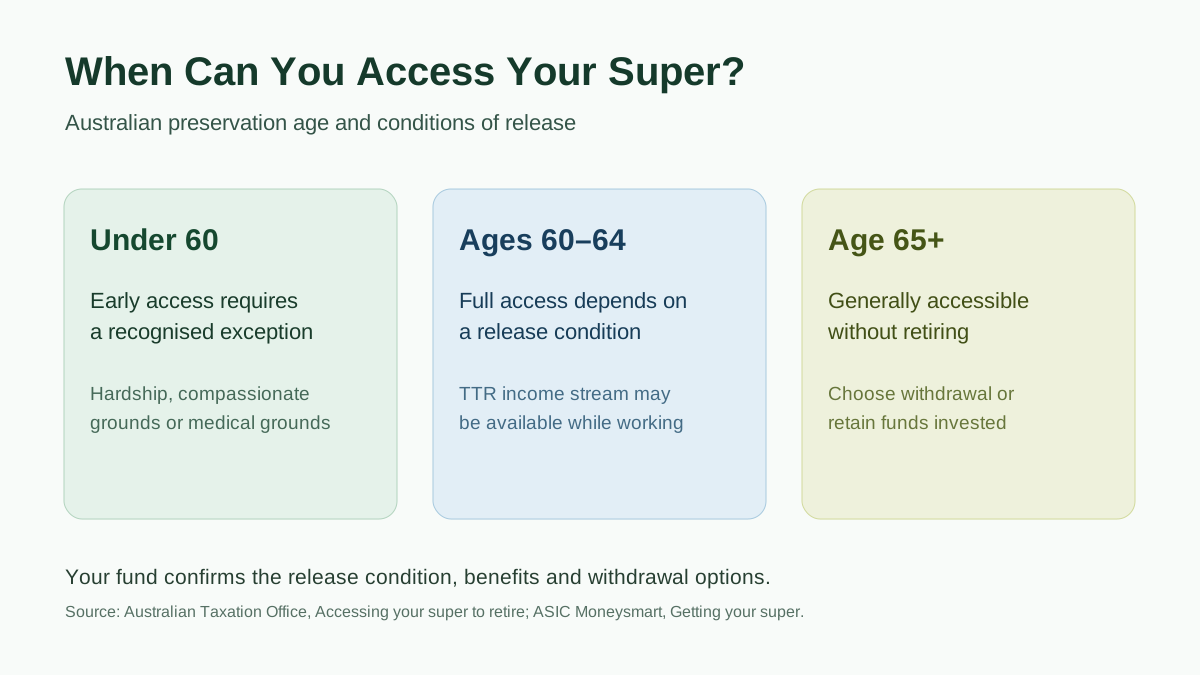
Super benefits are classified as preserved, restricted non-preserved or unrestricted non-preserved. Unrestricted non-preserved amounts are already accessible under the fund's rules; restricted amounts follow separate conditions. According to the Australian Taxation Office (ATO), Accessing your super to retire (2026), the applicable condition determines when preserved benefits can be released.
What Is Preservation Age for Super in 2026?
Preservation age is 60 for people reaching it in 2026. It is the minimum ordinary age for retirement-related access, not an automatic entitlement to a cash withdrawal.
Some older cohorts had preservation ages between 55 and 59 under historical transitional rules. Someone turning 55 in 2026 does not qualify for ordinary retirement-based release merely because the former table included age 55. A valid condition of release remains necessary.
For example, a person who turns 60 and continues the same employment arrangement generally needs another condition of release to withdraw preserved super as a lump sum. According to the Australian Taxation Office, Conditions of release (13 October 2025), reaching preservation age and continuing to work does not by itself remove cashing restrictions.
Can I Withdraw My Super at 60 If I Am Still Working?
YES, if another full condition of release has been met. NO, if age 60 is the only relevant fact and the person remains in the same ongoing employment arrangement with no separate release condition.
| Working situation, age 60–64 | General outcome |
|---|---|
| Same ongoing job, no full release condition | Preserved balance remains restricted; a TTR income stream may be an option |
| Genuinely ceased an employment arrangement after turning 60 | A full release condition may apply to eligible accumulated benefits |
| Turned 65 | Full age-based release condition applies even while working |
Check the actual cessation date and which benefits the fund considers unrestricted before requesting a cash withdrawal.
Does Leaving One Job After 60 Let Me Access My Super?
YES, genuinely ceasing an employment arrangement after 60 can satisfy a release condition even when a different job continues. Merely reducing hours without genuinely ending an arrangement is not the same event.
For example, a 62-year-old stops working for Employer A but continues with Employer B. A fund can assess release based on cessation of the first arrangement. Contributions made later may remain preserved pending a further condition. Ask the fund which evidence it requires, such as written confirmation of cessation. Source: ATO, Conditions of release.
How Does a Transition to Retirement Pension Work?
A transition-to-retirement (TTR) pension permits eligible members who have reached preservation age to draw a restricted income stream while working, without meeting a full release condition.
For a standard account-based TTR pension started at age 60–64, annual payments are generally limited to 4%–10% of the relevant balance for a full financial year. Ordinary lump-sum access from preserved benefits is restricted until a full release condition is met.
For illustration, on a $200,000 balance used to calculate a full-year pension payment, 4% is $8,000 and 10% is $20,000. The actual calculation depends on account balance, commencement date and fund rules. According to ASIC Moneysmart, Transition to retirement (updated 30 September 2026), payment limits and the income stream's tax treatment must be considered together.
Can I Access All My Super at 65 Without Retiring?
YES, from age 65 you can generally withdraw preserved super without resigning or retiring. The fund still processes identification, payment instructions and relevant account requirements.
You can take a lump sum, retain money in accumulation or transfer eligible amounts into an account-based pension. These choices have different investment, fee, insurance and tax implications. Turning 65 does not mean the fund automatically transfers your savings to a bank account. Source: ATO, Accessing your super to retire; ASIC Moneysmart, Getting your super.
Can I Access My Super Before Age 60?
YES, but only through an applicable legal release condition. Common pathways are severe financial hardship, specified compassionate expenses, permanent incapacity or terminal medical condition. A general wish to pay debts or retire early does not qualify on its own.
| Early access pathway | Decision maker | Core evidence or restriction |
|---|---|---|
| Severe financial hardship | Super fund trustee | Income support and immediate living-expense tests |
| Compassionate grounds | ATO approval, then fund processing | Qualifying expense and supporting evidence |
| Permanent incapacity | Super fund trustee | Medical and work-capacity evidence |
| Terminal medical condition | Super fund trustee | Prescribed medical certification |
Unauthorised early-access schemes can produce substantial tax and enforcement consequences. Source: ATO, Early access to super and Illegal early access to super.
Can I Get Super Early Due to Financial Hardship?
YES, where the legislative severe-financial-hardship criteria are satisfied. Having a debt or missed bill does not automatically qualify a member.
The conditions differ by age:
- Below preservation age plus 39 weeks: You must have received eligible Commonwealth income support continuously for 26 weeks and be unable to meet reasonable and immediate family living expenses. The usual release is $1,000–$10,000, once in any 12-month period. If the balance is below $1,000, the remaining balance can be released.
- At or above preservation age plus 39 weeks: You must have received eligible income support for a cumulative 39 weeks after reaching preservation age and not be gainfully employed when applying. Different cashing restrictions apply.
According to the Australian Taxation Office, Access due to severe financial hardship (updated 8 July 2026), the super fund assesses eligibility and processes the payment.
Apply through your super fund, which assesses the criteria and documentation. Withdrawal tax depends on age and benefit components. Source: ATO, Early access to super; Superannuation Industry (Supervision) Regulations 1994, Schedule 1.
What Compassionate Grounds Qualify for Early Release?
Compassionate grounds cover specific eligible costs, not general financial difficulty. Examples include qualifying medical treatment and transport, threatened mortgage foreclosure, disability-related home or vehicle modifications, palliative care and funeral expenses for a dependant.
Apply to the ATO with the required supporting documentation and expense evidence. ATO approval identifies the release amount; the fund then processes the approved payment subject to its rules and balance. Check the timing and reimbursement restrictions before paying an expense. Source: ATO, Access on compassionate grounds.
Can I Access Super Due to Incapacity or Terminal Illness?
YES, an eligible permanent-incapacity or terminal-medical-condition release can allow access before age 60.
Permanent incapacity generally concerns an inability, due to physical or mental ill-health, to undertake gainful employment for which the member is reasonably qualified by education, training or experience. Terminal medical condition release requires prescribed medical certifications and time limits. Your super trustee assesses the release condition; a total and permanent disability insurance claim can involve a separate insurer decision. Source: ATO, Early access to super.
Can I Use Super to Buy a House?
NO, ordinary preserved super cannot be withdrawn early simply to purchase a home. The separate First Home Super Saver (FHSS) scheme allows eligible purchasers to release qualifying voluntary contributions and associated earnings.
The FHSS scheme counts up to $15,000 of eligible voluntary contributions per financial year and $50,000 across all years. The amount available for release generally includes 85% of eligible concessional contributions, 100% of eligible non-concessional contributions and calculated associated earnings. Compulsory employer Super Guarantee contributions do not qualify.
Request an ATO FHSS determination before ownership of the property transfers. The release and property-contract timing requirements are separate. According to the ATO, First home super saver scheme (updated 17 March 2025), these rules apply specifically to eligible first-home buyers.
How Do I Apply to Withdraw My Super?
Apply through the super fund for most age-based release conditions; some exceptional pathways first require an ATO decision.
- Identify your age, work status, benefit classification and relevant condition of release.
- Ask your fund for its claim process, identity requirements and payment choices.
- For compassionate grounds or FHSS, complete the relevant ATO process before requesting release.
- For hardship or medical incapacity, submit evidence to the fund trustee.
- Check tax, pension eligibility and insurance consequences before authorising a withdrawal.
- Retain the assessment and payment records.
Before selecting a lump sum or income stream, ask the fund for the available payment options and the taxable and tax-free components. Source: Australian Taxation Office, Withdrawing and using your super; ASIC Moneysmart, Getting your super.
How Can I Verify My Super Release Eligibility?
Check your date of birth, current employment status, genuine cessation dates and benefit classification with the fund before applying.
| Circumstance | What to verify |
|---|---|
| Age 59 without an exception | Whether any recognised early-release condition applies |
| Age 60–64, continuously employed | TTR eligibility and any other full release condition |
| Age 60–64, genuinely ceased one job | Cessation evidence and which benefits become unrestricted |
| Age 65 or older | Withdrawal or pension options, identification and account conditions |
Defined-benefit arrangements and fund insurance may require additional checks.
What Happens to Insurance When I Withdraw Super?
A full withdrawal can end insurance held through that super account, including death, total and permanent disability or income protection cover, depending on the fund and policy.
Before withdrawing, confirm the existing insured amount, premiums, cancellation conditions and continuation options with your fund. Even a partial withdrawal can leave insufficient money to pay premiums. Replacement cover may require fresh underwriting. Source: ASIC Moneysmart, Insurance through super.
How Much Tax Applies When I Withdraw Super?
Tax depends on age, tax-free and taxable components, whether a benefit is taxed or untaxed and its payment form. Many withdrawals from taxed super funds at age 60 or older are tax-free.
An untaxed component can still attract tax after 60, especially in some public-sector and defined-benefit schemes. Early-release benefits before 60 have different treatment and qualifying terminal-medical-condition lump sums receive special rules. Obtain a component breakdown from your fund. The tax treatment of super withdrawals differs by component, age and fund type. Source: ATO, Tax on super benefits.
What Is the Difference Between Super Access Age and Age Pension Age?
Super access and Age Pension use different age and eligibility rules. Ordinary super access starts from 60 with a release condition and is generally unrestricted at 65. The government Age Pension eligibility age is 67, subject to residency, income and asset tests.
| Feature | Super access | Age Pension |
|---|---|---|
| Relevant age | Generally 60 with a condition, or 65 without retiring | 67 |
| Main test | Super preservation and condition of release | Residency, income and asset tests |
| Provider | Super fund | Services Australia |
| Payment | Lump sum or super income stream under the applicable rules | Government pension when eligible |
A member can withdraw super before qualifying for Age Pension. Super and other assets can affect pension means testing. Source: Services Australia, Who can get Age Pension.
Written by
Superannuation Calculator Australia
Calculation guidance and general information; independent financial advice is not provided.