Does Overtime Count for Super? Australian Rules and Examples
Does overtime count for super? Check Australian ordinary-hours rules, 12% SG calculations, exceptions and how to verify payments.
Superannuation Calculator Australia · · 8 min read
Genuine overtime performed outside ordinary hours generally does not attract compulsory super in Australia. The distinction depends on ordinary hours under an award or agreement and whether overtime amounts are separately identifiable. From 1 July 2026, employers calculate the 12% super guarantee (SG) on qualifying earnings under Payday Super. Ordinary time earnings (OTE) form part of that base. The employer must classify pay correctly before calculating SG.
Does overtime count for super in Australia?
NO, separately identifiable overtime outside ordinary hours generally does not attract compulsory superannuation in Australia. The payment is excluded from ordinary time earnings (OTE), a component of qualifying earnings under Payday Super.
The decisive question is whether the hours are ordinary hours under the applicable award, enterprise agreement or other employment arrangement. A higher hourly rate or a recurring shift does not by itself establish overtime. According to the Australian Taxation Office (ATO), Superannuation Guarantee Ruling SGR 2009/2, the actual ordinary-hours arrangement and whether overtime earnings can be identified determine the usual SG treatment.
What are ordinary hours for super purposes?
Ordinary hours for super are the hours specified as ordinary in an applicable award or agreement. Where no applicable instrument specifies ordinary hours, the employee's normal, regular, usual or customary working hours are assessed from the circumstances.
Earnings for those hours generally form part of OTE. Shift loadings and certain allowances also form part of the ordinary-hours earnings base. Under Payday Super, qualifying earnings include OTE and certain additional specified payments.
Start with the award classification and hours clause, then examine the employment agreement, roster and pay records. A payroll label on its own does not settle the treatment.
Does mandatory or rostered overtime change the rule?
NO, mandatory or regularly rostered overtime does not automatically become ordinary hours. Where the governing instrument defines ordinary hours and the additional overtime remains distinguishable, the extra hours retain their overtime treatment.
ATO SGR 2009/2 includes an example of regularly worked Saturday overtime that remains excluded from OTE, despite the repeated work pattern.
When can extra hours count toward super?
Extra hours count toward super when the employment rules treat them as ordinary hours rather than separately identifiable overtime. Where a payment does not separately identify any overtime component, the ATO may treat the whole amount as OTE, depending on the applicable hours and remuneration arrangement.
To classify a payment:
- Read the applicable award or enterprise agreement to identify ordinary hours and overtime thresholds.
- Compare the employment contract and roster against those definitions.
- Separate identifiable overtime pay from ordinary earnings and qualifying loadings.
- Review undissected salary arrangements against the ATO guidance, including SGR 2009/2.
How are shift penalties and overtime different?
A weekend or public holiday penalty rate can apply to ordinary hours. Overtime pay generally concerns hours outside the ordinary-hours limits or span under the applicable instrument. The payment rate alone is not decisive.
| Payment scenario | Ordinary hours? | Typical SG treatment |
|---|---|---|
| Rostered Sunday shift paid at a penalty rate | Yes, if within ordinary hours | Include qualifying earnings |
| Additional hours beyond the award overtime threshold | No, if clearly identifiable as overtime | Exclude genuine overtime component |
The relevant award, agreement and employment pattern determine the classification.
What about casual and part-time employees?
Casual and part-time employees receive SG on additional shifts when those hours qualify as ordinary hours. Additional hours are not automatically overtime merely because they exceed a familiar roster.
For a part-time worker, the relevant award or agreement may specify when additional hours become overtime. For a casual employee without defined ordinary hours or a discernible regular pattern, the ATO's examples treat all hours actually worked as ordinary in some circumstances. Check the employee's specific instrument and work pattern.
How do you calculate super when overtime is paid?
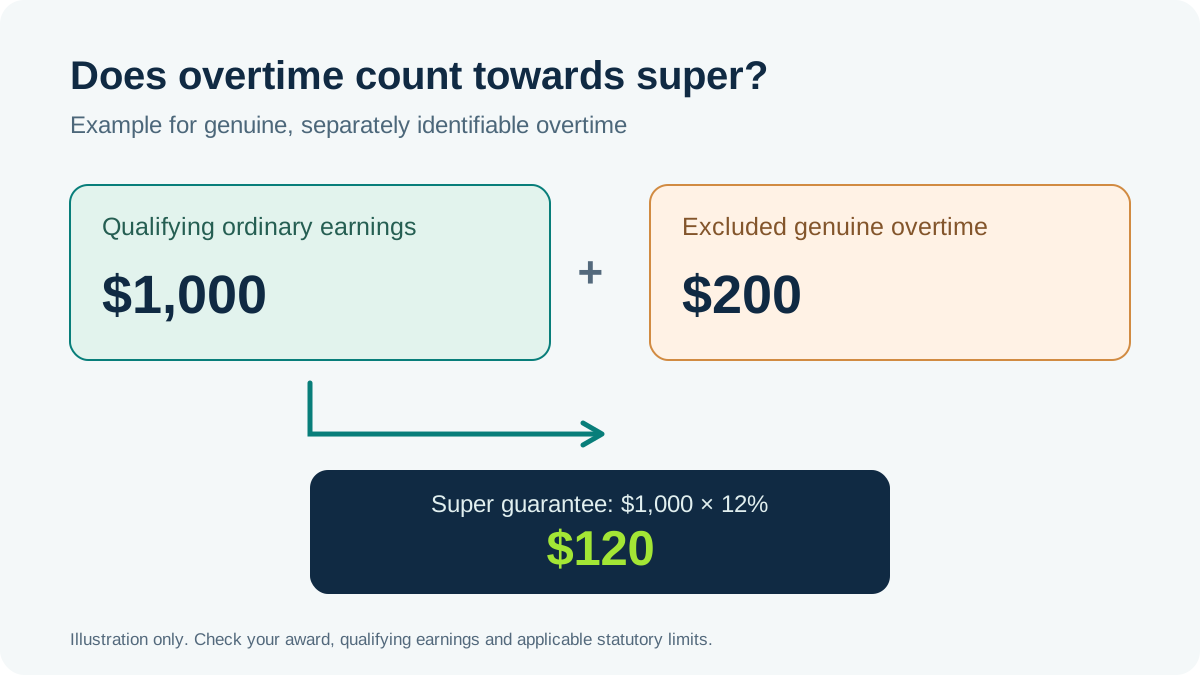
Calculate compulsory super as 12% of qualifying earnings, subject to applicable statutory limits and adjustments. Genuine separately identifiable overtime that falls outside the qualifying-earnings base is excluded from this example.
| Pay component | Illustrative amount | SG treatment |
|---|---|---|
| Ordinary qualifying earnings | $1,000 | Included |
| Identifiable excluded overtime | $200 | Excluded |
| Qualifying earnings used for SG | $1,000 | SG = $120 (12%) |
The worker receives $1,200 in gross pay, but minimum SG is $1,000 × 12% = $120, not $144. The superannuation Calculator Australia estimates employer SG from eligible earnings. The illustration assumes no additional qualifying payment, salary-sacrifice adjustment or maximum contribution base issue.
What does a mixed-rate payslip show?
A mixed-rate payslip should identify pay for ordinary hours separately from genuine overtime. Compare the payslip with the timesheet, roster and award before testing the employer's SG calculation.
For example, $900 ordinary pay + $100 qualifying shift loading + $200 excluded overtime creates an illustrative $1,000 qualifying-earnings base and $120 SG at 12%. A payroll code labelled “overtime” is evidence of classification, not proof that the legal definition has been met.
How did the rules change in July 2026?
From 1 July 2026, Payday Super requires employers to calculate SG on qualifying earnings when they pay salary or wages. The SG rate remains 12% and the fund generally must receive the contribution within seven business days after payday. Specific extensions and exceptions apply.
Qualifying earnings include OTE and additional specified payments, including all employee commissions and certain salary-sacrifice amounts. The super Contributions Calculator Australia also distinguishes employer SG from salary sacrifice and personal contributions. Payday Super replaced the former quarterly SG payment timetable for paydays on or after 1 July 2026. It did not automatically make genuine separately identifiable overtime eligible for SG.
According to the ATO, What payments are qualifying earnings (updated 2 September 2026), the new category combines OTE with specified additional earnings. The ATO's Payment deadlines for Payday Super explains the general seven-business-day deadline and exceptions.
How can you check and correct an unpaid super amount?
Check underpaid super by comparing qualifying earnings on each payslip with the employer's SG liability and contributions received by your fund. An amount appearing on a payslip does not itself prove the fund received the money.
- Identify the pay period, employment instrument and applicable ordinary-hours clause.
- Match timesheets and rosters to ordinary hours, shift loadings and identifiable overtime.
- Calculate the expected SG from qualifying earnings at 12% for 2026–27, allowing for relevant limits.
- Check the fund's transaction history and the correct receipt deadline, applying the timing rules explained in how super is paid in Australia.
- Ask payroll for the contribution amount, payment date and fund reference. If unresolved, use the ATO unpaid super reporting process.
If the discrepancy remains after the applicable deadline, report the suspected unpaid SG to the ATO. Keep the award provision, payslips and fund transaction records together.
Does regular rostered overtime automatically attract super?
NO, repeated overtime outside an award's specified ordinary hours remains overtime when the payment can be identified. According to the ATO, Superannuation Guarantee Ruling SGR 2009/2 (29 July 2009), its treatment does not turn on how frequently the extra hours occur.
Can an award require super on payments beyond the statutory minimum?
YES, an award, enterprise agreement or employment contract can provide super benefits above the statutory SG minimum. Check the exact clause to distinguish an additional employment entitlement from minimum SG liability.
Is a weekend penalty rate always overtime?
NO, a weekend penalty rate can apply to a rostered ordinary shift. According to the Fair Work Ombudsman, Penalty rates (accessed 12 October 2026), higher rates apply at certain times or on certain days, including weekends and public holidays. A penalty loading on ordinary hours generally counts towards OTE.
Can overtime count if it is not separately identifiable?
YES, overtime-related remuneration can count towards OTE where an undissected payment does not separately identify the overtime amount. The ATO's List of payments that are ordinary time earnings (30 April 2026) explains that overtime must be clearly identifiable. The applicable ordinary-hours arrangement still determines the assessment.
A payroll code alone cannot establish an exclusion; retain the award, roster and wage calculation supporting the identified overtime amount.
Do additional casual shifts always qualify as overtime?
NO, additional casual shifts are assessed against the ordinary-hours and overtime provisions applying to that engagement. Where neither the instrument nor the work pattern identifies separate ordinary hours, the ATO's ordinary-hours principles can result in all hours worked being treated as ordinary.
Can a part-time worker receive super on extra hours?
YES, a part-time employee receives compulsory SG on additional hours that qualify as ordinary hours. Where those hours are clearly overtime under the applicable instrument, the separately identified overtime payment is generally excluded from the compulsory SG base.
Does a higher hourly rate automatically mean overtime?
NO, a higher hourly rate can reflect a shift loading or public holiday penalty for ordinary work. Check the hours category before excluding any amount from qualifying earnings.
Sources and verification
- Australian Taxation Office, Superannuation Guarantee Ruling SGR 2009/2 (29 July 2009).
- Australian Taxation Office, List of payments that are ordinary time earnings (30 April 2026).
- Australian Taxation Office, What payments are qualifying earnings (updated 2 September 2026).
- Australian Taxation Office, Payment deadlines for Payday Super (2026).
- Fair Work Ombudsman, Overtime pay (10 August 2026).
- Fair Work Ombudsman, Penalty rates (accessed 12 October 2026).
The worked examples use the 2026–27 SG rate and are illustrative. Award-specific entitlements depend on the applicable employment instrument.
Written by
Superannuation Calculator Australia
Calculation guidance and general information; independent financial advice is not provided.