Super Payments Australia: SG, Payday Super, Deadlines
Learn how employers pay super in Australia, including the 12% SG rate, Payday Super deadlines, eligible earnings and checking contributions received by your fund.
Superannuation Calculator Australia · · 14 min read
Australian employers generally pay compulsory superannuation into an eligible worker’s complying super fund, not into the worker’s bank account. The contribution is calculated from qualifying earnings, reported through payroll and remitted using a SuperStream-compliant service. Since 1 July 2026, Payday Super has linked payment timing to each pay cycle. A worker can check the contribution shown on a payslip against the amount and receipt date recorded by their fund.
How is superannuation paid in Australia?
According to the Australian Taxation Office, How to work out and pay super (2026), employer superannuation contributions are paid into a complying super fund or permitted retirement savings account. The contribution is separate from an employee’s ordinary wage payment. The process has three stages:
- Calculate SG: Payroll identifies qualifying earnings and calculates super guarantee (SG).
- Send the contribution: The employer submits payment and contribution data through a compliant payment channel.
- Confirm receipt: The fund receives the payment and allocates it to the member account.
Fund receipt, rather than the payslip entry alone, matters for the Payday Super deadline. Employees can check the fund's transaction history.
Who must pay super for Australian employees?
According to the Fair Work Ombudsman, Tax and superannuation, employers must pay minimum SG for eligible full-time, part-time and casual employees, as well as certain contractors covered by SG rules. Voluntary salary sacrifice and personal contributions are separate from compulsory SG. A total-remuneration package does not remove the employer's minimum SG obligation.
Which employees are eligible for super guarantee payments?
According to the Australian Taxation Office, Work out if you have to pay super, employees aged 18 or older generally qualify for SG whether they work full-time, part-time or casually. Employees under 18 generally qualify when they work more than 30 hours in a week.
The former $450 monthly earnings threshold was removed on 1 July 2022. Low monthly earnings alone do not generally exclude an adult worker. Employers must also assess labour-based contractors rather than assume an ABN prevents SG. Other eligibility rules and exemptions can apply.
How much super do employers pay in 2026–27?
According to the Australian Taxation Office, Super guarantee (2026–27), the minimum employer Super Guarantee (SG) rate is 12% of qualifying earnings, subject to applicable limits and exceptions. The rate has been 12% since 1 July 2025. It applies to qualifying earnings rather than take-home pay after PAYG withholding.
A fortnightly payment of $2,000 in qualifying earnings produces $240 in minimum SG ($2,000 × 12%), assuming no relevant exception. An award, agreement or contract may require a higher contribution.
Qualifying earnings include ordinary time earnings and other specified payments. Employers must classify payroll items before calculating SG.
What earnings count towards employer super payments?
According to the Australian Taxation Office, Explaining qualifying earnings (2 September 2026), qualifying earnings have been the basis for calculating minimum SG under Payday Super since 1 July 2026. They include ordinary time earnings (OTE), commissions, relevant salary sacrifice amounts and certain payments to workers covered by the extended SG employee definition.
OTE generally includes pay for ordinary hours, along with applicable loadings and many bonuses or allowances linked to those hours. Separately identifiable genuine overtime is generally excluded from OTE. Employers must still classify each payment under the current qualifying-earnings rules.
How do you calculate super from gross pay?
The minimum SG contribution equals 12% of qualifying earnings for the relevant pay period, subject to applicable limits and exceptions. A $2,000 qualifying-earnings amount produces $240 in SG ($2,000 × 12%). Qualifying earnings can differ from total gross pay or taxable income because some payroll items are excluded.
A $100,000 remuneration package that includes super must be separated into salary and SG components. Adding 12% to an already inclusive package gives the wrong breakdown. Check the earnings categories and relevant limits first.
For salary-package calculations, use the superannuation Calculator Australia.
What is Payday Super in Australia?
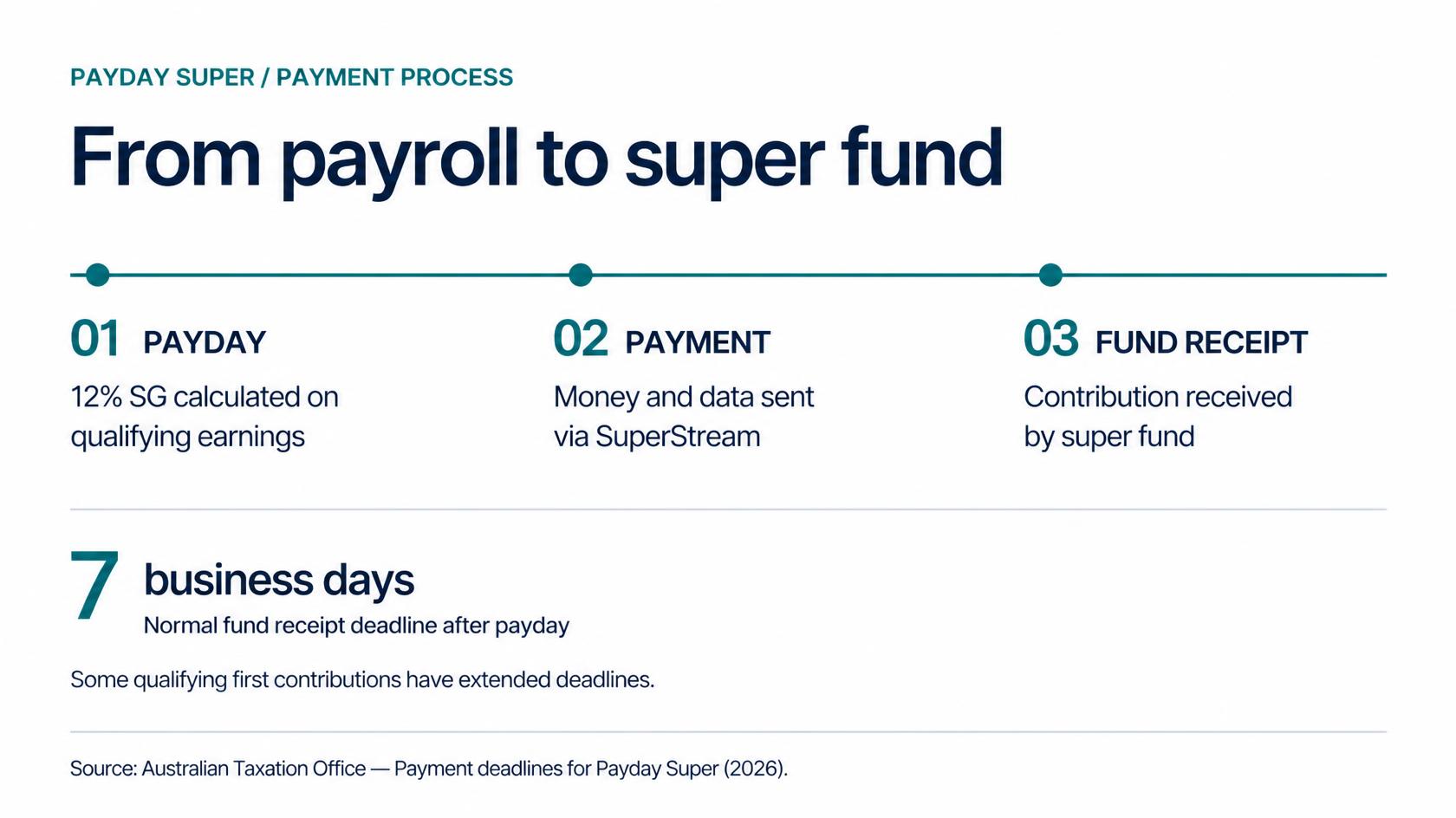
According to the Australian Taxation Office, About Payday Super (2026), Payday Super began on 1 July 2026. Employers generally calculate SG each time they pay salary or wages, and the contribution must usually reach the employee’s fund within seven business days after payday.
The deadline is based on fund receipt, not merely on submitting a clearing-house instruction. Employers therefore need payroll calculations, timely remittances and monitoring for rejected or delayed payments.
The ATO published a first-year compliance approach. It does not remove the obligation to pay SG.
When must super reach the employee's super fund?
According to the Australian Taxation Office, Payment deadlines for Payday Super (2026), employer SG contributions must generally reach the employee’s super fund within seven business days after payday.
An extended deadline of up to 20 business days applies to qualifying first contributions for new employees and to a new fund for an existing employee, subject to the ATO's conditions.
A Monday payday starts a seven-business-day receipt window under the general rule, rather than seven calendar days. Public holidays can affect the deadline. Employers should retain evidence of fund receipt and check the conditions before applying an extension.
How did super payments change from quarterly to payday?
According to the Australian Taxation Office, Payday Super: How to manage super during the changeover (2026), employer SG payments were generally due at least quarterly before 1 July 2026. Payday Super links contributions to each payday from that date.
| Period | Payment trigger | Receipt rule |
|---|---|---|
| Through 30 June 2026 | Quarterly SG periods | Applicable quarterly due dates |
| From 1 July 2026 | Each pay event | Normally within seven business days after payday |
The final April–June 2026 quarter retained its quarterly payment deadline of 28 July 2026. This differs from the rules for paydays from July 2026.
How do employers pay super contributions to employees' funds?
The Australian Taxation Office's How to work out and pay super (2026) describes employer payments through a complying fund and SuperStream. Employers identify the member's fund, calculate SG, submit the contribution and confirm receipt.
A practical employer payment workflow is:
- Verify the fund: Check the employee’s chosen or stapled super fund.
- Confirm payroll details: Validate member details and earnings codes.
- Calculate the liability: Determine SG for the relevant pay event.
- Submit payment and data: Use supported payroll software, a fund service or a commercial clearing house.
- Reconcile fund receipt: Investigate rejected transactions and verify when the fund received the payment.
SuperStream is a data and payment standard, not a requirement to use one software vendor. The ATO Small Business Superannuation Clearing House closed on 1 July 2026, so employers need an alternative compliant service.
How do you select a super fund for a new employee?
According to the Australian Taxation Office, Superannuation standard choice form and stapled-fund guidance, employers generally offer new eligible employees a choice of complying super fund. If the employee does not make a valid choice, the employer checks for an existing stapled fund through the ATO. An eligible default fund is used only when the applicable rules allow it.
Incorrect member or fund details can cause rejected or delayed contributions. Employers should verify those details and retain choice forms and onboarding records.
How can employees verify when their super was received?
ASIC Moneysmart's Super contributions guidance and the ATO's Super from your employer guidance recommend checking contribution records. Employees can match payroll records with fund credits for the corresponding pay events:
- Check the payslip: Record the pay date, qualifying earnings and SG amount.
- Check the fund: Review contribution amounts and receipt dates in the member portal or statement.
- Cross-check myGov: Review ATO online services as supporting evidence, allowing for reporting delays.
- Ask payroll: For any unmatched payment, request the transaction reference and receiving fund.
A payslip or employer bank debit alone does not prove on-time fund receipt. Keep dated statements for any discrepancies.
What is the difference between payslip super and fund receipt?
Payslip super shows an amount reported by payroll. Fund receipt confirms that the contribution reached the super fund.
| Evidence | What it establishes |
|---|---|
| Payslip SG entry | Amount calculated or declared by payroll |
| Clearing-house or bank submission | Money or data submitted for processing |
| Fund contribution record | Amount credited and recorded receipt information |
A failed or rejected payment can appear in payroll before it reaches the fund.
If payment timing is disputed, request dated remittance and fund-confirmation records. The date displayed in the member portal may differ from the legally relevant receipt date.
What happens when an employer pays super late?
According to the Australian Taxation Office, What happens if you don't pay super correctly (2026), late or insufficient employer SG contributions can trigger a shortfall and a super guarantee charge (SGC). Employers may need to report and correct non-compliance through the ATO.
Payday Super uses a different SGC and compliance framework from the former quarterly system. Employers should not rely on outdated quarterly-payment instructions.
Employers should identify affected pay events, check qualifying earnings and fund receipt dates, then follow current ATO guidance on late payments and disclosure.
The ATO's first-year risk-based compliance approach for 2026–27 does not remove the SG obligation.
How can workers report unpaid or missing super?
Workers can report unpaid super to the ATO using its unpaid-super reporting process, after checking their fund history and asking their employer to explain the discrepancy. Use this sequence:
- Collect payslips showing SG amounts and pay dates.
- Download the fund’s dated contribution history.
- Ask payroll which account received the contribution and when.
- If the discrepancy remains unresolved, use the ATO's unpaid super enquiry or reporting process.
Include the employer’s details, relevant work periods and missing contribution amounts.
A missing fund credit may indicate an incorrect account, a processing delay or non-payment. Keep evidence that helps distinguish these situations.
Is super paid on overtime, bonuses and commissions?
The Australian Taxation Office's ordinary-time-earnings and Payday Super guidance distinguishes super treatment of overtime, bonuses and commissions by the payment's qualifying-earnings classification. Commissions are included under Payday Super. Other payments must be assessed against OTE or another qualifying category.
| Payment | General treatment |
|---|---|
| Commission | Included in qualifying earnings under Payday Super |
| Ordinary-hours bonus or allowance | Often included when part of OTE |
| Genuine separately identifiable overtime | Generally excluded from OTE. Check any other qualifying-earnings rules |
| Mixed allowance or undifferentiated payment | Requires classification using contracts, awards and payroll records |
Employers should document why an item is included or excluded. For bonus-specific rules and worked examples, see does a Bonus Attract Super?.
What super obligations apply to contractors and sole traders?
Employers may owe SG for certain independent contractors paid principally for their personal labour, even where they invoice using an ABN. Assess the labour component of the contract, whether work must be performed personally and whether there is a genuine right to delegate.
Sole traders operating independently generally arrange their own personal super contributions. However, their legal form alone does not decide whether a payer has an SG obligation. A payment into a contractor’s ordinary bank account does not satisfy SG when employer contributions are required. Review the written contract and actual arrangements using the ATO’s contractor eligibility guidance.
How do you reconcile super across more than one job or fund?
Employees with more than one job should reconcile each employer’s SG separately and match contributions to the correct fund. For each employer, keep a reconciliation ledger recording:
- Employer name and payday
- Qualifying earnings and expected SG
- Member fund and account
- Amount received and fund transaction date
Employer A's $1,000 in qualifying earnings generates $120 SG, while Employer B's $800 generates $96 SG. The combined expected amount is $216, but each employer has a separate payment obligation.
If contributions go to different funds, check both transaction histories before deciding a payment is missing. Match transactions by employer and reference number.
What records should employers keep to prove super arrived on time?
Employers should retain evidence connecting each payday, its SG calculation and the fund’s receipt. Useful records include:
- Payroll earnings codes and payslips
- Fund choice or stapled-fund records
- SuperStream file references and clearing-house settlement reports
- Fund acceptance or rejection messages
- Records of follow-up corrections
A payment instruction alone does not establish fund receipt. Keep the payday and receipt dates together to check compliance with the deadline.
Record-retention obligations can differ by document type. Check current ATO requirements.
How can employers avoid super payment errors under Payday Super?
According to the Australian Taxation Office, How to work out and pay super and About Payday Super (2026), employers can reduce payment failures by checking worker eligibility, validating fund details and reconciling fund receipts for each pay run. Prioritise these controls:
- Update qualifying-earnings categories and the 12% SG rule in payroll.
- Confirm employee and fund identifiers before the first payment.
- Schedule remittances early enough for the fund to receive them on time.
- Monitor rejected files, returned payments and bank settlement failures.
- Assign responsibility for tracing overdue contributions.
- Maintain a dated exception log.
How should employees and employers verify super is paid correctly?
Employees and employers should verify the same outcome from different records: correct SG calculated and received in the right fund by the applicable deadline.
| Employee verification | Employer verification |
|---|---|
| Match payslip SG to qualifying earnings | Reconcile payroll earnings and SG calculation |
| Check fund account and credit history | Confirm member fund and remittance details |
| Raise missing entries with payroll | Investigate rejected files and returned payments |
| Keep dates and transaction references | Preserve fund acceptance and receipt evidence |
Where records disagree, contact payroll and the fund. Escalate unresolved missing super to the ATO after checking the supporting evidence.
Can employees choose their own super fund?
YES, eligible employees generally can choose a complying super fund. When no valid choice is made, stapled-fund and default-fund rules apply. Some employees have exceptions. See the fund-selection process above.
Do employers have to pay super at the same time as wages?
YES, employers generally must arrange SG with each payday from 1 July 2026, with fund receipt normally due within seven business days. Qualifying first contributions may have an extended deadline. See the Payday Super section above. To estimate the minimum SG on eligible earnings for a pay period, use the superannuation Calculator Australia.
Does super shown on a payslip prove the fund received it?
NO, a payslip shows the amount calculated or reported by payroll, not confirmed fund receipt. Check the fund's dated contribution record, as explained in the verification section above.
Are employees under 18 always entitled to super?
NO, employees under 18 generally must work more than 30 hours in a week for compulsory SG to apply. Casual status alone does not decide eligibility. See the eligibility section above.
Can super be paid into an employee's ordinary bank account?
NO, compulsory SG must go to an eligible complying super fund or permitted retirement savings account. Paying an allowance into the employee's everyday bank account does not satisfy that obligation. To understand employer and voluntary payments into super, use the super Contributions Calculator Australia.
Is employer super normally deducted from take-home pay?
NO, compulsory SG is not normally withheld from net take-home pay. A quoted salary package can include super, but its salary and SG components must be separated. Salary sacrifice does not replace minimum employer SG. To estimate how ongoing contributions could build retirement savings, use the super Projection Calculator Australia.
Official guidance and further reading
Australian Taxation Office — How to work out and pay super and Explaining qualifying earnings (2026).
Australian Taxation Office — Super guarantee (2026–27). General SG rate: 12%.
Australian Taxation Office — Payment deadlines for Payday Super (2026). General seven-business-day receipt requirement and conditional 20-business-day first-contribution window.
Australian Taxation Office — Superannuation standard choice form and Super for independent contractors.
Fair Work Ombudsman — Tax and superannuation.
Australian Taxation Office — Small Business Superannuation Clearing House (closure effective 1 July 2026) and Payday Super: How to manage super during the changeover (2026). Final April–June 2026 quarter due 28 July 2026.
Australian Taxation Office — PCG 2026/1 (2026). First-year compliance approach. This does not waive SG obligations.
Information reflects the rules discussed as at 10 October 2026. Individual circumstances and statutory exceptions may change the result.
Written by
Superannuation Calculator Australia
Calculation guidance and general information; independent financial advice is not provided.