How Much Super Should I Have at 50? Average & Targets
How much super should you have at 50 in Australia? Compare the $198,000 average for ages 50–54 with retirement targets and plan your next steps.
Superannuation Calculator Australia · · 14 min read
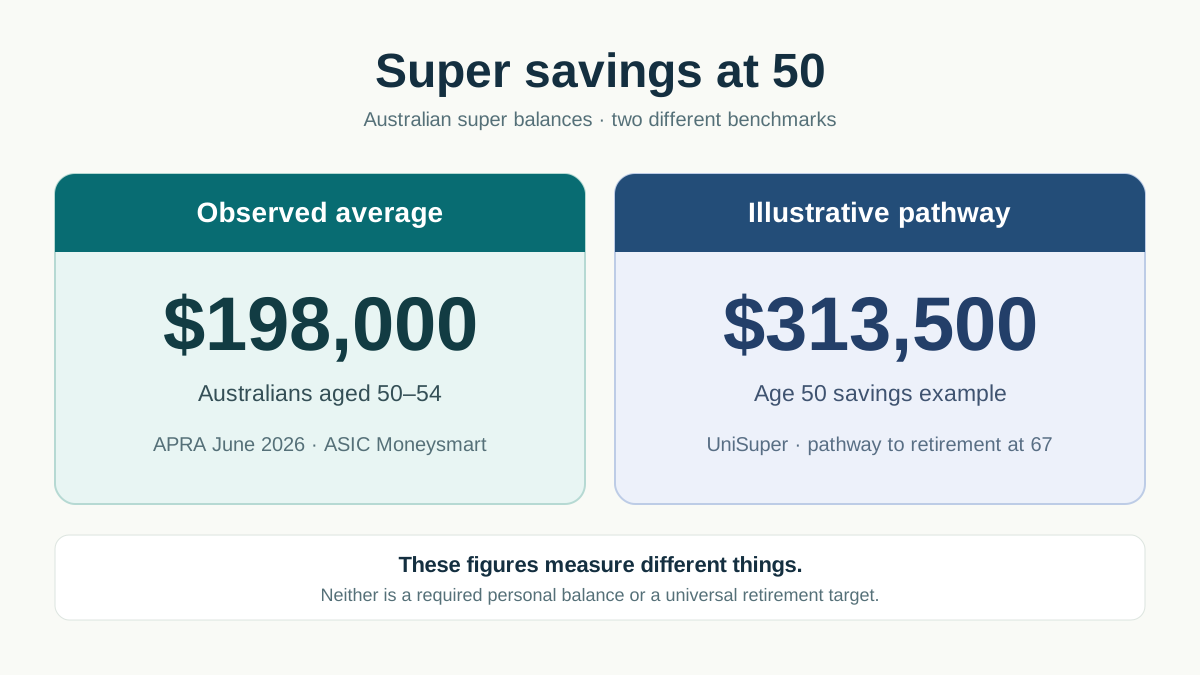
At age 50, there is no single required super balance. According to ASIC Moneysmart's How much super should I have? (updated 6 October 2026), APRA's June 2026 data show an average super balance of $198,000 for Australians aged 50–54. UniSuper's How much super should I have? (accessed 11 October 2026) separately shows an illustrative $313,500 balance at age 50 on a pathway towards a comfortable retirement at 67.
These benchmarks answer different questions. The $198,000 figure describes what people in the age group currently hold on average. The $313,500 figure is a modelled savings-path illustration. Your own target depends on retirement age, spending, housing, other household resources, possible Age Pension income, future contributions, fees and investment returns.
How much super should I have at 50 in Australia?
Use the $198,000 average for ages 50–54 as a comparison with current Australian balances, not as a required retirement target. The $313,500 UniSuper illustration is a separate reference point based on a pathway to age 67 and stated assumptions, including annual pre-tax earnings of $65,000.
Neither figure tells you exactly how much you personally need. A useful target should be based on the retirement income you want, how long your super can continue growing and the other resources available to your household.
What is the average super balance for Australians aged 50–54?
According to ASIC Moneysmart's How much super should I have? (updated 6 October 2026), APRA data for June 2026 show an average super balance of $198,000 for Australians aged 50–54. APRA's June 2026 Quarterly Superannuation Industry Publication also reports member demographics and average member balances by age bracket.
The adjacent age groups averaged $157,900 at ages 45–49 and $243,300 at ages 55–59. These observed balances are not minimum savings requirements, and they do not show the amount a person exactly aged 50 should have.
What is the median super balance at age 50?
The median super balance is the middle value in a defined population when balances are ordered from lowest to highest. The average is the total divided by the number of observations, so unusually high balances can raise the average.
A current median for Australians exactly aged 50 was not established from the authoritative sources reviewed. ASIC Moneysmart's $198,000 average for ages 50–54 must not be labelled as the median. A median comparison needs a source specifying its age group, reference period and population.
How does super at 50 compare for men and women?
UniSuper's How much super should I have? (accessed 11 October 2026) reports June 2023 average balances for people aged 50–54 of $254,071 for men and $190,175 for women.
These June 2023 gender figures should not be directly compared with the June 2026 overall average because the periods and underlying datasets differ. Earnings, work patterns and career breaks can affect individual balances. Gender alone does not establish a retirement savings target. For the earlier age benchmark, see how Much Super Should I Have at 40 in Australia?.
How much super is recommended at age 50 for a comfortable retirement?
There is no universal recommended super balance at age 50. UniSuper's How much super should I have? (accessed 11 October 2026) shows $313,500 at age 50 as an illustrative pathway towards a comfortable retirement at 67 and states an annual pre-tax earnings assumption of $65,000.
Retirement-end benchmarks answer a different question. According to ASFA's Understanding ASFA Retirement Standard's new lump sums (26 March 2026), the comfortable-retirement lump sums for homeowners aged 67 are $630,000 for a single person and $730,000 for a couple. ASIC Moneysmart also reports $110,000 for a single homeowner seeking a modest retirement and $340,000 for a single private renter seeking a modest retirement, based on ASFA figures accessed in September 2026.
| Benchmark | Amount | What it measures |
|---|---|---|
| Age 50 illustrative pathway | $313,500 | UniSuper modelled savings pathway under stated assumptions |
| Age 67 comfortable, single homeowner | $630,000 | ASFA retirement-end lump sum |
| Age 67 comfortable, homeowner couple | $730,000 | ASFA retirement-end lump sum |
| Age 67 modest, single homeowner | $110,000 | ASFA retirement-end lump sum |
| Age 67 modest, single private renter | $340,000 | ASFA retirement-end lump sum |
These benchmarks are guides rather than personal recommendations. Household composition, housing, Age Pension assumptions, spending and the reference date all affect the amount required.
How do I know if my super balance at 50 is on track?
A super balance at 50 is on track when a realistic retirement projection can support your intended spending goal. The test depends on your retirement age, future contributions, investment assumptions and likely sources of retirement income.
To assess your position:
- Choose a retirement age and annual spending goal.
- Enter your current balance, expected employer super, additional contributions and fund costs in the super Projection Calculator Australia.
- Compare lower, central and higher investment-return assumptions.
- Consider housing costs, possible Age Pension income and how savings may be drawn down.
An age-group average measures relative account balances. It does not establish whether your retirement income will be adequate.
How much super will a $150,000 balance at 50 grow by age 67?
A $150,000 super balance at age 50 grows to approximately $343,800 at age 67 over 17 years at a hypothetical 5% effective annual net return, with no additional contributions.
The calculation is $150,000 × (1.05)^17 ≈ $343,800. New contributions would increase the projected balance. Administration charges and insurance premiums would reduce it unless already included in the return assumption. Actual returns vary, so this fixed-return example is not a forecast.
How does retiring at 60, 65 or 67 change my super target?
Retirement age determines how long super can accumulate and how many retirement years the savings may need to support. A $150,000 balance at age 50, with no further contributions and a hypothetical 5% effective annual net return, grows to approximately $244,300 at 60, $311,800 at 65 and $343,800 at 67.
Retirement at 60 leaves fewer potential contribution years and may require savings to fund a longer retirement. Access to preserved super also depends on satisfying a condition of release.
| Retirement age | Growth years | Illustrative balance, no new contributions |
|---|---|---|
| 60 | 10 | $244,300 |
| 65 | 15 | $311,800 |
| 67 | 17 | $343,800 |
How do I estimate my retirement income from super?
Retirement income from super depends on the accumulated balance, withdrawal schedule, investment earnings, fees and applicable tax treatment after retirement. A balance divided by the number of retirement years is only a rough illustration because it ignores ongoing investment returns and changing spending.
An income estimate should also account for living costs, housing and any Age Pension entitlement. ASIC Moneysmart's retirement planner can help test scenarios. Future-dollar projections should be clearly distinguished from amounts expressed in today's purchasing power.
How do the Age Pension and home ownership change my super target?
Age Pension eligibility and housing costs can materially change the amount of super needed to support retirement spending. Age Pension entitlement is subject to income and assets tests, while housing status affects both living costs and how retirement benchmarks are constructed.
According to ASIC Moneysmart's How much super should I have? (updated 6 October 2026), ASFA's September 2026 illustrations estimate $110,000 for a single homeowner and $340,000 for a single private renter seeking a modest retirement at 67. These are modelled situations, not personal Age Pension entitlements or universal savings targets.
What can I do if my super is below average at 50?
A below-average super balance at age 50 does not necessarily mean retirement savings are inadequate. Your required balance depends on spending, housing, retirement timing and other resources.
Useful checks include:
- Confirm account balances and employer contributions.
- Review fund fees, investment options and insurance cover.
- Model the effect of additional savings or a later retirement date.
- Compare salary sacrifice and after-tax contributions against the relevant caps using the super Contributions Calculator Australia.
Cash flow, debt, contribution eligibility and investment risk influence which action is suitable.
How does salary sacrifice change my balance after 50?
Salary sacrifice redirects an agreed portion of pre-tax salary into super and counts towards concessional contributions. According to the Australian Taxation Office's About your contributions (published 8 July 2026), voluntary concessional contributions, including salary sacrifice amounts, are generally taxed at 15% in the fund.
A $100 gross monthly salary-sacrifice contribution would therefore leave $85 invested where the standard 15% contributions tax applies, assuming sufficient cap space and no additional tax such as Division 293. The employer's compulsory Super Guarantee remains a separate obligation. Personal income-tax effects depend on individual circumstances, so comparisons with after-tax contributions should use the amounts actually invested.
How do super fees and investment returns affect a 17-year projection?
Investment returns and fees affect the growth of super across the 17 years from age 50 to 67. A $150,000 balance, with no further contributions, reaches approximately $292,200 at 4%, $343,800 at 5% or $403,900 at 6% using constant effective annual net returns.
The three rates are hypothetical, not predictions. Administration charges and insurance premiums should be modelled separately unless already included in the return assumption. Investment fees and earnings tax should not be deducted twice when the assumed return is already net of those items.
Should I consolidate multiple super accounts at 50?
Super account consolidation can simplify recordkeeping and reduce duplicated fees, but closing an account may end valuable insurance cover or other benefits.
Account holders should check insurance, exclusions, account-specific benefits, fees and tax implications before transferring a balance. ATO online services accessed through myGov can help identify accounts. Consolidation is not automatically the better option.
How much extra super per month would close my retirement shortfall?
Additional monthly super contributions can close a projected retirement shortfall when there is sufficient time for payments and investment growth. The amount depends on the shortfall, remaining contribution periods and assumed investment return.
For additional contributions made at each month-end, the required net monthly deposit to close a future-value shortfall is:
Monthly deposit = shortfall × r ÷ ((1 + r)^n − 1)
Here, r = (1 + annual effective return)^(1/12) − 1 and n is the number of monthly deposits. The target and projected balance must use the same future-dollar or today's-dollar convention. Concessional contributions may require a higher gross payment because contributions tax reduces the amount invested. At a zero return, divide the shortfall by the number of deposits instead. This formula assumes a fixed monthly contribution, constant return and a shortfall stated in future dollars.
How does an extra $100 or $250 per month change my projected balance?
Additional after-tax contributions of $100 per month over 17 years could add approximately $31,700 to retirement savings at a hypothetical 5% effective annual net return. $250 per month could add about $79,300 under the same assumptions.
A $100 gross monthly salary-sacrifice contribution would generally leave $85 invested where the standard 15% contributions tax applies and could add about $27,000, before individual exceptions. The examples assume month-end deposits, constant returns and no additional fixed fees. Gross salary sacrifice and after-tax deposits are not directly equivalent.
How can I compare today’s dollars with super at retirement?
Future-dollar super projections show the nominal balance expected at retirement. Today's-dollar projections express that amount in current purchasing power after adjusting for assumed inflation.
For example, $500,000 in 17 years equates to approximately $328,600 in today's dollars at 2.5% annual inflation, using $500,000 ÷ 1.025^17. The fund would not display $328,600 as the projected nominal balance. Compare targets using the same dollar convention.
Which super benchmarks should 50-year-olds rely on?
Super benchmarks for people aged 50 answer three different questions:
- Observed balance: ASIC Moneysmart's June 2026 APRA age-group averages describe what account holders have accumulated.
- Age-50 pathway: UniSuper's $313,500 illustration describes a modelled route towards a comfortable-retirement goal at 67.
- Retirement-end target: ASFA estimates describe savings needed for specified spending, housing and Age Pension assumptions.
The source date, age group, household and assumptions should accompany each figure. A personal projection tests whether future savings and income may meet the household's spending goal.
Does having less than $300,000 in super at 50 mean I cannot retire comfortably?
NO, holding less than $300,000 in super at 50 does not automatically prevent a comfortable retirement. Your projected future contributions, retirement age, investment outcomes, housing, other savings and potential Age Pension income all affect the outcome. A shortfall against an illustrative age-50 pathway is a reason to test different savings and retirement scenarios, not evidence that comfortable retirement is impossible.
Can I retire at 50 and access all my super?
NO, turning 50 does not ordinarily allow someone to withdraw their entire super merely because they want to retire. Access depends on preservation age and a qualifying condition of release, subject to limited exceptions such as severe financial hardship or compassionate grounds. According to the Australian Taxation Office's Accessing your super to retire (last updated 5 June 2026), preservation age is 60 for people born after 30 June 1964. Check the current ATO access rules before planning any withdrawal.
Does the 12% super guarantee count towards my super target?
YES, the compulsory 12% employer Super Guarantee contributes to your future super savings and belongs in a projection if eligible earnings are expected to continue. The amount invested is affected by contributions tax and relevant limits. Do not count employer contributions twice when a calculator already estimates them from salary and the contribution rate.
According to the Australian Taxation Office's Super guarantee (last updated 17 April 2026), the general Super Guarantee rate is 12% for 1 July 2026 to 30 June 2027. Check expected employer contributions using the superannuation Calculator Australia.
Can I improve my retirement projection by contributing extra after age 50?
YES, extra concessional or non-concessional contributions can increase a projection after age 50 when the member is eligible and the payments are within the relevant rules. Before-tax salary sacrifice and after-tax personal payments have different tax outcomes and caps. Compare scenarios on the basis of amounts actually credited to the fund, not gross contributions alone.
Does a super balance at 50 guarantee a comfortable retirement?
NO, a balance recorded at 50 does not guarantee a comfortable retirement. Subsequent investment returns, fees, contributions, inflation, spending needs and retirement timing all remain uncertain. Any age-specific benchmark is conditional on assumptions; actual retirement income also depends on how the balance is drawn down and whether other income is available.
Is the average super balance the amount I need for retirement?
NO, the average super balance is not the amount an individual needs for retirement. An average measures existing balances within an age group; a retirement target estimates savings needed to support spending under specified assumptions. Compare the two only after identifying the dataset, reference date, household circumstances and whether figures are in today's dollars.
Sources and verification
- ASIC Moneysmart, How much super should I have? (updated 6 October 2026). Reports APRA June 2026 average super balances for ages 45–49 ($157,900), 50–54 ($198,000) and 55–59 ($243,300), plus ASFA retirement savings illustrations.
- Australian Prudential Regulation Authority, Quarterly Superannuation Industry Publication — June 2026 (published September 2026). Provides member demographic and average member-balance statistics by age bracket.
- Association of Superannuation Funds of Australia, Understanding ASFA Retirement Standard's new lump sums (26 March 2026). Confirms the $630,000 comfortable single-homeowner and $730,000 comfortable homeowner-couple lump sums.
- UniSuper, How much super should I have? (accessed 11 October 2026; publication date not shown in the retrieved result). Reports the $313,500 age-50 illustration, $65,000 annual earnings assumption and June 2023 male/female age-group figures.
- Australian Taxation Office, Super guarantee (last updated 17 April 2026). Confirms the 12% general Super Guarantee rate for 2026–27.
- Australian Taxation Office, About your contributions (published 8 July 2026) and current concessional-contribution guidance. Confirms salary sacrifice as a concessional contribution and the standard 15% tax treatment in the fund, subject to individual exceptions.
- Australian Taxation Office, Accessing your super to retire (last updated 5 June 2026). Confirms preservation-age and condition-of-release rules relevant to retirement access.
- ASIC Moneysmart, Superannuation calculator (updated 2 July 2026) and Super contributions optimiser (updated 7 August 2026). Provide tools and context for scenario testing. The compound-growth and contribution examples in this article are illustrative calculations, not figures published by ASIC.
Information reviewed on 11 October 2026. Historical averages, retirement benchmarks and projected balances measure different things. Figures are not personalised financial advice.
Written by
Superannuation Calculator Australia
Calculation guidance and general information; independent financial advice is not provided.