Super for Self-Employed People: Contributions, Tax and Rules
Sole traders usually pay super voluntarily. Compare 2026–27 caps, tax deductions, contractor rules and how to contribute.
Superannuation Calculator Australia · · 10 min read
Super for self-employed people in Australia generally means making voluntary personal contributions rather than receiving compulsory employer super for their own sole-trader business. Sole traders and partners generally do not owe themselves super guarantee (SG), but some contractors qualify for compulsory contributions from the business engaging them. Personal contributions usually remain in super until a legal condition of release is met, generally no earlier than age 60. This guide covers contribution options, 2026–27 caps, tax deductions and practical steps for managing irregular income.
Do self-employed people have to pay super?
NO, sole traders and individual partners generally do not have to pay SG for themselves. They can make personal super contributions to build retirement savings. However, a company that employs its owner or director, and a business engaging a contractor primarily for personal labour, must assess separate SG obligations.
According to the Australian Taxation Office (ATO), Super for sole traders and partnerships (updated 26 April 2024), sole traders and partners are not required to pay SG for themselves but can make personal contributions.
| Business arrangement | General super position |
|---|---|
| Sole trader working in own business | No compulsory SG for themselves; personal contributions are voluntary |
| Individual partner in a partnership | Generally no SG on their own partnership drawings |
| Director receiving eligible wages from a company | Company assesses and pays SG on qualifying earnings |
| Individual contractor mainly paid for personal labour | Engaging business may owe SG under contractor rules |
What about contractors and company directors?
An ABN or contractor label does not decide SG entitlement. An individual contractor can qualify for employer SG where the contract is principally for their personal labour and skills, requires them to perform the work personally and does not primarily pay for a specified result. GST and separately identified materials are excluded when identifying the labour component.
A company director receiving eligible salary or wages is assessed under the company’s employer obligations. The engaging business generally does not pay SG directly for labour supplied through a separate company, trust or partnership under a contract with that entity. According to the ATO, Super for independent contractors (updated 5 April 2024), the contracting entity and personal-labour requirements determine the SG treatment.
What types of super contributions can you make?
Self-employed people generally make personal deductible contributions or personal after-tax contributions. A valid tax deduction changes how a personal contribution is counted against annual caps.
| Contribution | Tax deduction | Cap category |
|---|---|---|
| Personal contribution with a valid deduction claim | Generally eligible, subject to conditions | Concessional |
| Personal contribution without a deduction claim | No personal deduction | Non-concessional |
| Employer SG from separate eligible employment | Employer payment, not a personal deduction | Concessional |
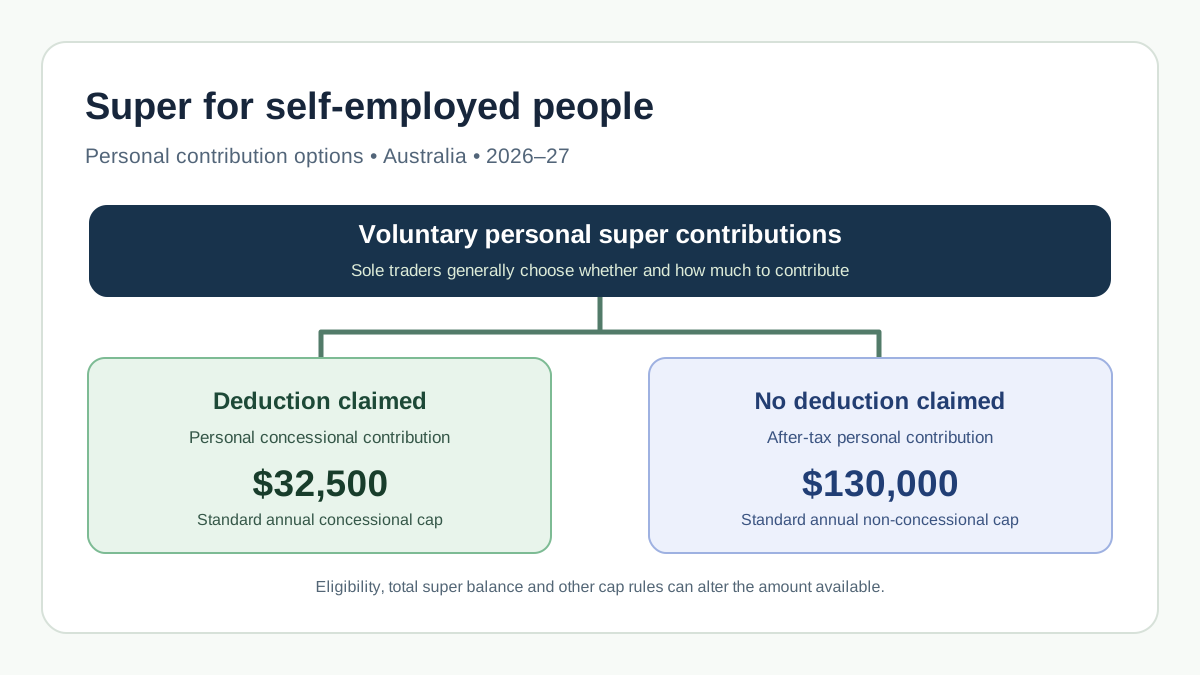
The contributions are typically paid from a personal or business bank account, but the account used to transfer money does not, by itself, establish tax deductibility.
How can self-employed people pay into a super fund?
A self-employed person can make regular or lump-sum personal payments to an existing eligible super fund or open an account with a fund accepting personal contributions.
- Check that the fund accepts personal contributions and confirm membership details.
- Obtain its BPAY, direct debit or bank-transfer instructions and payment reference number.
- Contribute amounts consistent with available cash flow and contribution caps.
- Check when the fund received each payment and retain the transaction record.
- For a tax deduction, lodge a valid notice of intent and obtain the fund’s acknowledgement before claiming it.
A contribution does not automatically become tax-deductible when transferred.
How much super should a sole trader set aside from irregular income?
There is no compulsory percentage of a sole trader’s own profit that must be contributed to super. The 12% SG rate can be used as an illustrative savings benchmark, not as a legal obligation or a personalised recommendation.
For example, annual business receipts of $90,000 excluding GST and operating costs of $30,000 leave an illustrative $60,000 profit before personal income tax. Saving 12% of that amount would equal $7,200 for the year, or $600 per month if spread evenly.
- Calculate available profit and cash rather than applying a rate to GST-inclusive sales.
- Reserve funds for income tax, GST, business costs and emergencies before locking money in super.
- Adjust voluntary payments to seasonal or uneven revenue.
The super Contributions Calculator Australia helps illustrate contribution amounts. The superannuation Calculator Australia provides a broader retirement-saving estimate. The example is a budgeting calculation, not tax advice.
What super contribution caps apply in 2026–27?
The standard 2026–27 concessional contributions cap is $32,500 and the standard non-concessional contributions cap is $130,000. Eligibility for higher contributions depends on personal circumstances and the applicable tax rules.
| Cap | 2026–27 general amount | Included amounts |
|---|---|---|
| Concessional | $32,500 | Employer SG, salary sacrifice and deductible personal contributions |
| Non-concessional | $130,000 | Personal contributions for which no deduction is claimed |
| Bring-forward non-concessional limit | Up to $390,000 when eligible | Depends on total super balance and the bring-forward rules |
| Carry-forward concessional cap | Eligible unused amounts from the previous five years | Generally requires total super balance below $500,000 at the prior 30 June |
These caps apply across a person’s funds, not separately to each account. The full non-concessional cap is not available to everyone: total super balance and other eligibility rules can reduce it to zero. Exceeding a cap can produce additional tax consequences. According to the Australian Taxation Office, Concessional contributions cap and Non-concessional contributions cap (2026–27), the standard caps are $32,500 and $130,000 respectively. For cap mechanics, see super contribution caps.
Can self-employed people claim a tax deduction for super?
YES, eligible self-employed individuals can claim an income tax deduction for qualifying personal super contributions. The super fund must first receive a valid notice of intent and provide written acknowledgement.
The deducted amount normally counts towards the concessional contributions cap and is generally taxed at 15% inside the super fund. Higher effective tax can arise under Division 293 for eligible high-income individuals. The effect on personal income tax depends on eligibility and taxable income. Source: ASIC Moneysmart, Tax and super (updated 30 July 2026).
How do you lodge a notice of intent?
Submit the ATO-approved Notice of intent to claim or vary a deduction for personal super contributions (NAT 71121), or the fund’s equivalent, to the super fund.
- Pay the contribution and confirm the fund received it.
- State the amount to be claimed as a deduction on the approved notice.
- Lodge the notice while it remains valid, particularly before an affected rollover, withdrawal or pension commencement.
- Obtain written acknowledgement and then claim the eligible amount in the tax return.
The ordinary deadline is the earlier of lodging the return for the contribution year or the end of the following financial year. Specific circumstances can invalidate a notice sooner. Source: ATO, Notice of intent to claim or vary a deduction.
When must the fund receive a contribution?
The fund must receive the personal contribution during the intended financial year for it to count in that year's contribution totals. Initiating a bank transfer on 30 June does not establish receipt by that date.
Check fund cut-off times, weekends and payment processing delays. Retain the receipt date shown in your fund account. The timing of a later deduction notice does not move the contribution into a different financial year.
Can you carry forward unused concessional caps?
YES, eligible individuals can use unused concessional cap amounts from the previous five financial years. Their total super balance must generally be below $500,000 at the previous 30 June.
The unused amounts expire after five years. Check available carry-forward amounts and total super balance in ATO online services before contributing above the standard annual cap. Source: ATO, Concessional contributions cap.
Can eligible self-employed people receive government co-contributions?
YES, some self-employed people qualify for a government co-contribution when they make eligible personal after-tax contributions. Income, age, tax return and other eligibility requirements apply.
The government co-contribution is not available for amounts claimed as a personal tax deduction. Verify the ATO’s thresholds for the relevant financial year rather than assuming eligibility from self-employment alone. Source: ATO, Super co-contribution.
How should a sole trader choose a super fund?
Compare fees, investment choices, long-term net returns and insurance arrangements, together with practical payment options. No single fund is the best choice for every self-employed person.
- Compare administration fees and investment costs relative to account balance.
- Examine long-term investment performance alongside risk and fees.
- Check death, total and permanent disability (TPD) and income protection insurance.
- Review existing insurance before consolidating super funds.
- Confirm that personal contributions and online reporting are supported.
According to ASIC Moneysmart, Choosing a super fund, fees, investment performance and insurance are key comparison criteria. Past investment returns do not guarantee future performance.
What happens to insurance after leaving employment?
Insurance through super can change when employment ends, contributions stop or a fund is closed. Cover depends on the policy and the fund’s inactivity, balance and premium rules.
Confirm existing death, TPD and income protection cover before transferring balances. Check any waiting periods, occupation definitions and exclusions before replacing an existing policy.
Does holding an ABN remove an employer’s SG obligations?
NO, an ABN does not remove a business’s SG obligations where a worker meets the statutory tests. A contract chiefly for an individual’s personal labour, rather than a specified result, can create SG liability despite invoices and contractor terminology.
Check who performs the work, what the contract pays for and the relevant legal tests. Source: ATO, Super for independent contractors.
How can you check self-employed super before tax time?
Reconcile fund receipts, contribution categories, cap space and deduction notices before lodging a tax return.
- Download contribution histories from every super fund for the financial year.
- Separate employer SG, deductible personal contributions and after-tax contributions.
- Compare the amounts against annual caps and eligible carry-forward balances.
- Retain notices of intent and fund acknowledgements supporting deductions.
- Confirm contribution receipt dates, fund transfers and insurance arrangements.
ATO online services can lag recent fund activity. Check recent receipts with the fund itself. To estimate future balances, use the super Projection Calculator Australia.
Do sole traders legally have to contribute 12% for themselves?
NO, a sole trader does not have to contribute 12% of their own trading income for themselves. The statutory SG rate applies to eligible employees and certain contractors; voluntary personal contributions are a separate choice.
Can a sole trader voluntarily contribute more than 12%?
YES, a sole trader can contribute more than 12% of business income voluntarily, subject to contribution caps, age-related eligibility and total super balance restrictions. The percentage is not itself an annual tax cap.
Are personal super contributions always tax-deductible?
NO, personal contributions are deductible only when the legal requirements are met, including a valid notice of intent acknowledged by the fund. Non-deducted after-tax contributions generally count towards the non-concessional cap.
Does having an ABN remove entitlement to super guarantee?
NO, ABN registration alone does not change SG eligibility. A freelancer who personally performs a contract predominantly for labour can qualify for employer SG. Check the contract’s labour, delegation and results requirements rather than the invoicing method.
Can a freelancer make one annual super contribution?
YES, an eligible freelancer can make a single personal contribution for the year if the fund accepts it and receives it before the applicable year-end deadline. Contribution caps and any deduction notice requirements still apply.
Can you claim a deduction before your fund acknowledges the notice?
NO, the fund must acknowledge a valid notice of intent before a personal super deduction is claimed. Keep the written acknowledgement as evidence for the tax return.
Written by
Superannuation Calculator Australia
Calculation guidance and general information; independent financial advice is not provided.