Super Calculator for Weekly or Fortnightly Pay
Calculate weekly or fortnightly employer super at 12% for 2026–27. See pay examples, qualifying earnings and Payday Super rules.
Superannuation Calculator Australia · · 8 min read
Calculate employer super from weekly or fortnightly pay using the 12% super guarantee (SG) rate for 2026–27. From 1 July 2026, employers calculate Payday Super on qualifying earnings each payday. The correct estimate depends on eligible pay, whether a salary package includes super and the applicable statutory earnings limit. Compare your estimate against both your payslip and your super fund records.
How does a weekly or fortnightly super calculator work?
A weekly or fortnightly super calculator estimates the employer's minimum SG contribution for one pay period. Multiply qualifying earnings by 12% for 2026–27, subject to eligibility and the maximum earnings base. This is an employer contribution to a super fund, not take-home pay or a retirement-balance projection.
Enter the actual pay frequency and eligible pre-tax earnings. If your contract quotes a total package including super, separate the super component before entering wages. Use the superannuation Calculator Australia for a general calculation. For employer SG, salary sacrifice and other contribution categories, compare amounts with the super Contributions Calculator Australia.
What pay amount should you enter?
Enter qualifying earnings before income tax, rather than the amount deposited into your bank account. Qualifying earnings include ordinary time earnings (OTE) and certain additional specified payments under the Payday Super rules from 1 July 2026. Total gross pay is not necessarily the qualifying-earnings base.
Review ordinary hours, shift loadings, relevant allowances, commissions and salary-sacrifice arrangements. Exclude payments that do not form part of qualifying earnings under ATO rules.
What SG rate applies in Australia?
The minimum SG rate for 2026–27 is 12%. For each eligible pay period, multiply the qualifying earnings amount by 0.12. According to the Australian Taxation Office (ATO), Super guarantee rates and thresholds (2026–27), the rate increased to 12% on 1 July 2025.
How do you calculate weekly super?
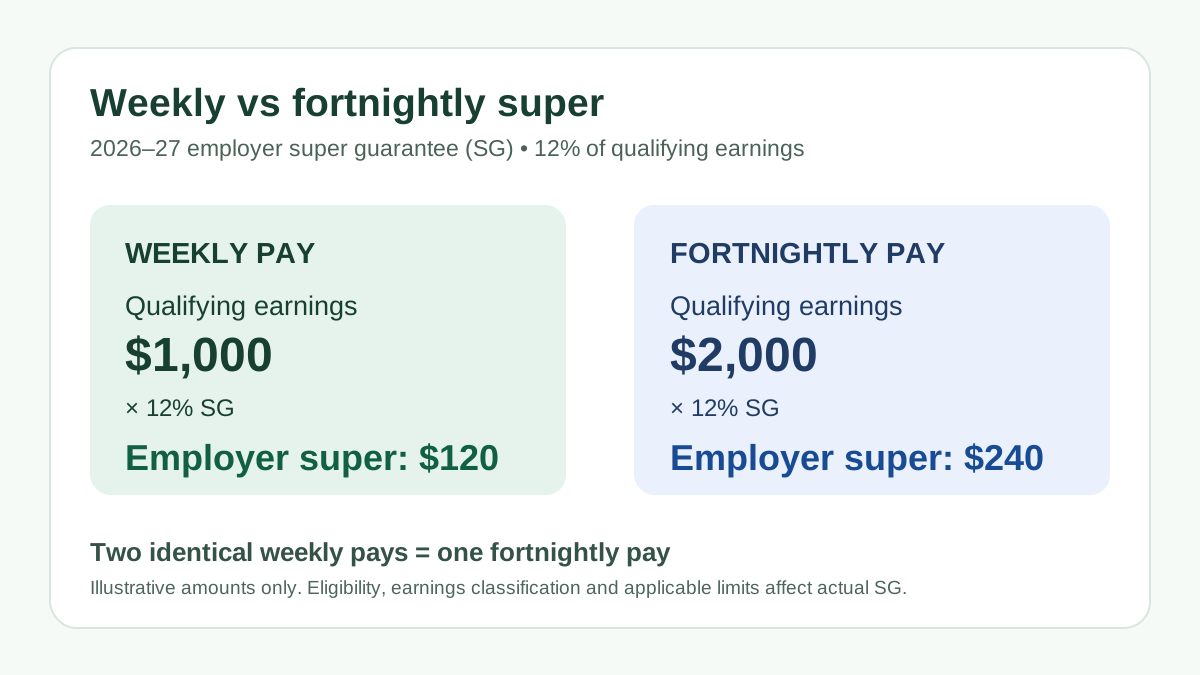
Multiply weekly qualifying earnings by 0.12. A worker with $1,000 in qualifying weekly earnings accrues $120 minimum SG for that payday, assuming the worker qualifies and no earnings limit changes the result.
Formula: weekly SG = weekly qualifying earnings × 12%.
| Pay frequency | Qualifying earnings | SG rate | Estimated employer SG |
|---|---|---|---|
| Weekly | $1,000 | 12% | $120 |
| Fortnightly | $2,000 | 12% | $240 |
| Weekly | $1,500 | 12% | $180 |
| Fortnightly | $3,000 | 12% | $360 |
How do you calculate fortnightly super?
Multiply fortnightly qualifying earnings by 0.12. A worker with $2,000 in eligible fortnightly earnings accrues $240 employer SG. Across 26 identical fortnights, that is $6,240 in estimated annual employer contributions.
Formula: fortnightly SG = fortnightly qualifying earnings × 12%. Use the actual qualifying pay for each fortnight if hours or commissions change.
How do weekly and fortnightly estimates compare?
Two weekly pay periods of $1,000 each produce the same $240 SG as one fortnightly pay period of $2,000 at 12%. Weekly and fortnightly frequency affect payroll timing, not the underlying SG percentage.
For evenly paid wages, annualisation commonly uses 52 weekly periods or 26 fortnightly periods. Payroll calendars and per-pay rounding sometimes produce differences in real financial-year totals.
How does salary packaging change the calculation?
A salary quoted plus super excludes SG from the wage figure. A package including super combines wages and the employer's SG contribution, so the two components must first be separated.
Under a simple 12% model, an inclusive $1,120 package comprises $1,000 of qualifying wages and $120 SG. If all wages are eligible and the entire package consists only of wages and SG, divide the inclusive package by 1.12 to estimate the wage component. A package containing bonuses or other benefits requires a component-by-component calculation.
What counts as ordinary time earnings?
Ordinary time earnings generally include wages for ordinary hours and eligible loadings, allowances or commissions. Under Payday Super, qualifying earnings are the operative SG calculation base from 1 July 2026. That category includes OTE and other specified payments.
Check the employment award, agreement and payment descriptions rather than assuming every item in gross wages is qualifying. For detailed classification, see does Overtime Count for Super?.
Is overtime included in weekly super?
NO, genuine, separately identifiable overtime outside ordinary hours is generally excluded from OTE. Classification depends on ordinary hours under the applicable award or agreement. Under the current qualifying-earnings rules, other prescribed payments also require assessment.
A payslip label alone does not establish the legal treatment. Compare the applicable employment instrument, roster and earnings calculation.
How do casual and variable hours affect super?
Use the actual qualifying earnings paid each week or fortnight. A casual worker with $750 in weekly qualifying earnings receives an estimated $90 SG; a later week with $1,250 produces $150 SG at 12%.
For an irregular fortnight, add the eligible earnings for that pay period before applying the rate. Do not use a fixed salary assumption for changing rosters.
Does the maximum contribution base affect high wages?
YES, a statutory maximum earnings base can limit the earnings on which an employer must pay minimum SG. The Payday Super rules from 1 July 2026 introduced an annual maximum earnings base, replacing the prior quarterly maximum contribution base system.
The annual limit applies to an employer's minimum SG liability for qualifying earnings above the prescribed maximum. High earners should check the ATO's current maximum earnings base before estimating their minimum SG. Awards and employment contracts can provide additional contributions above the statutory minimum.
When should employer super be paid?
Since 1 July 2026, employers calculate SG when paying wages, and contributions generally must reach the employee's super fund within seven business days after payday. Qualifying exceptions include certain first contributions for new employees.
Sending a payment instruction is not the same as fund receipt. For the detailed timing rules and the transition from quarterly payments, see how Super Is Paid in Australia. Source: ATO, Payment deadlines for Payday Super (2026); Fair Work Ombudsman, Payday Super: New rules starting 1 July 2026 (2026).
How can you check your payslip estimate against fund deposits?
Compare each payday's qualifying earnings and calculated SG with the corresponding contribution received by your fund. A payslip showing an amount does not establish that the fund has received it.
- Record the payday, qualifying earnings and expected SG.
- Check your fund's transaction history and receipt date.
- Ask payroll to explain differences in classification, rounding or payment allocation.
- If the amount remains missing beyond the applicable deadline, use the ATO's unpaid-super reporting process.
Keep the payslip, earnings breakdown and fund statement together. A fund's displayed allocation date can differ from the legally relevant receipt date.
Does super apply to casual employees?
YES, eligible casual employees receive employer SG even if shifts or hours vary. Workers aged 18 or older generally qualify; employees under 18 ordinarily need to work more than 30 hours in a week. Specific exceptions apply.
Is super calculated on take-home pay?
NO, employer SG uses qualifying earnings, not the after-tax bank deposit. PAYG income tax withholding does not set the SG calculation base.
Can a fortnightly employee receive a different SG amount from two weekly pays?
YES, differences arise when earnings components, adjustments, caps or rounding vary. Two weekly payments of $1,000 qualifying earnings each and one fortnightly payment of $2,000 both produce $240 SG before such differences.
Does a salary package always include super?
NO, employment contracts can quote salary excluding SG or a total package including it. Use the explicit remuneration wording before calculating the contribution.
Can SG change when ordinary hours vary?
YES, SG changes when qualifying earnings vary. At 12%, an additional $100 in qualifying earnings produces $12 additional SG, provided the statutory maximum earnings base has not been reached.
Is salary sacrifice additional to compulsory employer SG?
YES, salary-sacrifice contributions are additional to compulsory employer SG, and sacrificing salary does not reduce the employer's minimum SG obligation. Under Payday Super, relevant sacrificed amounts form part of qualifying earnings. For long-term estimates of how additional contributions affect retirement savings, use the super Projection Calculator Australia.
Sources and verification
- Australian Taxation Office, Super guarantee rates and thresholds (2026–27).
- Australian Taxation Office, Payday Super (2026).
- Australian Taxation Office, Payment deadlines for Payday Super (2026).
- Australian Taxation Office, What payments are qualifying earnings (updated September 2026).
- Fair Work Ombudsman, Payday Super: New rules starting 1 July 2026 (2026).
- Australian Taxation Office, Superannuation Guarantee Ruling SGR 2009/2 (29 July 2009).
Examples assume the 12% rate for 2026–27, qualifying employment and no applicable cap adjustment. High earners should check the ATO's applicable annual maximum earnings base and any higher contractual super entitlement.
Written by
Superannuation Calculator Australia
Calculation guidance and general information; independent financial advice is not provided.