Super Investment Options: Types, Risks and Choosing a Strategy
Compare growth, balanced and conservative super options, risk, fees and switching rules for Australian retirement savings.
Superannuation Calculator Australia · · 12 min read
Super investment options determine how an Australian super fund invests retirement savings across shares, property, bonds and cash. The asset mix affects volatility, fees and long-term growth potential. Compare what each option actually holds, not just its name, and match the exposure to withdrawal timing and tolerance for losses.
What are super investment options and how do they work?
Super investment options are the investment portfolios a super fund uses to hold and grow a member’s retirement savings. Each option has an asset mix, expected risk level, investment objective and fee structure. Investment gains and losses flow through to the account balance, usually through changes in unit prices.
A super fund typically invests contributions in Australian and international shares, property, infrastructure, fixed interest and cash. The chosen allocation determines exposure to market movements. According to ASIC MoneySmart, the fund manages the underlying assets and members generally select an option rather than individual securities.
What happens to your super investments if you make no investment choice?
If a member makes no investment selection, their contributions generally go into the fund’s MySuper default investment option. A MySuper strategy can be a diversified portfolio or a lifecycle approach that alters its mix with age.
The default is not automatically capital-protected. Review the product disclosure statement (PDS), its asset allocation and the risk level applied at the member’s current lifecycle stage.
Which main types of super investment options are available?
Super funds commonly offer diversified growth, balanced and conservative options, as well as cash, single-asset and specialist strategies. There is no industry-wide allocation attached to each name.
A single-asset option might track Australian shares, international shares, fixed interest or cash. Specialist options might apply ethical screens or geographic restrictions. The table below describes typical characteristics rather than universal rules.
| Option | Common emphasis | Main trade-off |
|---|---|---|
| Growth | Mostly growth assets | More market volatility |
| Balanced | Growth and defensive assets | Risk mix differs by fund |
| Conservative | Larger defensive allocation | Lower expected long-term growth |
| Cash | Cash and deposits | Inflation and reinvestment risk |
| Single asset | One sector or asset class | Concentration risk |
The classifications describe typical investment strategies. Actual asset allocations, minimum investment periods and risk bands depend on each fund’s current investment guide.
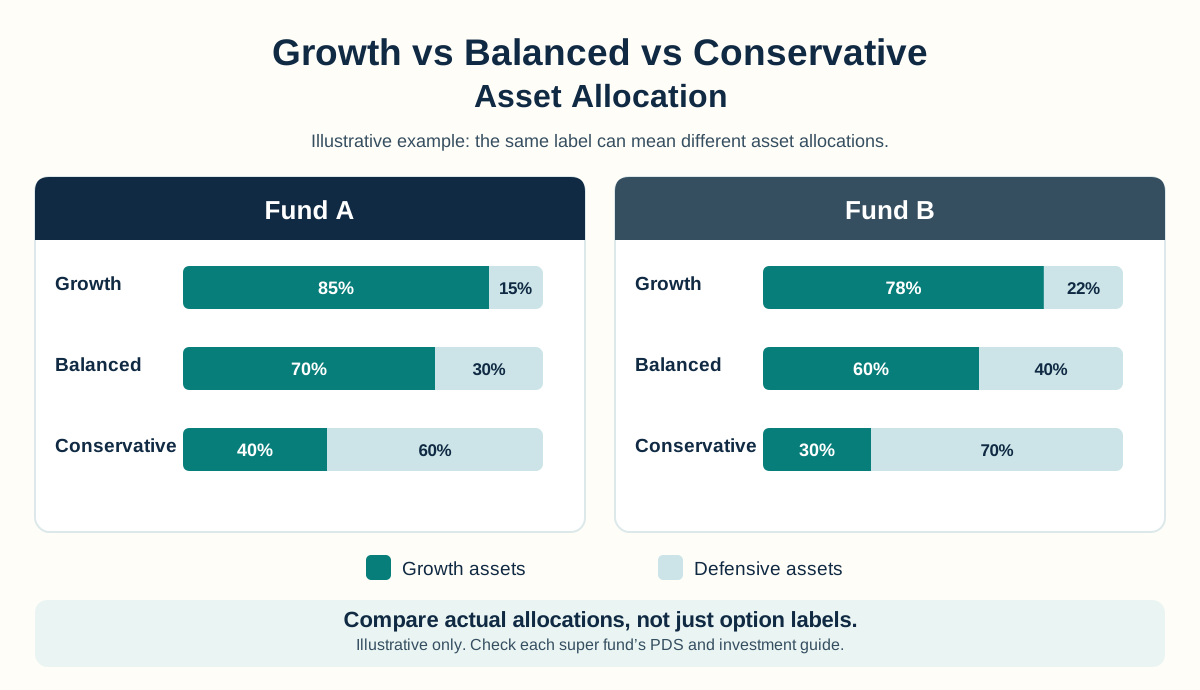
The asset allocation comparison below uses fictional Fund A and Fund B portfolios to show why matching investment option names do not guarantee matching risk exposure.
How does asset allocation change a super option’s risk?
Asset allocation determines how much of an option is exposed to growth assets such as shares and property versus defensive holdings such as cash and bonds. More equity exposure generally increases short-term fluctuations and the potential for higher long-term returns.
Compare the strategic allocation percentages, permitted ranges and treatment of property and infrastructure, not just the label. For example, compare two funds using the same six fields: growth-asset percentage, defensive-asset percentage, risk band, recommended timeframe, annual fees at your balance and reporting period. Two options called “balanced” can hold materially different shares of growth assets. Diversification reduces concentration risk but does not eliminate losses.
How do risk and return differ across super investment options?
Higher-growth options generally accept larger and more frequent short-term falls in pursuit of higher long-term returns. Conservative options seek greater short-term stability, usually at the cost of lower expected growth. Neither outcome is guaranteed.
Risk includes volatility, the chance of negative returns, liquidity limitations and inflation reducing purchasing power. A conservative option can still lose purchasing power if its return after fees and tax stays below inflation. Bonds can also fall in market value when interest rates rise. A portfolio suitable for one retirement horizon can be unsuitable for another. Check the investment objective and recommended minimum investment timeframe in the fund guide.
Why can unlisted super assets make risk harder to compare?
Unlisted infrastructure, direct property and private-company investments are valued periodically rather than continuously on public exchanges. Their recorded prices can therefore adjust later than traded share prices.
Delayed or appraisal-based valuations can reduce the appearance of short-term volatility without removing underlying economic risk. Liquidity can also be lower because selling an airport stake or office building takes longer than selling a listed security. Examine valuation and liquidity disclosures alongside reported returns.
How should time until retirement affect super investment risk?
Time until retirement affects how long a member has to recover from a market decline and when savings are expected to support withdrawals. Longer horizons often accommodate more short-term volatility; shorter horizons make drawdown risk more immediate.
The decision also depends on savings adequacy, other assets, pension access, spending plans and tolerance for a falling balance. Reaching retirement does not mean every dollar is withdrawn immediately; some retirement savings remain invested for decades.
Why do market falls near retirement have a different impact?
A market fall close to retirement can cause greater damage when withdrawals continue while investment values are depressed. Selling units to fund spending leaves fewer units participating in a later recovery.
Illustration: a $200,000 account falling 20% reaches $160,000. With an immediate $10,000 withdrawal the balance falls to $150,000 before any recovery. This is sequence-of-returns risk; the figures are hypothetical and exclude fees, tax and further contributions.
What happens to a super balance after a market fall under different options?
A fund balance falls according to the losses of its actual holdings, not merely the option’s name. A portfolio invested largely in shares can decline more sharply than a cash-heavy portfolio during a share-market sell-off, although asset returns do not move uniformly.
Illustration: an initial $100,000 balance after a hypothetical 20% decline becomes $80,000. A subsequent 25% gain returns $80,000 to $100,000; a 20% gain only reaches $96,000. Switching after the decline changes exposure at the current price and participation in any rebound. This is not a market forecast.
How do investment fees change long-term super outcomes?
Administration and investment fees reduce the amount of a super balance retained and compounded over time. Compare the total ongoing costs of comparable options, not the investment fee alone.
For a simplified illustration, calculate $100,000 × (1 + assumed annual return after fees)^20. At a constant 6% annual return before fees for 20 years, the result is approximately $320,714 when no fees are deducted. With a simplified 0.5 percentage-point annual fee drag and a resulting 5.5% net return, the result is approximately $291,776. With a 1 percentage-point fee drag and a resulting 5% net return, it is approximately $265,330.
These scenarios are not projections of actual fund performance. They use annual compounding and a constant return, with no contributions, insurance premiums, investment earnings tax or transaction charges. The percentage-point fee drag is simplified: actual fees can include fixed charges and costs already reflected in reported net investment returns. Do not deduct an investment fee twice. Model different assumed outcomes with the Super Projection Calculator Australia.
Are indexed super investment options different from actively managed options?
YES, indexed options typically aim to follow a specified market index while active managers choose holdings in pursuit of a different or higher return. Passive strategies often have lower management costs, but both are exposed to market losses.
Compare the tracked index, currency exposure, investment mix, total estimated fees and benchmark methodology. An indexed equities option is not inherently less volatile than a diversified actively managed option.
How should you compare super investment option performance?
Compare investment options across equivalent periods, risk levels and asset allocations, using returns reported on a consistent fee and tax basis. A single strong year does not establish sustained performance.
Review five- and ten-year annualised returns where available, compare against the stated objective and appropriate benchmark, then inspect fees and risk. Record whether each figure is after investment fees and investment earnings tax and whether administration fees are excluded. Compare the same end date to avoid mistaking different market periods for manager skill. The ATO YourSuper comparison tool focuses on MySuper products; it does not cover every selectable option. APRA’s annual performance test is a regulatory benchmark assessment, not a prediction of future gains. For the effect of fees on projections, see super investment returns.
What does a super option’s risk label actually measure?
An investment option’s Standard Risk Measure generally indicates the estimated frequency of negative annual returns over a 20-year period. It does not tell members the size of a possible loss or all forms of risk.
The Standard Risk Measure uses seven bands based on the expected number of negative annual returns over 20 years. It was developed through industry guidance from the Association of Superannuation Funds of Australia and the Financial Services Council. Two strategies in the same category can still experience different worst-year falls and liquidity pressures. Check the fund’s published definition and assumptions.
How can you change your super investment option?
Members can usually change their investment option through their super fund’s online portal, app or member service team. A switch changes the assets to which the account is exposed, rather than transferring the account to another fund.
- Check the fund’s current investment guide and selected option.
- Review target asset allocation, risk, fees and recommended holding period.
- Choose the proportion for the new option and confirm whether existing holdings and future contributions are included.
- Submit the request and retain the confirmation.
- Check the executed unit prices, processing date and final allocation.
Fund cut-off times, trading delays, buy-sell spreads and limits differ. If you are reviewing how much enters super before changing your investment strategy, use the Super Contributions Calculator Australia to estimate contributions separately from investment returns.
Can you invest existing super and future contributions differently?
YES, many funds allow a different allocation for the existing balance and future contributions. The account’s current investments and incoming money are separate instructions when the fund provides that feature.
Confirm both settings after an investment switch. An instruction for future contributions alone does not necessarily move existing holdings. Fund systems and processing arrangements vary.
What should you check before selecting or switching a super option?
Check risk capacity, investment horizon, asset allocation, fees, performance measurement and the exact switching mechanics before choosing a super investment option. The lowest-risk or best-performing label alone is insufficient.
Use this comparison sequence: identify when funds will be needed; match allocation and likely drawdown to that horizon; compare comparable net results and costs; read the PDS and investment guide; check transaction or buy-sell spreads; confirm how an instruction affects existing savings versus future contributions. For a broader fund-level comparison, see how to choose a super fund. Review insurance separately if changing funds rather than merely switching options. The Superannuation Calculator Australia can help assess how a change in return assumptions affects a retirement savings projection.
Is a MySuper default option always low risk?
NO, a MySuper default option is not necessarily low risk. It is a regulated default product intended to be simple and suitable for a broad membership, but its asset mix can still have substantial growth-asset exposure.
Some MySuper products use lifecycle strategies, with the growth and defensive mix changing as a member ages. Read the actual lifecycle stage and underlying portfolio rather than assuming “default” means cash or capital protection.
Can a growth super investment option lose money?
YES, a growth super option can lose money, sometimes substantially, when the market value of its underlying holdings falls. Higher long-term return objectives do not eliminate negative years.
Check the option’s reported history, strategic equity exposure, expected risk band and recommended time horizon. Past returns are not a guarantee, and a negative year does not by itself prove a strategy has failed.
Is a balanced option identical across different super funds?
NO, the term “balanced” does not impose a single asset allocation across Australian super funds. Different portfolios can hold different proportions of shares, private assets, fixed interest and cash.
Compare actual growth and defensive percentages and risk measures in each fund’s disclosure. One balanced option can be materially more aggressive than another despite sharing the same name.
Can you change investment options without switching super funds?
YES, most accumulation super funds permit members to switch investment choices while keeping the same super fund and member account.
A change within a fund is distinct from moving the balance to another provider. Confirm any restrictions, processing timetable, fees and treatment of pending contributions with the trustee. Changing super funds is a different process.
Does a lower investment fee guarantee better super returns?
NO, a lower investment fee does not guarantee better returns. Net performance also depends on asset allocation, investment outcomes, administration charges and other costs.
Compare equivalent risk strategies on the same basis. Fee savings are certain only to the extent the quoted charges apply; differences in future investment returns are uncertain. See how to compare super fund fees.
Sources and verification (October 2026)
- ASIC MoneySmart, Super investment options (guidance checked October 2026).
- ASIC MoneySmart, Choosing a super fund (guidance checked October 2026).
- ASIC MoneySmart, Superannuation (guidance checked October 2026).
- Australian Taxation Office, YourSuper comparison tool (published 18 September 2024; guidance checked October 2026).
- Australian Prudential Regulation Authority, MySuper Statistics Selected Feature (risk-reporting definition; publication date not confirmed).
- Australian Prudential Regulation Authority, Annual superannuation performance test (2026 results; document date not confirmed).
- Association of Superannuation Funds of Australia and Financial Services Council, Standard Risk Measure Guidance Paper (publication date not independently confirmed).
This article provides general information, not personal financial advice. Check the current PDS and investment guide for the particular fund and option. Worked examples use hypothetical assumptions.
Written by
Superannuation Calculator Australia
Calculation guidance and general information; independent financial advice is not provided.