Insurance Through Superannuation: Cover, Costs and Claims
Understand insurance through super in Australia: cover types, eligibility, premiums, cancellation rules and claims.
Superannuation Calculator Australia · · 14 min read
Insurance through superannuation is life, total and permanent disability (TPD) or income protection cover arranged through your super fund. Premiums are usually deducted from your super account, so insurance can protect your household but reduce retirement savings. Cover depends on eligibility, the fund's policy and the insurer's terms. Compare insurance types, default cover rules, ongoing costs, cancellation risks and claims requirements before keeping, changing or cancelling a policy.
What Is Insurance Through Superannuation?
Insurance through super is personal risk insurance arranged by a super fund trustee for eligible members. The fund's insurer provides cover according to the applicable policy. The insurance benefit is distinct from your accumulated super investment balance. Most non-self-managed funds offer death cover and TPD insurance; some offer income protection. The insurer assesses claims against the policy wording while the trustee administers insured benefits and any release under super law.
Premiums are deducted from the member account, generally without a separate household bill. Check the certificate of cover and product disclosure statement (PDS) for the actual insured amount and policy conditions.
What Types of Insurance Can You Get Through Super?
Three common types are available through super funds. The insured event, payout and policy conditions differ.
Compare each insurance type by the event covered and the way benefits are paid. On smaller screens, scroll horizontally to view all columns.
| Cover type | When it applies | Typical benefit |
|---|---|---|
| Death cover | Death or a qualifying terminal illness | A lump sum or benefit through the fund |
| TPD cover | Permanent disability meeting the policy definition | Usually a lump sum |
| Income protection | Temporary inability to work from sickness or injury | Periodic payments during the benefit period |
Income protection policies specify a waiting period before payments start and a maximum benefit period, sometimes two years, five years or to a stated age. Trauma or critical illness cover generally cannot be held inside super. Confirm limits and exclusions in the relevant PDS.
Who Is Eligible for Default Insurance Through Super?
Default insurance generally cannot start automatically for a new member who is under 25 or whose super balance is below $6,000. Members who meet these thresholds still need to satisfy their fund's insurance eligibility rules; cover is not guaranteed.
Exceptions include members who opt in to cover and eligible members in dangerous occupations where the fund has an applicable exemption. Default cover does not mean every illness or occupation is insured. An eligible account can have no insurance if the fund does not provide that particular benefit. Check the fund's policy commencement date, employment classification and opt-in form before relying on cover.
How Are Insurance Premiums Paid Through Super?
Super funds deduct insurance premiums from the member's account, commonly each month. The premium reduces the amount invested for retirement. For general background on super accounts and retirement savings, see Superannuation Calculator Australia. Its amount depends on the insured sum, age, occupation category, smoking status, underwriting and the insurer's rate schedule.
Some policies use age-based stepped pricing, meaning premiums rise as members become older. Insurance is a separate deduction from investment and administration fees. A fund statement should show the dollar premium, cover amount and payment period, while its PDS explains how prices and benefits change.
How Do Insurance Premiums Affect Retirement Savings?
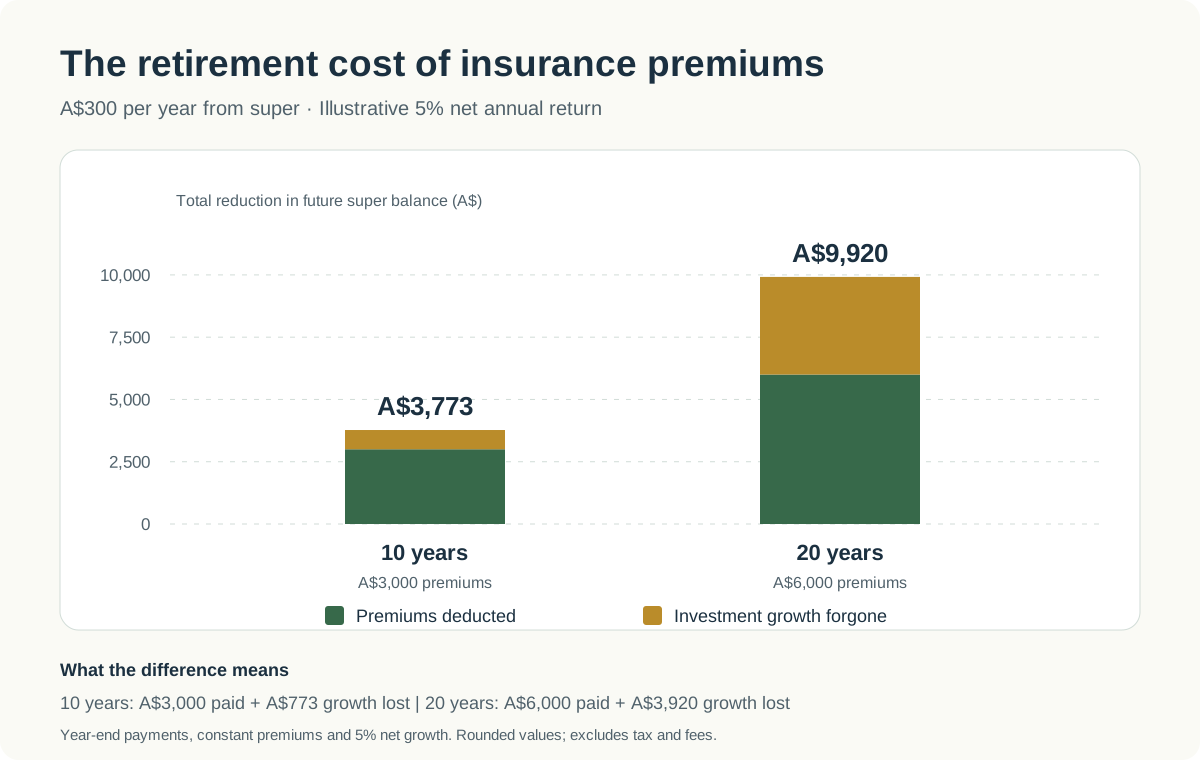
The premium erosion chart separates direct premium deductions from forgone investment growth. The figures are also provided in the comparison table below.
Premiums reduce retirement savings twice: first through the deduction and then through foregone investment returns. This example assumes a $300 premium paid at each year-end, 5% annual net investment growth, no changes to contributions or premiums and no tax modelling.
Illustration: $300 deducted at each year-end with 5% annual net growth. Figures are rounded, not forecasts.
| Period | Premiums paid | Hypothetical balance reduction |
|---|---|---|
| 10 years | $3,000 | $3,773 |
| 20 years | $6,000 | $9,920 |
The future-value formula assumes a constant premium paid at each year-end: annual premium × (((1 + net return)^years − 1) ÷ net return). Figures are rounded to the nearest dollar. At a 0% return the balance reduction equals total premiums. Returns fluctuate, real premiums can change and the value of insurance protection is not represented in this comparison. The Super Projection Calculator Australia can help explore retirement balances using different assumptions. For contribution inputs, use the Super Contributions Calculator Australia.
How Does Insurance Inside Super Compare With Outside Cover?
Neither location is universally cheaper or more suitable. Insurance inside super typically preserves immediate cash flow because premiums come from the account, but the deductions reduce retirement savings. Retail cover is generally paid from personal funds and can provide different definitions, options and underwriting.
Compare equivalent insurance terms rather than premium prices alone. On smaller screens, scroll to view the full comparison.
| Attribute | Inside super | Outside super |
|---|---|---|
| Premium source | Super account | Personal cash flow |
| Default acceptance | Often available subject to eligibility and exclusions | Usually individually underwritten |
| Customisation | Limited by fund policy | Depends on retail product |
| Portability | Review when changing funds | Usually independent of a super account |
| Claim and payment | Fund trustee and insurer involved | Usually direct insurer claim |
Compare equivalent benefit amounts and definitions rather than headline premiums alone.
How Does Tax Treatment Differ Inside and Outside Super?
Tax treatment depends on the policy structure and payment type. Premiums deducted from super are not generally a personal income-tax deduction for the member. Super funds can have their own tax treatment for eligible insurance costs, while income protection premiums paid personally may be deductible subject to Australian Taxation Office (ATO) conditions.
Life and TPD cover outside super generally do not attract a personal deduction. Claim payments and super withdrawals have separate tax rules, so do not assume a tax deduction or tax-free payout from the purchase location alone. Seek qualified advice for a particular payout.
When Does Insurance Through Super Stop?
Under the inactivity rules, insurance through super generally stops when an account has received no contributions or rollovers for 16 consecutive months, unless the member has elected to keep cover or an exception applies. The fund must contact affected members before cancellation under the inactivity arrangements.
Cover may also end under policy age limits, cancellation requests, exhausted balances or other fund conditions. According to Moneysmart, TPD cover usually ends around 65 and death cover around 70, although policies differ. Check the fund's notice and current insurance status, especially after unpaid leave, changing jobs or consolidating accounts.
How Can You Check Insurance Through Your Super Fund?
Check insurance in your fund's online account, annual statement and current PDS. Confirm the exact insured benefit and its conditions, not merely that a premium was deducted.
- Sign in to the fund portal and open the insurance or member benefits section.
- Record each cover type, sum insured, effective date and premium.
- Read the insurer's PDS for exclusions, claims definitions, waiting periods and expiry.
- Confirm occupation classification, beneficiaries and any cancellation notices.
- If details conflict, ask the fund for a written certificate of cover.
Repeat for each super account. A myGov or ATO super account listing is useful for identifying funds but is not a substitute for a policy certificate. For account discovery, see how to check your super balance.
How Can You Change or Cancel Super Insurance?
You can request changes or cancellation through your fund, subject to its policy. Reducing or cancelling cover generally decreases future premiums but removes or limits financial protection. Increasing cover typically requires application questions, underwriting or medical evidence and can produce exclusions or premium loadings.
Before cancelling, compare household protection needs and establish whether replacement cover has been formally accepted. Retain written confirmation of the change and its effective date.
What Should You Check Before Changing Super Funds?
Check replacement insurance before transferring or closing an insured super account. A transfer can cancel the previous fund's insurance even if the new fund has not yet accepted replacement cover. Cover does not ordinarily transfer automatically with the balance.
First obtain the existing policy's insured sum, exclusions and cessation conditions. Then verify the new fund's application outcome, acceptance date, new premium and any waiting period. Allow for an overlap where suitable rather than creating a gap between cessation and commencement. A member with past health problems or a specialised occupation can find replacement cover difficult or materially different. Keep both certificates until the transition is complete. Review the guide to changing super funds before transferring.
Can Multiple Super Accounts Charge Duplicate Premiums?
YES, you can pay premiums on multiple super accounts when each account has active insurance. Duplicate deductions consume funds that would otherwise remain invested. However, multiple policies do not guarantee that every benefit can be claimed in full: offset clauses, benefit definitions and other-policy disclosure rules differ.
List each account, death and TPD sum insured, income protection benefit and premium. Review these before consolidating super, because closing an account can also close its insurance.
What Cover Exclusions Can Affect a Claim?
Insurer definitions and exclusions determine whether a claim qualifies. TPD may be assessed against an any occupation, own occupation or activities-of-daily-living definition, depending on the contract.
Income protection includes a waiting period, benefit period, disability test and sometimes offsets for other payments. Policies may limit pre-existing conditions, risky activities or certain occupations. A default offer without an initial medical questionnaire is not proof that every condition is covered. Read the PDS version applying when cover commenced and any subsequent policy change notices.
How Do You Make an Insurance Claim Through Super?
Contact your super fund to start an insurance claim. The fund and insurer identify the benefit, evidence requirements and relevant claim forms.
- Obtain policy details and a claim pack from the fund.
- Provide identity documents and relevant medical, employment or death records.
- Return forms and respond to insurer requests for additional evidence.
- Request the decision and reasons in writing, including information about review.
- For a dispute, use the fund's internal dispute resolution first and then consider the Australian Financial Complaints Authority (AFCA) if eligible.
An insurer's assessment and trustee decisions can be separate steps. Ask the fund how any approved benefit will be paid or released.
Does an Approved TPD Claim Allow Immediate Withdrawal?
NO, insurer approval of a TPD claim does not automatically mean the insured amount is immediately withdrawable from super. The benefit is generally paid into the fund and release requires the trustee to assess a relevant condition of release, commonly permanent incapacity.
The insurance definition and super law release condition are not identical. The tax treatment of any withdrawal depends on age, tax components and the payment circumstances. Ask for the trustee's release decision and an estimated net payment before planning to spend the benefit.
Who Receives a Death Insurance Benefit Through Super?
A death insurance benefit held in super generally becomes part of the member's super death benefit, administered by the trustee. Eligible recipients and binding nominations are governed by super law and fund rules. The trustee may pay eligible dependants directly or pay the deceased member's legal personal representative for estate distribution.
A person qualifying as a recipient under super law is not automatically a tax dependant under tax law. A financially independent adult child can receive a benefit yet have taxable components treated differently from a tax dependant. Check the nomination, benefit components and recipient status. See superannuation beneficiaries for nomination rules.
How Much Insurance Do You Need Through Super?
The appropriate insured amount is the gap between financial obligations and resources available after death or disability. For death cover, add outstanding debts, funeral costs and the present value of dependants' living expenses, then subtract available super, savings and other assets.
Consider a separate TPD amount for treatment, rehabilitation, debt and lost earning capacity. Income protection requires assessment of monthly living costs, employment leave, the waiting period and benefit duration. The Moneysmart life insurance calculator can help with a needs-based estimate, but does not calculate all other cover types.
Could Your Occupation Rating Increase Premiums?
YES, an incorrect or higher-risk occupation rating can make premiums more expensive. Funds and insurers use occupational classifications that can affect pricing and eligibility.
Compare the occupation on your certificate with your actual duties, especially after moving from manual work to office work. Ask the fund whether reclassification needs employer evidence and whether it changes benefits or exclusions. Obtain written confirmation rather than assuming lower-risk work automatically updates cover.
What Should You Verify in the PDS Before Replacing Cover?
Verify the old and proposed policies using their PDS and written certificates before replacing cover. Check insured sum, premium, expiry age, exclusion wording, occupation class, TPD definition, income protection waiting and benefit periods, claim offsets and linked-cover reductions.
Record the new insurer's acceptance date and the existing insurer's cancellation date. A comparison without these dates misses the risk of being uninsured during a transfer. Keep copies of both disclosure documents and fund confirmation messages.
Is Life Insurance Through Super Automatic?
YES, eligible members often receive automatic default death and TPD insurance in super. Standard automatic commencement generally depends on being at least 25 and having $6,000 in the account, subject to relevant exceptions and the fund's policy. The presence and size of income protection cover varies by fund. Confirm that cover actually commenced before relying on it.
Can Insurance Through Super Be Cancelled for Inactivity?
YES, insurance generally must be cancelled when a super account has been inactive for 16 consecutive months, unless an applicable election or exception preserves it. Check whether contributions or rollovers have been received. Your fund should notify you before cancellation. Verify your account's contribution history and respond to notices promptly if you want the cover to continue.
Does Insurance Automatically Transfer When You Change Funds?
NO, insurance does not ordinarily transfer automatically when you move money to a new super fund. Cover under the old fund is tied to its policy, while the receiving fund has its own eligibility and insurance arrangements. Confirm replacement acceptance and effective dates before requesting closure.
Can You Hold TPD Cover Without Life Cover in Super?
YES, some fund policies allow TPD cover separately, while others package TPD with death cover. The available combinations depend on the insurer and fund. Confirm whether a TPD payout reduces linked life cover and whether removing one benefit affects another.
Can You Get Trauma Cover Through Super?
NO, standard trauma or critical illness cover generally cannot be held within super under the ordinary conditions for super-owned policies. Retail trauma cover outside super is a separate option. Confirm what the policy actually insures rather than assuming serious illness always qualifies as TPD.
Can You Keep Existing Cover When Your Balance Falls Below $6,000?
YES, existing cover usually continues if your super balance later falls below $6,000, according to ASIC's Moneysmart guidance. The $6,000 threshold primarily affects automatic commencement for new low-balance members. Cover can still end under separate fund balance rules, unpaid premiums or the 16-month inactivity provisions.
Is Default Insurance in Super Always Cheaper?
NO, default insurance through super is not always cheaper than comparable retail cover. Bulk pricing can lower premiums, but age, occupation, exclusions, insured amount and benefit definitions determine value. Compare equivalent policy terms, likely future premiums and the retirement-balance cost rather than the first quoted payment.
Sources and verification (October 2026)
- ASIC Moneysmart, Insurance through super, 17 September 2026.
- ASIC Moneysmart, Life insurance cover (accessed October 2026).
- ASIC Moneysmart, Total and permanent disability (TPD) insurance, accessed October 2026.
- ASIC Moneysmart, Making a life insurance claim (accessed October 2026).
- ASIC Moneysmart, When you can access your super early, accessed October 2026.
- ASIC Moneysmart, Life insurance calculator (accessed October 2026).
- Australian Taxation Office, Income protection insurance (accessed October 2026).
- Australian Taxation Office, Taxation Ruling TR 2012/6 (2012).
Insurance benefits, premium rates and policy definitions differ between funds. This article provides general information and is not personal insurance, tax or financial advice.
Written by
Superannuation Calculator Australia
Calculation guidance and general information; independent financial advice is not provided.