Changing Super Funds: Balance Transfers, Insurance and Fees
Learn what happens to your super balance, insurance, fees and employer contributions when switching super funds in Australia.
Superannuation Calculator Australia · · 12 min read
When you change super funds, your existing balance does not move automatically: you must request a rollover if you want it transferred. Future employer contributions also require separate fund-choice instructions. Your investment option, ongoing fees and insurance arrangements can change. Before moving money, compare the benefits and costs, verify cover and check both the rollover and subsequent employer payments.
What happens to your super balance when you switch funds?
Your existing super balance moves to the receiving fund when you request a rollover. The transferred amount reflects the value of the old account at the relevant valuation and transaction dates, after applicable costs. Super funds cannot charge exit fees, but investment transaction costs and outstanding insurance premiums can affect account values. Market movements mean the amount received can differ from the balance displayed when you first request the transfer.
A rollover is not a cash withdrawal into your bank account. The receiving super fund records the transferred benefit in your new account, subject to its chosen investment option. Use the Super Projection Calculator Australia to compare the long-term effect of different fee and return assumptions. Before submitting a request, save your old balance, account number and latest statement to help reconcile the transfer.
Illustrative example: If an account shows $48,000 when a rollover is requested, a later transfer receipt of $47,840 does not by itself prove $160 in transfer fees. Check valuation timing, market movements, insurance premiums and transaction costs before drawing conclusions.
What happens to your insurance when you change super funds?
Insurance attached to your old account can end when you roll out the full balance and the account closes. Cover in the new fund is separate and is subject to that fund’s eligibility rules, exclusions, premiums and commencement date.
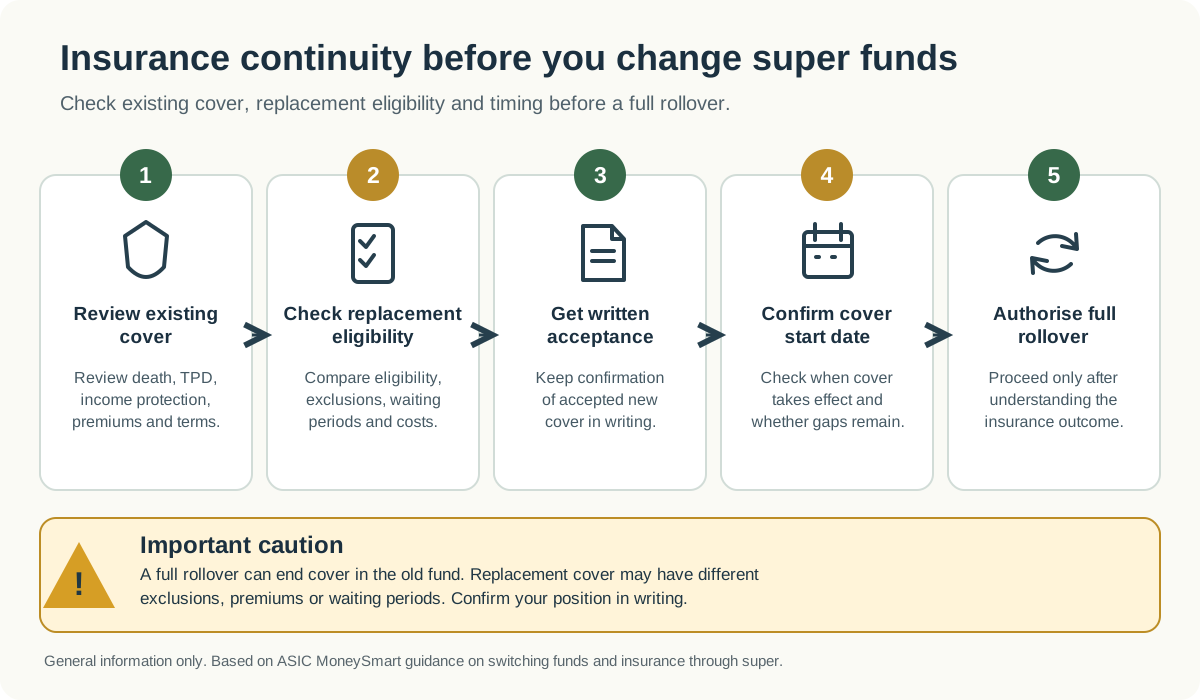
Compare death cover, total and permanent disability (TPD) cover and income protection. Check any beneficiary nominations separately: a nomination held by your previous trustee does not automatically become a valid nomination with the new trustee. Check insured amounts, occupation classifications, waiting periods and any pre-existing condition restrictions. Ask both funds for written confirmation of the dates of cancellation and new cover commencement. Do not assume the new policy matches the old one.
According to ASIC MoneySmart's guidance on insurance through super, older members and people with pre-existing medical conditions can find replacement cover difficult to obtain. Investigate any transfer-of-cover option before instructing the old fund to close.
How do you change super funds in Australia?
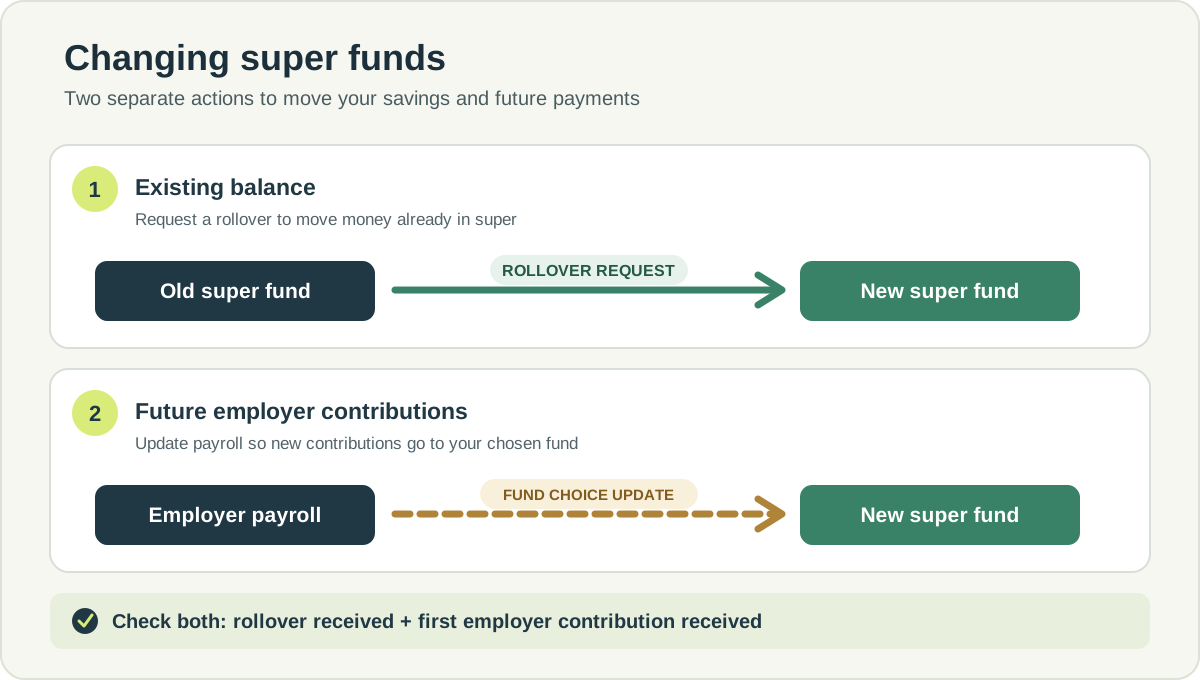
Changing super funds involves choosing a suitable account, arranging any rollover of existing money and separately directing future employer contributions. Opening a new account alone does not automatically move the old balance or update payroll.
- Compare the new fund’s investment options, long-term performance, total fees, insurance and member services with your current arrangements.
- Confirm any defined benefit, employer-linked or insurance conditions that could be lost.
- Open the receiving account and check the fund name, Australian business number (ABN), unique superannuation identifier (USI) and member number.
- Request a rollover through the receiving fund or ATO online services via myGov, selecting the correct account and amount.
- Give your employer the new fund details through an accepted choice-of-fund process.
- Check the receiving account and a later payslip or contribution statement to confirm both movements.
Keep a record of the rollover request and read the receiving fund’s product disclosure statement (PDS). If you have a salary sacrifice arrangement, tell payroll about your new fund and confirm where additional contributions are sent. Moving super from a defined benefit account or a fund with special entitlements requires particular care. If you made personal contributions and intend to claim a tax deduction, lodge a valid notice of intent and obtain acknowledgement from the old fund before a full rollover. According to the Australian Taxation Office, Personal super contributions (accessed October 2026), a notice lodged after the entire interest has been rolled out is not valid. For a detailed rollover process, see how to consolidate super.
Do you need to tell your employer when you change super funds?
YES, if you want future employer contributions paid into the new fund. A rollover of existing savings does not automatically change your employer’s payroll instructions.
The ATO standard choice form or an employer-approved digital choice process records the receiving fund details. According to the Australian Taxation Office, Superannuation standard choice form (4 July 2023), you can request a new fund choice at any time, but your employer is required to accept only one choice in a 12-month period. The employer has two months to action a valid choice. Confirm which fund receives contributions during the transition and verify the first payment to the new account.
How long does a super fund rollover take?
Rollover timing depends on the fund, validation checks and whether the transfer follows the standard electronic process. The displayed balance can also change between the request date and transfer date.
Ask the transferring fund for its current processing timeframe and request reference. Confirm identity and account details promptly if further information is required. Ask whether pending investments, identity checks or account restrictions are delaying the transfer. Escalate an overdue transfer with the fund and retain all correspondence.
Do you pay tax when you transfer super funds?
NO, a standard rollover between complying Australian super funds generally does not trigger personal withdrawal tax merely because the balance changes funds. The tax-free and taxable components are ordinarily carried into the receiving fund.
Exceptions require individual assessment, including certain untaxed elements and transfers involving overseas funds or special schemes. A rollover is not the same transaction as cashing out super. Confirm treatment with the ATO or a licensed tax professional when your account has unusual tax components. For separate tax scenarios, see superannuation tax in Australia.
What fees or costs change after switching super funds?
Your new fund applies its own administration fees, investment fees, transaction costs and any insurance premiums. Australian super funds cannot charge exit fees, but transaction costs such as buy/sell spreads can still affect the amount transferred. The old fund's fee structure no longer applies after its account is closed, but charges up to the closure date can affect the final balance.
Compare costs for the same account balance and comparable investment options, not just headline percentages. The following example shows the annual impact of fixed and percentage administration charges only. It excludes investment costs, transaction costs and insurance premiums.
The following estimates use illustrative fee structures, not actual super fund prices. On smaller screens, scroll the table horizontally to compare both funds.
| Balance | Fund A: $90 + 0.20% | Fund B: $170 + 0.10% |
|---|---|---|
| $10,000 | $110 | $180 |
| $40,000 | $170 | $210 |
| $80,000 | $250 | $250 |
| $150,000 | $390 | $320 |
Illustrative administration fees only; these are not real fund quotes. At $80,000 both examples cost $250 annually. See how to compare super fund fees for a full-cost approach.
What happens to investments and returns while your super is transferred?
Your old fund normally redeems the investments supporting the transferred balance, and the receiving fund invests the proceeds under its selected option. The timing can create a short period outside market investments.
If markets rise during that period, the transferred money can miss gains; if markets fall, it can avoid some losses. Neither outcome is predictable. Compare like-for-like risk profiles before assigning the new investment choice, and check the receiving fund’s transaction pricing and investment commencement rules.
Is changing funds the same as consolidating super accounts?
NO, changing the fund that receives future contributions and consolidating existing accounts are related but different actions. Changing your nominated fund affects new employer payments; consolidation transfers balances from two or more super accounts into a chosen account.
You can switch your contributions without rolling over every old balance. Conversely, you can consolidate existing balances while leaving payroll unchanged. Because unused accounts can continue to attract fees or insurance premiums, check both the balance transfer and employer instructions.
How do you compare super funds before switching?
Compare investment options, long-term returns after fees, total costs, insurance and member services using the same assumptions. ASIC MoneySmart identifies these five areas as key selection criteria, and the ATO YourSuper comparison tool offers comparable MySuper product information.
Use the same comparison criteria for each shortlisted fund. On smaller screens, scroll horizontally to view the complete table.
| Comparison | Verify |
|---|---|
| Investments | Comparable asset allocation and level of risk |
| Performance | Consistent reporting dates and returns after applicable fees and tax |
| Annual costs | Administration, investment and transaction costs at your balance |
| Insurance | Cover amounts, eligibility, exclusions and premiums |
| Features | Employer arrangements, special benefits and member services |
Use comparable multi-year performance periods, preferably five or ten years where available. Past performance does not guarantee future returns. Check whether your existing account has defined benefit rights, special employer arrangements or insurance terms that the receiving fund cannot replicate. See how to choose a super fund for a broader fund-selection framework.
How can you confirm both your rollover and future contributions reached the new fund?
Check the receiving fund's transaction history for the rollover credit and, separately, the first employer contribution after your payroll change. These are distinct transactions with different dates and references.
Match the rollover against the old fund's closing statement and the new account's credit. Then compare employer contributions against your payslip, employer payroll confirmation and fund transaction history. Estimate expected employer payments with the Super Contributions Calculator Australia. ATO online services can help review reported super accounts, but fund records are the best source for current transaction status.
What if your rollover is delayed or the balance does not arrive?
Contact the transferring fund first for the rollover status, processing reference and any unresolved identity or account validation checks. Contact the receiving fund to confirm whether it has accepted or rejected the payment.
Keep the date of request, member numbers, transfer amount and written responses. If the funds do not resolve the problem through their internal dispute process, consider the Australian Financial Complaints Authority (AFCA) for an eligible complaint. Avoid submitting repeated transfers of the same balance without confirming the first request.
Should you switch super funds or keep your existing fund?
A switch is worth considering when the new fund's overall benefits outweigh transition risks and lost benefits. Keep your current arrangement when its insurance, defined benefit features, investment option or employer arrangements offer value that a new account does not replace.
Watch for unsolicited calls, clickbait advertisements or claims of guaranteed high returns that pressure you to transfer super quickly. ASIC MoneySmart, Switching super funds (3 August 2026), warns about high-pressure super switching pitches. Use a decision check: What is the expected difference in fees on your actual balance? Are you comparing investment options at similar risk levels? Is equivalent insurance available and active? Are any employer contributions or special account rights affected? For an overall retirement savings estimate, use Superannuation Calculator Australia. The decision should reflect long-term retirement outcomes, not a recent performance ranking.
Can you change super funds more than once?
YES, you can open or transfer between super funds more than once, subject to fund rules and any restrictions tied to your benefits. Repeated switches can cause investment transition costs and insurance complications.
The ATO's one-choice-in-12-months minimum employer obligation concerns payroll nominations, not the ability to request a super rollover. Employers can accept additional valid fund choices.
Does switching super funds automatically move your employer contributions?
NO, transferring your existing super balance does not automatically redirect employer contributions. Payroll continues using the fund details held by your employer until the valid change is processed.
Give your employer the receiving fund's correct ABN, USI and member number where required. Check the first contribution and follow up promptly if payments continue to the old fund.
Does your old super account close after a full rollover?
YES, a full rollover usually closes the former account, although the precise outcome depends on the fund and account type. Closing the account can terminate associated insurance and remove access to special account benefits.
Confirm account closure in writing and preserve the final statement. If employer contributions are still directed to the old fund, ask payroll and the fund how subsequent payments will be handled.
Can you transfer only part of your super balance?
YES, some fund arrangements permit a partial rollover, letting you keep money in an existing account. Check the transferring fund’s minimum-balance rules, insurance requirements and eligibility before proceeding.
Leaving a smaller account open does not guarantee insurance remains active. Consider the ongoing administration fees and premiums on both balances and confirm the actual rollover amount with the fund.
Does changing super funds automatically preserve existing insurance?
NO, insurance does not automatically transfer between super funds. The receiving fund's policy has its own eligibility criteria and start date, while full rollover or closure of the former account can end existing cover.
Ask about underwriting and transfer-of-cover options, confirm coverage before closing the old account and keep written evidence of any approved replacement policy.
Is a super rollover the same as withdrawing super?
NO, a rollover moves retirement savings from one super fund to another while preserving the superannuation framework. A withdrawal releases benefits to a person and is governed by conditions of release and any applicable tax rules.
A routine change of funds does not give early access to retirement savings. For relevant conditions of release, see when you can access super.
Sources and verification (October 2026)
- ASIC MoneySmart, Switching super funds (3 August 2026).
- ASIC MoneySmart, Choosing a super fund (29 September 2026).
- ASIC MoneySmart, Insurance through super (accessed October 2026).
- Australian Taxation Office, Superannuation standard choice form (updated 4 July 2023).
- Australian Taxation Office, Transferring or consolidating your super (2026).
- ASIC MoneySmart, Stapled super fund (29 September 2026).
- AustralianSuper, How to switch super funds (accessed October 2026; corroborating information on rollover processing and exit fees).
- Australian Taxation Office, Personal super contributions (accessed October 2026).
Written by
Superannuation Calculator Australia
Calculation guidance and general information; independent financial advice is not provided.