How to Choose a Super Fund: Fees, Returns and Insurance
Learn how to choose an Australian super fund by comparing fees, long-term returns, insurance and investment options.
Superannuation Calculator Australia · · 11 min read
To choose a super fund in Australia, compare investment options, long-term performance, fees, insurance and member services for your circumstances. Compare options with similar asset allocations over the same period, calculate fees at your balance and read the current product disclosure statement (PDS) before deciding.
How do you choose a super fund in Australia?
Compare the same five factors across two or three suitable funds: investment options, investment performance, fees, insurance and services. According to ASIC MoneySmart, Choosing a super fund (29 September 2026), these criteria provide a practical basis for deciding between funds.
- Identify your existing super accounts and the investment option within each account.
- Select funds offering investment options that suit your timeframe and tolerance for losses.
- Compare multi-year returns for options with similar asset allocation and matching end dates.
- Estimate annual administration, investment and transaction fees for your own balance.
- Review insurance premiums, eligibility, exclusions and member services before applying or transferring.
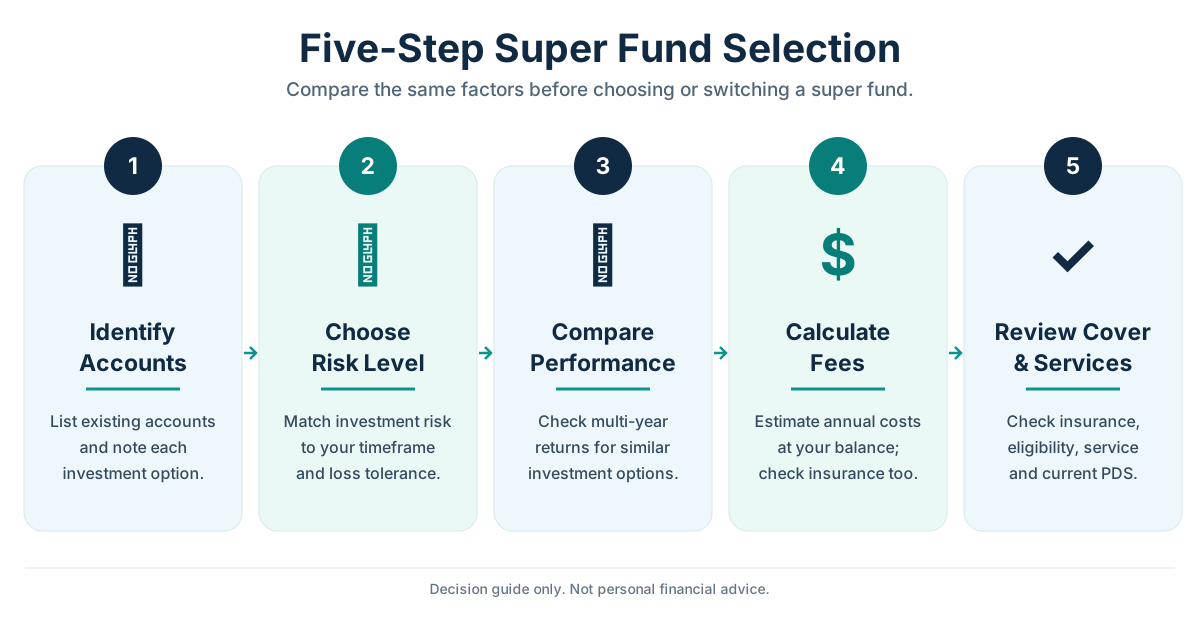
Record the fund, product and investment option separately. One fund can offer investment options with materially different risk and costs. Use this comparison record to prevent an attractive fund-level headline from being mistaken for the performance or price of your actual option:
| Comparison attribute | What to verify |
|---|---|
| Product and investment option | Exact name and asset allocation in the PDS or investment guide |
| Performance | Annualised return period, ending date and whether figures are after fees and tax |
| Cost at your balance | Fixed fee, percentage-based costs, other applicable charges and insurance premiums |
| Insurance | Death, TPD and income protection amounts, eligibility, exclusions and premiums |
| Access and service | Fund eligibility, member support, advice costs and online account management |
| Evidence date | Document version or date checked, to compare current information |
This is a decision worksheet, not a ranking or recommendation of any particular fund.
How do you compare super fund fees?
Compare annual costs in dollars for your account balance, not an advertised percentage alone. Super fees can include administration, investment and transaction costs. Insurance premiums are a separate cost that can reduce the amount invested. According to ASIC MoneySmart, Choosing a super fund (29 September 2026), compare fees alongside investment options, performance and insurance rather than selecting on price alone.
| Fee component | Fund A | Fund B |
|---|---|---|
| Fixed annual administration fee | $100 | $40 |
| Percentage-based annual fee | 0.40% | 0.55% |
| Estimated annual cost on $10,000 | $140 | $95 |
| Estimated annual cost on $100,000 | $500 | $590 |
Illustrative figures only, not actual fund offers. The calculation assumes the displayed fees are the only applicable charges and excludes insurance.
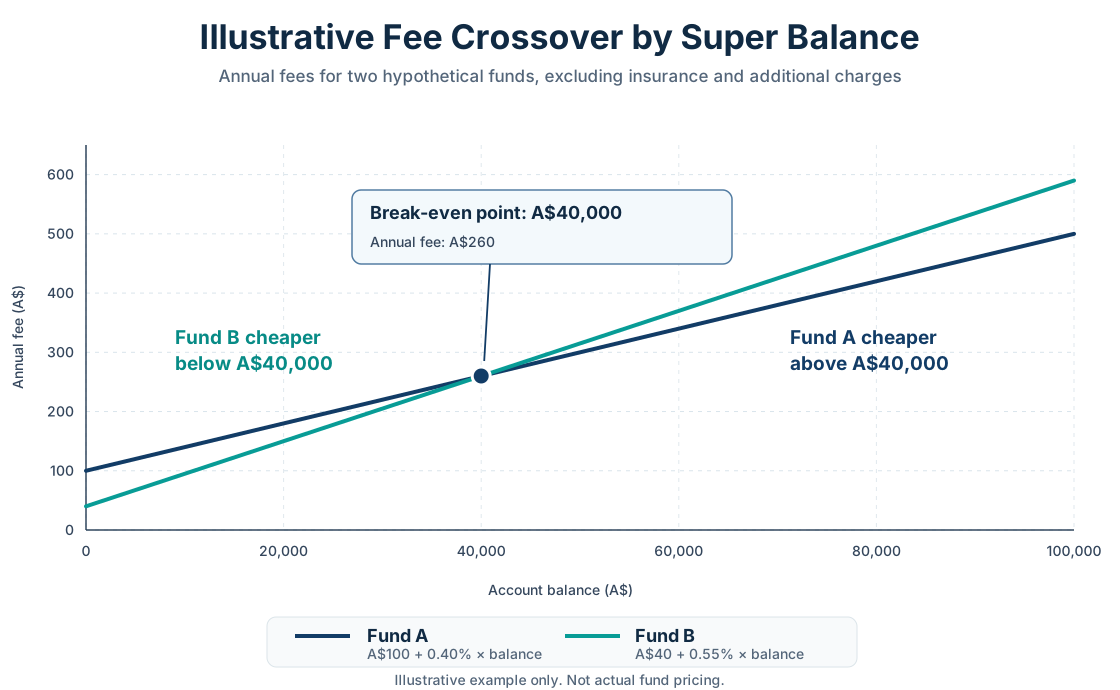
Under these assumptions Fund B costs $45 less annually at $10,000, while Fund A costs $90 less at $100,000. The two fee structures cost the same at a balance of $40,000: $260 annually. These are arithmetic examples, not current market quotes. Check all applicable charges in the product’s PDS.
How do you compare super fund performance?
Compare annualised returns over identical five-year or ten-year periods for investment options with similar growth exposure. Returns from a high-growth option and a conservative option are not a like-for-like comparison.
- Check whether published returns are after investment fees and tax, and whether administration fees are included.
- Compare the same ending date and asset-allocation category.
- Review risk, negative-return years and portfolio composition alongside returns.
- Use APRA's annual performance test as an additional check, not a complete ranking of all investment choices.
According to the Australian Prudential Regulation Authority (APRA), Annual superannuation performance test (2026), the test assesses specified products against prescribed benchmarks. Past returns do not guarantee future returns. For further context, see super investment returns and use the super Projection Calculator Australia to model alternative fee and return assumptions.
Which super investment option should you choose?
Match the investment option to your time until retirement, willingness to accept losses and desired asset allocation. Growth-oriented options commonly invest more in shares and other growth assets. Conservative options generally allocate more to defensive assets, though definitions vary by fund.
A MySuper product is a regulated default product, although individual suitability still depends on risk and retirement plans. Check the option’s investment objective, risk indicator, asset allocation ranges and suggested timeframe in its current disclosure material. Estimate employer contributions using the super contributions calculator Australia and compare your retirement savings using the superannuation calculator Australia.
What insurance should you compare between super funds?
Compare death cover, total and permanent disability (TPD) cover and income protection separately. Insurance eligibility, benefit limits, premium levels, waiting periods and exclusions differ across funds.
- Check the insured benefit amount and how cover changes with age.
- Compare occupation classifications, eligibility conditions and pre-existing condition clauses.
- Confirm whether insurance starts automatically or requires an application.
- Calculate premiums separately from investment and administration fees.
According to ASIC MoneySmart, Insurance through super (2026), switching or consolidating accounts can affect cover. Do not cancel existing cover before the replacement is accepted and effective.
How do you compare super funds using YourSuper?
The ATO YourSuper comparison tool displays standardised comparisons for MySuper products, including fees, historical performance and performance-test results. According to APRA, The 2026 annual superannuation performance test: MySuper products (28 August 2026), the 2026 MySuper test results are incorporated into YourSuper. Use the tool to shortlist products before examining your chosen investment option and insurance terms.
- Open the ATO's official YourSuper comparison tool.
- Review products on a consistent balance and age basis where the tool permits.
- Compare the fees, historical performance and performance-test labels displayed.
- Shortlist relevant products and check their current PDS, investment options and insurance guides.
According to the Australian Taxation Office, YourSuper comparison tool (accessed October 2026), displayed values depend on the tool's methodology and reporting data. Note the comparison balance and reporting period when recording the result; obtain current product documents before acting.
What YourSuper cannot tell you
NO, YourSuper is not a complete comparison of every super investment option or every member's insurance costs. Its core MySuper comparisons do not replace checking a chosen investment option's PDS, personalised insurance premiums, eligibility or defined-benefit conditions. Compare any alternatives outside the tool separately.
Industry, retail and public sector funds
Industry, retail and public sector funds differ in structure and product access, but fund type alone does not determine cost or performance. Industry funds are commonly profit-to-member entities. Retail funds may offer extensive investment menus. Public sector funds can include restricted or employer-linked products.
According to ASIC MoneySmart, Types of super funds (18 June 2026), a fund, member account and investment option are distinct concepts, and access and product features vary. Compare the actual product's fees, performance, insurance and eligibility rather than relying on its label.
What happens if you don't choose a super fund?
An employer generally checks whether a stapled fund applies when an eligible employee has not chosen a fund. If there is no chosen or applicable stapled fund, the employer follows the relevant default fund rules.
The ATO describes a stapled super fund as an existing account linked to an employee so that super can follow them between jobs. A default MySuper investment option is not the same as the employer's process for selecting where contributions go.
How do you switch super funds safely?
Choose the receiving fund, check existing benefits, arrange the new account and then request a transfer. Moving a balance and directing future employer contributions are separate actions.
- Check whether insurance or other benefits would cease when the old account closes.
- Confirm that the new fund accepts your membership and desired investment option.
- Request an eligible rollover through official myGov-linked ATO services or a fund's authorised process.
- Give your employer the new fund details using its fund-choice process.
- Verify the incoming rollover, outgoing balance and subsequent employer contribution.
For the full transfer process, see how to consolidate super funds.
Check insurance continuity before moving money
Confirm replacement cover in writing before closing an account that holds important insurance. Record the insured amount, exclusions, premiums, waiting periods and policy commencement date. A change in health, occupation or age can affect replacement eligibility or premiums. Some members retain an account specifically to preserve cover, subject to account and inactivity rules.
Compare fees for a small and large balance
A fund with a low fixed fee can become more expensive at a higher balance when its percentage-based fee is greater. The illustrative table above crosses over at $40,000. At that balance, Fund A costs $100 + (0.40% × $40,000) = $260 and Fund B costs $40 + (0.55% × $40,000) = $260. The comparison excludes insurance and other charges; calculate the total from each product's current disclosures.
How do you verify super fund performance and fees?
Verify investment performance and fees against the fund's current published documents and APRA's independent regulatory data. The annual performance test applies to specified super products and has a defined methodology. A passing result does not prove that a product is best for every investor.
According to APRA, 2026 annual superannuation performance test – accessible version of dashboards (August 2026), 49 of 50 MySuper products passed, with one first-time failure and no repeat failures. These results assess specified products against regulatory benchmarks; they are neither a ranking of all investment options nor a prediction of future returns. If your product fails, examine the notice, compare equivalent products and check insurance before transferring.
Verify product disclosure and third-party ratings
Use the PDS, target market determination where relevant, investment fact sheets and insurance guide to validate product-specific claims. Record document dates and compare identical option names and return periods. Independent ratings can help identify options to investigate, but each provider applies its own scoring criteria. Cross-check any award or star rating against actual fees, investment choice, relevant timeframe and personal insurance requirements.
Can you choose your own super fund?
YES, most Australian employees have a right to choose a super fund for compulsory employer contributions. Some awards, agreements and specific employment or scheme arrangements have different rules. Confirm your eligibility and submit the fund-choice information your employer requires.
Can you change super funds at any time?
YES, most members of ordinary accumulation funds can apply to switch funds, subject to account, product and legal conditions. Before moving, check insurance, defined-benefit rights, outstanding contributions and any investment or transaction restrictions.
Is the super fund with the lowest fees always best?
NO, the lowest fees do not automatically produce the best fit. Compare the total cost for your balance, the matching investment option's risk and historical returns, available insurance and member services.
Does YourSuper compare all superannuation products?
NO, the ATO YourSuper tool is designed around MySuper product comparisons. It does not display every choice investment option or provide a complete personalised insurance comparison. Review other products through their disclosure documents.
Can changing funds affect your life insurance?
YES, transferring out or closing a super account can end insurance attached to that account. Replacement cover can have different premiums, exclusions or eligibility conditions. Confirm cover is active before cancelling the old policy.
Can you keep the same super fund when changing jobs?
YES, employees can generally keep an existing super fund when changing employers, subject to applicable fund-choice arrangements. Give the new employer the relevant fund and member details and check that the first contribution reaches the correct account.
Sources and verification (October 2026)
- ASIC MoneySmart, Choosing a super fund (29 September 2026), covering investment performance, fees, insurance, investment options and services.
- ASIC MoneySmart, Insurance through super (2026), describing cover types and potential consequences of changing funds.
- ASIC MoneySmart, Types of super funds (18 June 2026), explaining funds, accounts, investment options and fund structures.
- Australian Taxation Office, Choosing a super fund and YourSuper comparison tool (accessed October 2026).
- Australian Taxation Office, Stapled super funds for employers (accessed October 2026).
- APRA, The 2026 annual superannuation performance test: MySuper products (28 August 2026), test coverage and connection to YourSuper.
- APRA, 2026 annual superannuation performance test – accessible version of dashboards (August 2026), 49 passes, one first-time failure and no repeat failures among 50 MySuper products.
This is general educational information. Check current fund documents and seek appropriately licensed personal financial advice where individual circumstances require it.
Written by
Superannuation Calculator Australia
Calculation guidance and general information; independent financial advice is not provided.