Superannuation Fees: Types, Annual Costs and Comparisons
Compare super fees by type and annual cost. Check fixed and percentage charges, the YourSuper tool and switching risks.
Superannuation Calculator Australia · · 12 min read
To compare superannuation fees in Australia, calculate the total annual dollar cost at your account balance, match equivalent investment options and check the current product disclosure statement (PDS). Fixed administration charges and percentage-based investment costs can change which fund costs less as your balance grows. Fees matter alongside net investment returns, insurance and investment risk.
What fees do Australian super funds charge?
Super funds generally charge administration, investment and transaction costs. Charges can be fixed dollar amounts, percentages of assets or a combination. According to the Australian Securities and Investments Commission (ASIC), Regulatory Guide 97: Disclosing fees and costs in PDSs and periodic statements (current guidance accessed October 2026), disclosure documents identify fee categories and how they apply.
A fee labelled as a percentage is not necessarily deducted as a separate transaction from your account. Some investment-related costs are reflected in unit prices and the investment return reported by the fund.
Which fees make up the total yearly cost?
The main annual cost comprises administration fees and costs, investment fees and costs, and transaction costs. Additional charges apply only in relevant circumstances, such as insurance premiums, advice or a particular transaction.
| Fee component | How to compare it |
|---|---|
| Fixed administration fee | Convert weekly or monthly charges to a yearly dollar amount |
| Percentage administration fee | Apply the stated annual rate to the relevant balance, allowing for any cap |
| Investment fees and costs | Use the applicable rate for the specific investment option |
| Transaction costs | Include disclosed costs that are not already counted in investment fees |
| Insurance premiums | Compare separately using your actual cover and circumstances |
| Other applicable charges | Check advice fees, buy/sell spreads and product-specific conditions |
Use the fund's current fees and costs guide rather than an outdated advertisement. Avoid counting a cost twice when it is already included in an aggregated fee figure. According to ASIC MoneySmart, How to check your super (accessed October 2026), ongoing annual costs can include administration, investment and transaction costs. Member activity costs can include buy/sell spreads, switching, personal advice and insurance.
How do you calculate annual super fund fees?
Add the annual fixed fees to the percentage-based charges calculated on the relevant account balance. Include any other charges that apply to the account. Percentage rates may have different calculation bases, fee caps and treatment in disclosed examples.
For a simplified comparison, use this annual formula:
Estimated annual fees = fixed annual charges + (balance × applicable annual percentage fees) + other relevant costs.
For example, assume Fund A charges $100 per year plus 0.40% of the balance. At $50,000, the estimated annual cost is $300: $100 + ($50,000 × 0.004). These figures are illustrative and do not represent a current fund offer. They exclude insurance and any additional costs not specified.
Compare the same balance across both hypothetical funds. On smaller screens, scroll the table horizontally to see both fund columns.
| Account balance | Fund A: $100 + 0.40% | Fund B: $40 + 0.55% |
|---|---|---|
| $10,000 | $140 | $95 |
| $40,000 | $260 | $260 |
| $50,000 | $300 | $315 |
| $100,000 | $500 | $590 |
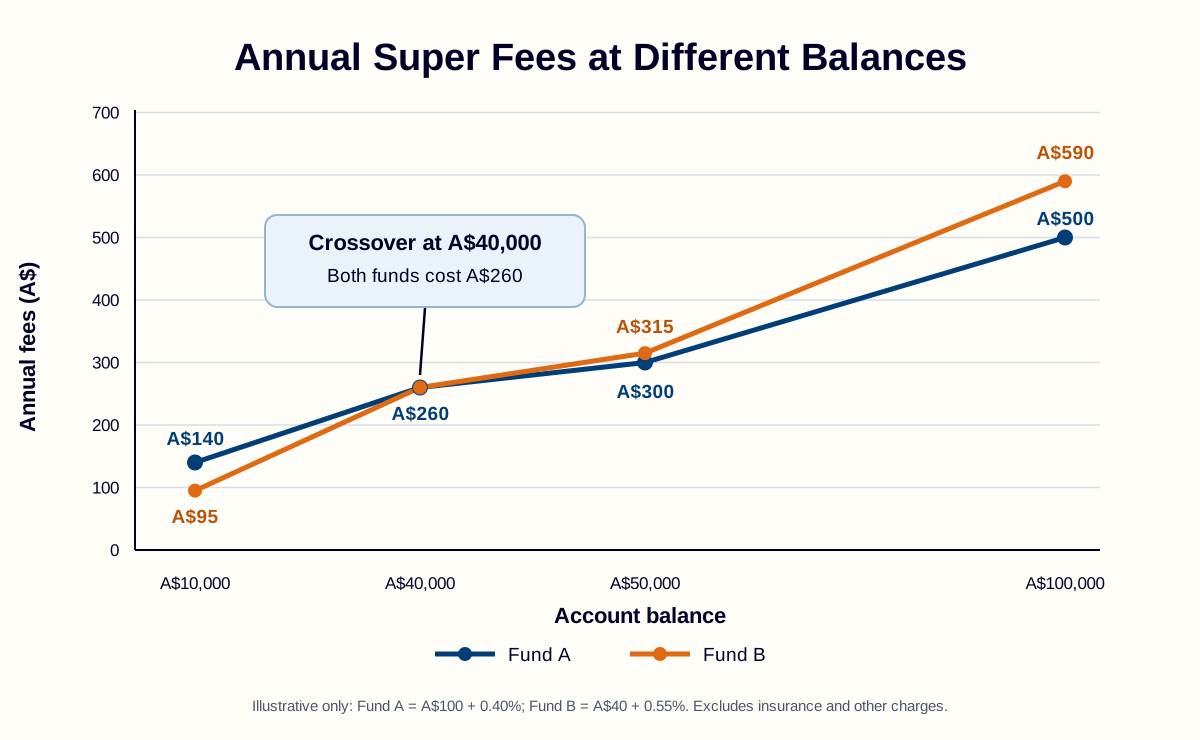
Comparison result: Fund B has lower fees at $10,000; both charge $260 at $40,000; Fund A has lower fees at $50,000 and $100,000. These are assumed rates, not product prices.
How do fund fees change with your super balance?
Fixed charges have a greater proportional effect on small balances, while percentage-based fees generally increase in dollars as the balance rises. A $100 annual fixed fee equals 1% of a $10,000 balance but only 0.1% of a $100,000 balance. A 0.40% variable charge costs $40 and $400 at those respective balances.
Always recalculate from the applicable fee schedule rather than extrapolating from one advertised example. Percentage caps, tiered fees and investment options can alter the result.
At what balance does the cheaper fee structure change?
The break-even balance is where both fee structures produce the same annual dollar cost. For simplified linear fees, solve the equation:
Fund A fixed fee + (Fund A rate × balance) = Fund B fixed fee + (Fund B rate × balance).
With illustrative rates of $100 + 0.40% and $40 + 0.55%, the fee crossover is $40,000. Each costs $260 annually at that balance. Below $40,000, Fund B is cheaper under these assumptions. Above $40,000, Fund A is cheaper.
This calculation excludes insurance and additional charges. Fee caps or non-linear tiers require a separate calculation. If the formulas have no positive crossover, one structure remains cheaper across positive balances within the assumptions.
How can you compare equivalent investment options?
Compare investment options with similar asset allocations and risk profiles over the same timeframe. A Balanced product and a High Growth option do not provide a like-for-like comparison simply because both belong to super funds.
- Record each fund, product and exact investment option.
- Check the allocation to growth and defensive assets.
- Use the same account balance and reporting period for annual fee estimates.
- Compare investment returns using matching end dates and clearly identified fee and tax treatment.
- Review risk, insurance and access to services before drawing a conclusion.
According to ASIC MoneySmart, Choosing a super fund (29 September 2026), use comparable investment options and matching timeframes when assessing long-term performance. For the wider decision framework, read how to choose a super fund. Estimate future contributions separately with the super contributions calculator Australia.
Where can you check the fees your fund charges?
Check the latest PDS, incorporated fees and costs guide, and your annual member statement. The PDS describes disclosed product charges. An annual statement reports fees and costs over an actual reporting period, subject to how the fund presents different cost types.
Record the publication date of each document, the investment option and the member balance used in fee examples. ASIC's Regulatory Guide 97 sets out disclosure guidance for PDSs and periodic statements.
How can you use the ATO YourSuper tool?
The Australian Taxation Office's YourSuper comparison tool helps compare eligible MySuper products using standardised information. It provides a starting point for investigating fees, historical performance and relevant performance-test results.
- Open the ATO's YourSuper comparison tool using its official website or linked myGov service.
- Identify the displayed product and comparison balance.
- Review its fee figures and performance information, including the reporting period.
- Check the selected product's current PDS and investment guide before making a decision.
YourSuper does not cover every choice investment option or calculate an individual's exact insurance premiums. It is a product-comparison starting point, not a personalised recommendation.
Why might your statement show different fees from a PDS example?
A PDS fee example and the fees appearing on an annual statement can differ because they use different balances, timeframes or assumptions. The statement reflects your account during its reporting period; a PDS fee example typically uses specified illustrative assumptions. Compare the same time period, balance basis and cost categories before treating different totals as an error.
Reconcile the figures by checking the investment option, account balance, fee dates, variable charges and whether costs have been reflected through investment returns rather than debited separately. For an unresolved discrepancy, ask the fund for an itemised explanation.
How do insurance and advice charges affect the comparison?
Insurance premiums and personal advice charges can increase an account's total cost beyond the standard administration and investment fees. They depend on the cover held or services used and should not be treated as identical for every member.
Check premiums for death cover, total and permanent disability cover and income protection. Compare insured amounts, eligibility and exclusions alongside the prices. Advice charges should be recorded only where the service and fee actually apply.
Why do returns after fees matter?
Net returns help assess what an investment option delivered after relevant investment costs and tax, but the exact return definition matters. A published net investment return may exclude some member-level administration fees, so it must not automatically be treated as the final net benefit for every account.
Compare equivalent asset-allocation categories, the same historical period and the same return basis. According to AustralianSuper's Guide to measure your super performance, measures such as net investment return and net benefit incorporate different cost treatments. Past performance does not guarantee future returns.
Why is the cheapest super fund not always best?
The fund with the lowest fees is not automatically the most suitable. Investment risk, after-fee outcomes, insurance eligibility and services affect the decision. A lower fee does not compensate for an unsuitable investment option or insurance cover that fails to meet a member's needs.
Use the super investment returns guide for return comparisons and the super projection calculator Australia to explore how different fee and return assumptions affect projected balances. For a starting retirement estimate, use the superannuation calculator Australia. In both calculations, keep the assumed fee rate, contribution amount and investment return consistent.
What fee protections apply to small super balances?
A statutory fee cap protects eligible low-balance super accounts from specified administration and investment fees and costs. For eligible MySuper and choice super products with an account balance below $6,000 at the end of the fund's income year, the combined administration fees, investment fees and applicable indirect costs are capped at 3% of that balance. Any amount charged above the cap must be refunded. According to the Australian Taxation Office legal database, Treasury Laws Amendment (Protecting Your Superannuation Package) Regulations 2019, Schedule 1, the cap applies to specified fees and costs, not every account deduction.
Insurance premiums and member-initiated costs require separate consideration. Compare the annual dollar cost and the fee-cap adjustment shown in the fund's disclosure documents. For example, 3% of a $5,000 year-end balance is $150; this is a cap calculation, not an estimate of the member's total yearly account deductions.
What should you check before switching to a lower-fee fund?
Check the total fee saving, investment option and insurance continuity before transferring super. Closing an account can end attached insurance cover and may affect other benefits.
- Calculate the annual cost difference using your own balance and the current fee schedules.
- Confirm the receiving fund's investment option, eligibility and insurance terms.
- Check whether existing cover will end and whether replacement cover is accepted and active.
- Review any special benefits, tax considerations, exit-related costs or transaction restrictions.
- Arrange future employer contributions and an eligible rollover through authorised processes.
For the transfer steps and duplicate-account risks, see how to consolidate super.
Are super fund administration fees always charged as a percentage?
NO, administration fees can be fixed charges, percentage-based amounts or a combination. A weekly fixed charge and an annual asset-based charge can both apply. Read the current fee schedule to determine the cost for your balance.
Can a lower advertised fee cost more at a higher balance?
YES, a lower fixed fee can be outweighed by a higher percentage rate as the account grows. Compare total dollar costs at the same balance rather than one displayed percentage or a single standard-balance example.
Are investment fees always directly deducted from a member's account?
NO, some investment fees and costs are reflected in investment returns or unit prices instead of appearing as separate account transactions. Review the product disclosure and periodic statement methodology to avoid interpreting unlisted deductions as zero cost.
Does the ATO YourSuper tool include every investment option?
NO, the ATO YourSuper tool focuses on eligible MySuper products. It does not provide a complete comparison of every choice investment option or each member's personalised insurance costs. Check the product documents separately.
Is the cheapest super fund automatically the best choice?
NO, lower total annual fees do not alone establish the best fund. Compare similar-risk investment options, after-fee performance, insurance and services against your circumstances.
Can holding more than one super account mean paying duplicate fees?
YES, multiple accounts can result in separate administration fees and insurance premiums. Before consolidating, check whether a closed account's insurance or other benefits will be lost. Use how to check your super balance to identify accounts.
Sources and verification (October 2026)
- Australian Securities and Investments Commission, Regulatory Guide 97: Disclosing fees and costs in PDSs and periodic statements.
- ASIC MoneySmart, Choosing a super fund (29 September 2026).
- ASIC MoneySmart, How to check your super (accessed October 2026).
- Australian Taxation Office legal database, Treasury Laws Amendment (Protecting Your Superannuation Package) Regulations 2019, Schedule 1, fee cap and refund requirements.
- Australian Taxation Office, YourSuper comparison tool (accessed October 2026).
- AustralianSuper, Guide to measure your super performance.
- ASIC MoneySmart, Insurance through super (2026).
General educational information only. Worked fee amounts are illustrative and exclude charges not specified. Check current fund documents and consider licensed personal financial advice for individual circumstances.
Written by
Superannuation Calculator Australia
Calculation guidance and general information; independent financial advice is not provided.