Concessional vs Non-Concessional Super Contributions: Tax, Caps and Choices
Compare concessional and non-concessional super contributions, 2026–27 caps, tax treatment and equal-cost examples in Australia.
Superannuation Calculator Australia · · 11 min read
Concessional super contributions include employer SG, salary sacrifice and eligible tax-deductible personal contributions; they generally incur 15% contributions tax. Non-concessional contributions are usually made from after-tax savings without a personal deduction and generally incur no contributions tax. In 2026–27, the standard annual caps are $32,500 and $130,000 respectively, subject to eligibility. The comparison below explains tax, cap rules, equal-cost outcomes and restrictions on accessing super.
Concessional and Non-Concessional Contributions Compared
The Australian Taxation Office (ATO), Understanding concessional and non-concessional contributions (15 January 2026), distinguishes the categories by their tax treatment. Whether a personal payment is deductible, rather than which bank account funded it, determines its ordinary concessional or non-concessional treatment.
| Comparison | Concessional | Non-concessional |
|---|---|---|
| Ordinary examples | Employer SG, salary sacrifice and deductible personal payments | Personal savings contributed without a deduction |
| Personal income-tax treatment | Salary sacrifice reduces taxable salary; an eligible personal deduction reduces taxable income | No personal deduction for the amount kept non-concessional |
| Tax when received by a complying fund | Generally 15%, with exceptions and possible additional tax | Generally no contributions tax within the applicable rules |
| General annual cap in 2026–27 | $32,500 | $130,000, subject to eligibility |
Special categories, including some government and downsizer contributions, have separate treatment. This comparison concerns ordinary contributions rather than every statutory exclusion.
How Each Contribution Type Is Taxed
Concessional contributions are generally taxed at 15% in a complying fund. An ordinary non-concessional contribution within the applicable rules generally enters the fund without contributions tax.
For example, a $1,000 concessional payment ordinarily leaves $850 after $150 of contributions tax, before fees or other deductions. A $1,000 non-concessional payment ordinarily adds $1,000, but it has not produced a personal tax deduction.
The standard rate does not describe every outcome. Division 293 can impose an additional 15% on some or all relevant concessional contributions for higher-income members. Low-income super tax offsets can reduce the effective contributions-tax burden for eligible members. Excess contributions have separate consequences.
Tax on investment earnings and withdrawals is separate from tax on contributions. A non-concessional payment does not make every future earning or withdrawal tax-free. ASIC MoneySmart, Super contributions (29 September 2026), explains these contribution categories and the principal tax qualifications.
When a Personal Payment Becomes Concessional
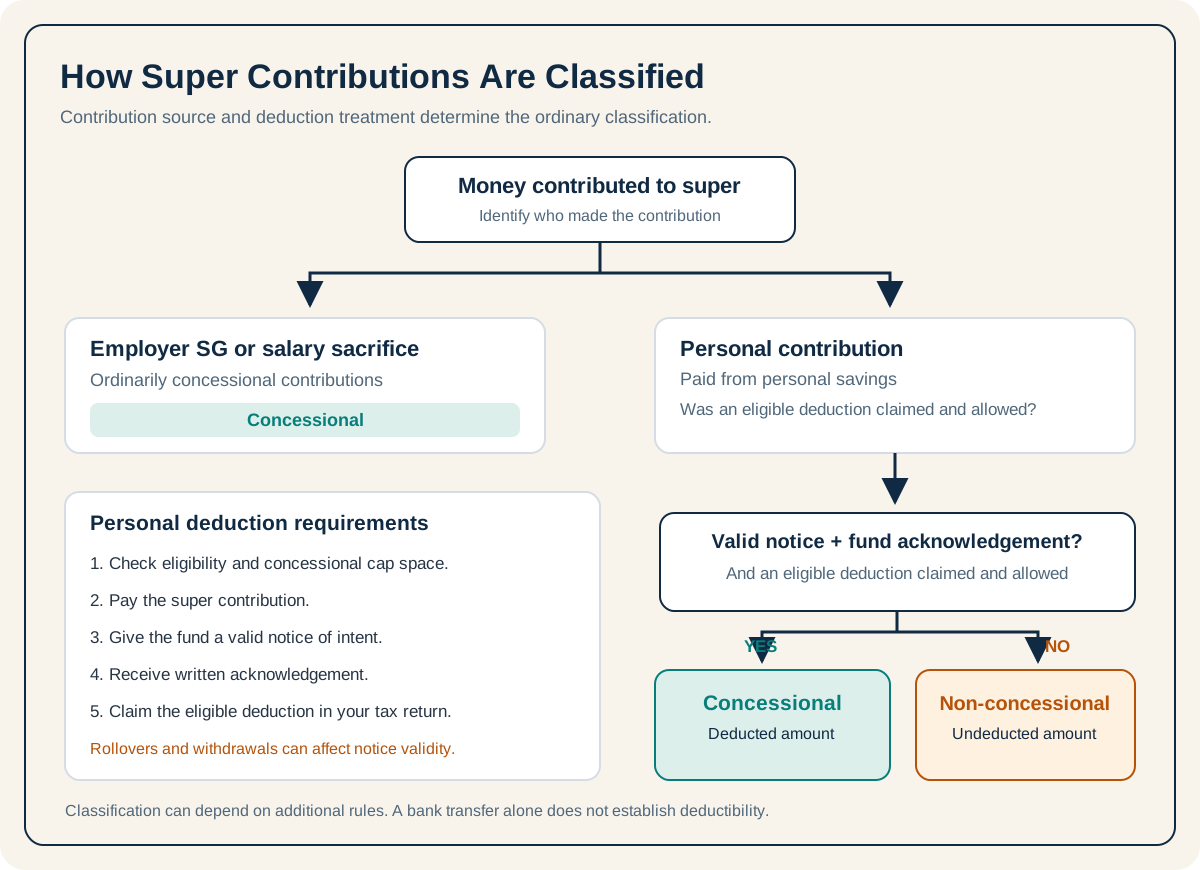
An ordinary personal super payment becomes concessional to the extent that an eligible income-tax deduction is claimed and allowed. Paying from take-home savings does not prevent a deduction, but transferring money alone does not establish eligibility.
Follow this sequence before claiming:
- Confirm that the contribution qualifies for a deduction and that sufficient concessional cap space remains after employer and other contributions.
- Pay the contribution to your super fund and retain confirmation of receipt.
- Give the fund a valid notice of intent to claim a deduction for the intended amount.
- Receive the fund's written acknowledgement before claiming the deduction.
- Claim only the eligible amount in your tax return and reconcile the tax treatment with the fund.
Give the notice by the earlier of lodging the tax return for the contribution year and the end of the following financial year. A rollover, withdrawal or commencement of an income stream can invalidate or restrict a notice if the fund no longer holds the relevant contribution. Members aged 67–74 generally need to satisfy the work test or a recognised exemption to claim a personal contribution deduction, even though the fund may accept a non-concessional contribution without that test. Fund acknowledgement does not by itself establish tax-deduction eligibility.
According to the ATO, Personal super contributions (22 May 2024), the notice and acknowledgement requirements form part of the deduction process. A valid notice does not itself replace the deduction claimed and allowed through the return.
Contribution Caps in 2026–27
From 1 July 2026, the general annual caps are $32,500 concessional and $130,000 non-concessional. These are general limits, not an assurance that every member can contribute those amounts.
According to the Australian Taxation Office, Contributions caps (2026), the concessional cap increased with indexation from 1 July 2026. Its Caps, limits and tax on super contributions guidance confirms the contribution categories and applicable rules. Contributions are counted across a person's funds. Employer SG, salary sacrifice and deductible personal contributions share the concessional cap.
For example, $12,000 of employer contributions plus $5,000 of salary sacrifice uses $17,000 of the general concessional cap. That leaves $15,500 before other concessional amounts, assuming no adjustment to the applicable cap.
Your available amount also depends on prior contributions, total super balance and any existing arrangements. Confirm the financial year in which the fund receives the payment. Use the current super contribution caps and cap-space checks for detailed eligibility and calculations. The super contributions calculator can help estimate additional contributions, but it cannot confirm your available cap space.
Carry-Forward and Bring-Forward Compared
Carry-forward uses unused concessional cap amounts from earlier years. Bring-forward permits eligible members to use non-concessional cap amounts from future years. Their eligibility rules differ.
| Check | Carry-forward | Bring-forward |
|---|---|---|
| Contribution category | Concessional | Non-concessional |
| Years involved | Unused amounts from up to five preceding financial years | Up to three financial years including the starting year |
| Key eligibility checks | Total super balance below $500,000 at the previous 30 June and available unused amounts | Age, previous 30 June total super balance and any existing arrangement |
| Amount to confirm | Actual unused amounts still available, plus the current cap | Applicable arrangement limit and amounts already used |
For a new arrangement in 2026–27, an eligible member’s total super balance at 30 June 2026 determines the maximum non-concessional cap. These thresholds apply to the ordinary rules:
- Less than $1.84 million: up to $390,000 over three years.
- $1.84 million to less than $1.97 million: up to $260,000 over two years.
- $1.97 million to less than $2.1 million: ordinarily up to $130,000 for one year.
- $2.1 million or more: the non-concessional cap is nil.
These thresholds assume a new arrangement and eligibility under the age rules. An existing bring-forward arrangement can change the available amount; it does not automatically adopt an indexed cap. Check the ATO record before contributing.
ASIC MoneySmart, Super contributions (29 September 2026), describes the five-year carry-forward and conditional three-year bring-forward mechanisms. Check the ATO's current rules before making a large payment.
Comparing Contributions at the Same Personal Cost
At an illustrative $680 personal cost, salary sacrifice or an eligible deductible personal payment adds $850 to super under the assumptions below. An undeducted non-concessional payment adds $680.
Assume a 32% effective income-tax reduction and 15% fund contributions tax. All amounts fit within the relevant caps. The example excludes Division 293, offsets, changes to benefits or levies, fees and other adjustments. The 32% rate is an assumed effective marginal reduction, not a statement of every reader's tax rate.
| Amount | Salary sacrifice | Eligible deductible personal payment | Undeducted personal payment |
|---|---|---|---|
| Gross contribution | $1,000 | $1,000 | $680 |
| Income-tax reduction assumed | $320 | $320 | $0 |
| Net personal cost after tax benefit | $680 | $680 | $680 |
| Fund contributions tax assumed | $150 | $150 | $0 |
| Added to super after contributions tax | $850 | $850 | $680 |
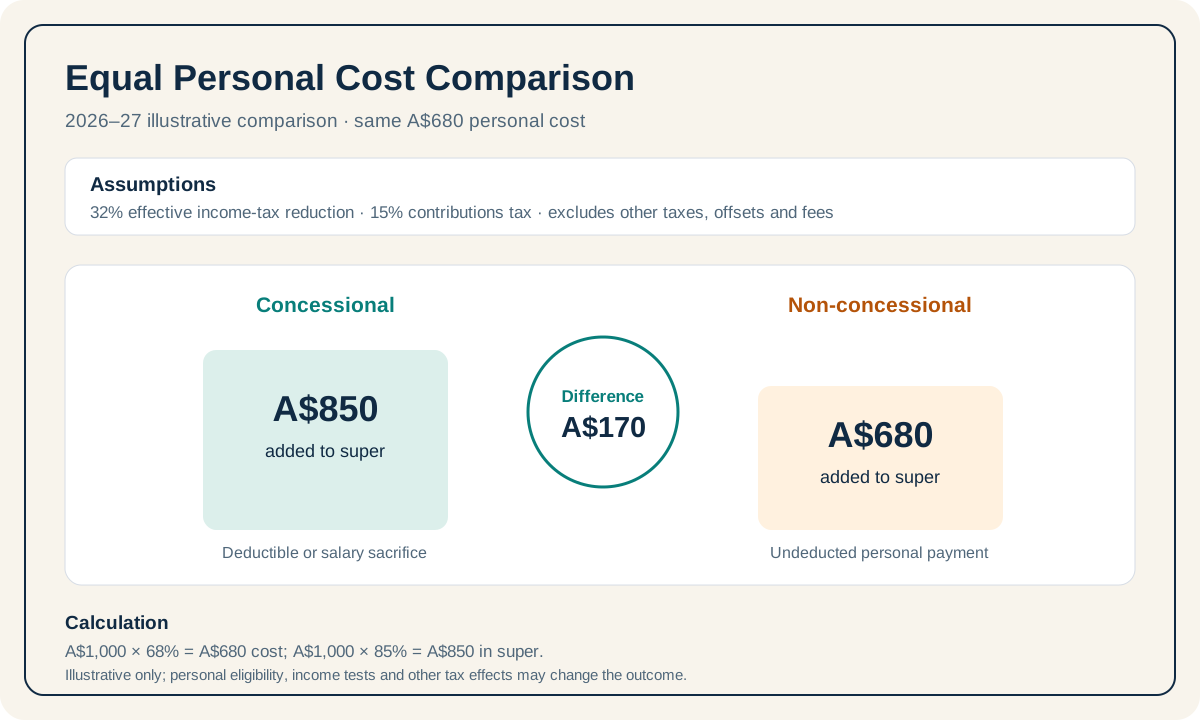
Calculation: $1,000 × (1 − 32%) = $680 personal cost; $1,000 × (1 − 15%) = $850 added to super. The illustrated difference is $170 at the same personal cost.
The deductible personal option requires $1,000 upfront; the tax benefit is generally realised through the tax return process. Salary sacrifice changes take-home pay through payroll instead. Neither example includes investment returns or guarantees a better personal outcome. Salary sacrifice and deductible personal contributions can also affect income tests for some benefits and obligations, including HELP repayments; an income-tax saving is not necessarily an equivalent improvement in overall cash flow. For a longer-term estimate, the super projection calculator models potential balance changes under selected assumptions.
Which Contribution Type Suits Your Situation?
The more suitable option depends on the tax concession available, how much cap space remains and whether you can leave the money in super until a condition of release is met.
- Reducing taxable income: salary sacrifice or an eligible deductible personal contribution may help if the deduction is valuable after accounting for other income-test effects and tax rules.
- Adding savings without claiming a deduction: a non-concessional contribution may suit someone using after-tax savings, provided the balance and age-based rules allow it.
- Making a large one-off payment: first check unused carry-forward concessional amounts or whether a bring-forward non-concessional arrangement is available; the two mechanisms are not interchangeable.
- Needing access to money soon: retaining accessible savings may matter more than a contribution tax concession, because money in super is generally preserved.
Checks Before Choosing a Contribution Type
Check the actual tax benefit, contribution eligibility, available caps and the money you need outside super before paying. A larger balance inside super does not compensate for losing access to cash needed for current expenses.
- Calculate the effect using your own taxable income, deductions, offsets and any additional tax.
- Combine employer and personal contributions across all funds. Allow for reporting delays when checking ATO records.
- Confirm carry-forward or bring-forward eligibility rather than assuming the maximum applies.
- Check fund receipt dates and complete any required deduction notice before affected transactions or deadlines.
- Keep sufficient accessible savings for expenses and emergencies.
For a broader estimate of retirement savings, the superannuation calculator can help explore how contribution assumptions affect a future balance. Calculator estimates do not establish deduction eligibility or available cap space.
Is Salary Sacrifice a Concessional Contribution?
YES, salary sacrifice into super is a concessional contribution. It shares the applicable concessional cap with employer SG and deductible personal contributions, so count the combined amounts before arranging extra payments.
Can You Make Both Types in One Year?
YES, eligible members can make both types in the same financial year within the applicable caps and rules. A single dollar is not counted as both types. A partly deducted personal payment can be split between its deducted and undeducted amounts.
Do Non-Concessional Contributions Reduce Taxable Income?
NO, an ordinary personal payment kept non-concessional does not provide a personal deduction. If an eligible deduction is claimed and allowed for an amount, that amount receives concessional treatment. The earlier notice process explains the distinction.
Does Another Super Fund Give You an Extra Cap?
NO, contribution caps apply per person across their funds. Opening another account does not create a second allowance. Combine employer and personal amounts received by every fund when checking available space.
Can You Withdraw Non-Concessional Contributions at Any Time?
NO, non-concessional contributions generally remain subject to super preservation and release rules. The contribution's tax classification does not create a right to withdraw it immediately. See when you can access super for the relevant conditions.
Are Concessional Contributions Always Better?
NO, the result depends on effective tax rates, offsets, additional tax, deduction eligibility, cap space and access needs. Someone with little taxable income may receive little deduction benefit. Compare tax treatment, contribution caps and personal cost using your circumstances rather than treating either category as universally preferable.
Sources and verification (October 2026)
- Australian Taxation Office, Understanding concessional and non-concessional contributions, updated 15 January 2026; corresponding official print section reviewed 16 October 2026.
- Australian Taxation Office, Contributions caps (2026) and Caps, limits and tax on super contributions, reviewed October 2026; 2026–27 caps and bring-forward guidance.
- Australian Taxation Office, Personal super contributions, updated 22 May 2024; deduction eligibility and notice requirements.
- Australian Taxation Office, Personal superannuation contribution deduction notice of intent to claim, updated 2 February 2025; indexed official fund-reporting guidance checked 16 October 2026.
- ASIC MoneySmart, Super contributions, updated 29 September 2026; reviewed 16 October 2026.
- ASIC MoneySmart, Getting your super, updated 6 August 2026; reviewed 16 October 2026.
General information only. The calculation is illustrative and does not account for every tax, contribution or access rule.
Written by
Superannuation Calculator Australia
Calculation guidance and general information; independent financial advice is not provided.