What Happens to Your Super When You Die?
Learn who inherits super after death, how nominations and wills work, when tax applies and how to claim a death benefit.
Superannuation Calculator Australia · · 13 min read
When you die, your remaining super balance and any payable insurance cover are generally paid as a superannuation death benefit. The money does not automatically become part of your estate or pass under your will. The fund trustee distributes it under superannuation law, fund rules and any valid beneficiary nomination. Who receives the benefit, how the claim is processed and whether tax applies are separate questions.
What Happens to a Super Balance and Life Insurance After Death?
A deceased member's super fund generally pays the remaining account balance and any insurance proceeds accepted under the fund's policy as a death benefit. The trustee first checks the account, insurance cover, eligible beneficiaries and any nomination.
For example, a super balance of $180,000 and $120,000 in payable life insurance could produce a $300,000 gross death benefit before any relevant adjustments, assuming the insurance claim is accepted. Investment movements, premiums, fees and policy exclusions can change the final amount. The trustee does not simply transfer the member's last displayed account balance.
Does Super Automatically Form Part of Your Will or Estate?
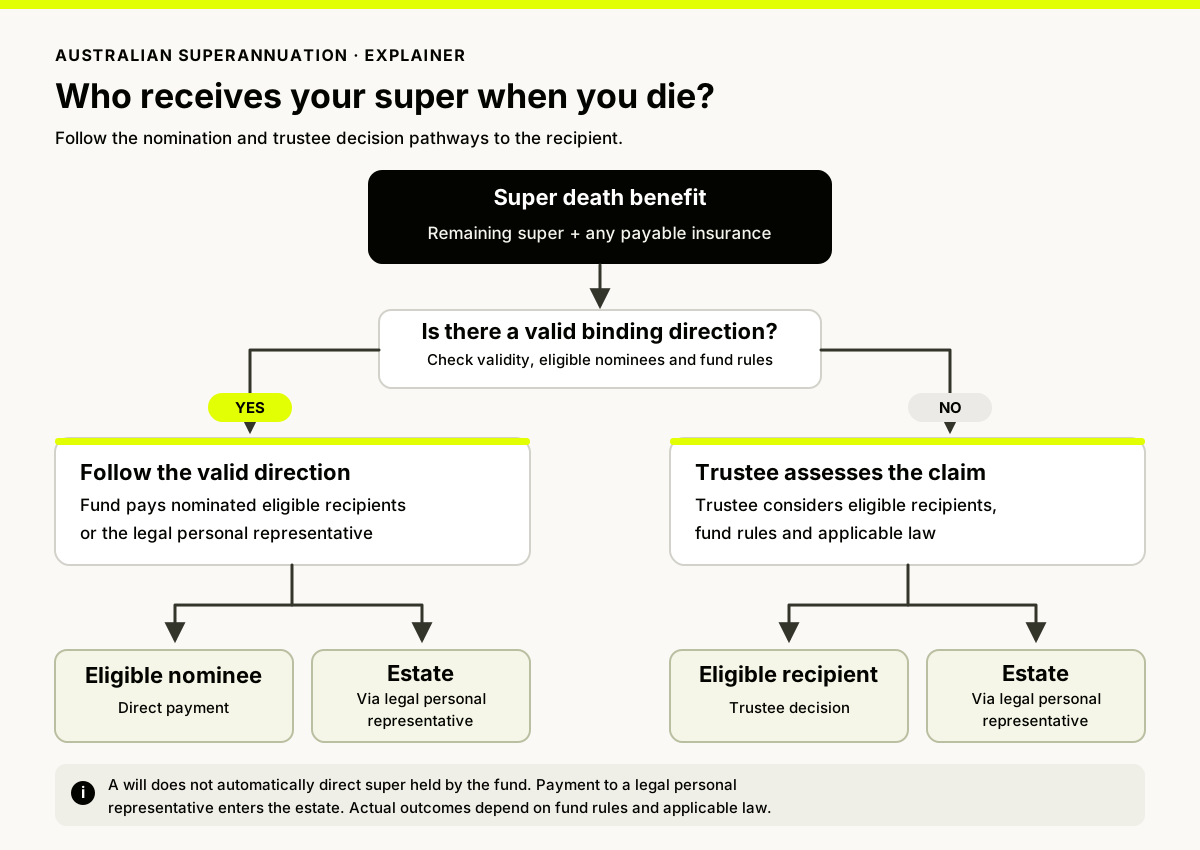
NO, super generally does not automatically form part of the deceased person's estate or pass through their will. The super fund trustee administers the benefit under the fund's trust deed and applicable law.
A benefit paid to the legal personal representative becomes an estate asset and is then dealt with under the will or intestacy law. A will naming a person as a beneficiary does not, by itself, make that person the beneficiary of super paid directly by the trustee.
Who Can Receive Your Super When You Die?
Super death benefits generally go to eligible dependants or the deceased member's legal personal representative. Depending on the law and circumstances, an eligible recipient can include a spouse or de facto partner, a child of any age, someone financially dependent on the deceased or someone in an interdependency relationship.
An adult child can be eligible to receive a lump sum even when financially independent. Eligibility to receive super and eligibility for tax-free treatment are different tests. The trustee may need evidence of relationships, dependence and competing claims. For the general rules governing accounts and retirement savings, see what is superannuation.
How Does a Binding Death Benefit Nomination Direct Who Gets Your Super?
A valid binding death benefit nomination instructs the trustee to pay the death benefit to the nominated eligible recipients, in the nominated proportions, subject to applicable rules. The fund checks that the nomination was completed correctly and remains valid when the member dies.
A non-binding nomination communicates the member's preference but does not direct the trustee. Some funds support lapsing and non-lapsing binding nominations, and certain pensions have reversionary beneficiary provisions.
| Nomination or arrangement | Effect after death | Check before relying on it |
|---|---|---|
| Lapsing binding nomination | Directs payment to eligible nominees while valid | Expiry date and formal renewal requirements |
| Non-lapsing binding nomination | Directs payment while valid without a standard three-year expiry | Fund rules and events that invalidate it |
| Non-binding nomination | Guides the trustee without requiring that distribution | Current eligible beneficiaries and trustee decision process |
| Reversionary pension nomination | May continue an eligible pension to its designated beneficiary | Pension terms and recipient eligibility |
According to ASIC Moneysmart, Who gets your super if you die (2 October 2026), nomination types vary by fund. This table is a decision aid, not a replacement for the fund's trust deed.
Who decides where super goes without a valid binding nomination?
Without a valid binding direction, the super fund trustee determines which eligible recipients or estate should receive the benefit. The trustee considers the trust deed, governing law, any non-binding nomination and evidence from claimants.
A non-binding nominee is not guaranteed payment. The trustee may request proof of identity, a relationship, financial dependence or other potential beneficiaries before deciding. A claimant can ask the fund which evidence is outstanding and whether an insurance assessment is running separately.
When Does a Super Beneficiary Nomination Expire or Become Invalid?
A lapsing binding nomination generally expires after three years unless renewed. Other funds provide non-lapsing nominations, subject to the fund's rules and ongoing beneficiary eligibility.
Incorrect signing or witnessing, an ineligible nominee, the nominee's death and some changes in personal circumstances can affect validity. Check your fund's confirmation and nomination terms after major life changes instead of assuming every nomination follows the same expiry rule.
How can you nominate or update your super beneficiaries?
Nominate beneficiaries using your fund's accepted process and confirm that the instruction is recorded and valid. Review every fund separately if you have multiple super accounts.
- Identify your super funds, account balances and insurance arrangements.
- Check whether each fund supports binding, non-binding or non-lapsing nominations.
- Select legally eligible beneficiaries or the legal personal representative and allocate percentages as required.
- Complete signature, identity and witnessing requirements.
- Keep the fund's acknowledgement and review nominations after marriage, separation, births or deaths.
A nomination is not a substitute for a complete estate plan. Changes to family relationships can affect the practical outcome.
Is Superannuation Taxed When Someone Dies?
A super death benefit is not always tax-free. Tax depends on whether the recipient is a death benefits dependant for tax purposes, the taxable and tax-free components and whether the benefit is paid as a lump sum or an income stream.
For a lump sum paid directly to a tax dependant, the benefit is generally tax-free. A lump sum paid to a non-tax dependant can attract tax on its taxable component, with different treatment for taxed and untaxed elements. Estate distributions require a separate assessment of the ultimate beneficiaries. According to the Australian Taxation Office, these rules depend on the recipient's tax status and the benefit's components.
| Lump sum recipient | General treatment |
|---|---|
| Death benefits dependant for tax | Generally tax-free |
| Non-tax dependant | Tax-free component remains tax-free; taxable component can be taxed |
| Legal personal representative | Estate tax treatment follows the tax-dependant status of the intended beneficiaries |
These are general rules rather than an individual tax calculation. According to the Australian Taxation Office, Superannuation death benefits (2026), recipient tax status and component breakdown determine the result. See superannuation tax in Australia for the broader tax context.
How might death benefit tax differ for a spouse and an independent adult child?
A spouse is generally a death benefits dependant for tax purposes and usually receives a lump sum super death benefit tax-free. An independent adult child is ordinarily not a tax dependant, even though they are eligible to receive the benefit under super law.
For illustration, an independent adult child receiving a $100,000 lump sum with a $40,000 tax-free component and a $60,000 element taxed in the fund generally has $60,000 subject to a maximum 15% tax rate plus applicable Medicare levy. At 15%, the tax on that element is $9,000 before any Medicare levy. This assumes the recipient is not a tax dependant and no special circumstances apply. An untaxed element is treated differently. According to the Australian Taxation Office, Superannuation lump sums and death benefits, the tax-free component is not taxed.
How to Claim super after Someone Dies?
A beneficiary or executor claims a death benefit through the deceased member's super fund. The fund reviews documents and decides who is entitled to payment before releasing the benefit.
- Notify the fund of the death and ask for its claim requirements.
- Supply a death certificate and identification as requested.
- Provide relationship, dependency, nomination or estate documents relevant to the claim.
- Confirm whether an insurance claim also needs to be assessed.
- Review the trustee's decision, the benefit breakdown and any tax withholding.
- If the claim is delayed or disputed, complain to the fund first and consider the Australian Financial Complaints Authority (AFCA) if eligible.
Different funds request different documents. If several super accounts exist, a separate claim may be needed with each fund. Keep a claim record listing the fund, membership number, documents submitted, date of submission, contact details, any outstanding request and the next follow-up date. This provides a practical way to track multiple claims without assuming a fund-wide payment deadline.
How long does a super death benefit claim take and what causes delays?
There is no single guaranteed payment timeframe for every super death benefit claim. Timing depends on receiving required documents, confirming eligible beneficiaries, investigating insurance cover and resolving competing claims.
Missing identity documents, unresolved relationships, complex estates and disputes can delay a decision. Ask the trustee for its current claim status, outstanding evidence and complaints process rather than relying on an estimated number of weeks.
What happens to super if you die before retirement age?
Super can still be paid as a death benefit when the member dies before reaching preservation age or retirement. The member's age does not prevent the trustee from administering the death benefit.
Any attached life insurance remains subject to the policy terms and the insurer accepting the claim. Recipient eligibility, payment form and tax treatment still apply.
What Happens to a Super Pension When Someone Dies?
An account-based super pension may continue to an eligible reversionary beneficiary where the pension terms provide for one. Otherwise, remaining benefits are dealt with under the pension and fund rules and applicable death benefit requirements.
Income streams after death have eligibility, timing and taxation rules that differ from simple lump sum payments. Review the pension agreement and the recipient's eligibility before assuming the pension automatically continues. See when you can access super for the separate rules applying during a member's lifetime.
Who manages a super death benefit in an SMSF?
An SMSF's trustees or corporate trustee directors administer a member's death benefit subject to super law, the trust deed and valid nominations. Death of a trustee or director can also require changes to the fund's governance.
Trustees should check the SMSF deed, nomination wording and payment deadlines, and obtain specialist advice where trustee appointments, an estate dispute, liquidity or a reversionary pension complicate the payment.
How can a family find all super accounts after someone dies?
The deceased's executor or authorised representative can check records, correspondence, employers and relevant ATO processes to help locate super accounts. Access to another person's information requires appropriate authority.
Ask known funds about any death benefit claim and insurance cover. Lost or multiple accounts can create separate claim processes, so reconcile the list of funds before assuming the entire super balance is known.
Why is a dependant for super payment different from a tax dependant?
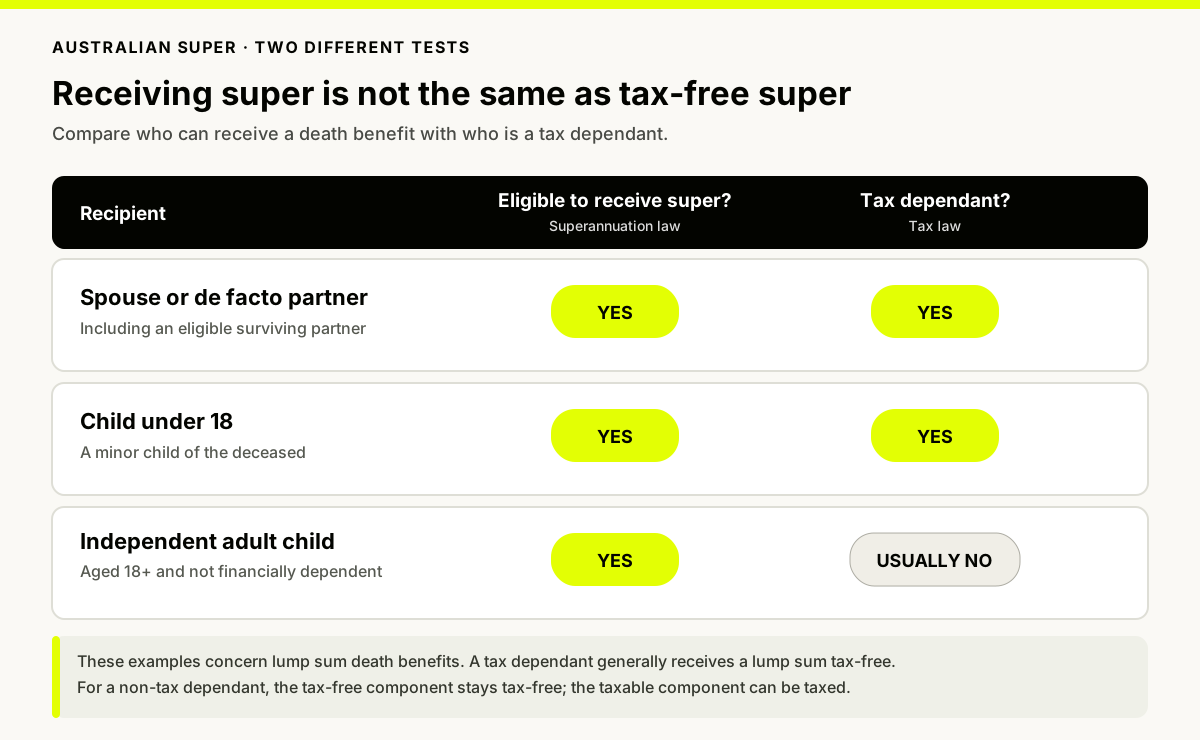
Super law and tax law use different dependant definitions. A child may qualify to receive a super death benefit under super law but not qualify for tax-free lump sum treatment under tax law when financially independent and an adult.
The trustee's payment eligibility decision therefore does not settle the tax outcome. Record the recipient's relationship and financial circumstances separately for each test.
Which steps determine whether super goes directly to a person or through an estate?
The trustee checks the fund rules, valid binding nomination, eligible recipients and any direction to pay the legal personal representative. These factors determine whether the benefit goes directly to beneficiaries or first enters the estate.
Where a nomination directs payment to the legal personal representative and is valid, estate administration follows. In the absence of an effective binding direction, the trustee makes its decision under the applicable rules.
How can beneficiaries reconcile a death benefit quote with the final payment?
Compare the member's date-of-death balance, subsequent investment movements, fees, accepted insurance proceeds and any tax withholding with the amount ultimately paid. An initial account estimate is not necessarily the final payable amount.
Request the fund's benefit statement or payment breakdown and distinguish gross entitlement from the net amount received.
Can super be paid to an adult child who is financially independent?
YES, an adult child can generally receive a super death benefit as a child of the deceased under super law. Being financially independent does not automatically disqualify them from receiving a lump sum.
An independent adult child is generally not a tax dependant, so the taxable component can be taxed. Do not treat beneficiary eligibility as proof of tax-free treatment.
Does a binding nomination always last for three years?
NO, some binding nominations lapse after three years while other arrangements are non-lapsing. The term depends on the fund's rules and the type of nomination it offers.
Confirm the nomination's status with the fund and check whether the named recipients remain eligible.
Can a super death benefit include life insurance?
YES, a death benefit can include life insurance held through the deceased member's super fund when the cover was active and the insurer accepts the claim.
Policy conditions, exclusions and any premium or cover changes affect the amount payable. The insured sum should not be added to the account balance until confirmed.
Can the super trustee ignore a non-binding nomination?
YES, the trustee can make a different distribution from a non-binding nomination when its legal duties and the fund's rules require another decision.
The nomination remains relevant evidence of the member's wishes, but it does not automatically determine the recipients.
Does naming a beneficiary in your will guarantee they get your super?
NO, naming someone in a will does not guarantee they receive super paid directly by a fund trustee. Super generally sits outside the estate unless paid to the legal personal representative.
A valid binding nomination and the fund rules are critical when deciding where the payment goes.
Can a beneficiary receive a super pension instead of a lump sum?
YES, an eligible beneficiary can sometimes receive a death benefit income stream rather than a lump sum, subject to the beneficiary's relationship, age and the applicable super and pension rules.
Not every recipient qualifies for a death benefit pension. Confirm pension eligibility and tax treatment with the fund before choosing a payment arrangement.
Sources and verification (October 2026)
- Australian Taxation Office, Superannuation death benefits (2026).
- Australian Taxation Office, Superannuation lump sums and death benefits (accessed October 2026).
- ASIC Moneysmart, Who gets your super if you die (2 October 2026).
- ASIC Moneysmart, Claiming a super death benefit (30 July 2026).
- Australian Taxation Office, Paying superannuation death benefits (accessed October 2026).
Fund-specific nomination provisions, SMSF trust deeds, insurance terms and individual tax outcomes require case-specific checking.
Written by
Superannuation Calculator Australia
Calculation guidance and general information; independent financial advice is not provided.