Who Can Be a Superannuation Beneficiary?
Who can receive your super? Understand Australian eligibility rules, beneficiary nominations, estates and death benefit tax.
Superannuation Calculator Australia · · 12 min read
A superannuation beneficiary is an eligible person, or the deceased member's legal personal representative, who receives a death benefit from a super fund. Eligible recipients generally include a current spouse, children, financial dependants and people in an interdependency relationship. An estate provides another route. Superannuation law determines who can receive a benefit; separate tax rules determine the tax treatment. Checking both sets of rules helps prevent nomination mistakes.
Who Can Receive Your Super When You Die?
Australian super funds generally pay a deceased member's benefit to eligible dependants under superannuation law or to the deceased estate through the legal personal representative. The benefit can include the account balance and insurance proceeds held within super.
Eligible payees include:
- A current spouse or de facto partner
- Children of any age
- People financially dependent on the member when they died
- People in an interdependency relationship with the member
- The deceased member's legal personal representative, acting for the estate
Use this eligibility check before submitting a nomination:
- Identify whether the intended recipient qualifies as a spouse, child, financial dependant or person in an interdependency relationship.
- If direct eligibility is not established, consider whether a nomination of the legal personal representative aligns with the intended estate distribution.
- Confirm which nomination types the fund permits and check signing, witnessing and expiry conditions.
- Check death-benefit tax treatment separately from eligibility to receive the benefit.
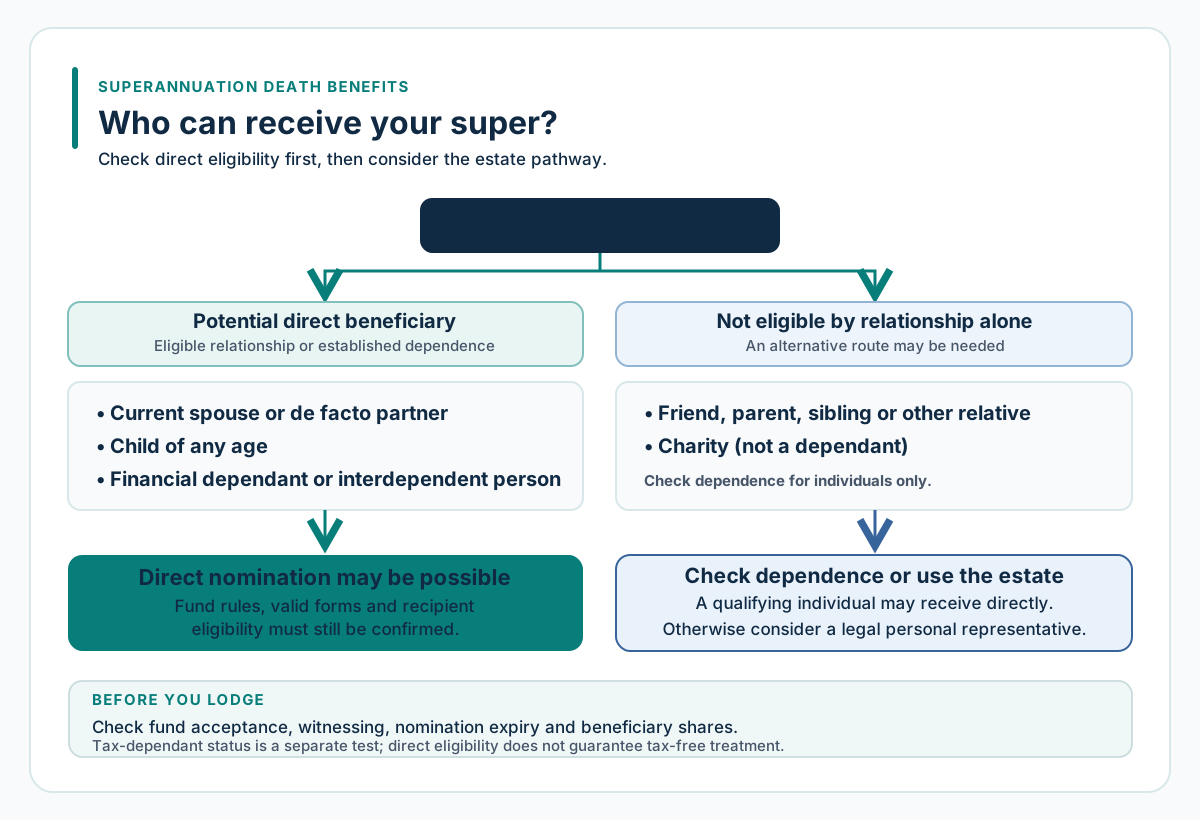
For example, an independent 35-year-old child is eligible to receive a lump-sum super death benefit directly, but generally does not qualify as a tax-law dependant. By contrast, a close friend is not eligible merely because they are named in a will. Payment to the estate may be an appropriate route if the member wants the will to provide for that friend. These examples assume the fund's governing rules and all relevant legal conditions are satisfied.
Eligibility alone does not guarantee payment. The trustee considers the nomination, fund rules and evidence relating to the circumstances at death. For the wider distribution process, see what happens to super when you die.
Can Your Spouse or Children Be a Super Beneficiary?
YES, a current spouse or de facto partner can generally receive a super death benefit, as can a child of any age. Spouses include qualifying same-sex de facto partners. Children can include adopted children and stepchildren under the applicable statutory definition.
Adult children do not need financial dependence to qualify under superannuation law, although their tax treatment can differ. A fund may request identity and relationship documents.
How Does Financial Dependency Qualify Someone?
Financial dependence generally means the person relied on the member for necessary financial support at the time of death. The trustee examines actual financial arrangements, not just the description on a nomination.
Relevant evidence includes recurring transfers, household bills paid by the member, shared living costs and the recipient's own financial resources. Occasional gifts alone do not establish financial dependence. The fund considers the full circumstances.
What Is an Interdependency Relationship?
An interdependency relationship generally involves a close personal relationship, living together and providing financial support, domestic support and personal care. Statutory exceptions apply in certain disability or temporary-separation circumstances.
Living apart can still be consistent with an interdependency relationship in specified circumstances, including where disability or temporary separation affects cohabitation. A shared address or friendship alone does not establish interdependency. Relevant evidence includes household arrangements, financial responsibilities and the care provided. The trustee assesses the relationship against the statutory criteria.
Can Parents, Siblings or Friends Receive Super?
Parents, siblings and friends are not automatically eligible to receive super directly because of their relationship to the deceased. They can qualify if they satisfy the financial-dependence or interdependency tests.
Where a person cannot receive the benefit directly, nominating the legal personal representative can allow the benefit to enter the estate. A will can then determine its distribution, subject to estate law. Naming an ineligible person on a binding nomination does not override superannuation law.
Can You Leave Your Super to Your Estate?
YES, you can nominate the legal personal representative as a beneficiary in accordance with the fund's rules. The trustee pays the death benefit to the executor or administrator, who deals with it as part of the estate.
This route can provide for a friend, sibling or charity through a will when direct payment is unavailable. Consider estate administration, creditors and tax consequences. Super paid directly to another eligible beneficiary generally stays outside the estate.
How Do Super-Law and Tax-Law Dependants Differ?
Superannuation law determines who can be paid directly; tax law determines how the death benefit is taxed. For example, a financially independent adult child qualifies as a dependant for superannuation payment purposes, but generally not as a death-benefit dependant for tax purposes.
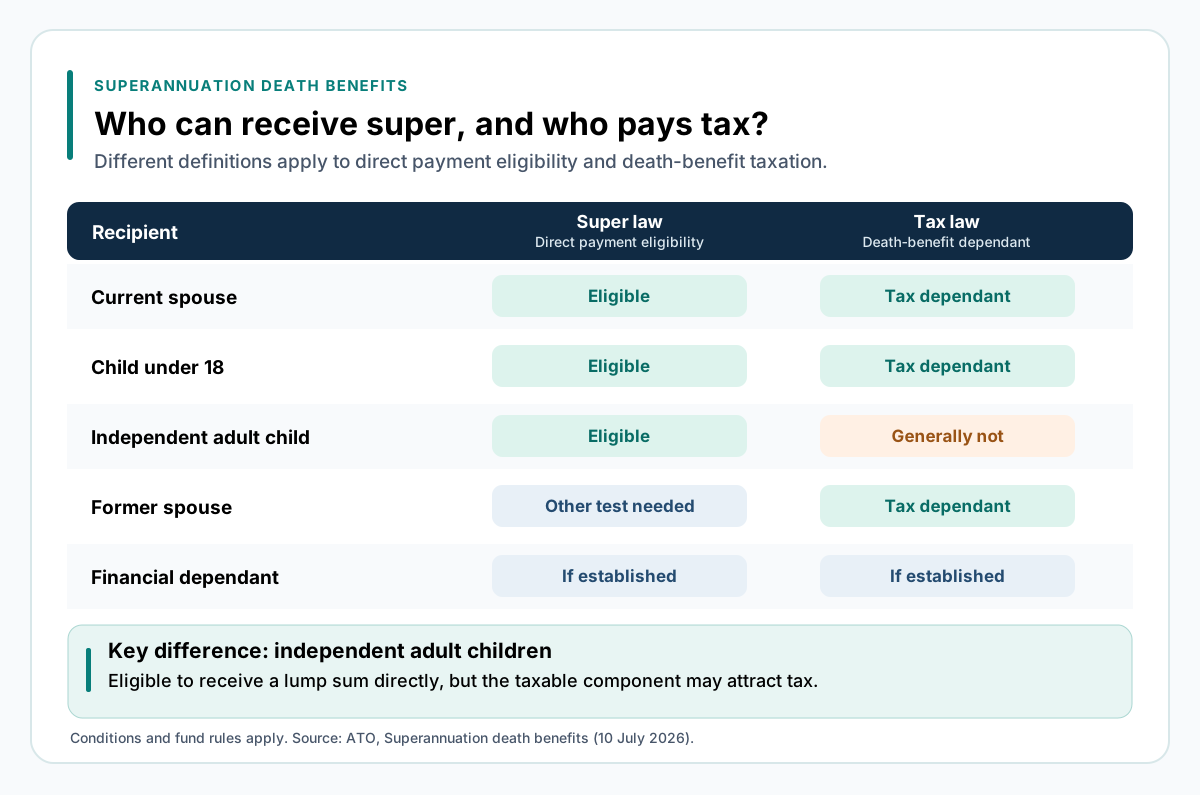
The table compares common categories. On smaller screens, scroll horizontally to read every column. Eligibility is assessed at the time of death.
| Recipient | Super-law dependant | Tax-law dependant |
|---|---|---|
| Current spouse | Generally yes | Generally yes |
| Independent adult child | Yes | Generally no |
| Former spouse | Not by former-spouse status alone | Yes |
| Financial dependant | Where dependence is established | Where dependence is established |
| Legal personal representative | Permitted recipient for the estate | Tax treatment considers ultimate beneficiaries |
According to the ATO's Superannuation death benefits guidance (10 July 2026), the definition used to determine tax treatment includes a former spouse. Former-spouse status alone does not establish direct-payment eligibility under superannuation law. Keep the two definitions separate when assessing a nomination or estimating tax.
Which Beneficiary Nomination Types Can You Use?
The main arrangements are binding, non-binding, non-lapsing binding and reversionary nominations. Not every fund offers all four options.
- Binding: The trustee must follow an effective and valid nomination of eligible recipients.
- Non-binding: The trustee considers the member's preference but retains discretion.
- Non-lapsing binding: The nomination has no automatic time expiry, subject to ongoing validity and the fund's conditions.
- Reversionary: An eligible recipient continues a super income stream after death under applicable pension rules.
See binding versus non-binding super beneficiary nominations for a detailed comparison.
When Does a Beneficiary Nomination Expire or Become Invalid?
According to ASIC MoneySmart's Who gets your super if you die (2 October 2026), a lapsing binding nomination generally expires after three years unless renewed. Others have different expiry rules. Nominations can also become ineffective because of ineligible recipients, procedural defects or changes affecting the nomination.
Marriage, divorce or separation can alter the intended or legally eligible recipient. A non-lapsing nomination is not automatically valid forever. Confirm the fund's accepted record, expiry date, witnessing requirements and trust deed provisions.
Can You Nominate Multiple Super Beneficiaries?
YES, many funds permit eligible beneficiaries to share a death benefit. Record each recipient's identity, qualifying relationship and required share. If the form requests percentages, check that they total 100%.
Accumulation and pension accounts can have different beneficiary arrangements. The trustee follows the applicable fund rules and legal requirements, not an informal instruction.
What Happens If You Have No Valid Beneficiary Nomination?
Where no valid binding nomination exists, the trustee generally decides how to distribute the death benefit under superannuation law and the fund's rules. It examines eligible dependants, any non-binding nomination and whether payment to the estate is appropriate.
The outcome can differ from the member's will or informal wishes. The estate does not automatically receive the super balance. Potential beneficiaries should contact the fund promptly.
What Evidence Will a Beneficiary Need to Claim Super?
A claimant generally needs evidence of death, identity, the relationship to the deceased and any relevant financial dependence or interdependency. The fund's requirements depend on the claim.
Documents can include a death certificate, marriage or birth certificate, bank records, statutory declarations and probate or letters of administration. Request the fund's claim checklist and keep copies of documents and correspondence.
Does a Super Beneficiary Have to Pay Tax?
A super death benefit is not automatically tax-free merely because the recipient qualifies under superannuation law. A lump-sum death benefit paid to a tax-law dependant is generally tax-free, whereas the taxable component paid to a non-dependant can attract tax. Tax treatment depends on tax-dependant status, the taxable and tax-free components, the payment type and the circumstances.
According to the ATO's Superannuation death benefits guidance (10 July 2026), a spouse generally qualifies as a death-benefits dependant for tax purposes; an independent adult child usually does not. A child under 18 generally qualifies for tax purposes, with additional statutory categories and exceptions for older children. Estate payments can require consideration of the ultimate beneficiaries. For rates and worked examples, see superannuation death benefits tax.
Which Family Changes Should Trigger a Nomination Review?
Review your nomination after marriage, separation, divorce, a birth or adoption, a beneficiary's death or a major change in financial support or care.
Also check changes to fund membership, pension arrangements and SMSF trust deeds. Compare intended recipients with fund records, eligibility and estate documents before completing a replacement form.
Do SMSF Beneficiary Rules Differ?
YES, self-managed super funds operate under superannuation law, but the SMSF trust deed and governing procedures are critical. The deed determines whether binding nominations are available and how they must be executed. Trustee succession also affects the administration of a death benefit.
Do not assume that the three-year rule applying to many regulated funds automatically applies to an SMSF. The ATO's Death of an SMSF member (2 April 2025) explains the trustee's death-benefit obligations. Obtain qualified advice on the deed and nomination.
What Should You Check Before Confirming a Beneficiary?
Verify the eligibility of each recipient or nominate the legal personal representative if the estate is intended to receive the benefit. Confirm the fund's requirements before relying on the nomination.
- Confirm the correct recipient type and eligibility under superannuation law.
- Check names, account coverage, benefit percentages and permitted nomination type.
- Check signing, witnessing, acceptance and expiry conditions.
- Compare the nomination with estate documents, family changes and potential tax treatment.
- Keep confirmation from the fund and review the nomination after significant changes.
Use the Superannuation Calculator Australia to estimate your retirement balance, but confirm beneficiary arrangements directly with your fund. Calculators do not determine the legal eligibility of a death-benefit recipient.
Can an Adult Child Receive Super Even if They Are Financially Independent?
YES, a financially independent adult child is generally an eligible dependant for superannuation payment purposes. However, they are usually not a death-benefit dependant under tax law, so the taxable component of a lump sum can be taxed. Rules for continuing a death-benefit pension are more restrictive.
Can You Nominate Your Former Spouse as a Beneficiary?
NO, former-spouse status alone does not generally qualify a person for direct payment under superannuation law. They might qualify through another dependency category or benefit through the estate. Tax law separately recognises a former spouse as a death-benefit dependant. Review nomination validity after divorce.
Can a Close Friend Be a Beneficiary Without Financial Dependence?
NO, friendship alone does not make someone eligible for a direct super death benefit. An interdependency relationship can establish eligibility even where financial dependence is absent, provided the statutory conditions are met. Otherwise, consider an estate nomination and appropriate will provisions.
Does a Will Automatically Override a Super Beneficiary Nomination?
NO, a will does not automatically override a valid super beneficiary nomination. Super benefits are administered under the fund's trust arrangements. A will directs the use of a super death benefit only once that benefit becomes part of the estate.
Can a Super Fund Pay a Benefit to Your Estate?
YES, a super fund can pay a death benefit to the deceased's legal personal representative under a valid nomination or another payment permitted by law and fund rules. The executor or administrator then deals with the money as part of the estate.
Can a Binding Nomination Expire?
YES, a lapsing binding nomination can expire, commonly after three years for many APRA-regulated funds. Non-lapsing arrangements can remain effective without a time-based renewal, provided their continuing validity conditions are met. Check the accepted nomination and expiry details with the fund.
Sources and verification (October 2026)
- Australian Taxation Office, Superannuation death benefits, updated 10 July 2026.
- ASIC MoneySmart, Who gets your super if you die, updated 2 October 2026.
- ASIC MoneySmart, Claiming a super death benefit, updated 30 July 2026.
- Australian Taxation Office, Death of an SMSF member, 2 April 2025.
- Australian Taxation Office, Paying superannuation death benefits, 6 November 2025.
This article provides general Australian superannuation information, not personal legal or tax advice. Check the governing rules of your fund and seek appropriately qualified advice for complex estates, SMSFs and tax treatment.
Written by
Superannuation Calculator Australia
Calculation guidance and general information; independent financial advice is not provided.