Superannuation Death Benefits Tax: Rates and Dependants
Understand Australian super death benefits tax, dependant rules, lump-sum rates, pensions and estate payments with examples.
Superannuation Calculator Australia · · 10 min read
Super death benefits may be tax-free or taxable depending on who receives them, the benefit's tax-free and taxable components and how it is paid. This guide explains tax dependants, lump-sum tax rates, death benefit pensions, deceased estate payments and a worked calculation. It provides general information, not personal tax advice.
What Is Superannuation Death Benefits Tax?
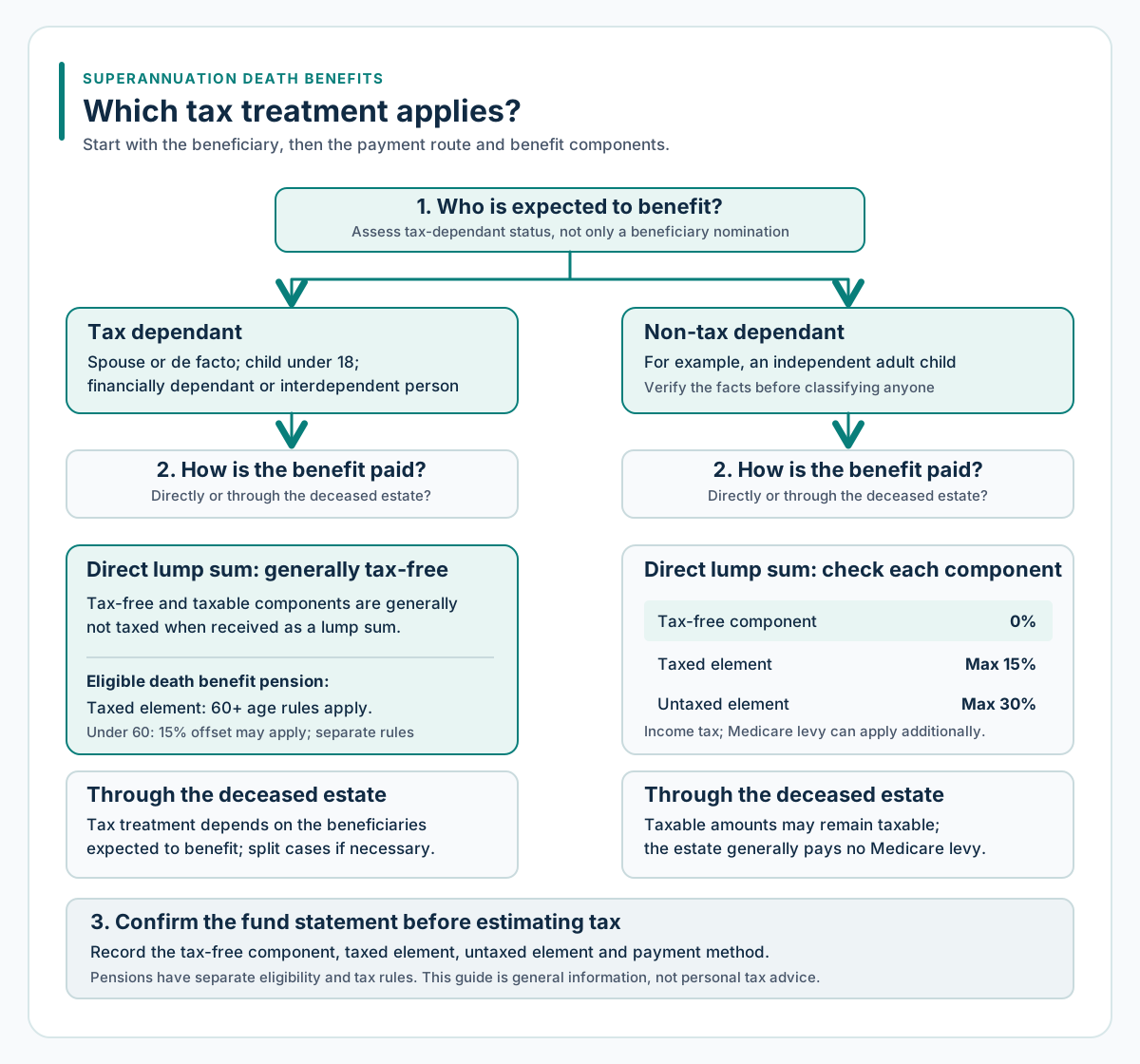
Superannuation death benefits tax is the tax treatment of super paid after a fund member dies. Tax depends on the beneficiary's tax-dependant status, the tax-free and taxable components and whether payment takes the form of a lump sum or income stream.
A death benefit can combine the deceased person's super balance and insurance inside super. Turning 60 does not automatically make a lump sum paid to a non-dependant tax-free. Australian Taxation Office (ATO) rules distinguish payments after death from ordinary member withdrawals.
Who Is a Tax Dependant for Super Death Benefits?
Tax dependants generally include a spouse or de facto partner, a child under 18, a financially dependent person or someone in an interdependency relationship with the deceased. A lump sum paid to a death benefits dependant for tax purposes is generally tax-free.
An independent adult child is not automatically a tax dependant. Financial dependence or interdependency is assessed on the circumstances at death. For example, an adult child who was genuinely financially dependent on the deceased can qualify for different tax treatment from an independent adult child. A former spouse's status and special categories, including certain deaths in the line of duty, require separate checks.
How Do SIS Dependants Differ From Tax Dependants?
Superannuation law and tax law apply different dependant definitions. The Superannuation Industry (Supervision) framework controls who can receive a benefit directly from a fund. Tax law decides whether the recipient receives tax-dependant treatment.
An independent adult child can qualify to receive a fund payment but still owe tax on the taxable component. Being named in a nomination does not change the tax test. The fund should confirm beneficiary eligibility separately from the tax-component statement.
Which Super Death Benefit Components Are Taxed?
A death benefit comprises a tax-free component and potentially a taxable component. The taxable component can have a taxed element and an untaxed element.
After-tax contributions often contribute to the tax-free portion. Concessional contributions and investment earnings generally contribute to the taxed element. Some benefits include an untaxed element, particularly where applicable amounts have not been taxed in the fund. Obtain the component breakdown from the super fund rather than inferring it from the total balance. According to the ATO's Superannuation death benefits guidance, the recipient's tax status and the components must be assessed together.
What Tax Rates Apply to Lump Sum Death Benefits?
A lump sum paid directly to a non-tax dependant is tax-free to the extent of its tax-free component. The taxable part is generally included in assessable income, with tax offsets limiting the applicable income-tax rates. The taxable taxed element is subject to a maximum 15% income tax, and the taxable untaxed element to a maximum 30% income tax. A Medicare levy can apply in addition.
A lump sum paid to a tax dependant is generally tax-free regardless of its components. The following table compares the principal direct-payment rules. According to the ATO's Tax on super death benefits guidance, the statutory tax offsets cap income tax on the taxed and untaxed elements received by non-dependants.
Compare the tax treatment by beneficiary and component. On smaller screens, scroll the table horizontally to see every column.
| Component | Tax dependant | Non-tax dependant |
|---|---|---|
| Tax-free component | 0% | 0% |
| Taxable taxed element | 0% | Up to 15% income tax, plus applicable Medicare levy |
| Taxable untaxed element | 0% | Up to 30% income tax, plus applicable Medicare levy |
These maximum income-tax rates are not a flat percentage of the entire balance. Individual Medicare levy treatment and payments made through an estate can change the final assessment.
How Are Death Benefit Income Streams Taxed?
A death benefit income stream is taxed differently from a lump sum. For an ordinary account-based death benefit pension, payments from the taxed element are generally tax-free if the deceased was 60 or older at death or the recipient is 60 or older when the payment is made.
If both people are under 60, the taxable taxed element is generally taxed at marginal rates, with a 15% tax offset. Untaxed elements and capped defined benefit income streams have distinct rules and restrictions. Not all beneficiaries can receive a death benefit pension.
Does Payment Through an Estate Change the Tax?
YES, payment through a deceased estate can change which entity accounts for the tax and the Medicare levy outcome. It does not automatically eliminate tax on a benefit ultimately intended for a non-tax dependant.
Under section 302-10 of the Income Tax Assessment Act 1997, the estate's legal personal representative applies the relevant tax treatment according to whether tax dependants or non-tax dependants are expected to benefit. Where both groups benefit, their respective portions require separate consideration. The estate generally does not pay Medicare levy on the taxable death benefit. That differs from direct payments to non-dependants.
How Is Super Death Benefits Tax Calculated?
Calculate the tax by identifying the recipient, each tax component and the payment route. Apply the relevant tax treatment separately rather than multiplying the entire super balance by 15% or 30%.
Before estimating tax, follow these steps in order:
- Ask the fund whether the payment will be a lump sum or a permitted death benefit income stream.
- Determine whether each intended recipient is a tax dependant; a super fund beneficiary nomination does not decide tax status.
- Obtain the fund's payment statement with the tax-free component, taxed element and untaxed element.
- Establish whether payment is made directly or through the deceased estate, and check potential Medicare levy consequences.
- Apply the relevant tax rates and offsets to each component. Confirm any exemptions and the final assessment with a registered tax agent when circumstances are complex.
The Super Contributions Calculator Australia estimates contributions, not death benefit tax.
Illustrative example: An independent adult child receives a $500,000 direct lump sum consisting of $100,000 tax-free, $350,000 taxable taxed and $50,000 taxable untaxed. Using maximum income-tax rates, the amount before Medicare levy is $67,500.
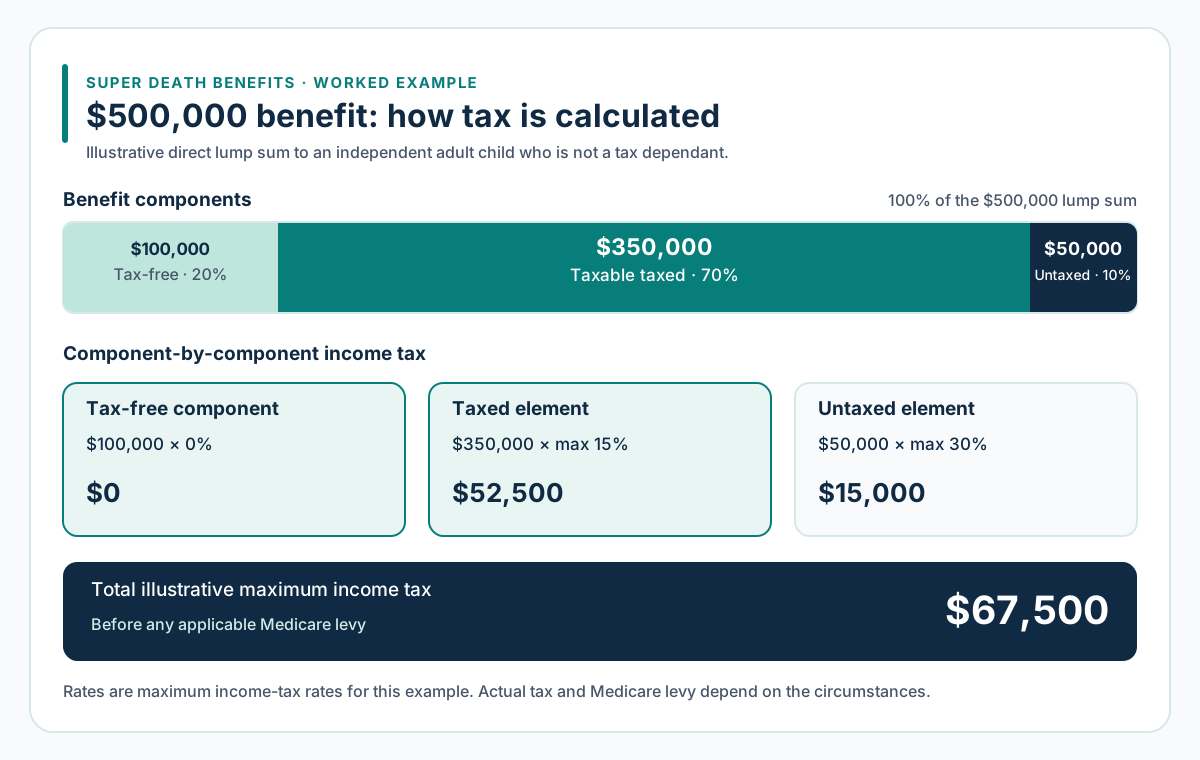
The amounts below are illustrative maximum income-tax calculations, excluding Medicare levy. On smaller screens, scroll horizontally to see all columns.
| Component | Amount | Rate | Illustrative income tax |
|---|---|---|---|
| Tax-free | $100,000 | 0% | $0 |
| Taxable taxed | $350,000 | 15% | $52,500 |
| Taxable untaxed | $50,000 | 30% | $15,000 |
| Total | $500,000 | Before Medicare levy | $67,500 |
If a full 2% Medicare levy applies to the $400,000 taxable portion, the simplified levy is $8,000 and the combined illustrative amount is $75,500. Actual Medicare levy liability depends on the individual's circumstances and assessment. Fund withholding, offsets and the final tax assessment can differ from this illustration. For comparison, if the same $500,000 benefit passed through an estate entirely for an independent adult child, the taxable elements could still attract income tax. However, the estate generally would not incur Medicare levy on that payment. This comparison assumes identical components and no other relevant adjustments; the estate's distribution records and intended beneficiaries determine the actual treatment.
When Must a Child Death Benefit Pension End?
A child death benefit pension generally must be commuted to a lump sum at age 25, unless an exception applies, including where the child meets the relevant permanent disability test. Children aged 18 to 24 ordinarily need to satisfy the rules for continuing an eligible child pension. This restriction concerns the continuing income stream rather than the underlying entitlement to the benefit. Confirm the pension terms with the super fund.
How Do Insurance Proceeds Change the Tax Components?
Insurance proceeds inside super can affect the mixture of taxed and untaxed components. Certain insured amounts can form an untaxed element where the corresponding amount has not previously been taxed in the fund. The insurance payout does not create its own universal tax rate. Request the final component statement from the fund.
Does a Binding Nomination Determine the Tax?
NO, a binding beneficiary nomination does not establish tax-dependant status. A valid nomination directs a benefit to eligible recipients, while tax law separately determines tax treatment according to the relationship and circumstances.
Can Super Death Benefits Tax Be Reduced?
YES, lawful planning can sometimes reduce the taxable component of a future death benefit. The result depends on withdrawal eligibility, contribution caps, timing and the person's circumstances.
A withdrawal and recontribution arrangement can change the proportion of tax-free and taxable components where both transactions are permitted. Before taking action, check the fund component statement, withdrawal conditions, available non-concessional cap, total super balance and the potential effects on insurance, Centrelink entitlements and investments. A recontribution is a new contribution and must satisfy the rules applying at the time. See personal super contributions and the super bring-forward rule for related contribution conditions.
Is a super death benefit lump sum tax-free for a spouse?
YES, a spouse who qualifies as a death benefits dependant generally receives a tax-free super death benefit lump sum, including amounts from the taxable taxed and untaxed elements. Different rules apply to some pension payments.
Does an independent adult child pay tax on the taxable component?
YES, an independent adult child who is not a tax dependant ordinarily pays tax on the taxable component of a directly paid lump sum. Maximum income-tax rates are 15% for the taxed element and 30% for the untaxed element, plus applicable Medicare levy.
Can a non-tax dependant receive an ongoing death benefit pension?
NO, a non-dependant generally cannot receive an ongoing death benefit pension. An independent adult child ordinarily receives a lump-sum death benefit rather than a continuing income stream, subject to the applicable legal eligibility rules.
Is the tax-free component always tax-free to a recipient?
YES, the identified tax-free component of a super death benefit lump sum is tax-free to its recipient, including a non-tax dependant. That does not exempt any taxable component.
Does paying through an estate always eliminate tax?
NO, a payment through an estate does not remove tax on the taxable component attributable to non-tax dependants. The estate's assessment and the Medicare levy outcome differ from direct fund payment.
Does a beneficiary nomination change tax-dependant status?
NO, a nomination does not itself change tax-dependant status. The relationship, financial dependency and interdependency rules determine that status independently of the nominated payment destination.
Sources and verification (October 2026)
- Australian Taxation Office, Paying superannuation death benefits, accessed October 2026.
- Australian Taxation Office, Tax on super death benefits, in Individual tax return instructions (2026), accessed October 2026.
- Australian Taxation Office, Superannuation death benefits, accessed October 2026.
- Australian Taxation Office, guidance on super death benefit income streams, accessed October 2026.
- Australian Government, Income Tax Assessment Act 1997, Division 302.
- Australian Securities and Investments Commission, Moneysmart, Claiming a super death benefit, updated July 2026.
This article provides general Australian tax information. Individual beneficiary eligibility, actual fund tax components and Medicare levy treatment require case-specific confirmation. Request the benefit statement and confirm the intended recipient before acting on an estimated tax figure.
Written by
Superannuation Calculator Australia
Calculation guidance and general information; independent financial advice is not provided.