Super Bring-Forward Rule: Eligibility and Caps
Understand 2026–27 bring-forward eligibility, $130,000 annual caps, balance limits and worked after-tax super contribution examples.
Superannuation Calculator Australia · · 8 min read
The super bring-forward rule lets eligible Australians contribute more than one annual after-tax contribution cap by using two or three years of non-concessional cap space sooner. For 2026–27, the ordinary annual cap is $130,000, with eligible three-year arrangements reaching $390,000. Age, total super balance and existing arrangements determine what is available. The rule does not increase the total cap over the period.
What Is the Super Bring-Forward Rule?
The bring-forward rule allows eligible people to access two or three years of non-concessional (after-tax) contribution capacity earlier. It applies to amounts counted towards the non-concessional cap, including personal contributions for which no tax deduction is claimed. For broader retirement projections, use the Superannuation Calculator Australia; its estimates do not establish ATO contribution eligibility.
What Are the 2026–27 Bring-Forward Limits?
According to the Australian Taxation Office (ATO), Non-concessional contributions cap (2026–27 rates, reviewed October 2026), the standard annual cap is $130,000. The available amount for a new arrangement depends on total super balance at 30 June 2026:
| Total super balance at 30 June 2026 | Maximum non-concessional contributions | Bring-forward period |
|---|---|---|
| Below $1.84 million | $390,000 | Three years |
| $1.84 million to below $1.97 million | $260,000 | Two years |
| $1.97 million to below $2.1 million | $130,000 | Annual cap only |
| $2.1 million or more | Nil | Not eligible |
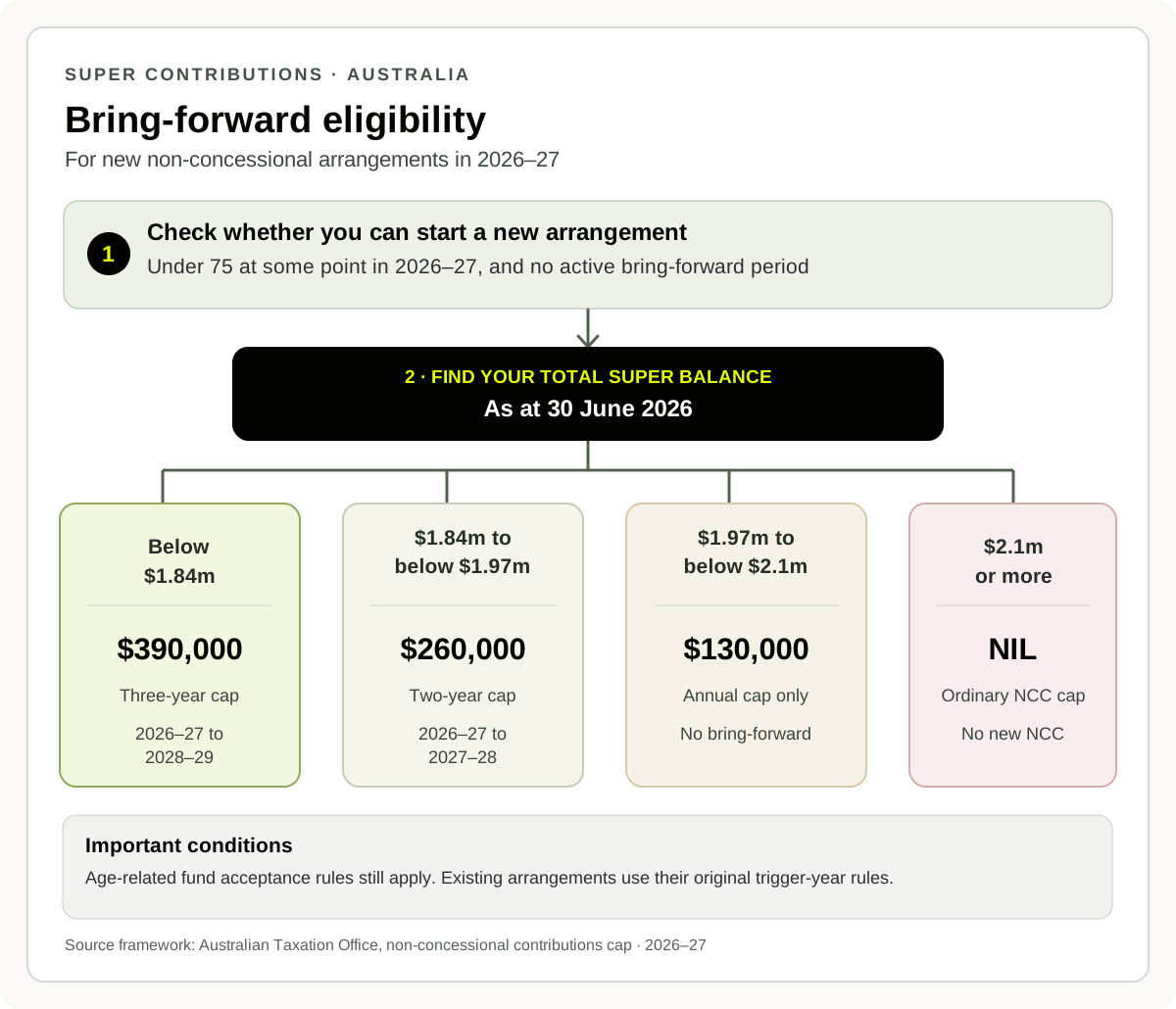
How to read the table: locate your total super balance at 30 June 2026 in the left column. The corresponding maximum is the total available for the stated period, not an amount that renews annually. These thresholds apply to new arrangements in 2026–27. An arrangement already triggered in 2025–26 keeps the amount and period fixed in its original trigger year.
How Does Total Super Balance Affect Eligibility?
The test uses total super balance at the preceding 30 June, taking account of relevant interests across funds. Exactly $1.84 million falls in the two-year tier, while exactly $1.97 million receives only the ordinary annual cap. Check relevant interests across funds rather than relying on one account's displayed balance.
Who Can Use the Bring-Forward Rule?
You generally must be under 75 at some point during the financial year, pass the total-super-balance conditions and not already be in an active arrangement. Special fund acceptance deadlines apply near age 75.
How Do You Trigger a Bring-Forward Arrangement?
An eligible person triggers the arrangement automatically by making counted non-concessional contributions above the ordinary annual cap. No application is required. The ATO combines counted non-concessional amounts across all super accounts.
- Confirm your total super balance and existing arrangement.
- Add up contributions made to all funds.
- Check the receiving fund's processing deadline.
- Transfer the money and retain evidence of fund receipt.
How Long Does the Two- or Three-Year Period Last?
The period includes the trigger financial year. A three-year arrangement starting in 2026–27 ordinarily ends on 30 June 2029; a two-year arrangement ends on 30 June 2028.
How Do You Calculate Your Remaining Bring-Forward Cap?
Subtract counted non-concessional contributions from the cap fixed when the arrangement was triggered. For example, $250,000 contributed against $390,000 leaves $140,000 before applying any later-year restrictions.
Worked Example: Contributing $200,000 in the First Year
An eligible $200,000 contribution in 2026–27 triggers the full $390,000 three-year limit, leaving $190,000 for later contributions, assuming no other counted payments or restrictions.
| Financial year | Illustrative contribution (AUD) | Remaining period cap (AUD) |
|---|---|---|
| 2026–27 | $200,000 | $190,000 |
| 2027–28 | $100,000 | $90,000 |
| 2028–29 | $90,000 | $0 |
Example assumptions: the member qualified for the full three-year cap at the trigger date, has no other counted non-concessional contributions and remains eligible to contribute in later years. The schedule is illustrative, not an individual cap determination. The $190,000 is available across the remainder of the period, not as a fresh allowance in each later financial year. The illustration assumes no later-year balance restriction.
What if Your Balance Exceeds the Limit in a Later Year?
A later increase in total super balance can reduce the remaining non-concessional cap to nil for that financial year, even where the originally triggered arrangement has unused capacity. The ATO explains that the remaining cap in the second or third year becomes nil when the preceding 30 June total super balance is at least the general transfer balance cap. For example, an arrangement triggered in 2026–27 can have unused cap space in 2027–28, but a total super balance at or above the relevant general transfer balance cap on 30 June 2027 makes the following year's non-concessional cap nil. Check the relevant threshold before transferring more money.
Bring-Forward vs Carry-Forward Contributions: What's Different?
Bring-forward uses future non-concessional cap capacity. Carry-forward uses eligible unused concessional cap amounts from the previous five financial years, subject to the carry-forward total super balance test of less than $500,000 at the preceding 30 June. Their tax treatment, balance thresholds and timeframes differ. For contribution classification, see concessional versus non-concessional contributions.
| Comparison attribute | Bring-forward: non-concessional | Carry-forward: concessional |
|---|---|---|
| Contributions | Non-concessional | Concessional |
| Cap years | Current and future | Eligible previous years |
| Typical tax treatment | After-tax; no personal deduction claimed | Employer or deductible personal amounts, generally taxed in the fund |
What Happens if You Exceed the Bring-Forward Cap?
An excess can lead to an ATO excess non-concessional contributions determination. The ATO ordinarily offers an election to release the excess and 85% of associated earnings, with associated earnings included in assessable income and a 15% tax offset, or retain the excess with tax at the highest marginal rate including Medicare levy. The applicable ATO determination sets the election deadline. These are different from ordinary contributions tax rules.
When Must Your Contribution Reach Your Fund?
Payments generally count when the super fund receives them, not when the bank transfer is initiated. For 2026–27, receipt generally must occur by 30 June 2027. Check fund cut-offs.
How Do Downsizer Contributions Differ?
Qualifying downsizer contributions follow separate eligibility, reporting and timing rules and generally do not count towards the ordinary non-concessional cap. Sale proceeds alone do not establish eligibility. Other specifically excluded types, such as eligible structured settlement and small business CGT cap contributions, have separate conditions and documentation requirements. Do not treat these as ordinary bring-forward contributions without checking their classification.
What Should You Check Before Making a Lump-Sum Contribution?
Before paying, check the preceding 30 June total super balance, existing bring-forward arrangements, contributions across all funds and payment cut-offs. For payment methods and receipt checks, read how to make personal super contributions.
- Review ATO online services via myGov.
- Reconcile current fund statements with potentially delayed ATO reports.
- Confirm the contribution type and fund receipt date.
- Add contributions across every fund before testing the annual threshold; for example, $90,000 at one fund plus $50,000 at another totals $140,000 and can trigger the rule for an eligible member.
- Check special contribution and deduction rules.
How Can You Check an Existing Bring-Forward Arrangement?
Use ATO online services linked through myGov to review reported non-concessional contributions and any existing arrangement information. Compare amounts and dates with each fund's transaction statement because reporting can lag. If records differ, obtain the fund's receipt confirmation before relying on the displayed remaining cap.
Does Indexation Increase an Already Triggered Bring-Forward Cap?
NO, a subsequent rise in the annual cap does not ordinarily increase the original arrangement's fixed maximum. A $360,000 arrangement triggered in 2025–26 does not automatically become $390,000 in 2026–27.
Can you trigger a bring-forward arrangement without applying?
YES, the arrangement triggers automatically once eligible counted non-concessional contributions exceed the annual cap.
Can you use the bring-forward rule after turning 75?
YES, in limited circumstances when the person was under 75 at some time during the financial year and the fund's age-related contribution acceptance rules permit the payment.
Can you use bring-forward contributions if your total super balance is $2.1 million?
NO, a total super balance of $2.1 million or more at 30 June 2026 results in a nil ordinary non-concessional cap for 2026–27. Earlier arrangements require separate assessment.
Does a $130,000 after-tax contribution automatically trigger bring-forward?
NO, $130,000 alone equals rather than exceeds the 2026–27 standard cap. Other counted payments can cause an exceedance.
Can you make contributions to two super funds under the same bring-forward cap?
YES, counted amounts across funds are aggregated. Two payments of $100,000 to separate funds count as $200,000 towards one person's cap. Each account does not receive a separate $130,000 annual cap.
Are bring-forward contributions tax-deductible?
NO, non-concessional amounts generally are not personally deductible. A valid deduction changes the deductible portion to concessional treatment and a different cap.
Can an existing bring-forward arrangement extend beyond three years?
NO, unused capacity does not extend the initial statutory period. A new arrangement requires fresh eligibility after expiry.
Sources and verification (October 2026)
- Australian Taxation Office, Non-concessional contributions cap, 2026–27 thresholds, period and indexation rules; verified 17 October 2026.
- Australian Taxation Office, Personal super contributions, age and classification rules; reviewed October 2026.
- Australian Taxation Office, Non-concessional contributions cap and Release authorities, excess contributions elections and tax treatment; checked October 2026.
- Australian Taxation Office, Downsizer super contributions, separate eligibility rules; reviewed October 2026.
Written by
Superannuation Calculator Australia
Calculation guidance and general information; independent financial advice is not provided.