Spouse Super Contributions: Eligibility, Tax Offset and How to Claim
Check spouse super contribution eligibility, income thresholds and the $540 tax offset. Learn how to contribute and claim in Australia.
Superannuation Calculator Australia · · 11 min read
Spouse super contributions are after-tax payments made directly to a married or de facto partner's super account. An eligible person can claim a tax offset of 18% of qualifying contributions, up to $540 per financial year. The offset depends on the receiving spouse's income, the amount paid and other Australian Taxation Office (ATO) eligibility conditions.
What are spouse super contributions
A direct spouse contribution adds money to your partner's super account rather than your own. It is generally a non-concessional contribution of the receiving spouse. The money belongs to their super account and remains subject to ordinary preservation and release rules. It is different from transferring eligible contributions already made into your own account through contribution splitting. For broader retirement estimates, use the Superannuation Calculator Australia.
Who is eligible for the spouse super tax offset
The person making the payment and the receiving spouse must satisfy the ATO's eligibility conditions for the income year. Eligible spouses include married and de facto partners, including same-sex partners. The person must be your spouse when you contribute. Both must be Australian residents at that time and must not live permanently separately and apart. Being married or in a de facto relationship alone does not establish eligibility.
- The receiving spouse must have relevant income below $40,000.
- The receiving spouse must be under 75, with applicable fund acceptance requirements also satisfied.
- The recipient must not exceed their non-concessional contribution cap in the payment year. Their total super balance on the preceding 30 June must be below that year's general transfer balance cap: $2.1 million for 2026–27 or $2 million for 2025–26.
- The contributor cannot claim a tax deduction for the same direct spouse payment.
According to the ATO's Spouse super contributions guidance, these tests apply alongside the requirement that the payment reach a complying super fund or retirement savings account. Confirm the receiving fund can accept the payment before transferring it.
How do spouse income thresholds affect the tax offset
The full offset base is available at spouse income of $37,000 or less; it progressively reduces above $37,000 and reaches zero at $40,000. Relevant income includes assessable income excluding assessable First Home Super Saver released amounts, total reportable fringe benefits amounts and reportable employer super contributions. It is not simply take-home pay or taxable income after deductions. According to the ATO's Superannuation-related tax offsets (8 June 2026), these components determine the thresholds.
The contribution base falls as the receiving spouse's relevant income rises. On smaller screens, scroll horizontally to read the full table.
| Receiving spouse's relevant income | Maximum contribution base |
|---|---|
| $37,000 or less | $3,000 |
| $38,000 | $2,000 |
| $39,000 | $1,000 |
| $40,000 or more | $0 |
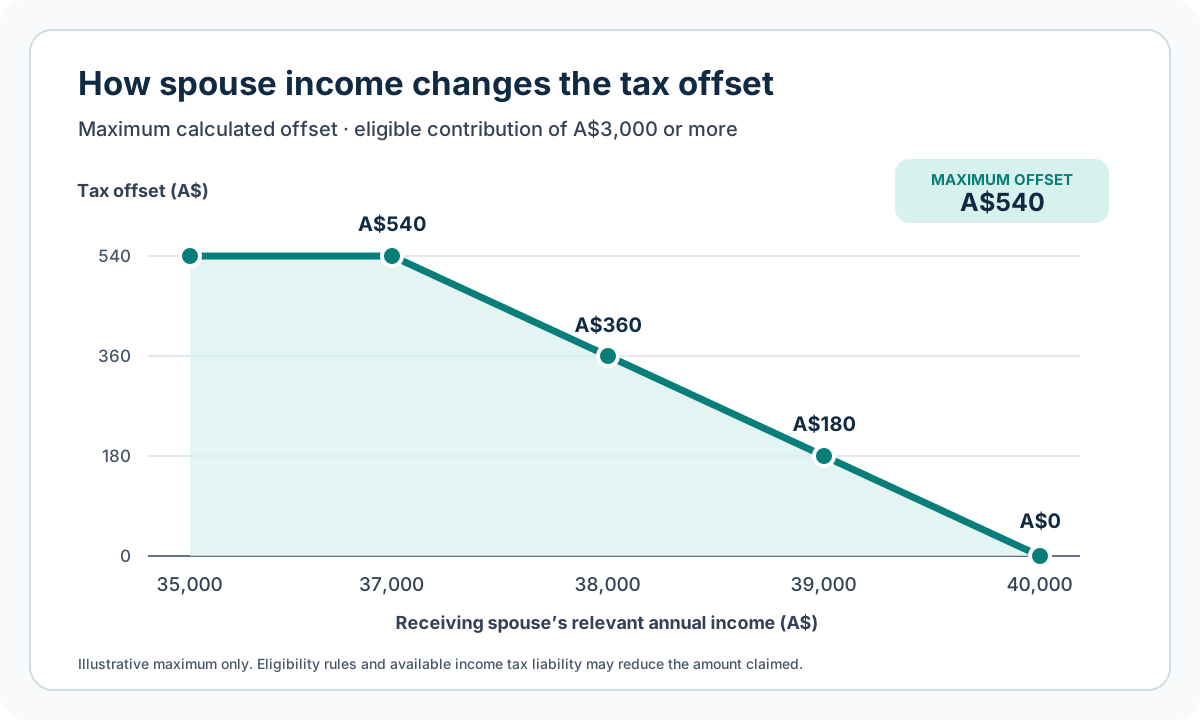
The base reduces by $1 for each $1 of relevant income above $37,000. The offset is 18% of the lower of this base and the qualifying amount contributed. The contribution paid can exceed the base, but the excess does not generate another spouse offset.
How do you calculate the spouse contribution tax offset
The offset is 18% of the lower of the eligible contribution and the income-adjusted contribution base, with an overall maximum of $540. The income-adjusted base equals $3,000 minus the amount by which the receiving spouse's relevant income exceeds $37,000, with a minimum of zero. This is the calculation in section 290-235 of the Income Tax Assessment Act 1997.
For an eligible spouse whose income does not exceed $37,000, a $3,000 payment produces $540, a $2,000 payment produces $360 and a $1,000 payment produces $180 before any limitation from the claimant's available tax liability.
For example, if the recipient's relevant income is $38,500 and the payment is $3,000, the adjusted base is $1,500 and the calculated offset is $270 (18% × $1,500). This is an illustrative calculation, not a personal tax assessment. The spouse tax offset is non-refundable: it cannot create a tax refund beyond the claimant's otherwise payable tax.
How do you make a spouse super contribution
Use the receiving spouse's own fund instructions and identify the payment as a spouse contribution. Accepted channels and references vary by fund.
- Confirm the receiving spouse's account is active and accepts spouse contributions.
- Check the recipient's age, total super balance, contribution caps and the fund's payment cut-offs.
- Obtain the fund's spouse-contribution form or correct payment reference.
- Make the payment and retain the transaction receipt.
- Confirm the fund has allocated it to the correct member, contribution type and financial year.
Do not use another member's BPAY reference or assume that an initiated bank transfer has been received by the super fund.
How do you claim the spouse super tax offset in myTax
The contributing spouse claims the eligible offset in their own individual income tax return, including through myTax. The receiving spouse does not claim it.
- In Personalise return for myTax 2026, indicate that you had a spouse and select You're claiming tax offsets or adjustments, then Other tax offsets.
- In Prepare return, open Offsets and select Super contributions on behalf of your spouse.
- Enter the spouse's requested income components and the total contributions paid, rather than the $540 maximum. myTax calculates the offset.
- Check all figures against fund records and save the section.
These labels are from the ATO's myTax 2026 Superannuation contributions on behalf of your spouse (1 June 2026), covering the 2025–26 return. Later myTax labels can change.
Which contribution caps apply to spouse super payments
A direct spouse contribution generally uses the receiving spouse's non-concessional contributions cap, not the paying spouse's concessional cap. The $3,000 amount is the maximum base for this particular offset, not a universal contribution limit.
The ATO's Caps, limits and tax on super contributions (2026 guidance) lists the standard 2026–27 non-concessional cap at $130,000, compared with $120,000 for 2025–26. The recipient's available cap and bring-forward eligibility depend on their total super balance and any existing arrangement. Review these before making a larger payment. For an explanation of tax treatment, see concessional versus non-concessional contributions. To understand direct payments more broadly, see personal super contributions. The Super Contributions Calculator Australia can estimate contribution scenarios but does not establish offset eligibility.
How does spouse contribution splitting differ from a spouse payment
A direct spouse payment adds new after-tax money to the receiving spouse's account; contribution splitting moves an eligible portion of concessional contributions already made to the contributor's account. Contribution splitting itself does not qualify for the spouse contribution tax offset.
| Attribute | Direct spouse contribution | Contribution splitting |
|---|---|---|
| Money moved | New after-tax contribution | Eligible contributions already in your super |
| Destination | Spouse's super account | Spouse's super account |
| Ordinary cap treatment | Recipient's non-concessional cap | Original contribution remains counted against contributor's relevant cap |
| Spouse tax offset | Potentially available if eligible | Not available for the split |
| Process | Pay the receiving fund | Apply to the fund holding the original contributions |
The fund may limit which contributions are eligible for splitting and when an application can be made. A contribution made to satisfy a spouse's entitlement under a family-law super splitting obligation is not eligible for this offset, according to the ATO's 2026 myTax instructions.
How much offset applies at different spouse incomes and contribution amounts
The offset depends on both the actual contribution and the spouse's income-adjusted base. The following figures are illustrative and assume all other eligibility conditions are satisfied and sufficient tax liability exists.
| Spouse income | Eligible contribution | Maximum offset |
|---|---|---|
| $35,000 | $3,000 | $540 |
| $35,000 | $2,000 | $360 |
| $38,000 | $3,000 | $360 |
| $39,000 | $3,000 | $180 |
| $40,000 | $3,000 | $0 |
Is a spouse super tax offset the same as a tax deduction
NO, a tax offset reduces eligible tax payable, while a tax deduction reduces taxable income. An eligible personal super contribution deduction relates to contributions made to the claimant's own fund and requires separate notice and acknowledgement rules. A direct spouse payment used for the spouse offset is not also deductible to its payer.
When must a spouse super contribution reach the fund
The fund must receive the contribution within the financial year for which the offset is claimed. For the year ending 30 June, account for transfer and fund processing times. Initiating a payment on 30 June does not prove that the fund received it that day.
How can you check that the fund recorded a spouse contribution correctly
Match the receiving spouse's fund transaction to your payment record. Confirm the amount, effective date, receiving account and spouse-contribution classification. If the record is missing or incorrectly classified, ask the fund for written confirmation or correction before lodging the tax return.
What should you check if the spouse tax offset does not appear in myTax
Check the tax-offset item, spouse details and the contribution's eligibility. Confirm the payment reached the correct fund in the relevant year. Recheck the spouse income test, residency, recipient age and total super balance conditions. If a lodged return omitted an eligible offset, follow the ATO's amendment guidance or consult a registered tax agent.
Is there any tax offset benefit from contributing over $3,000
NO, a direct spouse contribution above $3,000 does not increase this tax offset beyond $540 in the income year. Additional contributions can still build retirement savings if the fund can accept them and the recipient satisfies the applicable contribution cap rules.
Can a spouse payment qualify for the government co-contribution
NO, a contribution made by one spouse into the other's account is not the receiving spouse's own eligible personal contribution for the government co-contribution. The recipient can instead be assessed separately for their own eligible after-tax contributions. The government super co-contribution has different eligibility conditions.
Why might couples use spouse contributions to balance retirement savings
Couples can use direct spouse contributions to add savings to the partner with a lower super balance, potentially alongside an eligible tax offset. Future benefits depend on each account's investment performance, fees, insurance costs, contribution caps and access conditions. The Super Projection Calculator Australia can compare long-term savings scenarios using stated assumptions. Balancing accounts does not guarantee a higher combined retirement income.
Can you claim an offset for a de facto partner
YES, de facto partners fall within the ATO's spouse definition for this offset when the other conditions are satisfied. The relationship alone is insufficient: residency, income, age and relevant super limits still apply.
Can the receiving spouse claim the offset instead
NO, the tax offset belongs to the eligible person who makes the contribution. The receiving spouse owns the amount credited to their fund, while the contributing spouse claims the offset in their own return.
Can you receive the full $540 offset on a $2,000 contribution
NO, an eligible $2,000 contribution generates a maximum offset of $360 at the full 18% rate. A contribution of at least $3,000 is required to reach the $540 calculation ceiling, provided the spouse income test and all other conditions allow it.
Can a spouse contribution be made after 30 June for the previous tax year
NO, a payment received by the fund after 30 June generally counts in the new financial year. The sender's bank initiation date does not normally allow a contribution to be backdated. Check the fund's recorded receipt date.
Can a spouse contribution exceed $3,000
YES, a direct spouse payment can exceed $3,000 if the receiving fund accepts it and the recipient remains within applicable contribution rules. The amount above $3,000 does not create another spouse contribution tax offset.
Can you claim both a personal contribution deduction and the spouse offset on the same payment
NO, the payer cannot treat one direct spouse payment as both their deductible personal contribution and an eligible spouse offset contribution. A personal deductible payment into the payer's own fund is a different transaction, even if they subsequently request a qualifying contribution split.
Sources and verification (October 2026)
- Australian Taxation Office, Spouse super contributions, 2 August 2023; verified 17 October 2026.
- Australian Taxation Office, Superannuation-related tax offsets, 8 June 2026; verified 17 October 2026.
- Australian Taxation Office, Super co-contribution, verified 17 October 2026.
- Australian Taxation Office, Caps, limits and tax on super contributions, 2026 guidance; checked 17 October 2026.
- Australian Government, Income Tax Assessment Act 1997, sections 290-230 and 290-235, compilation current August 2026; checked 17 October 2026.
- Australian Taxation Office, myTax 2026 Superannuation contributions on behalf of your spouse, 1 June 2026; verified 17 October 2026.
- Australian Taxation Office, Personal super contributions, verified 17 October 2026.
- Australian Taxation Office, Superannuation contributions splitting, accessed 17 October 2026.
Written by
Superannuation Calculator Australia
Calculation guidance and general information; independent financial advice is not provided.