Government Super Co-Contribution: Eligibility, Income Limits and Payments
Check 2026–27 super co-contribution eligibility, income thresholds and how to receive up to $500 for eligible after-tax contributions.
Superannuation Calculator Australia · · 11 min read
Eligible Australians who make personal after-tax contributions can receive a government super co-contribution of up to $500 in 2026–27. Eligibility depends on income, age, employment or business earnings, total super balance and other Australian Taxation Office (ATO) rules. This guide explains the tests, calculation, contribution deadline and payment process.
What Is the Government Super Co-Contribution?
The government super co-contribution is an ATO-administered payment into a complying super fund for eligible people who make personal non-concessional contributions. The government ordinarily contributes 50 cents per eligible dollar, subject to a $500 maximum and an income-based phase-out.
For example, a $1,000 eligible after-tax payment can attract $500 when the individual meets all conditions and their income does not exceed the lower threshold. It is not an employer super guarantee payment or a refund of the original contribution. The super contributions calculator helps compare voluntary payment amounts, but does not determine ATO eligibility.
Who Is Eligible for a Government Super Co-Contribution?
You must satisfy all the ATO eligibility conditions for the relevant financial year:
- Make at least one eligible personal non-concessional contribution to a complying super fund.
- Have total income below the higher co-contribution income threshold.
- Derive at least 10% of the relevant income from employment-related activities, carrying on a business or both.
- Be under 71 years old at the end of the financial year.
- Meet the ATO's temporary-visa requirements, including applicable exceptions.
- Have a total super balance below the general transfer balance cap ($2.1 million for 2026–27) on the preceding 30 June.
- Not exceed the relevant non-concessional contributions cap and lodge the required income tax return.
Your fund also requires your tax file number (TFN) to accept personal contributions. Meeting a single test does not establish eligibility.
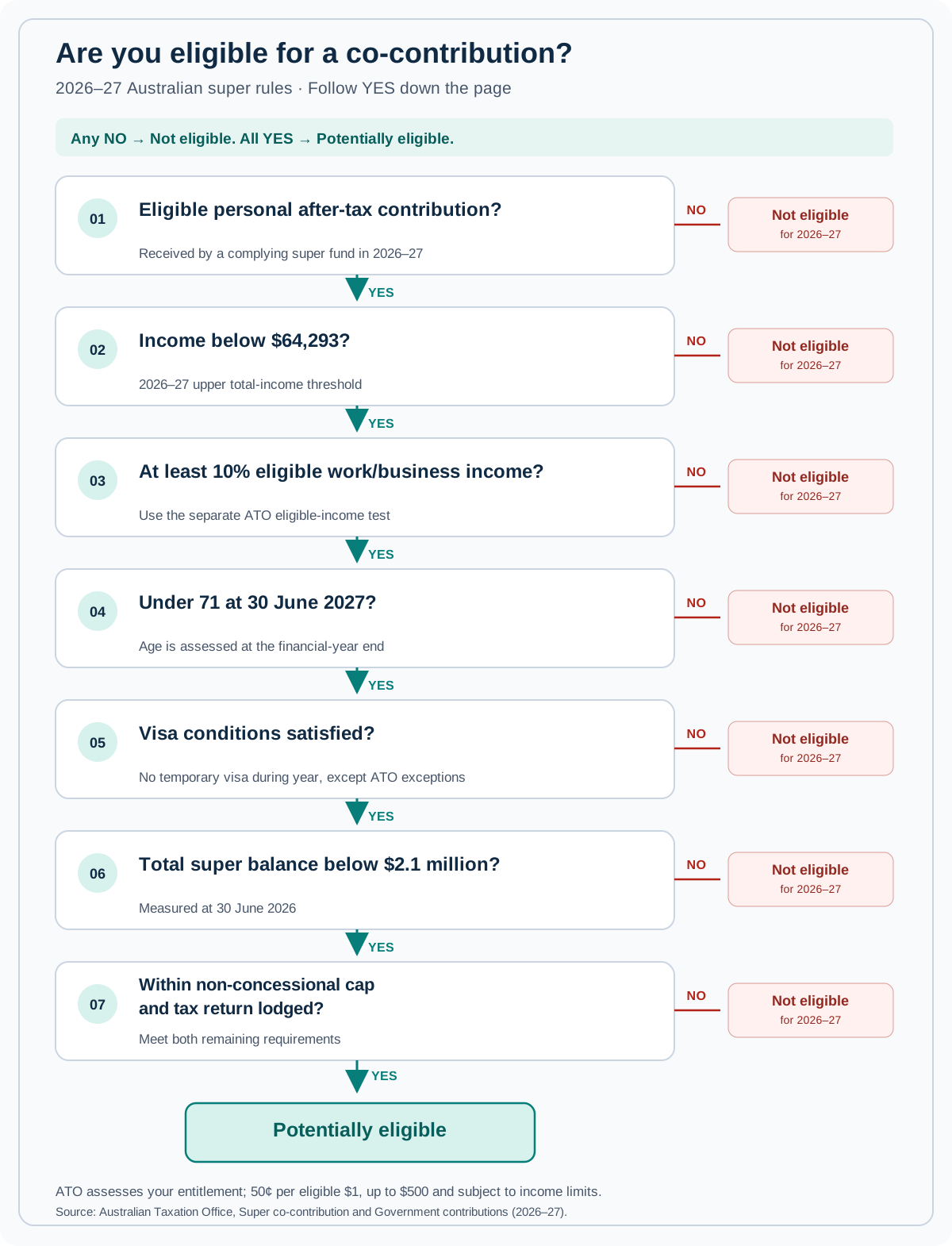
The diagram is a quick checklist, not a separate eligibility test. The income threshold and 10% eligible-income requirement use different ATO income definitions, and temporary-visa exceptions require individual review.
How Does the 10% Employment or Business Income Test Work?
At least 10% of the income used for the separate eligible-income test must come from employment-related activities, carrying on a business or both. Unlike the income threshold calculation, the ATO does not subtract allowable business deductions from the denominator for the 10% test. Salaries, wages, director fees and eligible sole trader or partnership business income are examples of qualifying income. Interest, rent, dividends and non-business trust distributions generally do not qualify.
Illustrative example: $6,000 eligible work income divided by $40,000 relevant income equals 15%. That passes the proportion test, but the person must still satisfy all other requirements. Investment income alone ordinarily does not meet the employment or business income requirement.
Which Income Thresholds Apply in 2026–27?
For 2026–27, the government co-contribution has a $49,293 lower income threshold and a $64,293 higher income threshold, according to ATO rates published for government contributions.
| Total income | Income-based maximum | Condition |
|---|---|---|
| Up to $49,293 | $500 | Subject to the contribution amount and all eligibility tests |
| Above $49,293 but below $64,293 | Reduces progressively | Income phase-out applies |
| $64,293 or more | $0 | Above the eligibility threshold |
These thresholds apply to annual income under the ATO test, not monthly take-home pay.
What Income Counts Towards the Threshold?
According to the Australian Taxation Office (ATO), Super co-contribution (accessed October 2026), the income threshold calculation adds assessable income, reportable fringe benefits and adjusted reportable employer super contributions, then subtracts any assessable first home super saver released amount and allowable business deductions. Reportable employer super contributions are reduced, but not below zero, by relevant excess concessional contributions.
Check the ATO's current definition before estimating your entitlement, particularly if you have investment income, business losses, salary sacrifice or reportable fringe benefits.
Which Contributions Qualify for the Government Match?
Personal non-concessional contributions made from after-tax money are potentially eligible. Employer super guarantee, salary sacrifice and personally deducted amounts do not qualify for the matching calculation.
The comparison below distinguishes qualifying after-tax payments from contributions that cannot attract the government match. On smaller screens, scroll horizontally to read the full table.
| Payment type | Counts towards the co-contribution? |
|---|---|
| Personal payment without a tax deduction | Yes, subject to other eligibility tests |
| Employer super guarantee | No |
| Salary sacrifice | No |
| Personal payment claimed as a tax deduction | No, to the extent deducted |
You can make multiple qualifying payments during the year. Their combined eligible amount is relevant when the ATO calculates the payment. See the guide to personal super contributions for fund payment steps.
Can I Claim a Tax Deduction on the Same Contribution?
NO, the amount claimed as an eligible personal tax deduction cannot also count as an eligible non-concessional amount for co-contribution purposes. Where only part of a payment is validly deducted, the undeducted part can remain eligible.
A notice of intent to claim a deduction changes the tax treatment of the relevant amount. Review the differences between concessional and non-concessional contributions before choosing.
How Much Government Co-Contribution Can You Receive?
Your co-contribution is generally limited to the lesser of 50% of eligible personal contributions and your income-adjusted maximum. According to the ATO, Super co-contribution (accessed October 2026), an entitlement below $20 is paid as $20 when all eligibility conditions are met, and payments are rounded up to the nearest five cents. This minimum does not make an ineligible person eligible.
| Annual income | After-tax deposit | Illustrative co-contribution |
|---|---|---|
| $40,000 | $200 | $100 |
| $40,000 | $1,000 | $500 |
| $56,793 | $200 | $100 |
| $56,793 | $1,000 | $250 |
| $64,293 | $1,000 | $0 |
The examples assume every other eligibility condition is met. The ATO determines actual entitlements using tax return and fund information.
How Does the Payment Reduce Above the Lower Income Threshold?
The $500 income-based maximum falls by $500 across the $15,000 income band, equivalent to approximately 3.333 cents per dollar above $49,293. It reaches zero at $64,293, before applying the separate contribution-size limit. The actual co-contribution remains capped at 50% of eligible contributions.
For example, an income of $56,793 is $7,500 above the lower threshold, reducing the income-based maximum by $250 to $250 before relevant ATO rounding.
What Do Worked Income and Deposit Examples Show?
The payment is constrained by both the size of the personal contribution and annual income. At $40,000 income, a $200 eligible deposit produces an illustrative $100 payment, while a $1,000 deposit produces $500. At $56,793 income, a $1,000 deposit produces only $250 because the income-based cap is lower.
For another example, a fully eligible low-income earner making a $20 after-tax contribution ordinarily qualifies for the $20 minimum payment even though half the deposit is $10. A person who fails an eligibility test does not qualify for this minimum. Use the ATO calculator for a personal estimate.
How Do You Make and Receive a Co-Contribution?
You make an eligible after-tax contribution, lodge your tax return and the ATO automatically assesses and pays the government amount to your super fund. A separate co-contribution application is generally unnecessary.
- Confirm your eligibility and check your fund's personal contribution payment details.
- Pay an after-tax contribution using the fund's approved method.
- Check the transaction in your fund account, including its received date and classification.
- Lodge your income tax return for the year.
- Check your ATO online services and super fund transaction history for the payment.
When Must the Fund Receive Your Contribution?
The fund must receive the eligible contribution within the relevant financial year, ordinarily by 30 June. Initiating a BPAY payment on 30 June does not ensure the fund receives it that day.
Allow time for bank and fund processing, retain confirmation and verify the recorded receipt date. The payment date is more important than the day you first instructed your bank.
How Do You Check If the ATO Has Paid?
Check ATO online services through myGov and your fund's transaction history. According to the ATO, Super co-contribution (2 August 2023), most payments for the previous financial year are made between November and January, after required tax and fund reporting. This is not a guaranteed payment date.
If no payment appears, first check whether your contribution was reported correctly and whether your income tax return was processed. Check that the Government super contribution labels on the return are accurate; incomplete information can affect the assessment. A fund unable to accept a payment, for example because it lacks your TFN, must return it to the ATO. Ask the ATO or fund to investigate with the transaction details after the required tax return and fund reporting information is available.
How Is Co-Contribution Different From LISTO?
The government super co-contribution relates to eligible personal after-tax contributions. The low income superannuation tax offset (LISTO) is a separate government payment associated with eligible concessional contributions and has different income and calculation rules.
These are separate government payments with different contribution types and eligibility tests. On smaller screens, scroll horizontally to compare them.
| Feature | Co-contribution | LISTO |
|---|---|---|
| Contribution basis | Eligible personal non-concessional payments | Eligible concessional contributions |
| Government amount | Up to $500, subject to income and eligible personal payments | Up to $500 under LISTO rules |
| Action required | Make an eligible after-tax personal contribution | No separate eligible after-tax personal payment required |
| Assessment | ATO co-contribution eligibility and income tests | Separate ATO LISTO eligibility tests |
The same person can potentially qualify for both payments when the separate requirements are satisfied. A government co-contribution is not taxed when paid into super and is not reported as personal income, but it is preserved under ordinary super access rules. Subsequent investment earnings are subject to the fund's applicable tax rules.
What Special Eligibility Situations Need Checking?
Part-time workers, students and self-employed people can qualify when their actual employment or business income meets the 10% test and every other condition is satisfied. Student status alone does not establish or exclude eligibility.
Where multiple super funds exist, check which fund received the eligible payment and whether the ATO has current payment details. Total super balance is considered across relevant interests. The ATO ordinarily pays to a fund receiving qualifying personal contributions. If you prefer a particular fund, contact the ATO and nominate the fund before lodging your tax return, according to its Super co-contribution guidance.
What Are the Main Co-Contribution Mistakes to Avoid?
The most frequent avoidable errors involve using an excluded contribution type, missing the 30 June fund-receipt deadline, claiming a deduction on the same amount or assuming income alone determines eligibility.
- Check the contribution classification before claiming a deduction.
- Confirm the money reaches the fund during the intended financial year.
- Check the 10% income test, age, visa and prior 30 June total super balance rules.
- Retain payment evidence and lodge the relevant tax return.
- Use the ATO calculator for an estimate, not a guarantee of entitlement. To understand the broader effect of voluntary deposits, compare assumptions using the Superannuation Calculator Australia.
Can You Get a Co-Contribution If You Work Part-Time?
YES, part-time workers can qualify if they pass the 10% eligible employment or business income test and all other conditions. Hours worked are not a standalone eligibility threshold.
Can a Self-Employed Person Receive the Government Co-Contribution?
YES, an eligible self-employed person can receive the payment when business income meets the relevant test and all other requirements, including income and personal contribution tests, are satisfied.
Can You Receive the Co-Contribution If Your Income Exceeds $64,293?
NO, a person with total income at or above $64,293 in 2026–27 does not qualify for that financial year's co-contribution under the income threshold.
Can You Receive the Co-Contribution Without Lodging a Tax Return?
NO, lodging the relevant income tax return is ordinarily an eligibility condition. The ATO uses return and fund information to determine entitlement.
Can Salary Sacrifice Attract a Government Co-Contribution?
NO, salary sacrifice contributions are concessional and do not count as eligible personal non-concessional contributions for this payment.
Can You Receive a Co-Contribution After Turning 70?
YES, someone who turns 70 during the financial year can qualify while under 71 at 30 June, provided all other conditions are met.
Can You Receive the Co-Contribution If You Have Multiple Super Funds?
YES, holding multiple super accounts does not itself prevent eligibility. The ATO assesses applicable contributions and balance rules across relevant fund interests.
Sources and verification (October 2026)
- Australian Taxation Office, Super co-contribution, updated 2 August 2023, eligibility, income tests, minimum payment, fund nomination and typical payment timing, checked 17 October 2026.
- Australian Taxation Office, Government contributions, 2026–27 co-contribution thresholds ($49,293 and $64,293), accessed 17 October 2026.
- Australian Taxation Office, Super co-contribution calculator, accessed 17 October 2026.
- ASIC MoneySmart, Super contributions, Australian consumer guidance, accessed October 2026.
General information only, not personal financial or tax advice. All dollar examples are illustrative and subject to the ATO's final eligibility assessment.
Written by
Superannuation Calculator Australia
Calculation guidance and general information; independent financial advice is not provided.