Division 293 Tax on Super Contributions: Threshold, Calculation and Payment
Learn who pays Division 293 tax, the $250,000 threshold, how the extra 15% is calculated and ways to pay through the ATO.
Superannuation Calculator Australia · · 10 min read
Division 293 tax adds 15% to affected concessional super contributions when your Division 293 income and relevant contributions exceed $250,000 in a financial year. It is assessed by the Australian Taxation Office (ATO) separately from ordinary contributions tax.
The liability depends on the excess above the threshold and the amount of relevant contributions, not just annual salary. This guide explains how to calculate, check and pay the assessment.
What Is Division 293 Tax on Super Contributions?
Division 293 tax is an additional 15% tax on the affected portion of low-tax super contributions for high-income earners. The taxable contribution amount is the lesser of your Division 293 super contributions and the amount by which your Division 293 income plus those contributions exceeds $250,000.
Concessional contributions ordinarily attract 15% tax inside a taxed fund. The additional Division 293 charge brings the combined contributions tax to 30% on the affected amount in the usual taxed-fund case. Special provisions apply to some defined benefit interests.
Who Pays Division 293 Tax?
An individual generally pays Division 293 tax when their Division 293 income plus Division 293 super contributions exceeds $250,000 and they have taxable super contributions for that income year.
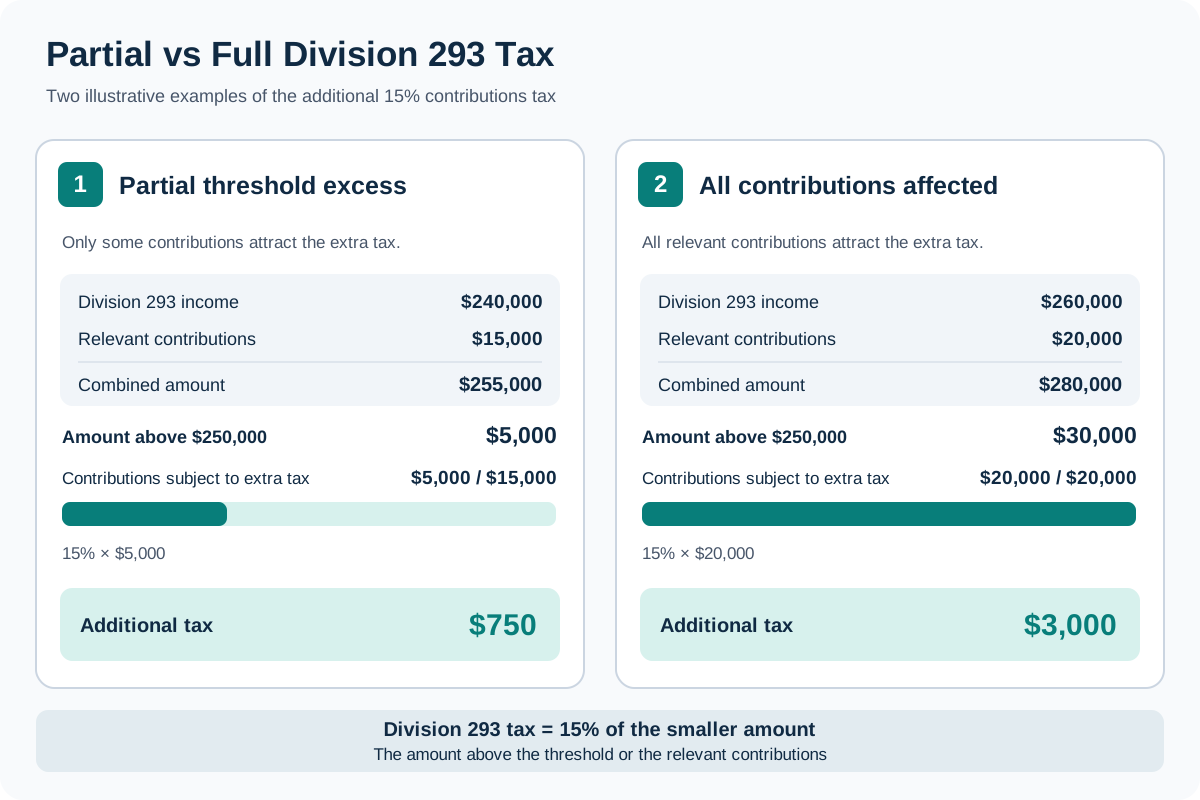
For example, $240,000 in Division 293 income and $15,000 in relevant contributions gives a combined total of $255,000. Only $5,000 is above the threshold, so the additional tax is $750 rather than 15% of the entire $15,000.
What Income Counts Towards Division 293?
Division 293 income generally starts with taxable income. The ATO adds reportable fringe benefits, net financial investment losses, net rental property losses and the net amount on which family trust distribution tax has been paid. It then subtracts specified taxed-element super lump sums and assessable first home super saver released amounts.
The measure differs from gross salary and ordinary taxable income. According to the Australian Taxation Office, Division 293 tax on concessional contributions by high-income earners (accessed October 2026), the calculation draws on the income-tax return and contributions reported by super funds. Check each component against the assessment.
Which Super Contributions Count?
Division 293 contributions generally include low-tax concessional contributions such as employer Super Guarantee payments, salary sacrifice and personal deductible contributions. Some defined benefit members have notional taxed contributions calculated under special rules.
Excess concessional contributions are generally excluded from the Division 293 low-tax contribution base because separate excess-contribution rules apply. A non-concessional payment for which no deduction is claimed does not ordinarily form part of the Division 293 tax base.
How Is Division 293 Tax Calculated?
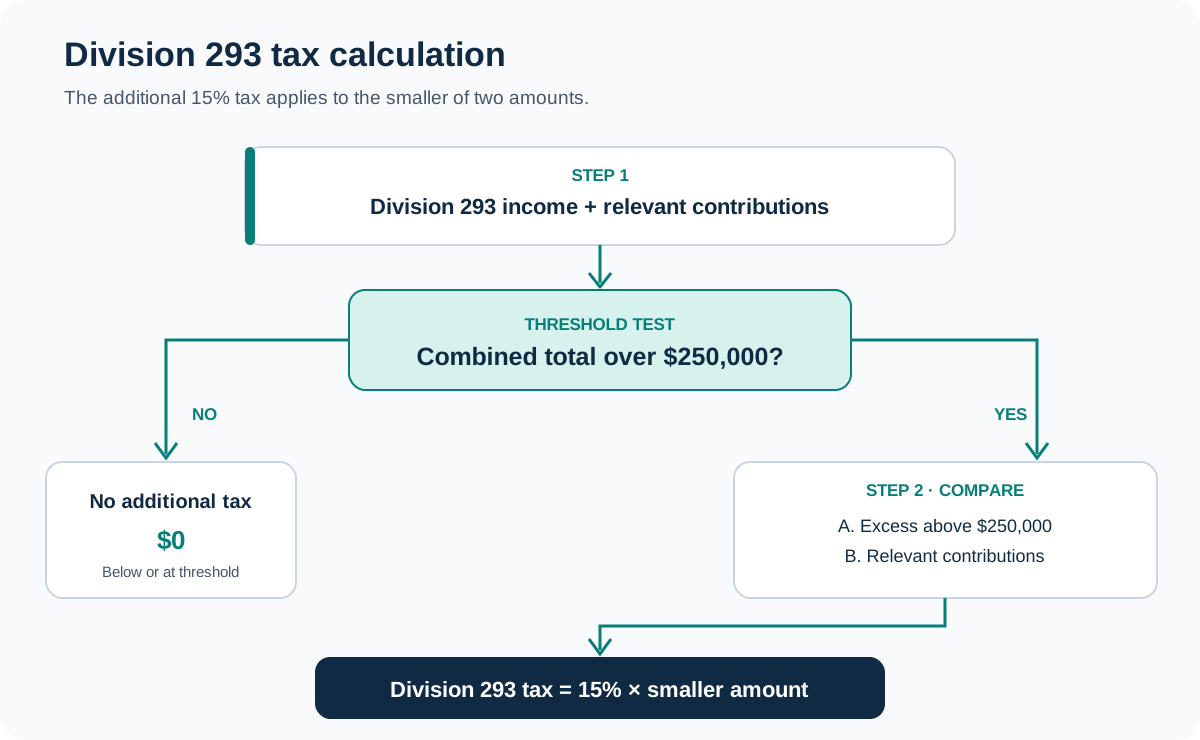
The additional tax is 15% of the lesser of your Division 293 super contributions (after relevant adjustments) and the amount by which combined Division 293 income and contributions exceed $250,000. The ATO calls that smaller figure taxable super contributions.
- Determine Division 293 income using the ATO income components.
- Add the relevant Division 293 super contributions for the financial year.
- Subtract $250,000 from the combined total, with a zero floor.
- Compare the threshold excess with Division 293 super contributions. The smaller figure is your taxable super contributions.
- Multiply the smaller amount by 15%.
For example, if the combined total is $280,000 and Division 293 super contributions are $20,000, the taxable base is $20,000. Additional Division 293 tax equals $3,000.
Division 293 Tax Calculation Examples
These illustrative scenarios assume ordinary taxable concessional contributions with no special defined benefit adjustment. The comparison illustrates why crossing the threshold does not necessarily make every contribution taxable.
On a narrow screen, scroll the table horizontally to see all columns.
| Scenario | Division 293 income | Contributions | Combined total | Extra tax |
|---|---|---|---|---|
| Partial threshold excess | $240,000 | $15,000 | $255,000 | $750 |
| Fully affected contributions | $260,000 | $20,000 | $280,000 | $3,000 |
In the first example, only $5,000 exceeds the threshold. In the second, the $30,000 threshold excess exceeds the $20,000 contribution amount, so the smaller $20,000 amount is taxed.
How Does Division 293 Compare With Other Contributions Tax?
Division 293 is additional to ordinary concessional contributions tax. It does not replace the 15% generally paid by taxed funds and it is separate from the treatment of contributions above an available cap. On a narrow screen, scroll the comparison table horizontally.
| Charge | Applies to | General treatment |
|---|---|---|
| Ordinary concessional contributions tax | Before-tax contributions | Usually 15% in a taxed super fund |
| Division 293 tax | Affected taxable contributions under the income test | Extra 15% of the lesser-of base |
| Excess concessional contributions | Contributions above the available cap | Separate assessment rules apply |
| Non-concessional contributions | Eligible after-tax contributions | Separate caps; generally outside Division 293 |
Does Salary Sacrifice Reduce Division 293 Tax?
NO, salary sacrifice does not automatically reduce Division 293 tax. A qualifying sacrifice lowers taxable salary but also increases concessional super contributions, which are generally included in the combined Division 293 threshold test.
For example, redirecting $10,000 of salary into an extra $10,000 of salary-sacrifice contributions generally leaves the combined threshold-test total unchanged, assuming there are no other adjustments. It can increase the contributions exposed to the additional tax where the threshold is already exceeded. Check the annual concessional cap and the salary-sacrifice arrangement before contributing.
Can Capital Gains Trigger Division 293 Tax?
YES, a taxable capital gain can increase the income amount used for Division 293. A one-off sale of an investment property or shares may push combined income and contributions above $250,000 for that financial year.
The relevant amount is reflected in taxable income after applicable capital gains tax treatment, rather than the asset's gross sale proceeds.
How Does Division 293 Work With Defined Benefit Super?
Some defined benefit members have notional taxed contributions and special rules for assessing or deferring Division 293 liability. The ATO generally records deferred liability in a debt account for the relevant defined benefit interest. Interest can accrue on unpaid deferred debt, and payment generally becomes due when a benefit is paid from that interest.
The calculation depends on the scheme and interest. Obtain the scheme's contribution reporting, the ATO assessment and any deferred debt statement before relying on an ordinary accumulation-account example.
When Will You Receive a Division 293 Assessment?
The ATO issues a Division 293 assessment after receiving the information required from your income-tax return and super fund reports. There is no single assessment date applying to every taxpayer. The notice normally arrives in your myGov inbox if you lodge through myTax, subject to your communication preferences.
An assessment may arrive after your ordinary income-tax notice of assessment. Check ATO online services and the due date printed on the Division 293 notice.
How Can You Check a Division 293 Assessment?
Compare Division 293 income, taxable super contributions, the threshold excess and the additional tax on the ATO notice with your tax return and fund contribution records.
- Check the financial year and income components in the notice.
- Obtain reported concessional contributions from each fund.
- Separate excess concessional contributions and any special defined benefit treatment.
- Recalculate 15% of the smaller relevant amount.
- Contact the ATO or your tax adviser if a reported amount or assessment differs from records.
Keep copies of the assessment, income-tax information and fund transaction history. Do not assume employer payroll figures alone match contributions received by the fund during the income year.
How Can You Pay Division 293 Tax?
Division 293 tax can generally be paid from your own money or by electing to release money from super using the ATO process. The assessment's due date and the deadline for requesting a super release are separate.
- Read your Division 293 notice and confirm the payment deadline.
- Pay the ATO using a listed payment method or use ATO online services to make a valid release election.
- If electing a super release, follow the ATO release authority process and keep confirmation.
- Confirm that the liability is paid and retain the notice and transaction details.
According to the ATO, the election to release money from super generally must be made within 60 days of the date of the Division 293 assessment. Check the current ATO instructions and your notice for your specific circumstances.
What Division 293 Rules Apply for 2026–27?
The general Division 293 income threshold remains $250,000, with an additional tax rate of 15% for affected low-tax contributions. The general concessional contributions cap for 2026–27 is $32,500. The ATO publishes the indexed contribution cap separately from the Division 293 threshold.
The Division 293 threshold and concessional cap are separate concepts. The cap restricts contributions receiving concessional treatment, while Division 293 determines an additional tax on the relevant contributions of higher-income people.
Do Carry-Forward Contributions Change Division 293 Tax?
YES, using eligible unused concessional cap amounts can change how much is contributed at concessional rates, which can affect the Division 293 calculation. Carry-forward eligibility does not increase the $250,000 Division 293 threshold.
An unused cap amount allows eligible additional concessional contributions without necessarily breaching the concessional cap. The ATO includes concessional contributions within an increased carry-forward cap when determining Division 293 contributions. It does not provide an exemption from Division 293 tax. See carry-forward super contributions for the eligibility rules.
How Are Contributions Reconciled Across Multiple Super Funds?
The ATO combines relevant contributions reported by all your super funds for the applicable financial year. For example, $12,000 in employer contributions received by Fund A and $8,000 in deductible personal contributions received by Fund B produce $20,000 in concessional contributions before any relevant adjustments. A second fund does not create a separate $250,000 threshold or separate concessional contribution cap.
Check the contribution receipt date and amount for each fund, including employer payments, salary sacrifice and deductible personal contributions. Avoid comparing a payroll-period figure with the fund's financial-year receipt records.
Can You Owe Division 293 Tax if Your Salary Is Below $250,000?
YES, your salary may be below $250,000 while the combined Division 293 income and relevant super contributions exceed that amount. Adjusted income items also affect the calculation.
Is Division 293 Tax Charged on All Super Contributions?
NO, the extra 15% applies to the relevant taxable contributions up to the calculated threshold excess. Non-concessional contributions are generally excluded.
Does the ATO Automatically Calculate Division 293 Tax?
YES, the ATO assesses Division 293 using income-tax information and super fund reporting. You receive a separate assessment if a liability arises.
Can You Pay Division 293 Tax Directly From Your Bank Account?
YES, you can generally pay the ATO personally using an approved payment method. Check the instructions and reference number on your assessment.
Can the Extra Division 293 Tax Be Paid From Your Super?
YES, an eligible person can elect to release an amount from super through the ATO process. Observe the election time limit and fund-specific restrictions.
Do Non-Concessional Contributions Attract Division 293 Tax?
NO, ordinary after-tax contributions without a claimed deduction do not form part of the low-tax contributions on which Division 293 is charged. Other contribution cap rules still apply.
Sources and verification (October 2026)
- Australian Taxation Office, Division 293 tax on concessional contributions by high-income earners, accessed October 2026.
- Australian Taxation Office, Release authorities, accessed October 2026.
- Australian Taxation Office, Concessional contributions cap, 2026–27 rate, accessed October 2026.
- Commonwealth Superannuation Corporation, Tax and your super, 2026–27 contribution caps, accessed October 2026.
Written by
Superannuation Calculator Australia
Calculation guidance and general information; independent financial advice is not provided.