Carry-Forward Concessional Contributions: Eligibility, Caps and How to Use Them
Understand carry-forward concessional contributions in Australia: eligibility, five-year unused caps, ATO checks, payments and tax.
Superannuation Calculator Australia · · 12 min read
Carry-forward concessional contributions let eligible Australians use unused before-tax super contribution cap amounts from the previous five financial years. Eligibility generally requires a total super balance below $500,000 at the preceding 30 June. The unused cap increases the amount that can be contributed concessionally; it is not a payment from the government or permission to withdraw super early.
What Are Carry-Forward Concessional Contributions?
Carry-forward concessional contributions are contributions above the general annual concessional cap that fit within unused cap amounts accumulated in the preceding five financial years. They are also called catch-up contributions. According to the Australian Taxation Office (ATO), Concessional contributions cap (updated July 2026), the ordinary current-year cap is used before carried-forward amounts.
- Employer super guarantee (SG) payments, salary sacrifice and eligible personal contributions claimed as tax deductions are concessional contributions.
- An unused amount arises when total concessional contributions for a year are less than that year's general cap.
- The ATO automatically applies eligible unused cap amounts after the current-year cap is exceeded.
This is extra contribution capacity, not a transfer of earlier contributions. For the contribution categories themselves, see concessional and non-concessional super contributions.
Who Can Use Carry-Forward Concessional Contributions?
You can use unused concessional cap amounts for a financial year if your total super balance at the previous 30 June was less than $500,000 and you have eligible unused amounts from the previous five years. Both conditions apply.
For a 2026–27 contribution, use your total super balance at 30 June 2026. Check the total across relevant superannuation interests rather than only the balance of the fund receiving the payment. The fund's ability to accept a payment and your eligibility to claim a personal deduction are separate questions. For example, a balance of $499,999 meets the balance threshold, subject to other eligibility conditions; exactly $500,000 does not. This balance test is separate from the annual contribution cap itself.
How Does the Five-Year Carry-Forward Window Work?
An unused concessional cap amount can be used for up to five financial years after the year it arose. Unused amounts first became available from 2018–19. The available period does not restart just because you made no contribution in a later year.
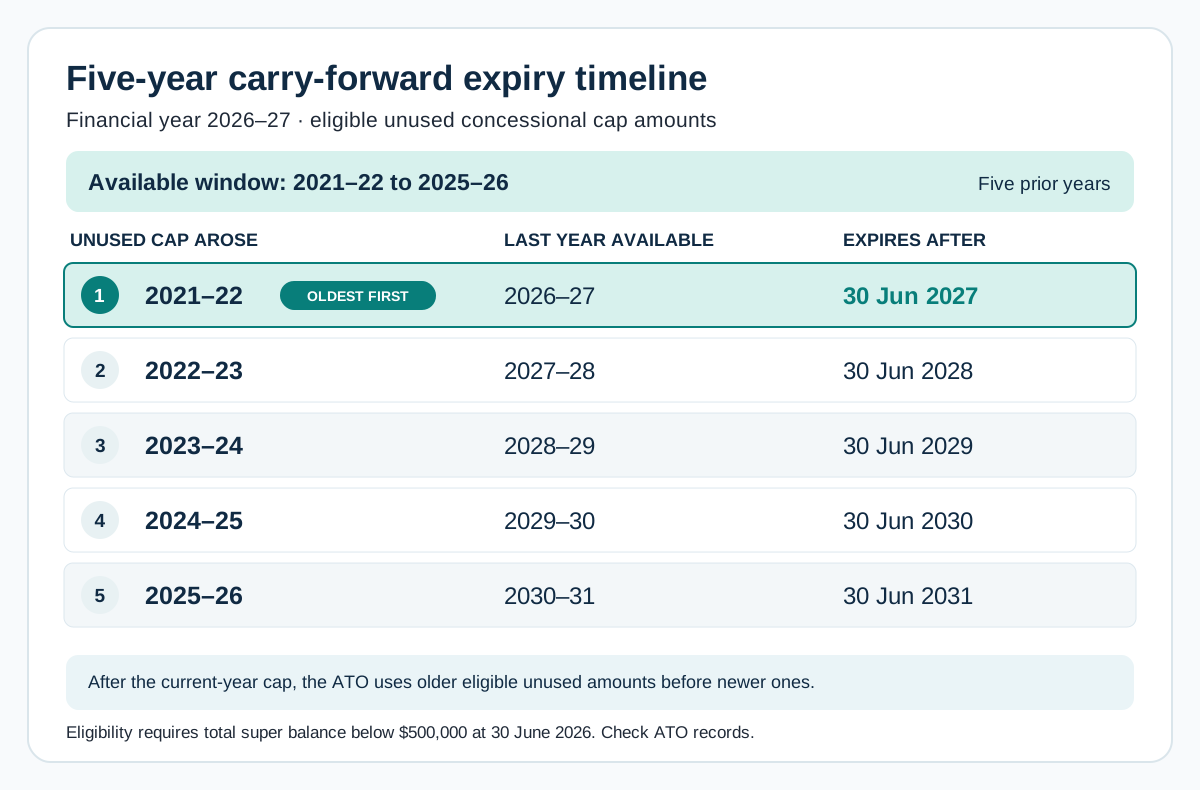
| Unused amount arose | Last financial year available | Expiry |
|---|---|---|
| 2020–21 | 2025–26 | 30 June 2026 |
| 2021–22 | 2026–27 | 30 June 2027 |
| 2022–23 | 2027–28 | 30 June 2028 |
| 2023–24 | 2028–29 | 30 June 2029 |
| 2024–25 | 2029–30 | 30 June 2030 |
Confirm your actual amounts and expiry dates in ATO online services because prior contributions and amendments can change the remaining capacity. On narrow screens, scroll the table horizontally to see the expiry column.
How Do Current and Unused Concessional Caps Work Together?
The general annual concessional cap is used first. Only the amount of concessional contributions above the annual cap uses eligible unused amounts from previous years. SG, salary sacrifice and eligible deductible personal contributions all count towards the current year's total.
According to the Australian Taxation Office, Contributions caps (2026), the general concessional cap for 2026–27 is $32,500, increased from $30,000 in 2025–26. Check your personalised unused cap record before contributing. For example, if the general cap is $32,500, $25,000 has already been contributed and the member has $15,000 of eligible unused caps, the theoretical remaining capacity is $22,500 ($32,500 + $15,000 − $25,000). This assumes all unused amounts remain eligible and no further contributions arrive.
Which Unused Cap Is Used First?
The ATO uses the oldest available unused cap amount first, after the current-year general cap has been exhausted. If you exceed the current cap by $12,000 and have $7,000 unused from 2021–22 and $9,000 from 2022–23, the ATO applies $7,000 from 2021–22 and $5,000 from 2022–23. The remaining 2022–23 amount is $4,000, subject to its expiry date. This example assumes eligibility and no other unused amounts from earlier years.
How Do You Check Unused Super Contribution Caps in myGov?
Use your myGov account linked to the ATO to check the unused concessional cap amounts held against your tax file number.
- Sign in to myGov and open the linked ATO service.
- Select Super, then Information (or Info, depending on the interface).
- Find Carry forward concessional contributions and review the financial-year amounts.
- Compare the history with employer payments and contribution transactions at each fund.
- Recheck before making a large payment or claiming a deduction.
ATO records can lag or be corrected after fund reporting. The fund's transaction history is useful for checking recently received contributions. A discrepancy between fund and ATO records needs reconciliation before relying on the displayed amount. For related account-checking instructions, see how to check your super balance.
How Do You Calculate Available Carry-Forward Contributions?
Calculate the amount by adding eligible, unexpired unused caps to the current general cap, then subtracting concessional contributions already received in that financial year. The carry-forward portion applies only when the previous 30 June total super balance is below $500,000. The following table shows an illustrative 2026–27 calculation, not a verified personal ATO balance.
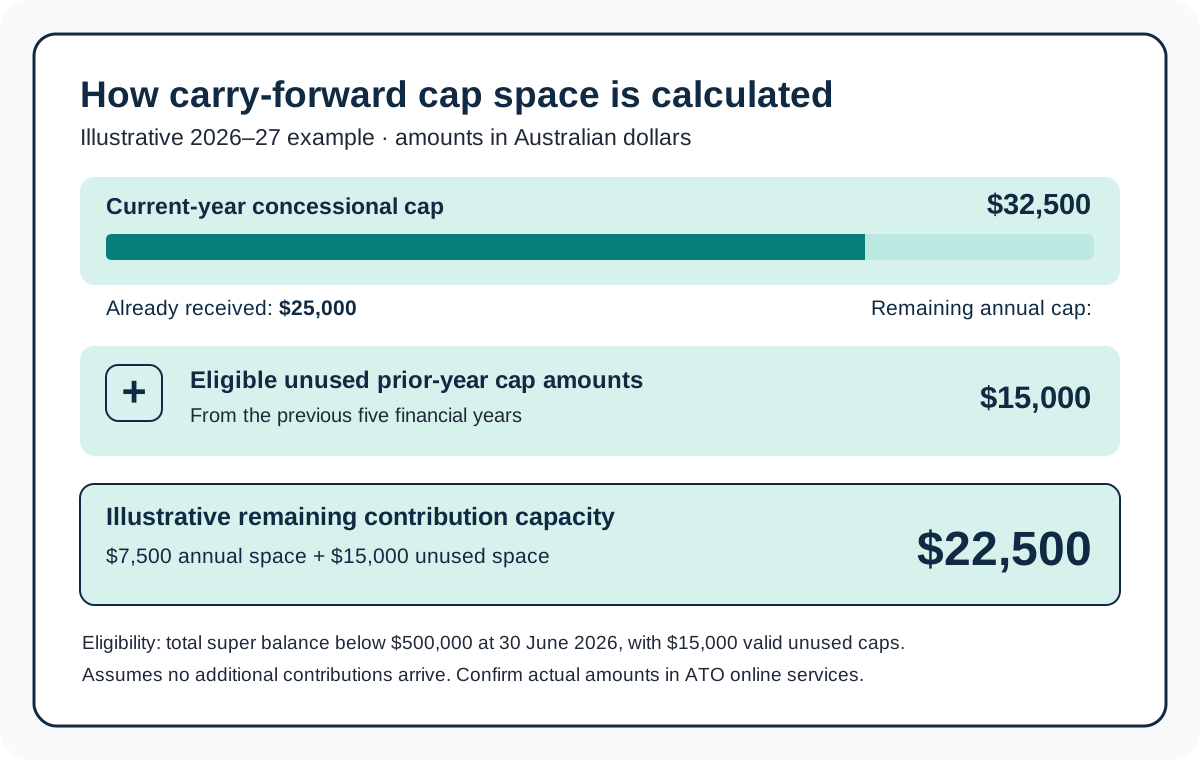
| Component | Illustrative amount |
|---|---|
| Current-year general cap assumed | $32,500 |
| Eligible unused cap amounts | $15,000 |
| Current-year concessional contributions | $25,000 |
| Illustrative remaining capacity | $22,500 |
Formula: General cap + eligible unused amounts − current-year concessional contributions. Do not add unused amounts when the preceding 30 June total super balance is $500,000 or more. Account for SG amounts expected to reach funds before 30 June and review the Super Contributions Calculator Australia for estimates, not actual ATO records. The Superannuation Calculator Australia can model broader super outcomes, but neither calculator verifies unused cap balances.
How Do You Make a Carry-Forward Super Contribution?
Make a normal eligible concessional contribution; no separate carry-forward payment method exists. The ATO uses eligible unused cap capacity automatically when the current concessional cap is exceeded.
- Verify your previous 30 June total super balance and unused cap history.
- Calculate the current-year cap already used across funds.
- Confirm fund acceptance rules, payment instructions and processing cut-offs.
- Arrange salary sacrifice through payroll or make a personal contribution.
- If claiming a personal deduction, submit a valid notice of intent, obtain the fund's acknowledgement and claim only the eligible amount.
- Keep transaction confirmations and reconcile fund records with ATO data.
Employer salary sacrifice and personal deductible payments have different administrative steps. Refer to personal super contributions for payment details.
When Do You Need a Notice of Intent to Claim a Deduction?
You need a valid notice of intent and written acknowledgement from the fund before claiming a deduction for a personal super contribution. The ordinary deadline is the earlier of lodging your tax return for the contribution year and the end of the following financial year.
A rollover, withdrawal, contribution split or pension commencement can affect the notice's validity. Submit and confirm the notice before making transactions that reduce the fund's holding of that contribution. Employer salary sacrifice does not use the same personal notice process.
How Are Catch-Up Concessional Contributions Taxed?
Eligible concessional contributions are generally subject to 15% contributions tax in a taxed super fund. An allowed personal deduction reduces taxable income, but the overall outcome depends on the person's income-tax position and other super tax provisions.
- Division 293: an additional 15% can apply to relevant concessional contributions for affected higher-income taxpayers where the applicable combined income and contribution threshold exceeds $250,000.
- Untaxed or defined benefit arrangements: different contributions-tax calculations can apply.
- Excess contributions: amounts exceeding the combined available cap can create further income-tax consequences.
The 15% rate is not a guaranteed tax saving. Compare the relevant income-tax rate, effects on other income-tested obligations and the fact that money contributed to super is generally preserved.
When Must Your Super Fund Receive the Contribution?
A contribution generally counts in the financial year when the fund receives it, rather than when you start the bank transfer or payroll process. To count for the year ending 30 June, the money must reach the fund by that date. A payment instructed on 30 June but received in July generally counts in the next financial year. Ask your fund about processing deadlines in advance.
Carry-Forward vs Bring-Forward Contributions: What Is Different?
Carry-forward uses unused concessional contribution caps from previous years. Bring-forward applies to eligible non-concessional contributions, drawing on future annual cap amounts under a separate set of rules. The comparison below distinguishes the contribution types and their eligibility tests.
| Attribute | Carry-forward | Bring-forward |
|---|---|---|
| Contribution category | Concessional | Non-concessional |
| Time period | Unused portions from the preceding five financial years | Eligible future cap capacity, potentially over three years |
| Core test | Prior 30 June total super balance below $500,000 | Applicable age, balance and existing arrangement rules |
| Income-tax deduction | Potentially available on an eligible personal contribution | Ordinarily no personal deduction |
The rules are not interchangeable. Check the current ATO non-concessional caps and balance thresholds separately for a bring-forward contribution.
What Happens if You Exceed Your Available Concessional Cap?
Contributions above the sum of the general cap and eligible unused cap amounts are excess concessional contributions. The ATO generally includes the excess in assessable income, with an associated offset reflecting contributions tax, and issues a determination. Release choices and potential consequences for the non-concessional cap depend on the assessment and the member's response. Do not assume an excess is automatically waived.
Does the $500,000 Balance Test Include All Super Accounts?
YES, the test covers the total super balance of all relevant superannuation interests, not only the account receiving the payment. The ATO calculation can differ from the sum of ordinary fund statements because different valuation rules apply to some super and pension interests. Use the ATO total super balance for the 30 June immediately preceding the contribution year.
How Do Age and Work-Test Rules Affect Deductions?
Age-related contribution rules and the work test can restrict an eligible personal deduction independently of carry-forward eligibility. For people aged 67 to 74, claiming a deduction generally requires satisfying the 40-hours-in-30-consecutive-days work test or a recognised exemption. Special acceptance deadlines apply near age 75. Confirm the contribution type and fund acceptance before paying.
When Should You Consider Using Carry-Forward Contributions?
Carry-forward contributions are relevant when eligible unused caps remain, the previous 30 June balance test is satisfied and the contribution suits the person's tax position and accessible cash requirements. The amount of extra capacity is a maximum limit, not a suggested payment.
Check expected employer SG, other deductions, taxable income, possible Division 293 tax and the super fund's receipt deadline. Also consider whether the funds need to remain accessible outside super for short-term spending. A one-off taxable event or fluctuating earnings can make the calculation worth reviewing, but suitability depends on personal circumstances. The Super Projection Calculator Australia helps explore long-term balance assumptions; it does not determine deduction eligibility.
Can you carry forward unused concessional caps if your super balance is exactly $500,000?
NO, a total super balance of exactly $500,000 at the preceding 30 June does not satisfy the requirement. The statutory balance threshold is less than $500,000, not less than or equal to that amount. A later decrease does not change the test for that year.
Can you use carry-forward contributions without submitting a separate carry-forward application?
YES, there is generally no separate carry-forward application. The ATO applies unused cap amounts when eligible concessional contributions exceed the current general cap. A personal tax deduction still has its separate notice and acknowledgement requirements.
Can unused concessional caps from more than five years ago still be used?
NO, unused amounts expire after their five-year availability period. For example, unused amounts originating in 2020–21 were no longer available after 30 June 2026. The expiry does not reset.
Does salary sacrifice count towards the current concessional cap?
YES, salary sacrifice counts as a concessional contribution alongside employer SG and eligible personal deductible contributions. Carry-forward capacity is relevant only once the annual concessional cap is exceeded and the eligibility test is met.
Can a personal after-tax payment become concessional if a valid tax deduction is claimed?
YES, a personal contribution made using after-tax savings can become concessional to the extent an eligible deduction is claimed and allowed. The fund needs a valid notice of intent and acknowledgement. Any remaining undeducted portion is generally subject to non-concessional contribution rules.
Can you access carry-forward contributions immediately after paying them into super?
NO, using carried-forward contribution capacity does not create a withdrawal entitlement. The payment becomes part of super and generally stays preserved until a relevant condition of release is met. Contribution eligibility and access eligibility are separate rules.
Sources and verification (October 2026)
- Australian Taxation Office, Concessional contributions cap, updated July 2026; verified 17 October 2026. Balance threshold, five-year expiry, unused cap application and contribution counting.
- Australian Taxation Office, Contributions caps, 2026; verified 17 October 2026. General 2026–27 concessional cap of $32,500.
- Australian Taxation Office, Personal super contributions, accessed 17 October 2026. Deduction notice, acknowledgment and age-related rules.
- Australian Taxation Office, Division 293 tax on concessional contributions by high-income earners, accessed 17 October 2026. Additional contributions tax.
- Australian Taxation Office, Caps, limits and tax on super contributions, accessed 17 October 2026. Contribution categories and excess cap treatment.
The calculations are illustrative, not personal tax advice. Confirm the personalised unused amounts, expected SG contributions and contribution receipt date before making a payment.
Written by
Superannuation Calculator Australia
Calculation guidance and general information; independent financial advice is not provided.