Super Nominations: Binding, Non-Binding & Validity
Compare binding and non-binding super nominations in Australia: trustee control, expiry, eligible beneficiaries and updates.
Superannuation Calculator Australia · · 11 min read
A binding super beneficiary nomination directs a super fund trustee to pay a death benefit to specified eligible recipients when the nomination is valid. A non-binding nomination records your preference but leaves the trustee to decide who receives the benefit under superannuation law and the fund's rules.
The distinction affects payment certainty, eligibility, expiry and the steps required to keep an instruction valid. This is general information, not personal legal or financial advice.
What Are Binding and Non-Binding Super Beneficiary Nominations?
Binding and non-binding nominations tell your super fund who you want to receive your death benefit. A valid binding instruction generally obliges the trustee to pay the nominated eligible recipients. A non-binding instruction expresses a preference that the trustee considers when making its decision.
A death benefit commonly includes the member's super account balance and any payable death insurance held through super. Nominating a person does not automatically make them eligible under superannuation law.
How Does a Binding Nomination Work?
A valid binding nomination directs the trustee to distribute the super death benefit to the eligible people or legal personal representative named in the instruction. The trustee must check the instruction against the fund's governing rules and applicable law when the claim arises.
A nomination may cease to bind if it has expired, has been revoked, names ineligible recipients or fails applicable signing and witnessing requirements.
How Does a Non-Binding Nomination Work?
A non-binding nomination communicates your preferred recipients but does not compel the trustee to follow that allocation. The trustee determines the beneficiaries in accordance with superannuation law and the fund's governing rules, taking relevant circumstances into account.
This provides trustee discretion where family circumstances have changed, but the nominated percentages are not guaranteed.
Binding vs Non-Binding: What Are the Key Differences?
The controlling difference is trustee discretion. A valid binding nomination restricts the trustee's decision; a non-binding nomination leaves that decision with the trustee.
The table compares legal effect, expiry and flexibility. On smaller screens, scroll horizontally to see all columns.
| Feature | Binding nomination | Non-binding nomination |
|---|---|---|
| Legal effect | Generally directs the trustee if valid | Records a preference |
| Trustee discretion | Restricted by a valid instruction | Trustee decides under applicable rules |
| Expiry | Lapsing or non-lapsing, depending on fund and arrangement | Fund rules govern how long the preference remains recorded |
| Formality | Specific execution and fund acceptance rules | Fund's nomination process applies |
| Best decision factor | Certainty for eligible named recipients | Flexibility for trustee assessment |
Example: Sam nominates their spouse for 100% of a death benefit. With a valid binding nomination, the trustee generally pays the spouse, provided they remain an eligible beneficiary. With a non-binding nomination, the trustee considers Sam's preference alongside other eligible claims, including dependent children. The nominated percentage is not guaranteed.
Do Binding Super Nominations Expire?
YES, a lapsing binding nomination made under regulation 6.17A generally ceases to operate three years after it was signed or last confirmed or amended, unless renewed in accordance with the rules. Some funds also offer non-lapsing binding nominations. These do not expire on the three-year cycle but can be revoked, replaced or become ineffective under their governing conditions.
Check the nomination type, expiry date and conditions in your fund's records. ASIC MoneySmart, Who gets your super if you die (2 October 2026), distinguishes lapsing, non-lapsing and reversionary binding arrangements.
Who Can Receive a Super Death Benefit?
Direct super death benefit recipients generally fall within the legally recognised dependant categories. A fund may also pay the benefit to the member's legal personal representative, for distribution through the estate.
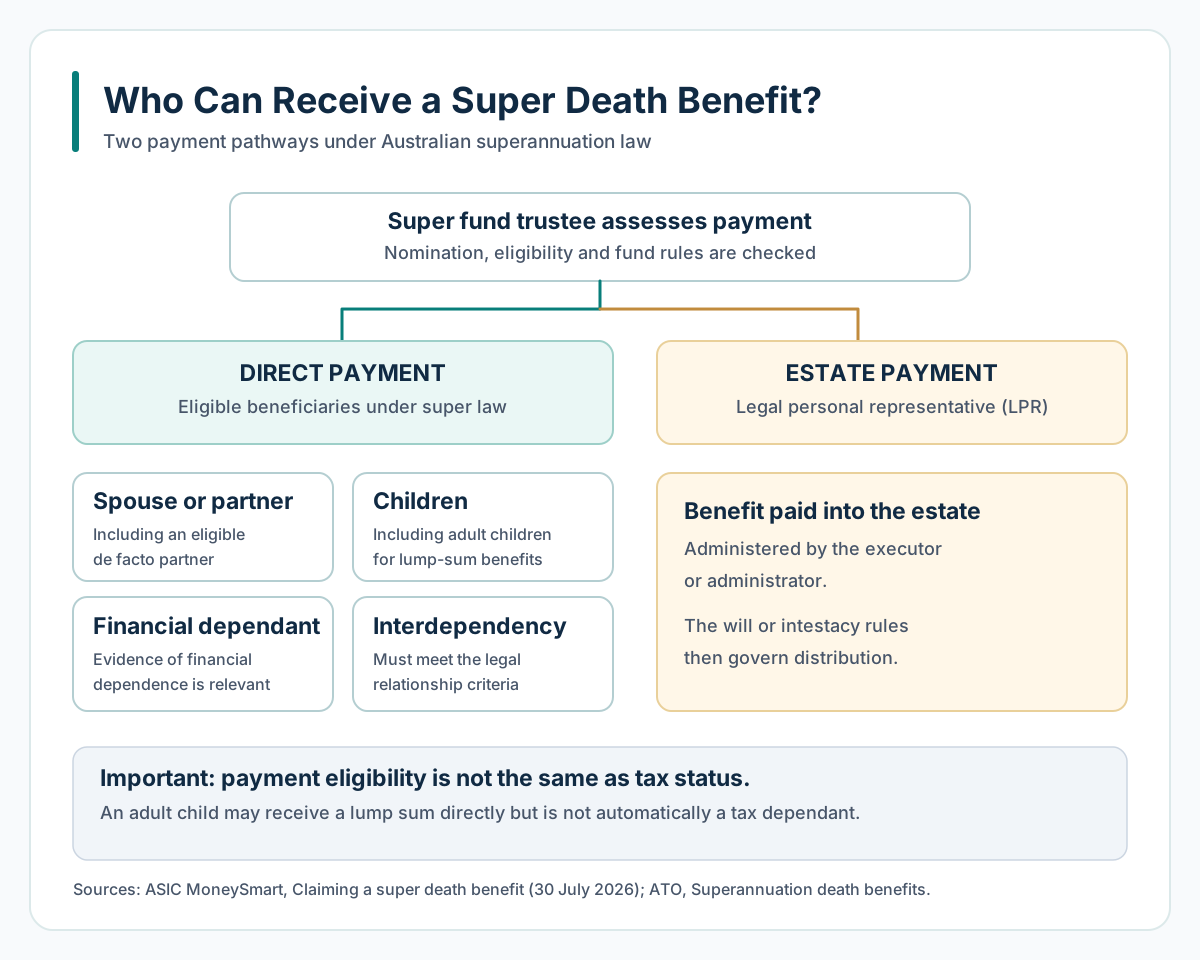
- A spouse or de facto partner meeting the applicable definition
- A child, including an adult child for eligible lump-sum payments
- A person financially dependent on the deceased member
- A person in an interdependency relationship with the member
- The legal personal representative, receiving the benefit for the estate
An unrelated friend is not automatically eligible for a direct payment merely because the member names them. Dependants under superannuation law and death benefits dependants under tax law are different categories. For example, an adult child is generally eligible for a lump-sum death benefit under super law but is not automatically a tax dependant. Eligibility and tax status must be checked separately. For wider death-benefit rules, see who receives super when someone dies.
How Do You Make a Valid Binding Nomination?
Follow the fund's prescribed nomination process and obtain confirmation that the instruction has been recorded. The diagram illustrates the validity checks before you rely on a binding direction.
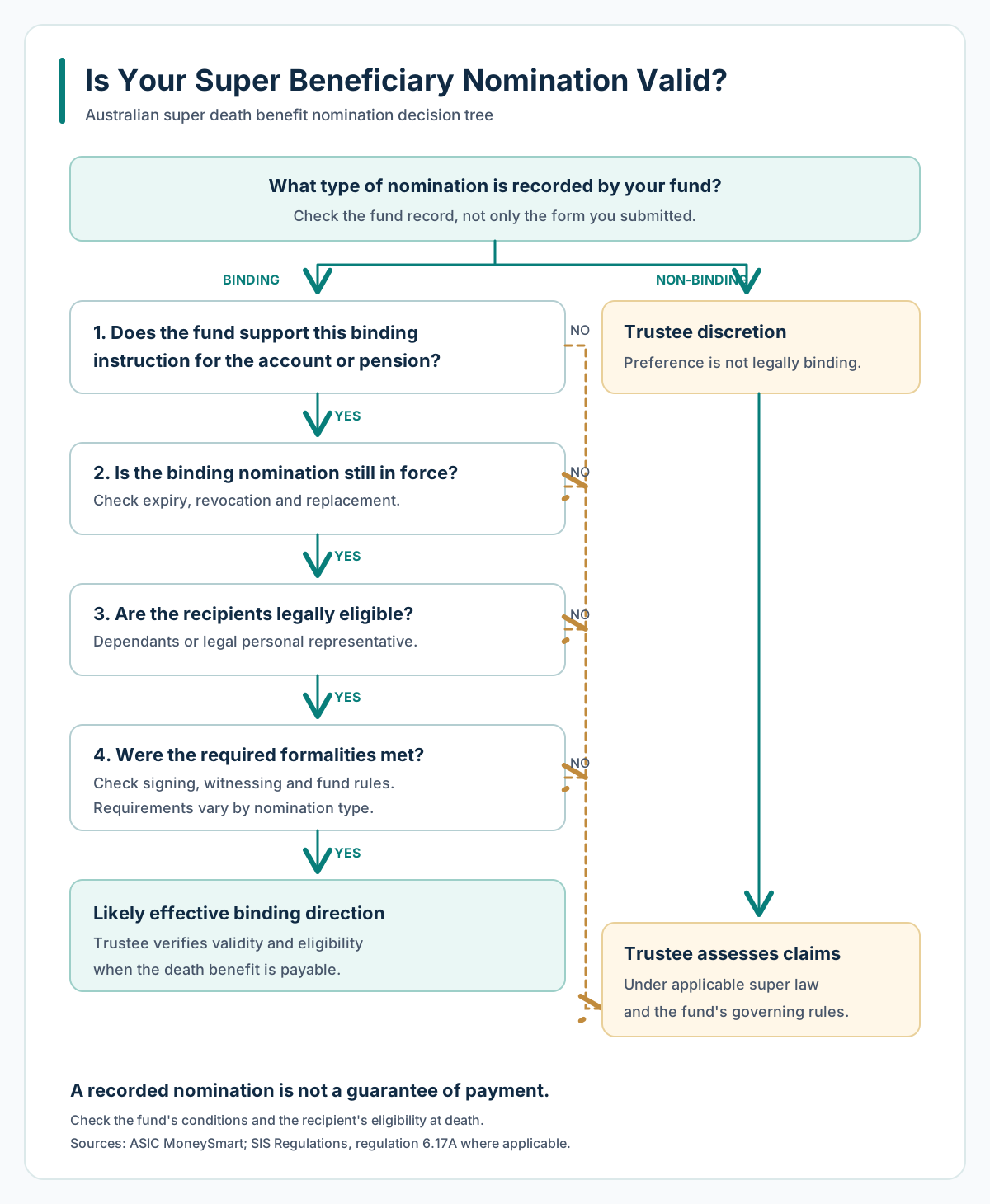
- Check which binding and non-binding nomination types your fund offers.
- Select legally eligible beneficiaries or your legal personal representative.
- Specify each recipient's share and confirm the percentages total 100%.
- Complete, sign, date and witness the approved form as required.
- Lodge it through the fund's accepted channel.
- Retain the acknowledgement and note any expiry or renewal date.
A correctly named beneficiary does not rescue a form that fails applicable execution requirements. A binding nomination can also be limited to a particular account. Check each fund's latest instructions rather than copying a form used for another fund.
How Can You Confirm a Fund Has Accepted the Nomination?
Check your online super account or request written confirmation from the trustee. Verify the nominated names, shares, nomination type, effective or recorded date and expiry status.
Keep copies of the signed instruction and fund acknowledgement. Following a rollover, fund merger or pension conversion, contact the current trustee to check whether the nomination remains operative. A recorded nomination is not proof that it will remain legally valid at death: eligibility and the fund's conditions still apply.
What Happens if a Nomination Expires or Is Invalid?
An expired or invalid binding nomination generally no longer binds the trustee. The trustee must then determine payment under the applicable legislation, fund rules and any other effective nomination.
For example, if a three-year binding nomination lapses without renewal, its original allocation is not guaranteed. The trustee considers eligible beneficiaries, the estate and the fund's governing rules. ASIC MoneySmart, Who gets your super if you die (2 October 2026), explains that an invalid binding nomination is normally treated like a non-binding nomination. Reconfirm instructions when circumstances change.
Does a Will Override a Super Beneficiary Nomination?
NO, a will does not ordinarily override a valid binding super nomination directing payment to eligible beneficiaries. Super generally does not form part of the estate simply because the member has died.
If the death benefit is paid to the legal personal representative, estate administration and the will become relevant to its subsequent distribution. See superannuation beneficiaries for further beneficiary distinctions.
How Do Relationship Changes Affect a Beneficiary Nomination?
Marriage, separation, divorce, a beneficiary's death and changes in financial dependency can affect eligibility or the operation of a nomination. An outdated instruction may still exist on the fund's records without producing the intended outcome.
After a relationship change, review the fund's rules, your nominated beneficiaries and your will. Divorce does not produce a uniform automatic cancellation result across all super arrangements.
How Are Eligibility and Death Benefit Tax Different?
Super law controls who is eligible to receive a death benefit; tax law controls how the amount is taxed. Their definitions of a dependant are not identical.
The table separates the two tests. On smaller screens, scroll horizontally to read the tax treatment column.
| Question | Superannuation law | Tax law |
|---|---|---|
| What is tested? | Who can receive the benefit from the fund | Whether the recipient is a death benefits dependant for tax |
| Adult child | Generally eligible for a direct lump sum | Not automatically a tax dependant |
| Result | Determines recipient eligibility | Determines applicable tax treatment |
According to the Australian Taxation Office, Superannuation death benefits (accessed October 2026), a lump-sum death benefit paid to a death benefits dependant is generally tax-free. For a non-tax-dependant, tax depends on the payment's tax-free and taxable components, including the taxed or untaxed element. A payment to an estate is assessed according to the status of the people expected to benefit from it. See super death benefits tax for a fuller explanation.
Should You Choose a Binding or Non-Binding Nomination?
A binding nomination suits a preference for a legally effective direction to eligible recipients. A non-binding nomination gives the trustee discretion to assess eligible claims when the member dies. Neither is automatically best: compare your fund's options, the need for certainty, potential changes in dependants and the treatment of estate assets.
The scenarios below are decision prompts rather than personal advice. Scroll the table horizontally on narrow screens.
| Priority or situation | Practical consideration |
|---|---|
| Fixed payment instructions | Check whether a valid binding option is available |
| Changing dependency arrangements | Understand how the trustee applies a non-binding preference |
| Estate distribution | Consider nomination of the legal personal representative and estate implications |
| Complex family or SMSF arrangements | Review fund-specific rules and obtain qualified advice |
Neither type of nomination overrides eligibility requirements or resolves tax and estate disputes by itself.
How Do SMSF, Pension and Insurance Rules Affect Nominations?
An SMSF is governed by its trust deed and relevant superannuation law. Binding instructions do not necessarily operate under the same rules as a large APRA-regulated fund. An account-based pension can also have a reversionary beneficiary arrangement that affects what happens on death.
When a death insurance claim is accepted, its proceeds generally form part of the death benefit administered through the fund. Verify whether the nomination applies to the relevant account, pension and insurance proceeds. Reversionary pension instructions can operate differently from lump-sum nominations and should be checked separately.
How Do You Review, Change and Renew a Nomination?
Check the current nomination against your fund's records and replace or renew it using the approved procedure. Review after major family, account or pension changes and when the annual statement arrives.
- Locate each super account and the most recently recorded nomination.
- Confirm the type, named recipients, shares and expiry date.
- Review changes such as separation, beneficiary death or fund transfer.
- Submit the fund's renewal, replacement or cancellation instruction.
- Obtain acknowledgement and retain it with your estate records.
Can a Binding Beneficiary Nomination Be Challenged?
YES, an apparently binding nomination can be disputed where validity, execution, eligible recipients, mental capacity or compliance with the fund's governing rules is contested. The appropriate dispute process depends on the fund and the grounds raised.
Keep records of the signed instruction, witnesses and fund acceptance.
Can a Non-Binding Nomination Be Overruled?
YES, the trustee can distribute a death benefit differently from a non-binding nomination when its lawful assessment of eligible recipients supports another outcome. Trustee discretion is constrained by superannuation law and the fund's governing rules.
Do You Need Two Witnesses for a Binding Nomination?
YES, for a lapsing binding nomination governed by regulation 6.17A, the signed and dated notice generally requires two adult witnesses who are not nominated beneficiaries. Other arrangements, including some non-lapsing nominations and SMSFs, can have different requirements.
Follow the instructions for the specific fund and nomination type.
Does a Non-Lapsing Binding Nomination Ever Expire?
NO, a non-lapsing binding nomination has no automatic three-year expiry. It can nevertheless be revoked, superseded or cease to operate under the fund's governing rules, including when a nominated person is no longer eligible. Confirm the conditions of your particular fund.
Can You Nominate Your Estate as a Beneficiary?
YES, you can generally nominate your legal personal representative so the benefit is paid into the estate and distributed through estate administration. This can be relevant where intended recipients are not eligible for direct payment.
Estate payment may introduce administration delays, creditor considerations and different tax consequences. Confirm the effect with professional advisers where circumstances are complex.
Sources and verification (October 2026)
- ASIC MoneySmart, Who gets your super if you die, updated 2 October 2026.
- ASIC MoneySmart, Binding death benefit nomination, updated 4 June 2026; Non-binding nomination, updated 4 June 2026.
- Australian Taxation Office, Superannuation death benefits, updated 10 July 2026; accessed October 2026.
- Federal Register of Legislation, Superannuation Industry (Supervision) Regulations 1994, regulation 6.17A, accessed October 2026.
- Australian Taxation Office, Tax on super death benefits, accessed October 2026.
Written by
Superannuation Calculator Australia
Calculation guidance and general information; independent financial advice is not provided.