How to Make Personal Super Contributions: Steps, Tax and Limits
Learn how to pay personal super contributions, claim an eligible deduction, check 2026–27 caps and avoid common payment mistakes.
Superannuation Calculator Australia · · 14 min read
Personal super contributions are extra payments you make to your super fund using your own money. You can generally pay by your fund’s accepted online payment method, BPAY or direct debit. Your payment is usually non-concessional unless you validly claim an eligible personal tax deduction, in which case the deducted amount is concessional. Check the fund’s receipt date, your available contribution caps and any notice-of-intent requirements before lodging your tax return.
What Are Personal Super Contributions?
According to the Australian Taxation Office (ATO), Personal super contributions (22 May 2024), personal super contributions are payments made directly by an individual, rather than compulsory employer super guarantee payments. They include payments from savings or other available money. An undeducted personal payment is usually a non-concessional contribution. If you claim and are allowed a personal super deduction, the deductible amount is generally concessional.
The distinction matters because concessional and non-concessional contributions use different caps and have different tax treatment. Paying money from a personal bank account does not automatically make it a non-concessional contribution for tax purposes. To understand these categories, see concessional versus non-concessional contributions.
How Do You Make a Personal Super Contribution?
Pay the money directly to your super fund using its approved contribution instructions, then verify that the payment has been allocated to the correct member account. Each fund provides its own payment references and accepted channels.
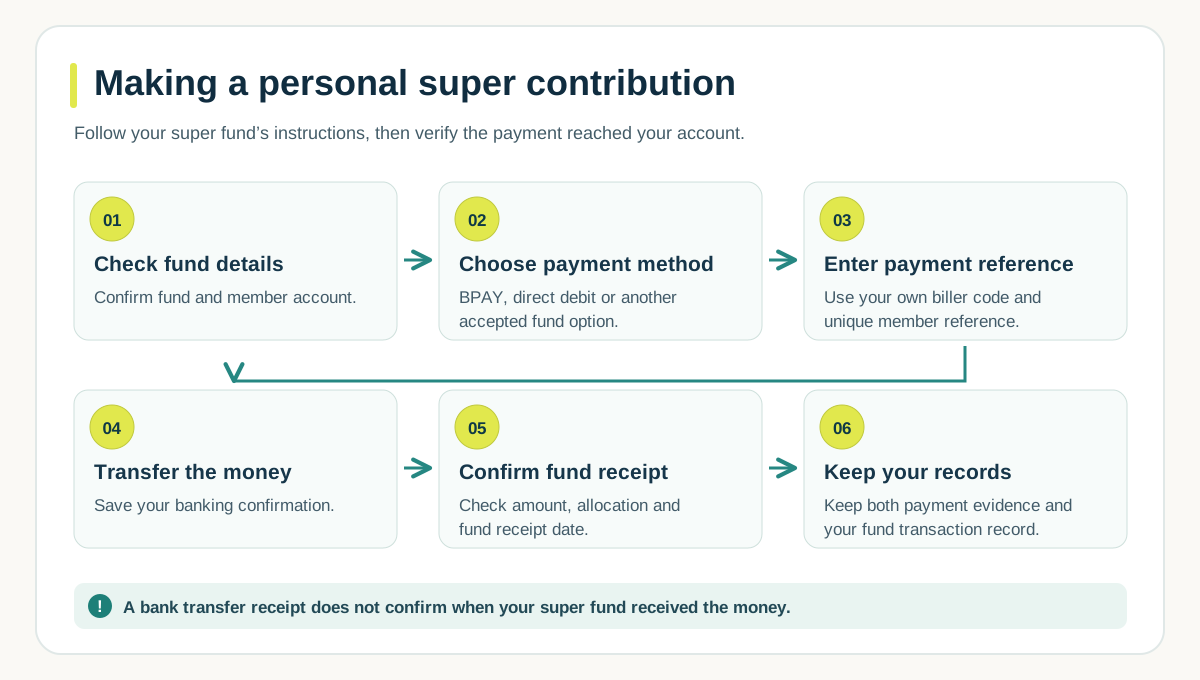
- Sign in to your super fund’s secure member portal or app.
- Find the voluntary or personal contribution payment options.
- Check the account details, permitted payment method and any individual contribution reference.
- Transfer the chosen amount using money available to you.
- Retain the payment confirmation and check your super transaction history for receipt.
- If you intend to claim a deduction, submit a valid notice of intent and obtain the fund’s acknowledgement before claiming.
Avoid using employer contribution payment instructions for a personal deposit. Confirm that the fund has your tax file number (TFN), as funds generally cannot accept personal contributions without it. Check for minimum amounts and processing cut-offs, especially before 30 June. For a broader estimate before contributing, use the super contributions calculator Australia; its result is not an ATO cap determination.
Which Payment Methods Can You Use?
The available methods depend on your fund. Common options include BPAY, direct debit, online member payments and, for some funds, bank transfer. BPAY details are usually member-specific; do not copy a biller code or customer reference from another person.
| Payment method | What to verify |
|---|---|
| BPAY | Fund biller code, your customer reference and processing time |
| Direct debit | Linked bank account, authorisation and collection date |
| Online member payment | Payment category, transaction confirmation and limits |
| Bank transfer, where supported | Account details and unique contribution reference |
Use the instructions issued directly by your fund, not a generic superannuation payment example.
How Can You Verify a Contribution Was Received?
Check the contribution transaction in your fund account, including its effective receipt date, payment amount and contribution classification. A bank receipt proves that a payment was initiated, but not necessarily that it reached and was allocated by the fund.
If the payment is absent, compare the payment reference and transfer date with the fund’s records. Keep the receipt and ask the fund to trace or correct any misallocated contribution. The ATO’s myGov reporting may not update immediately.
How Do Deductible and After-Tax Contributions Differ?
Deductible personal contributions generally count towards the concessional cap and are subject to contributions tax in the fund. Undeducted personal contributions generally count towards the non-concessional cap and ordinarily enter the fund without contributions tax.
| Attribute | Deductible personal payment | Undeducted personal payment |
|---|---|---|
| Contribution category | Concessional to the extent deducted | Non-concessional |
| Personal tax return | Eligible amount claimed as a deduction | No deduction claimed |
| Fund contributions tax | Generally 15%, subject to exceptions | Generally none within the applicable rules |
| Annual cap category | Concessional | Non-concessional |
| Key documentation | Valid notice of intent and fund acknowledgement | Payment and fund transaction confirmation |
An eligible personal contribution can be partly deductible; the non-deducted part ordinarily has different cap treatment. For example, if you contribute $5,000 and claim a valid deduction for $4,000, the $4,000 is ordinarily concessional and the remaining $1,000 non-concessional. The fund generally deducts $600 contributions tax from the deductible $4,000, subject to applicable exceptions. This split can also matter when assessing eligibility for a government co-contribution. According to the ATO, Personal super contributions (22 May 2024), deductible amounts are based on the deduction claimed and allowed, not simply the original payment method.
How Do You Claim a Personal Super Contribution Tax Deduction?
Lodge a valid notice of intent to claim a deduction with your fund, receive its acknowledgement and claim the eligible amount in your tax return. A transfer receipt by itself does not establish a deduction.
- Confirm your eligibility, contribution receipt and remaining concessional cap space, including employer super.
- Notify the fund of the precise amount you intend to deduct using its accepted notice-of-intent process or the ATO form.
- Obtain written acknowledgement before claiming the deduction in your tax return.
- Claim only the eligible amount and retain the acknowledgement and payment evidence.
According to the ATO, Personal super contributions (22 May 2024), deductible contributions are also generally reportable super contributions and can affect income-tested entitlements or obligations, including HELP repayments. An accepted notice is not proof that all income tax deduction requirements are met. People aged 67–74 face specific work-test or exemption rules for claiming personal deductions. Check the ATO’s personal super contribution guidance before claiming. Fund rollovers, partial withdrawals and pension commencements can affect notice validity.
When Must You Submit a Notice of Intent?
Submit the notice by the earlier of the day you lodge your tax return for the contribution year and the end of the following financial year. Obtain the fund’s acknowledgement before claiming the deduction.
For a contribution received during 2026–27, that statutory outer deadline is ordinarily 30 June 2028, unless you lodge the 2026–27 tax return earlier. Do not wait until that date if you plan to withdraw or roll over the money: changes to the relevant interest can prevent a valid notice.
How Much Can You Contribute in 2026–27?
The standard 2026–27 caps are $32,500 for concessional contributions and $130,000 for non-concessional contributions, subject to the member’s circumstances. These are cap categories, not permission for every individual to pay either amount.
According to Commonwealth Superannuation Corporation, Tax and your super (2026), these standard caps apply from 1 July 2026. Your concessional cap includes employer super guarantee payments, salary sacrifice and eligible deductible personal payments across all funds. Your non-concessional cap depends on your total super balance and any active bring-forward arrangement.
For example, if employer contributions total $15,000 and salary sacrifice totals $5,000 in 2026–27, an additional $12,500 would reach the ordinary $32,500 concessional cap, before other relevant amounts or adjustments. Review the full rules in super contribution caps.
When Do Carry-Forward and Bring-Forward Rules Apply?
Carry-forward and bring-forward rules can increase contribution capacity, but they apply to different categories. Carry-forward uses unused concessional amounts from up to five previous financial years, generally where the previous 30 June total super balance is below $500,000. Bring-forward brings forward eligible non-concessional cap amounts, subject to age, balance thresholds and prior arrangements.
| Rule | Applies to | Core eligibility check |
|---|---|---|
| Carry-forward | Concessional contributions | Previous 30 June total super balance and unused prior-year caps |
| Bring-forward | Non-concessional contributions | Age, previous 30 June total super balance and existing arrangements |
Do not assume the full three-year bring-forward amount is available. Confirm the relevant financial-year thresholds and existing arrangements in ATO online services before transferring money.
Who Can Make Personal Contributions?
Eligibility depends on the member’s age, the type of contribution and the intended tax treatment. Most adults below age 75 can ordinarily make voluntary personal contributions, subject to fund acceptance rules and caps. Additional restrictions apply from age 75 and when claiming a deduction at ages 67–74.
A fund’s acceptance of a contribution and a person’s eligibility to claim a tax deduction are separate tests. Confirm the current age limits, work-test rules and any special contribution category with the ATO and the receiving fund.
When Does a Personal Payment Count for the Financial Year?
A personal contribution generally counts in the financial year in which the super fund receives it, not the date you instruct your bank to transfer it. Payment processing around 30 June can change the applicable annual cap and deduction year.
For example, a payment sent on 30 June 2027 but received by the fund on 1 July 2027 is generally a 2027–28 contribution, not a 2026–27 contribution. Allow enough processing time before the financial year ends and obtain confirmation of the fund’s receipt date. The ATO, Concessional contributions cap (accessed October 2026), confirms that contributions count towards the cap for the financial year in which the fund receives them.
How Do You Check Contributions Across Multiple Funds?
Review the contribution transactions at each fund and compare them with ATO online services through myGov. Add together employer, salary sacrifice and deductible personal contributions when checking concessional cap usage.
ATO information may lag fund records. Check each fund’s contribution transaction list first, then compare the reported amounts with ATO online services. A fund balance includes investment returns, fees, insurance premiums and tax, so it is not a reliable substitute for summing contribution transactions. Check your total super balance as at the relevant preceding 30 June separately. You can also use the superannuation calculator Australia to estimate salary-based super, but it does not display actual personal contribution transactions. For account-checking steps, see how to check your super balance.
What Happens If You Exceed a Contribution Cap?
Excess concessional and excess non-concessional contributions have different consequences. The ATO assesses excess amounts under the relevant rules and may issue a determination or release instructions.
Excess concessional amounts can be included in assessable income with an associated tax offset, subject to the applicable ATO process; excess non-concessional amounts can lead to a choice about releasing money and associated earnings, or excess-contributions tax if retained. The exact response depends on the determination. Do not assume a payment is harmless because it was made voluntarily or distributed between funds. Check the applicable cap, unused carry-forward amounts and any bring-forward arrangement. If you receive an ATO determination, follow the specified response and payment instructions rather than attempting an informal correction.
Should You Contribute Personally or Salary Sacrifice?
The better method depends on payroll availability, tax eligibility and timing. Salary sacrifice is arranged with an employer before the relevant salary is earned. A deductible personal contribution is paid from your own money, followed by a valid deduction notice and tax-return claim.
| Decision factor | Salary sacrifice | Deductible personal payment |
|---|---|---|
| Who initiates payment? | Employer payroll | Individual |
| Income-tax treatment | Pre-tax salary arrangement | Eligible tax deduction claimed in return |
| Fund contributions tax | Generally 15% | Generally 15% |
| Concessional cap | Uses same cap | Uses same cap |
| Main timing control | Payroll schedule | Individual payment and fund receipt |
Both methods require you to account for employer SG when checking available concessional cap space. See the salary sacrifice super calculator for estimated scenarios.
Could You Receive a Government Co-Contribution?
Eligible low- or middle-income earners can receive a government super co-contribution of up to $500 for qualifying non-concessional personal payments. Eligibility depends on income, age, residency, earnings composition and other ATO criteria for the financial year.
According to the ATO, Super co-contribution (2 August 2023), a qualifying $1,000 undeducted personal payment can attract the maximum $500 co-contribution when the other conditions and lower income threshold are met. No separate application is generally required if your tax return and fund TFN records establish eligibility. A contribution for which you claim a tax deduction does not qualify as a co-contribution-eligible non-concessional amount. Check the ATO income thresholds and your personal eligibility before relying on an estimated government payment.
What Does a $5,000 Contribution Example Look Like?
An illustrative $5,000 deductible personal contribution generally leaves $4,250 in super after 15% contributions tax, before fees and other adjustments, assuming no additional fund tax. A $5,000 undeducted non-concessional contribution generally credits the full $5,000 before fees.
| Illustrative outcome | Deductible contribution | Undeducted contribution |
|---|---|---|
| Amount paid | $5,000 | $5,000 |
| Fund contributions tax assumed | $750 | $0 |
| Amount remaining after contributions tax | $4,250 | $5,000 |
| Personal tax deduction | Eligible $5,000 claimed | None |
The deductible method may also reduce personal income tax according to the taxpayer’s applicable marginal rate. These amounts are not an equal-after-tax-cost comparison and exclude Division 293, offsets and eligibility constraints. For longer-term scenarios, use the super projection calculator Australia with an assumed additional contribution and an explicit investment return; projections do not predict returns.
What Mistakes Should You Avoid Before Paying?
The most consequential mistakes are misjudging cap space, sending a payment too late and claiming a deduction before a valid acknowledgement. Follow a short pre-payment check:
- Confirm the correct fund account, contribution reference, payment type and registered TFN.
- Review all employer and personal contributions across your super accounts.
- Check the relevant concessional or non-concessional cap and any carry-forward or bring-forward eligibility.
- Allow time for the money to reach the fund before 30 June.
- If claiming a deduction, lodge a valid notice, obtain acknowledgement and avoid a premature full rollover.
- Retain bank receipts, fund transaction records and deduction correspondence.
Can I make a personal contribution without an employer?
YES, individuals can generally make voluntary personal super contributions without having an employer. Eligibility still depends on age, fund rules, contribution category and tax-deduction conditions. Self-employed contributors should distinguish an undeducted payment from one they intend to deduct.
Can I claim a tax deduction on an after-tax contribution?
YES, an eligible personal payment funded from after-tax money can be deductible when the statutory requirements are met. Give the fund a valid notice of intent, obtain its acknowledgement and claim the deduction in your tax return. The deducted portion is generally treated as concessional.
Do all personal contributions count towards the same cap?
NO, amounts claimed and allowed as personal deductions generally count towards the concessional cap; ordinary undeducted personal amounts generally count towards the non-concessional cap. Special categories have additional rules.
Can I use BPAY to pay extra money into super?
YES, where your super fund accepts BPAY for personal contributions. Use that fund’s current biller code and your member-specific reference. Check when the fund receives the payment rather than relying only on the banking initiation date.
Can a late-June transfer count for the following financial year?
YES, a payment instructed in late June can count towards the following financial year if the fund receives it on or after 1 July. Verify the actual fund receipt date and do not assume your bank transfer date determines the contribution year.
Can I still claim a deduction if I rolled over the whole balance?
NO, a new notice of intent is generally invalid once you have rolled over your entire interest from the fund that received the contribution. If you plan to claim, lodge a valid notice and obtain acknowledgement before the full rollover. Other rollover and withdrawal scenarios require individual checks.
Does claiming a deduction affect co-contribution eligibility?
YES, the amount for which you claim a personal tax deduction generally does not count as an eligible non-concessional personal contribution for the government co-contribution. Check how much remains undeducted and assess the separate income and eligibility conditions.
Sources and verification (October 2026)
- Australian Taxation Office, Personal super contributions (22 May 2024): deductible and undeducted contributions, notices, reportable contributions and tax treatment.
- Australian Taxation Office, Superannuation personal contributions notice of intent to claim or vary a deduction (accessed October 2026): notice deadlines, fund acknowledgement and rollover restrictions.
- Commonwealth Superannuation Corporation, Tax and your super (2026): 2026–27 concessional and non-concessional caps.
- Australian Taxation Office, Caps, limits and tax on super contributions (accessed October 2026): cap categories, exceptions and monitoring.
- Australian Taxation Office, Carry-forward concessional contributions and Bring-forward arrangements (accessed October 2026): additional cap conditions.
- Australian Taxation Office, Super co-contribution (2 August 2023): the maximum $500 government contribution, qualifying payments, TFN and income criteria.
- ASIC MoneySmart, Super contributions (2026): payment categories and tax distinctions.
- Australian Taxation Office, Options for adding to your super (accessed October 2026): reportable super contributions and income-tested obligations.
Contribution eligibility and individual tax consequences depend on personal circumstances. Confirm current ATO guidance and fund records before making or deducting a large payment.
Written by
Superannuation Calculator Australia
Calculation guidance and general information; independent financial advice is not provided.