Super Tax Deduction: Eligibility, Notice, Deadlines
Claim a deduction for personal super contributions. Check NOI deadlines, eligibility, concessional caps and myTax steps in Australia.
Superannuation Calculator Australia · · 14 min read
Australians can claim an income-tax deduction for eligible personal super contributions after giving their fund a valid notice of intent and receiving the fund's acknowledgement. The contribution must reach the fund in the correct financial year, the deduction must satisfy eligibility and notice rules and concessional contribution caps must be considered.
This guide covers the notice deadline, deduction claim, contribution caps and situations where a rollover or pension affects eligibility. It provides general information, not personal tax advice.
What Are Tax-Deductible Personal Super Contributions?
A tax-deductible personal super contribution is money an individual pays to an eligible super fund and claims as a deduction in their personal income-tax return. The amount successfully claimed generally becomes a concessional contribution and ordinarily incurs 15% contributions tax in the fund.
The contribution starts as a personal payment, not an employer Super Guarantee (SG) payment. Without a valid deduction claim, an eligible personal after-tax payment generally remains non-concessional. See personal super contributions for payment methods and transaction checks.
Who Can Claim a Deduction for Personal Super Contributions?
Employees and self-employed people can claim eligible personal contributions to a complying super fund or retirement savings account. The ATO's requirements include a valid contribution, age-related rules, a valid notice of intent and written acknowledgement from the fund. People aged 67 to 74 generally face a work-test or work-test exemption requirement for a personal deduction. Contributions made at age 75 or later are subject to stricter timing and eligibility limitations.
The amount deductible is not determined solely by the account balance or payment receipt. Check the fund's acceptance of the contribution, the income year and personal eligibility before claiming.
How Do You Claim a Tax Deduction for a Personal Super Contribution?
Pay the contribution, lodge a valid notice of intent (NOI), obtain the fund's written acknowledgement and then claim the acknowledged amount in your income-tax return. The diagram shows the correct sequence before the detailed steps.
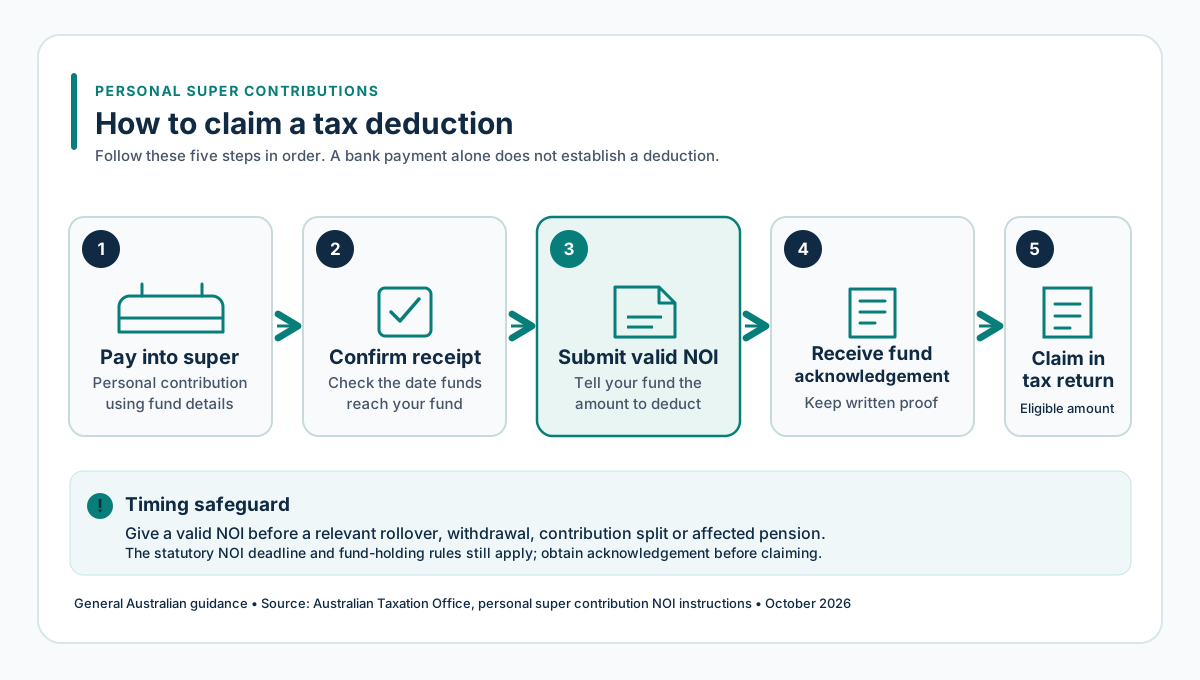
Complete these steps in order:
- Pay the eligible personal contribution directly to your fund and keep the payment details.
- Confirm the fund received the payment during the intended financial year.
- Check the available concessional cap after employer SG and salary-sacrifice amounts.
- Submit the NOI for the exact amount you intend to claim.
- Obtain the fund's acknowledgement before lodging the deduction claim.
- Enter the deductible amount under Personal super contributions in the relevant tax return.
A bank transaction record does not replace a valid acknowledged notice. To estimate the contribution amount before payment, use the Super Contributions Calculator Australia, then confirm your cap position against actual fund records.
The following table shows which actions can affect a notice of intent. On a narrow screen, scroll the table horizontally to read all columns.
| Your next action | What to do first | Reason |
|---|---|---|
| Lodge your income-tax return | Submit a valid NOI and receive its acknowledgement before claiming the deduction | A late NOI cannot generally be fixed by amending the return |
| Roll over or withdraw your entire interest | Give a valid NOI before the rollover or withdrawal | The original fund generally must still hold the contribution |
| Roll over or withdraw part of your interest | Ask the fund to determine the portion still covered by a valid NOI | A proportion of the contribution may no longer be deductible |
| Start an account-based pension | Give a valid NOI before the fund starts an income stream using the contribution | The notice is invalid once the relevant contribution is used to start the income stream |
| Apply to split the contribution | Complete the deductible-contribution NOI before applying to split | The contribution-splitting application can invalidate a later notice |
How Do You Submit a Valid Notice of Intent to Claim?
Submit the fund's approved NOI form or the ATO's Notice of intent to claim or vary a deduction for personal super contributions (NAT 71121). Identify your account, the relevant income year and the intended deduction amount. The fund must still hold the relevant contribution and the notice must meet statutory conditions. One valid notice can cover multiple eligible personal contributions to the same fund; separate funds require separate notices.
Keep the lodged notice and the fund's written acknowledgement together. Check the acknowledged amount rather than assuming every contribution in the financial year has been accepted for deduction.
When Is the Notice of Intent Deadline?
The standard NOI deadline is the earlier of the day you lodge your income-tax return for the contribution year or 30 June of the following financial year. A contribution received by the fund in 2025–26 ordinarily requires the notice on or before the date you lodge the 2026 tax return, and no later than 30 June 2027 if you have not yet lodged. You must receive the fund's acknowledgement before claiming the deduction.
Give the notice and receive the acknowledgement before claiming. Other events, including a full rollover, withdrawal or commencement of an income stream, can affect validity even before the formal deadline.
What Could Invalidate a Notice of Intent?
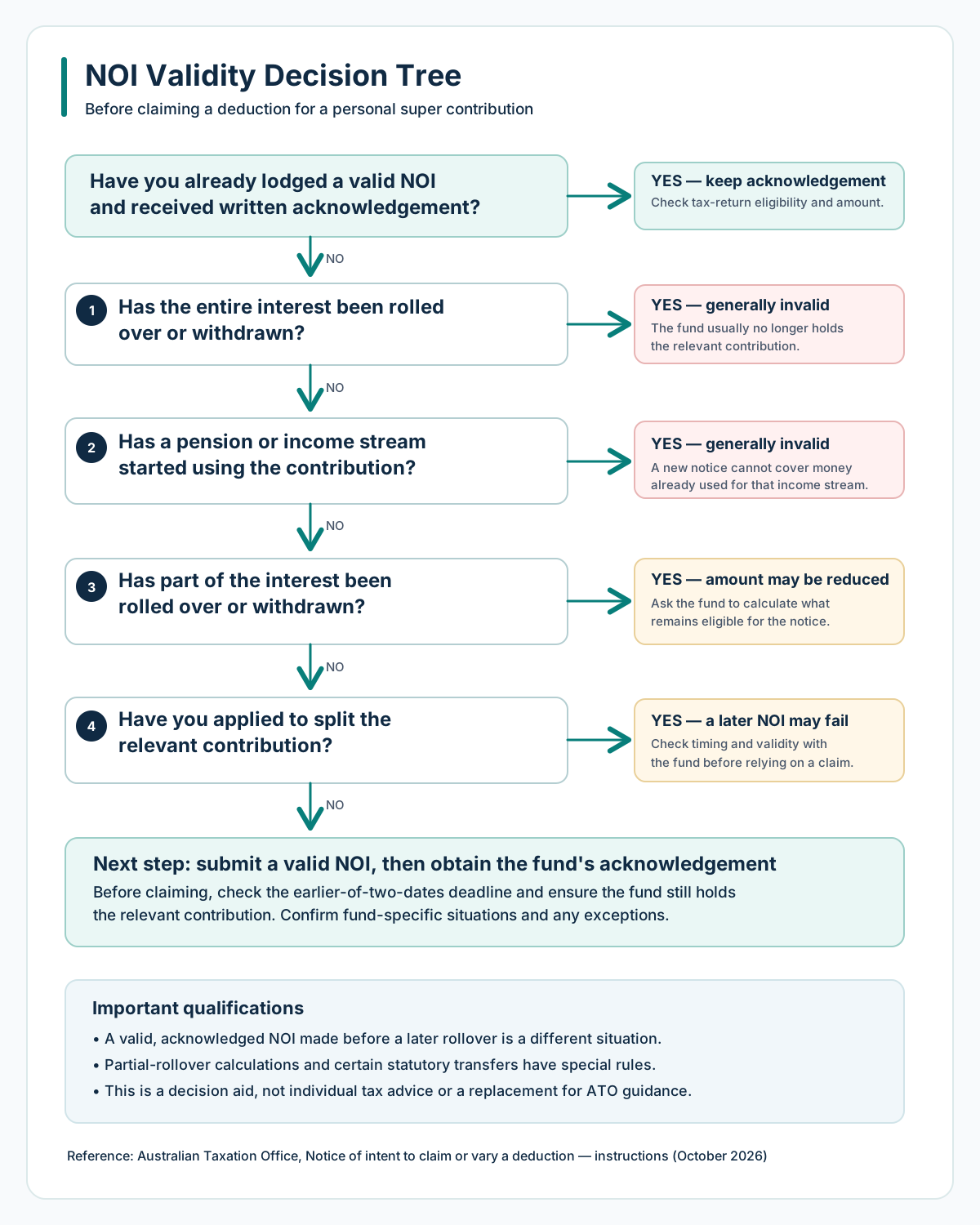
According to the Australian Taxation Office, Personal super contributions (accessed October 2026), a notice can be invalid if the member has left the fund, the fund no longer holds the relevant contribution or an income stream has started using it. An application to split the contribution, an amount already covered by a notice or certain first home super saver releases can also prevent a valid notice.
Check the fund's records before any rollover or pension commencement. A partial rollover or withdrawal can reduce the amount still eligible for a valid notice, even if the original deposit was larger.
How Do You Enter the Deduction in myTax?
Enter the amount acknowledged by your fund under Personal super contributions in the deductions area of myTax. For a 2025–26 contribution, use the ATO's myTax 2026 instructions. Match the income year, fund records and amount in the acknowledgement.
Do not enter compulsory employer SG as a personal deduction. Keep the acknowledgement with your records, even when the electronic return does not require it to be uploaded. If you use a tax agent, give the agent the notice and acknowledgement before lodgement.
How Much Can You Claim as a Super Contribution Tax Deduction?
The deductible amount depends on eligible personal contributions, a valid acknowledged NOI, personal deduction requirements and concessional cap exposure. The following table compares general caps by financial year. According to the ATO, the general concessional cap is $30,000 for 2025–26 and $32,500 for 2026–27.
| Financial year | General cap | Contributions counted |
|---|---|---|
| 2025–26 | $30,000 | Employer SG, salary sacrifice and deductible personal contributions |
| 2026–27 | $32,500 | Employer SG, salary sacrifice and deductible personal contributions |
An amount above the cap is not automatically an invalid deduction. Excess concessional contributions have separate tax consequences. Carry-forward cap space can also apply to eligible individuals.
How Do Employer Contributions and Salary Sacrifice Affect the Deduction Cap?
Employer SG, salary sacrifice and deductible personal contributions share the same concessional cap. For example, using the 2026–27 general cap of $32,500, employer contributions of $15,000 and salary sacrifice of $5,000 leave $12,500 of current-year cap room before other adjustments.
Check all super funds and contribution receipt dates. A deduction claim is not assessed against a separate personal-contribution allowance. For the payroll alternative, see the salary sacrifice super calculator. For a general estimate of employer contributions, see Superannuation Calculator Australia.
When Can Carry-Forward Concessional Caps Increase Deductible Contributions?
Eligible taxpayers can use unused concessional cap amounts from the previous five financial years after exhausting the current year's cap. The ATO generally requires a total super balance below $500,000 at the previous 30 June. Unused amounts expire after five years.
The additional cap does not remove NOI requirements or other deduction eligibility conditions. Check the ATO's personalised carry-forward figures in myGov before relying on unused amounts. To model how extra contributions affect a future balance, use the Super Projection Calculator Australia; a projection does not confirm tax deductibility.
How Much Tax Could You Save by Claiming a Personal Super Deduction?
A deductible personal contribution generally reduces assessable taxable income while attracting 15% contributions tax within the fund. The net outcome depends on the individual's marginal tax rate, Medicare levy, other income-based effects and applicable super taxes.
Illustrative example: A person claims an eligible $5,000 deduction and faces a 30% marginal income-tax rate. The deduction reduces income tax by $1,500, before Medicare levy and other interactions. The fund ordinarily charges $750 in contributions tax, leaving $4,250 invested. The simplified difference is $750, before Medicare levy, other tax offsets, fund fees and any further tax consequences. This is an illustration, not a guaranteed personal saving.
When Might Claiming a Deduction Be Less Beneficial?
A deduction can provide less benefit when personal taxable income is low, where contributions exceed the available concessional cap or where claiming changes eligibility for another tax or super benefit. The portion claimed as deductible does not count as an eligible after-tax contribution for the government's super co-contribution.
Compare the result with retaining a non-concessional contribution, especially when other income, offsets or contribution limits affect the outcome.
How Does Claiming a Personal Deduction Compare With Salary Sacrifice?
The table below compares the payment process and tax treatment of the two methods. Both arrangements generally result in concessional super contributions subject to the shared annual cap. The payment and paperwork differ: an individual pays a personal contribution and claims a deduction through an acknowledged NOI; salary sacrifice is agreed through payroll before the relevant salary is earned and is reported through employer contributions.
| Attribute | Personal deductible contribution | Salary sacrifice |
|---|---|---|
| Payment source | Personal funds | Employer payroll arrangement |
| NOI required | Yes, with fund acknowledgement | No personal NOI for employer salary sacrifice |
| Tax-return treatment | Eligible personal deduction claimed | Salary foregone before payment |
| Concessional cap | Counts towards cap | Counts towards same cap |
| Fund contributions tax | Generally 15% | Generally 15% |
Can You Claim Only Part of a Personal Super Contribution?
YES, you can claim a deduction for only part of an eligible personal contribution. If you deposit $6,000 and validly claim $4,000, the claimed portion is generally concessional and the remaining $2,000 is generally non-concessional, subject to applicable rules.
Specify the intended deduction amount accurately in the NOI. This split affects contributions tax and the contribution caps applied to each portion.
Can You Vary the Notice of Intent After Submitting It?
YES, a valid NOI can generally be varied downwards, including to zero, subject to the applicable timeframe and fund-holding conditions. Increasing an intended claim generally requires a further valid notice for the additional amount rather than a variation increasing the original notice.
Do not rely on a variation after the fund has fully rolled over the relevant contribution or commenced a pension using it. Ask the fund which form and evidence it accepts.
What Happens if You Lodge Your Return Before Fund Acknowledgement?
Claiming a personal super deduction without the fund's written acknowledgement does not satisfy the ATO's deduction conditions. If the valid NOI was given on time but the acknowledgement has not arrived, the ATO says you can lodge without claiming the deduction and request an amendment after receiving the acknowledgement.
A later amendment does not make an invalid or late NOI valid. Check the original notice and claim timing first.
What if You Have Already Rolled Over or Withdrawn Part of Your Super?
A full voluntary rollover or withdrawal before a valid NOI generally makes the notice invalid because the original fund no longer holds the contribution. Special statutory rules apply to certain successor fund and MySuper transfers. A partial rollover or withdrawal can reduce the amount available for a valid deduction notice under the ATO's proportionate rules.
Confirm the valid notice amount with the fund before lodging. This is a calculation involving the fund's remaining interest, not simply a subtraction of the withdrawn dollars.
How Should You Reconcile Contribution Dates, Fund Receipt and the NOI Amount?
Compare the bank payment date, fund receipt date and acknowledged NOI amount. The receipt date determines the financial year of a contribution. A transfer initiated on 30 June and received by the fund on 1 July generally falls in the new financial year.
Match the amount in your return to the fund's acknowledgement and check employer SG or other concessional contributions received in the same year. The contribution history in a fund account is the starting record; ATO reporting can lag.
What Is the Correct Order for a 2025–26 Contribution Claimed in a 2026 Return?
For a 2025–26 deduction, the correct sequence is:
- Confirm the personal payment was received by the fund by 30 June 2026.
- Check personal eligibility, the relevant 2025–26 cap and the contribution amount.
- Give the fund a valid NOI before lodging the 2026 return.
- Obtain the fund's written acknowledgement.
- Claim the acknowledged amount in the 2026 income-tax return.
If the return has not yet been lodged, the standard outside NOI date is 30 June 2027, subject to all other notice-validity conditions.
How Do You Correct an Incorrect Amount or Rejected NOI?
First identify whether the problem is a payment record, a wrong amount in a valid NOI or a rejected notice. Ask the fund for its rejection reason and the contribution balance it still holds. A permitted variation generally reduces a valid notice; an additional claim generally requires another valid NOI.
Check the statutory deadlines before amending a return. A rejected notice is not equivalent to an acknowledged one.
Can You Claim a Deduction Without Submitting an NOI?
NO, a personal super contribution deduction requires a valid NOI and written fund acknowledgement. A bank receipt or contribution transaction alone does not satisfy the notice requirement.
Can You Claim Before Receiving Fund Acknowledgement?
NO, you must receive the fund's written acknowledgement of a valid NOI before claiming the personal contribution deduction in your income-tax return. Retain the acknowledgement and match its amount to your return.
Can an Employee Claim a Personal Deduction?
YES, employees can claim eligible personal after-tax contributions even when their employer pays compulsory SG. Employer SG is not the employee's personal deduction. All concessional amounts still count towards the same applicable cap.
Can a Self-Employed Person Claim a Personal Deduction?
YES, self-employed people can claim eligible personal contributions when the fund, age, notice and tax-return conditions are satisfied. A sole trader generally does not receive employer SG for their own sole-trader income, so direct personal contributions provide an alternative way to contribute.
Can You Claim a Deduction on Employer Super Guarantee Contributions?
NO, compulsory employer SG contributions are not personal deductible contributions claimed by an employee. They are made by the employer, subject to the employer's tax treatment, and count towards the employee's concessional cap.
Can You Claim a Deduction After Starting a Pension With the Contributed Money?
NO, a subsequent NOI is not valid where the fund has already started paying a super income stream based wholly or partly on the relevant contribution. Obtain a valid acknowledged notice before commencing an affected pension.
Sources and verification (October 2026)
- Australian Taxation Office, Personal super contributions, published 22 May 2024; checked 17 October 2026.
- Australian Taxation Office, Notice of intent to claim or vary a deduction for personal super contributions (NAT 71121), checked 17 October 2026.
- Australian Taxation Office, Concessional contributions cap and Key superannuation rates and thresholds, checked 17 October 2026.
- Australian Taxation Office, myTax 2026 Personal super contributions, checked 17 October 2026.
- Commonwealth of Australia, Income Tax Assessment Act 1997, Division 290, checked 17 October 2026.
The examples are illustrative. Actual eligibility, the amount of income-tax savings and the validity of a contribution deduction depend on your circumstances, the relevant financial year and the fund's records.
Written by
Superannuation Calculator Australia
Calculation guidance and general information; independent financial advice is not provided.