How to Read Your Super Statement: Balances and Fees
Read your super statement, check contributions, fees, returns, insurance and beneficiaries, and reconcile balances with examples.
Superannuation Calculator Australia · · 12 min read
Your annual super statement records activity in your superannuation account over a reporting period. Check the opening and closing balances, employer and personal contributions, investment earnings, fees, insurance premiums and beneficiary details. Compare entries with your fund’s transaction history and your payslips. Ask the fund to explain any discrepancy. Start with the account summary, reconcile the transactions, then investigate any amount that does not match your records.
What is a super statement and when should you read it
A super statement is the account report your fund issues for a stated period, commonly the financial year. It records contributions, investment movements, deductions and your account value at the reporting date.
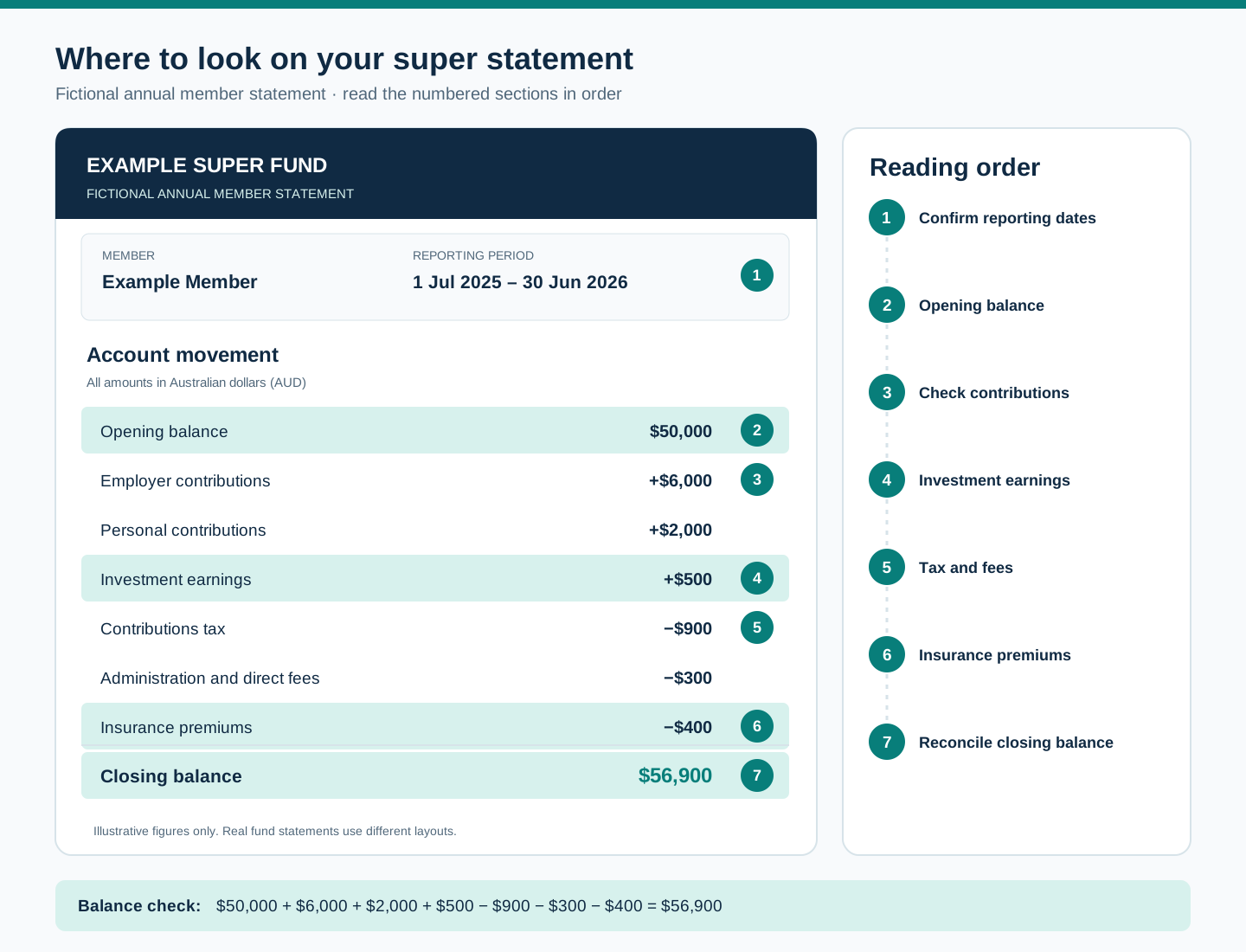
Use the annotated statement to follow the reading order. The example is fictional and contains no actual member data.
- Read your annual statement when it becomes available and after important account changes.
- Check the reporting dates before comparing transactions.
- Sign in to your fund’s official member portal or app and look for Documents, Statements or Correspondence. Download the annual statement for the correct year, or request a copy from the fund.
- Open your fund’s current online transaction history when the statement does not provide enough detail. The statement’s reporting date is not necessarily today’s balance.
Which account and personal details should you check
Check that your name, date of birth, contact details and member number match your fund’s current records. Confirm your fund has your tax file number through its secure member portal, even if the statement does not display it. Incorrect records can delay account servicing and important notifications.
How do you reconcile opening and closing super balances
Closing balance = opening balance + contributions + incoming rollovers + net investment movements − tax − fees − insurance premiums − withdrawals − outgoing rollovers. Treat a negative investment result as a subtraction. Avoid deducting fees or tax twice when they are already reflected in the fund’s published net investment return.
| Account movement | Effect on balance |
|---|---|
| Opening balance | Starting amount |
| Employer and personal contributions | Add |
| Rollovers received | Add |
| Investment earnings or losses | Add or subtract |
| Contributions tax, fees and premiums | Subtract when separately charged |
| Benefits paid and rollovers out | Subtract |
| Closing balance | Calculated result |
Use statement labels and transaction dates to reconcile each amount. A rollover transfers existing super, rather than representing new wages or employer contributions. If the statement gives a net earnings figure, check its explanatory notes before separately subtracting investment costs: some amounts are embedded in investment returns rather than shown as account transactions. For a closer examination of current and reported balances, see how to check your super balance. The Superannuation Calculator Australia is for estimating contributions and outcomes, not checking actual account transactions.
How can you check employer super contributions on your statement
Compare contributions credited to the fund with employer payments and super amounts shown on payslips. The annual statement records payments received and allocated, not necessarily every amount an employer owes. For a separate calculation of entitlement, use the Super Contributions Calculator Australia and verify the employer's applicable pay periods and qualifying earnings.
- Identify the reporting period and employer contribution entries.
- Compare amounts with payslips and payroll records for the relevant periods.
- Check your fund’s transaction history for payments allocated outside the statement period.
- Ask payroll for the contribution calculation and remittance evidence if amounts differ.
- Report suspected unpaid super to the ATO after checking the explanation and the relevant payment due dates.
The payslip date, employer payment date and fund allocation date can differ. Payday Super commenced on 1 July 2026. Employers generally calculate and pay super guarantee at each payday, with contributions required to reach the member's fund within seven business days after payday. Extended deadlines apply in specified circumstances, including some first contributions for new employees. For pay periods before July 2026, check the earlier quarterly payment deadlines. According to the Australian Taxation Office, Payday Super: Paying super for your employees (updated August 2026), the standard super guarantee rate is 12% of qualifying earnings for eligible employees.
How do you identify salary sacrifice and personal contributions
Salary sacrifice is an employer-paid concessional contribution arranged from pre-tax salary. A personal contribution is paid directly by the member. Its tax treatment depends on the applicable contribution rules and, for a claimed personal deduction, a valid notice of intent and fund acknowledgement. Match the statement’s contribution categories with your payroll or bank records and any deduction acknowledgement.
How should you read investment returns on a super statement
Read your account’s dollar investment gain or loss separately from the advertised percentage return for an investment option. Contributions and withdrawals during the reporting period affect your personal balance change.
For example, an opening balance of $40,000, contributions of $5,000 and an investment loss of $1,000 produces $44,000 before other deductions. This is a balance movement, not a personal investment return percentage. A negative dollar return does not mean that contributions were lost.
Compare investment options over the same dates and with similar asset exposure. Confirm whether the reported percentage is before or after investment fees and tax. Read more about super investment returns when comparing return conventions. Use the Super Projection Calculator Australia to test hypothetical future balances, rather than treating a past statement return as a forecast.
Which super fees and costs should you check
Check fees directly deducted from your account and costs reflected in an investment option’s net return or unit price. These are different presentation methods and must not be added together without checking the fund’s disclosure.
| Cost category | What to check |
|---|---|
| Administration | Dollar charges for account and member services |
| Investment fees and costs | Amount and basis of management-related costs |
| Transaction costs | Costs disclosed for managing the option |
| Member activity charges | Switching, advice or other applicable transaction charges |
| Insurance premiums | Separate charges for cover paid from the account |
Look for the total fees and costs disclosure as well as the transaction list. Fees deducted from investments can appear in the total annual costs even though no matching account debit appears in the transaction history. Compare costs over the same period and equivalent investment options. According to Commonwealth Superannuation Corporation, Understanding your annual statement (2026), its statement distinguishes fees deducted directly from the account from costs deducted from investments. See compare super fund fees for the broader comparison.
How do you read insurance premiums and cover details
Insurance premiums are charges for cover held through super. Check the amount deducted, the period charged and the type and status of insurance shown in your statement or fund portal.
| Cover | Statement or policy detail |
|---|---|
| Death cover | Benefit amount, active status and premium |
| Total and permanent disability (TPD) | Benefit amount and policy definition of disability |
| Income protection | Monthly benefit, waiting period, benefit period and premium |
A premium deduction alone does not establish that a claim is covered. Read the current insurance guide or product disclosure statement for exclusions, eligibility and cancellation conditions.
How do you check the investment option and risk profile
Find the investment option name, the portion of your balance allocated to it and its risk profile in the fund’s investment guide. Compare its growth and defensive asset allocation with the risk level you intended. A default or MySuper option is not necessarily equivalent to an option with a similar name at another fund.
How can you check your beneficiary nomination
Check beneficiary details in the statement or fund portal, then confirm the nomination type and validity directly with the fund.
- Verify each nominated person and any allocation percentages.
- Identify whether the nomination is binding, non-binding or scheme-specific.
- Check expiry and renewal requirements: some binding nominations lapse and others do not.
- Review the nomination after changes to family relationships or dependants.
The outcome of a death benefit depends on super law, the fund’s rules and the nomination’s validity. A name printed on a statement does not, by itself, guarantee payment.
Why are contribution tax and other deductions on your statement
Contributions tax applies to relevant concessional contributions and is different from administration fees, investment costs and insurance charges. Concessional contributions are generally taxed at 15% in a complying fund, with exceptions and additional rules for certain members and contributions. Division 293 tax and excess-contribution rules can create liabilities beyond what the annual statement shows. Use the fund’s transaction descriptions and ATO records to investigate unusual deductions.
What should you do if your super statement contains an error
Ask the fund for an itemised explanation or correction when a balance, contribution, fee, insurance charge or personal detail appears wrong.
- Save the statement, transaction history, payslips and any earlier statements involved.
- Record the disputed amount, date and description.
- Contact the fund, request an investigation reference and retain its written reply.
- For suspected unpaid employer super, check payroll evidence and use the ATO reporting process.
- For unresolved eligible complaints about fund decisions or administration, follow the fund’s internal dispute process and then consider the Australian Financial Complaints Authority (AFCA).
The ATO handles suspected employer super non-payment. The Australian Financial Complaints Authority considers eligible complaints about super fund decisions and administration after the fund's internal dispute process. Check AFCA's published complaint scope and time limits before lodging.
What if you have more than one super statement
Multiple statements usually indicate multiple super accounts or products. Compare balances, fees, insurance and any special benefits before deciding to consolidate. The ATO service linked to myGov can help identify accounts; consolidating super is a separate decision.
How does a defined benefit super statement differ
A defined benefit statement can show an accrued, preserved or projected entitlement calculated under scheme rules rather than an accumulation balance driven mainly by contributions and investment returns.
| Accumulation account | Defined benefit scheme |
|---|---|
| Contributions and investment movements affect account balance | Entitlement commonly depends on formula factors such as service and salary |
| Member investment option influences investment experience | Investment exposure and entitlement depend on scheme design |
| Closing balance is a recorded account value | Accrued or projected benefit may not equal immediately payable cash |
Follow the scheme’s own definitions when checking an estimate or comparing it with an accumulation statement. According to Commonwealth Superannuation Corporation, Understanding your annual statement (2026), defined benefit statements can also report scheme-specific adjustments, accrued benefits and explanatory notes. Do not apply the accumulation-account reconciliation formula to an entitlement calculated under a defined benefit formula.
Can you see an example of a super statement reconciliation
YES, the following fictional example reconciles to a $56,900 closing balance. It illustrates account arithmetic and is not a statement from an actual fund.
| Item | Amount (AUD) |
|---|---|
| Opening balance | $50,000 |
| Employer contributions | +$6,000 |
| Personal contributions | +$2,000 |
| Investment result | +$500 |
| Contributions tax | −$900 |
| Administration and other direct fees | −$300 |
| Insurance premiums | −$400 |
| Closing balance | $56,900 |
The example assumes the investment result already reflects any costs included in net returns. Subtract each deduction once.
What is a quick checklist for reviewing your super statement
Review your account in a consistent sequence and investigate unmatched entries before changing the account.
- Verify the member details and statement period.
- Reconcile opening and closing balances.
- Match employer contributions with payslips and fund transactions.
- Check salary sacrifice and personal contributions.
- Review the investment option, dollar earnings and comparison period.
- Check directly charged fees and separately disclosed investment costs.
- Confirm insurance premiums, cover status and beneficiary nomination.
- Save records and contact your fund about unexplained differences.
Retain the statement and any corrections for comparison with future periods.
Can a super statement show missing employer contributions?
YES, a missing or unusually low credit can indicate a payment or reporting problem. Check subsequent transactions and the statement cut-off before concluding that super is unpaid. Compare payroll records, request the employer’s remittance evidence and report suspected unpaid contributions to the ATO.
Does a negative investment return always mean your super fund is underperforming?
NO, a negative annual return alone does not prove underperformance. Compare the same period, investment risk and appropriate benchmark. Broad market declines can affect multiple comparable options, so a single-year result is insufficient for a fair assessment.
Are insurance premiums deducted from your super balance?
YES, insurance held through a super fund is generally funded by premiums deducted from the member account. Check the amount, frequency, insured period and cover status. These charges reduce the amount left invested even without a claim.
Can you find your super statement through myGov?
NO, the ATO information available through myGov is generally not a replacement for a fund-issued annual member statement. It can show fund details and reported balances. Download the complete statement, transactions and disclosures from the fund’s member portal or request them directly.
Does a beneficiary nomination always remain valid?
NO, some binding nominations expire unless renewed, while others remain effective subject to the fund’s rules. Check the nomination type, dates, fund requirements and current nominated recipients.
Should you close duplicate super accounts without checking insurance?
NO, closing or consolidating accounts can cancel existing life, TPD or income protection cover. Check each fund’s insurance terms, exclusions, premium costs and special benefits before transferring the balance.
Sources and verification (October 2026)
- Australian Taxation Office, Payday Super: Paying super for your employees, updated August 2026.
- Australian Taxation Office, Personal super contributions, updated October 2026.
- ASIC Moneysmart, How to check your super, reviewed May 2026.
- ASIC Moneysmart, Insurance through super, accessed October 2026.
- Australian Retirement Trust, Understanding your Annual Statement, updated 14 August 2026.
- Commonwealth Superannuation Corporation, Understanding your annual statement, 2026.
- UniSuper, Understanding your annual super statement, August 2026.
- Australian Financial Complaints Authority, Superannuation complaints, accessed October 2026.
- The relevant super fund’s annual statement, product disclosure statement and insurance guide govern individual member details.
General information only. Fund statements, insurance eligibility, benefit calculations and contribution rules vary by account and reporting period. The worked reconciliation contains illustrative figures.
Written by
Superannuation Calculator Australia
Calculation guidance and general information; independent financial advice is not provided.