Defined Benefit vs Accumulation: Payouts, Risks
Compare defined benefit and accumulation super in Australia: payout formulas, investment risks, retirement income and switching rules.
Superannuation Calculator Australia · · 13 min read
Defined benefit and accumulation super arrangements produce retirement entitlements differently. A defined benefit uses scheme rules and a formula, often linked to salary and service. An accumulation account builds a balance from contributions and net investment results. The better outcome depends on the member's actual scheme, career plans, risk exposure, retirement income options and consequences of leaving. Compare written benefit quotations before making an election. The Superannuation Calculator Australia provides general calculation tools, not a substitute for a scheme-specific benefit statement.
What Is the Difference Between Defined Benefit and Accumulation Super?
The primary difference is how the retirement benefit is determined: a defined benefit follows scheme rules, whereas an accumulation benefit follows the account balance. Neither label alone identifies a fund's fees, insurance, tax treatment or retirement payment options. ASIC Moneysmart's Defined benefit super explained (14 August 2026) and Types of super funds (18 June 2026) distinguish these account structures. Some funds offer both within one membership.
The calculation flow below shows how salary, service and scheme factors determine a defined benefit, while contributions, investment performance and deductions determine an accumulation balance.
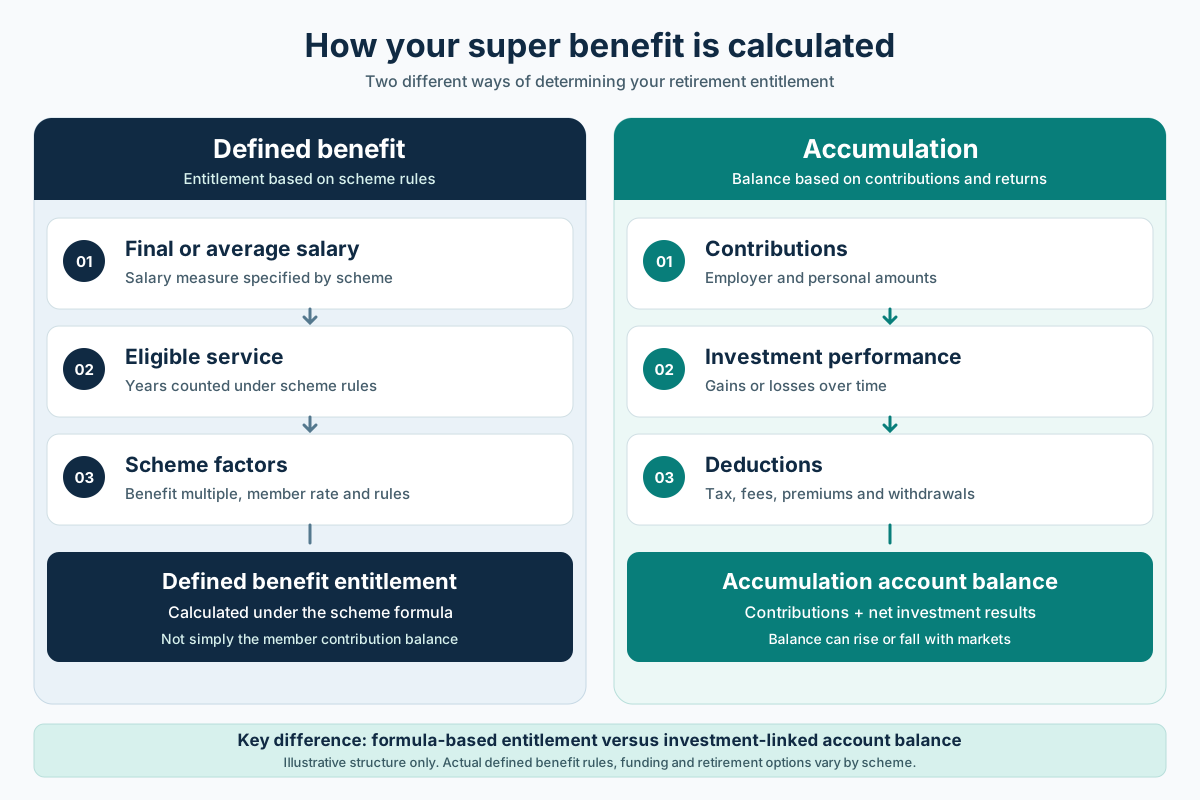
The table compares the benefit calculation, exposure to market movements and typical investment control. Scheme rules remain decisive for individual members.
| Attribute | Defined benefit | Accumulation |
|---|---|---|
| How valued | Scheme formula | Current account balance |
| Key inputs | Salary, service and scheme factors | Contributions and net returns |
| Investment exposure | Formula buffers direct market movements; funding risk remains | Member balance moves with markets |
| Choice and access | Dependent on scheme | Usually broader investment choice |
How Is a Defined Benefit Payout Calculated?
A defined benefit payout depends on the formula specified in the scheme deed, not a universal superannuation calculation. A displayed member-account or contribution balance is not necessarily the amount payable under the defined benefit formula. Common inputs are a final or average salary, years of service, member contribution rate and benefit multiple. A fund can apply different factors at retirement, resignation, disability and death. QSuper's How is your defined benefit calculated? illustrates why the particular scheme formula matters.
For example, where a scheme explicitly uses final salary × accrued multiple, a $100,000 salary and a 4.0 multiple produce an illustrative $400,000 gross benefit. The 4.0 multiple is an assumption, not a standard Australian rate. The member must obtain their scheme's actual projection and confirm whether the quoted amount represents a lump sum or an income stream.
How Does an Accumulation Balance Grow?
An accumulation account grows with contributions and investment earnings, then reduces through investment losses, tax, fees, insurance premiums and withdrawals. The balance is not a pre-set retirement entitlement. Employer super guarantee contributions and any additional member contributions affect the balance, but a statutory contribution percentage does not by itself establish a defined benefit payout. ASIC Moneysmart's Types of super funds (18 June 2026) describes this contributions-and-returns model.
A simplified illustration starts with $100,000, adds $12,000 in net contributions and earns $5,000 after all investment-related charges, resulting in $117,000 before any other deductions. Actual balances change with contribution timing, market conditions, investment choice and personal fees; the illustration is not a forecast.
Who Bears Investment and Funding Risk?
In a typical accumulation account, the member bears the investment risk: losses reduce their balance. In a defined benefit scheme, a formula buffers the promised benefit against ordinary market fluctuations, while the sponsoring employer and fund arrangements bear substantial funding obligations. However, a formula benefit is not universally risk-free: employer support, funding arrangements and members' entitlements depend on the scheme rules.
UniSuper publishes Defined Benefit Division funding updates. Those disclosures are a reason to assess a particular scheme's funding position rather than assume every formula has an unconditional government guarantee.
How Do Investment Choice and Fees Compare?
Accumulation accounts commonly offer a menu of investment options, so members choose an asset allocation and bear the corresponding returns. Defined benefit components typically offer less direct control because the entitlement follows a formula. Fees must be assessed against the actual product disclosure statement: compare administration, investment, insurance and advice costs alongside any embedded benefits. Compare the impact of charges on an accumulation account using the Super Projection Calculator Australia, with assumptions clearly separated from formula-based entitlements.
How Do Retirement Payment Options Differ?
Defined benefit schemes can provide a lifetime or other regular pension, a lump sum or a combination, subject to scheme eligibility. An accumulation balance can be withdrawn when a condition of release is met, rolled into an account-based pension or used for other permitted retirement products. ASIC Moneysmart's What happens to your super when you retire explains these pathways.
An account-based pension offers flexible drawdowns but does not guarantee income for life. A defined benefit pension's lifetime status must also be established from scheme documents rather than inferred from the defined benefit label. Minimum annual withdrawal percentages depend on age. For example, ASIC Moneysmart's Account-based pensions (July 2026) lists a 5% annual minimum at ages 65–74 and 6% at ages 75–79, calculated using the relevant 1 July account balance. A lifetime defined benefit pension may manage longevity risk differently, but its indexation and survivor provisions require scheme-specific checking.
The following comparison covers retirement income structures rather than assuming every defined benefit provides a lifetime pension.
| Feature | Defined benefit income | Account-based pension |
|---|---|---|
| Income basis | Scheme pension rules | Remaining invested account |
| Duration | May be lifetime or term-specific | Until capital is exhausted |
| Inflation protection | Scheme-specific | Depends on investment and withdrawals |
| Beneficiaries | Reversionary rights depend on scheme | Remaining balance/death-benefit rules |
How Do Tax Rules Differ?
Tax treatment depends on the benefit's tax-free component, taxable taxed element and taxable untaxed element, plus the recipient's age and the payment type. Many taxed-fund pension payments to people aged 60 or over are tax-free, but capped defined benefit income streams can be taxable above the defined benefit income cap, and untaxed elements can remain assessable. The ATO's Defined benefit income cap tool (updated 1 July 2026) and Transfer balance cap: capped defined benefit income streams explain these exceptions. Do not calculate pension tax from the fund label alone; obtain the payment summary and use current ATO guidance.
How Do Insurance and Dependant Benefits Differ?
Defined benefit memberships can include built-in death or incapacity benefits, spouse pensions or other survivor rights. Accumulation accounts commonly provide separately priced death and total and permanent disability insurance. Benefits are not interchangeable: eligibility, waiting periods, exclusions, premiums and beneficiaries depend on the fund rules and cover. ASIC Moneysmart's Types of super funds describes differences in cover and member benefits.
How Do Indexation and Longevity Risks Compare?
Indexation and longevity protection depend on the pension's contract, not simply whether it is called defined benefit. Some scheme pensions index payments, while others do not. An account-based pension's remaining capital responds to returns and withdrawals and can be exhausted. ASIC Moneysmart's Account-based pensions describes withdrawal requirements and investment risk. Compare CPI adjustment rules, pension duration, survivor entitlements and the real purchasing power of payments.
What Happens When You Change Employers?
Changing employers can change a defined benefit member's future accrual, preservation status or exit entitlement. The relevant scheme may specify a resignation or vested benefit calculated differently from the projected retirement benefit. Accumulation accounts are usually portable, but a defined benefit transfer can forfeit rights that cannot be restored. ASIC Moneysmart's Defined benefit super explained warns that leaving a scheme can cause benefits to be lost and rejoining is generally unavailable. Request an exit quotation before accepting a new role or initiating a rollover.
Can You Join a Defined Benefit Scheme Today?
YES, some new employees can enter an eligible defined benefit arrangement, but most legacy schemes are closed to new members. Eligibility is tied to the particular employer, sector, role and membership window. UniSuper describes its Defined Benefit Division for eligible higher education employees; eligibility is not general access to every legacy scheme.
Can a Fund Have Both Benefit Types?
YES, a fund can hold both components. A hybrid arrangement combines a formula-based defined benefit with an accumulation component whose value responds to contributions and investment performance. UniSuper's Defined Benefit Division is an example with a defined benefit component and an accumulation component. Confirm which statement figures belong to each component before calculating the overall retirement position.
What Should You Check Before Switching?
Before switching, obtain a written comparison of the resignation or exit benefit and the projected benefit from remaining in the scheme, using the same valuation date and explicitly stated assumptions. Review vesting, preserved-benefit rules, pension and survivor options, indexation, insurance, fees and tax treatment. Ask whether the decision is reversible and whether future employer contributions or benefit accrual would change. To model accumulation-only contribution scenarios, use the Super Contributions Calculator Australia; the result does not calculate or replace a scheme's defined benefit quotation. A projected accumulation balance is not directly comparable with a lifetime pension without considering duration and risk.
Use this checklist to request comparable written evidence before making a transfer or membership election.
| Decision question | Evidence to obtain | Why it changes the decision |
|---|---|---|
| What do I receive if I leave now? | Written resignation or exit benefit quotation | The exit value may differ from a retirement projection |
| What rights end on transfer? | Trustee confirmation of pension, insurance and rejoining rules | Some options may not be restored |
| What if salary or employment changes? | Scheme projections with stated salary and service assumptions | Defined benefit formula inputs change |
| What happens under poor market returns? | Accumulation scenarios using disclosed fees and returns | Investment risk affects the account balance |
| What will my beneficiaries receive? | Death benefit and reversionary pension terms | Survivor arrangements can differ materially |
Which Documents and Quotations Should You Request?
Request the latest member benefit statement, scheme deed or member guide, product disclosure statement, written exit quotation and retirement projection. Where relevant, request the insurance certificate, beneficiary nomination, tax-component breakdown and pension indexation schedule. Check quotation dates, assumptions, beneficiary conditions and any transfer deadline. Obtain licensed personal advice where a choice could permanently end defined benefit rights.
How Would Two Hypothetical Retirement Outcomes Compare?
A like-for-like comparison requires explicit assumptions for both arrangements. Two workers can earn the same salary but have different outcomes because a defined benefit multiple, vesting and retirement age are scheme-specific, while accumulation outcomes depend on contributions, time invested and net returns.
Illustrative snapshot, not a projection: For a scheme whose rules specify a final-salary multiple of 4.0, a $100,000 final salary produces a $400,000 lump-sum entitlement. An accumulation account starting at $350,000, receiving $18,000 in net contributions and $12,000 in net investment growth ends at $380,000. Both figures use assumed values, with no claim that either reflects an actual scheme or typical return. The $20,000 numerical difference is not an investment performance comparison. Different service periods, employer funding, tax components, insurance, pension entitlements and risk mean these figures alone cannot establish a better option.
The figures below are hypothetical Australian-dollar amounts at a single valuation point. They exclude scheme-specific tax and payment rights.
| Assumption or output | Formula-based illustration | Accumulation illustration |
|---|---|---|
| Starting inputs | $100,000 final salary; 4.0 benefit multiple | $350,000 starting balance |
| Additional inputs | Scheme multiple already assumed accrued | $18,000 net contributions; $12,000 net growth |
| Illustrative end amount | $400,000 | $380,000 |
| Important missing variables | Vesting, exit terms, pension rights and indexation | Future contribution timing, returns, fees and withdrawals |
The comparison becomes decision-useful only after matching the valuation date and considering the different rights behind each amount.
Are Defined Benefit Payouts Always Guaranteed?
NO, defined benefit payouts are not universally guaranteed without conditions. The scheme rules determine the entitlement, and funding and sponsor arrangements determine how it is supported. Check the scheme's governing documents, trustee disclosures and any circumstances affecting the benefit rather than assuming every formula is an unconditional government guarantee.
Can a Defined Benefit Account Lose Value?
YES, a member's defined benefit entitlement can change, although ordinary investment losses do not necessarily reduce a formula-based accrued benefit. Salary, service, contribution elections, resignation factors and scheme rules affect the amount payable. A hybrid membership can also include an accumulation component exposed to market losses.
Can You Hold Defined Benefit and Accumulation Super Simultaneously?
YES, a person can hold both a defined benefit interest and an accumulation account, including through a hybrid scheme or separate funds. Consolidation decisions should account for non-transferable defined benefit rights, duplicate insurance and actual fees. Do not transfer a formula-based entitlement using ordinary account-consolidation assumptions.
Is Switching From Defined Benefit Usually Irreversible?
YES, switching out of a defined benefit division is often effectively irreversible, but each scheme has its own rules. UniSuper says a member who transfers from its Defined Benefit Division to Accumulation 2 cannot return to the DBD. UniSuper's Accumulation 2 product guidance also states that the DBD-to-Accumulation 2 election is generally available only within the first two years of DBD membership. Confirm the exact election window and consequences in writing before signing.
Can New Employees Enter Every Defined Benefit Fund?
NO, new employees cannot enter every defined benefit fund. Most older schemes are closed, while a limited number accept eligible employees under specified employment or membership conditions. Check the current fund entry rules rather than relying on historical employer eligibility.
Are Defined Benefit Pensions Always Tax-Free After Age 60?
NO, defined benefit pensions are not always tax-free after age 60. Certain capped defined benefit income streams are subject to income-cap rules, and an untaxed element can remain assessable. Treatment depends on pension components and the member's other income streams. Use the ATO defined benefit income cap tool and the fund's payment statements rather than applying the general taxed-fund rule without checking. The ATO's Defined benefit income cap tool was updated on 1 July 2026.
Sources and verification (October 2026)
- ASIC Moneysmart, Defined benefit super explained, 14 August 2026.
- ASIC Moneysmart, Types of super funds, 18 June 2026.
- QSuper, How is your defined benefit calculated?, date not stated.
- UniSuper, Defined Benefit Division (DBD) super and funding updates, accessed October 2026.
- UniSuper, Compare DBD and accumulation accounts and Accumulation 2, accessed October 2026.
- ASIC Moneysmart, What happens to your super when you retire, accessed October 2026.
- ASIC Moneysmart, Account-based pensions, July 2026.
- Australian Taxation Office, Defined benefit income cap tool, updated 1 July 2026.
- Australian Taxation Office, Transfer balance cap: capped defined benefit income streams, 24 July 2025.
- ASIC Moneysmart, Retirement income and tax, 28 July 2026.
Written by
Superannuation Calculator Australia
Calculation guidance and general information; independent financial advice is not provided.