What Happens to Super When You Retire: Access, Payout Options and Tax
What happens to super when you retire? Compare access at 60 and 65, withdrawals, account-based pensions and tax in Australia.
Superannuation Calculator Australia · · 13 min read
Retiring does not automatically withdraw or close your super account. Your retirement savings normally remain invested until you instruct the fund to pay a benefit or transfer eligible savings into a retirement income account. Access depends on your age and whether you satisfy a condition of release. Once eligible, you can generally leave the money in accumulation, withdraw a lump sum, start an account-based pension or combine these approaches. The options differ in tax treatment, investment exposure, income flexibility and Age Pension consequences. Before making an irreversible withdrawal, compare the fund's current product terms and ask how the change affects any existing insurance.
What happens to super savings on the day you retire?
Your existing super balance remains in your account and invested under the fund's chosen investment strategy. Stopping work does not automatically move your savings into a bank account, start regular pension payments or close your membership. Investment returns, administration fees and any insurance premiums can continue to change the balance.
Your employer generally stops making contributions when your employment ends, although outstanding contributions can still arrive. Check your latest fund statement and member portal for contributions and deductions. According to ASIC MoneySmart, What happens to your super when you retire (30 September 2026), the next step is to confirm access eligibility and choose how to use your savings.
When can you legally access super after retiring?
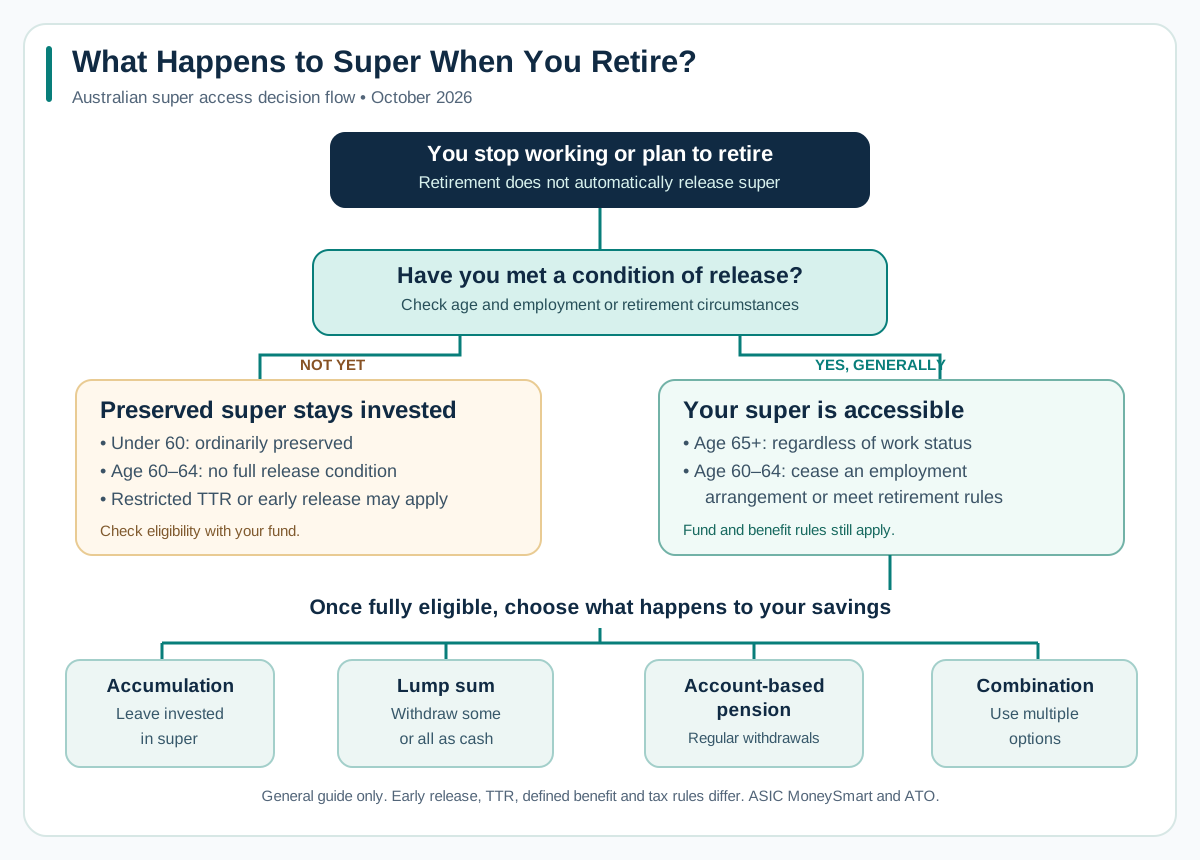
Most Australians can access preserved super from age 60 after satisfying a retirement condition of release, or at age 65 regardless of work status. Turning 60 alone does not always provide unrestricted access. A person aged 60 or older who ends an employment arrangement can generally satisfy a release condition, while separate rules apply to permanent retirement and other cases.
- Under 60: Preserved benefits ordinarily remain inaccessible unless another lawful release condition applies.
- Age 60 to 64: Access depends on meeting the applicable retirement or cessation-of-employment condition; transition-to-retirement income streams have separate restrictions.
- Age 65 and over: Preserved super becomes accessible even if the person continues working.
The Australian Taxation Office, When you can withdraw your super (checked October 2026), explains the conditions of release. Age Pension eligibility age is 67, subject to residence and means tests, not the super preservation age.
The super access flow shows why stopping work and meeting a condition of release are separate decisions.
Which options can you choose for your super at retirement?
Four common approaches are to retain accumulation savings, take a lump sum, start an account-based pension or combine these options. A fund's product rules and your release status determine what transactions are available.
| Option | What happens | Main consideration |
|---|---|---|
| Leave in accumulation | The balance remains invested in the accumulation account. | Fund earnings generally remain subject to accumulation-phase tax. |
| Lump sum | Some or all accessible super is withdrawn as cash. | Cash taken outside super generally loses its super tax treatment. |
| Account-based pension | Eligible super moves into a retirement income account and funds payments. | Minimum annual withdrawals and transfer balance rules apply. |
| Combination | Part is taken as cash while the rest stays invested or funds a pension. | Balances, fees, payment timing and tax treatment need to be assessed separately. |
| Lifetime income product | An eligible amount funds an annuity or another lifetime income stream. | Payment guarantees, access to capital, fees and death benefits depend on the product. |
The Superannuation Calculator Australia estimates a future super balance, while the Super Projection Calculator Australia models longer-term growth assumptions. Neither retrieves an actual fund balance or gives personal financial advice. Defined benefit scheme members should check their scheme's benefit statement: lifetime pension and lump sum entitlements can differ materially from an accumulation account.
How does an account-based pension work after retirement?
An account-based pension pays retirement income from super transferred into a pension account after you meet the relevant condition of release. The balance generally stays invested, so investment gains, losses, fees and withdrawals affect how long it lasts. Unlike a guaranteed lifetime annuity, a standard account-based pension does not promise payments for life.
The pension provider pays periodic amounts according to the product terms. For an ordinary retirement-phase account-based pension, you select withdrawals at or above the statutory minimum, subject to the account balance and product conditions. Transition-to-retirement income streams generally also have a 10% annual maximum until an unrestricted release condition is met. Additional lump sums depend on the applicable pension and release rules. See the super pension calculator to explore withdrawal assumptions.
How much super can enter retirement phase?
The general transfer balance cap for 2026–27 is $2.1 million. It limits the amount counted towards an individual's transfer balance account when eligible retirement-phase income streams commence. Your personal cap can differ, particularly if you started a pension previously. Accumulation savings above the available cap are treated separately.
Check your personal transfer balance account using ATO online services rather than assuming the current general cap is your personal entitlement. The cap is not a limit on the total super you own and is not a limit on the size of an ordinary lump sum withdrawal. If your available personal cap is lower than the amount you plan to transfer, ask the fund how to keep the excess in accumulation or withdraw it in accordance with the rules.
How much must retirees withdraw from an account-based pension?
The minimum withdrawal depends on the pension account balance at the relevant calculation date and the recipient's age. The standard annual minimum percentages for ordinary account-based pensions are shown below.
| Age | Minimum annual rate | Example on $500,000 |
|---|---|---|
| Under 65 | 4% | $20,000 |
| 65–74 | 5% | $25,000 |
| 75–79 | 6% | $30,000 |
| 80–84 | 7% | $35,000 |
| 85–89 | 9% | $45,000 |
| 90–94 | 11% | $55,000 |
| 95 or older | 14% | $70,000 |
Examples assume a $500,000 pension account balance at the calculation date and use the standard age-based rates. First-year pro-rating and product-specific circumstances can change the required payment. The Australian Taxation Office, Key superannuation rates and thresholds: Payments from super (checked October 2026), provides the minimum pension rates.
Does super continue to rise or fall during retirement?
YES, savings held in accumulation or an account-based pension remain exposed to investment movements. Positive net returns can increase the balance; market falls, withdrawals and fees can reduce it. The balance is not a fixed cash entitlement unless it has actually been withdrawn into cash.
For example, $500,000 growing by 5% over one year becomes $525,000. If a $30,000 withdrawal occurs at year-end, the remaining balance is $495,000, before any unmodelled costs or tax. With the withdrawal at the beginning of the year, the result is $493,500 because only $470,000 is invested for that year. The figures illustrate withdrawal timing and a constant assumed return; they are not forecasts.
How is super taxed after retirement?
Super benefits paid from a taxed super fund are generally tax-free once the recipient is aged 60 or over, but the fund's tax components and scheme type matter. Some untaxed public-sector benefits are treated differently, and payments before age 60 can attract tax.
Investment earnings in the accumulation phase are generally taxed at up to 15%, while eligible earnings supporting a retirement-phase pension are ordinarily tax-exempt within the applicable rules. Moving accessible super to an ordinary bank account changes how subsequent investment income is taxed. Do not equate a tax-free super withdrawal with tax-free earnings on investments held outside super.
For complex components, check the fund's tax breakdown and the Australian Taxation Office, Retirement withdrawal: Lump sum or income stream (31 March 2026).
Does accessing super affect Age Pension entitlement?
Accessing super can affect Age Pension payments because Services Australia assesses relevant income and assets. The result depends on age, how super is held, amounts withdrawn, what the proceeds are used for and the person's or couple's wider financial position.
For example, transferring $100,000 from accessible super to a bank deposit normally changes the type of assessable asset rather than removing $100,000 from the assets test. Services Australia generally applies deeming to financial assets, including assessable account-based pensions, rather than assessing the actual pension withdrawal amount as income. Spending savings on the principal home or repaying its mortgage can produce different means-test results. Age Pension eligibility begins at 67 and is subject to residence and means-test requirements.
What if you retire and return to work?
Returning to paid work after legitimately satisfying a super release condition does not automatically reverse a past lawful withdrawal. The exact release condition and your circumstances at the time matter. New employer contributions generally flow into an accumulation account and employment income can affect any Age Pension entitlement.
A transition-to-retirement income stream is different from an unrestricted retirement-phase pension. Confirm the fund account type and applicable rules before changing work patterns.
What is the difference between transferring to a pension and withdrawing into a bank account?
A pension transfer retains eligible savings inside the superannuation system, while a bank withdrawal removes the money from super. Eligible retirement-phase investment earnings are generally tax-exempt inside the pension. Interest or investment income subsequently earned in a personal bank or investment account follows ordinary tax rules.
Cash in a bank offers direct access but has different returns, deposit protections and tax treatment. Account-based pensions combine invested capital with required minimum withdrawals, so they also carry investment and longevity risk.
How do you arrange payments from your fund?
Contact the fund, confirm your condition of release, choose a payment option and complete the fund's identity, banking and application checks. Funds differ in processing requirements and pension product features.
- Check the preservation and tax components recorded by the fund.
- Compare leaving savings in accumulation with a withdrawal or account-based pension.
- Review the current product disclosure statement, fees, investments and insurance impact.
- Confirm the payment frequency, minimum drawdown and destination account.
- Submit the fund's application and review the first payment and new account statement.
If you have multiple funds, compare them before moving balances because rollovers can affect insurance and account features. Check that any intended pension transfer uses the correct receiving account and that you have met the release condition before signing. A lump sum removed from super is subject to contribution rules if you later try to put it back. If you are still receiving employer super, the Super Contributions Calculator Australia can help check an estimated contribution amount before making retirement plans.
What would different retirement choices look like for a $500,000 balance?
A $500,000 accessible balance can be retained, withdrawn or split between cash and a pension. The useful comparison is where the savings remain and how much is withdrawn, not a single supposedly optimal choice.
| Choice | Initial allocation | Practical consequence |
|---|---|---|
| Remain invested | $500,000 accumulation | No automatic pension payments; accumulation tax treatment continues. |
| Entire pension | $500,000 pension account | At age 65–74, the standard 5% minimum initially implies $25,000 a year. |
| Mixed withdrawal | $50,000 cash and $450,000 pension | A 5% minimum on the remaining pension balance is $22,500 annually at age 65–74. |
Illustrations ignore investment returns, administration costs, tax components, personal transfer balance limits and Age Pension assessment. They are not financial projections.
What happens to cover and beneficiaries when you change super accounts?
Moving or closing a super account can change insurance coverage and the handling of death benefits. Death, total and permanent disability (TPD) and income protection insurance are governed by the fund's cover conditions; an account-based pension does not necessarily carry the same cover as an accumulation account.
Confirm whether cover ceases on retirement, account transfer, age limits or zero balance. Review the binding or non-binding death benefit nomination and the pension product's reversionary beneficiary rules. Read more about insurance through super.
Which questions should you check before choosing a super payout method?
Check eligibility, tax components, cash-flow needs, pension minimums, investment risk, Age Pension treatment, fees and insurance before applying. Request a written explanation from the fund where a condition or amount is uncertain. Personal financial advice can assist with irreversible withdrawals, large pension transfers and complex family circumstances.
Do you have to withdraw your super when you retire?
NO, retiring does not generally require you to withdraw super. Eligible members can retain their accumulation savings, subject to the fund's terms. A new account-based pension is a choice that introduces minimum withdrawal obligations.
Can you retire before you can access your super?
YES, leaving work and gaining access to preserved super are different events. Someone who stops work before satisfying a condition of release must generally use other income or savings until eligible, unless a separate lawful release condition applies.
Can you leave your super invested after age 65?
YES, there is no general requirement to cash out accumulated super at age 65. It remains subject to investment returns, fees and the tax treatment of accumulation accounts until you choose another permitted arrangement.
Are super withdrawals always tax-free after age 60?
NO, although withdrawals from taxed super funds are generally tax-free from age 60, untaxed components and some defined benefit arrangements have different rules. Verify the payment type and taxable components before assuming every payment is tax-free.
Can you receive Age Pension and a super pension together?
YES, qualifying retirees can receive both an account-based pension and the government Age Pension. Services Australia applies eligibility, income and assets tests, so the Age Pension rate depends on circumstances rather than the existence of a super pension alone.
Can you restart work after drawing on super?
YES, work can restart after a lawful super withdrawal or pension commencement. The original release condition, any subsequent contributions and Age Pension means-testing still require separate consideration.
Does converting to a pension automatically cancel super insurance?
NO, conversion does not have one universal insurance outcome. The fund's policies govern whether the existing cover continues, changes or ends. Confirm cover in writing before transferring or closing the insured accumulation account.
Sources and verification (October 2026)
- Australian Securities and Investments Commission, MoneySmart, What happens to your super when you retire, 30 September 2026.
- Australian Taxation Office, Retirement withdrawal: lump sum or income stream, 31 March 2026.
- Australian Taxation Office, When you can withdraw your super (guidance checked October 2026).
- Australian Taxation Office, Payments from super: key rates and thresholds (2026–27 figures checked October 2026).
- Services Australia, Age Pension income test and Assets test for Age Pension (guidance checked October 2026).
- ASIC MoneySmart, Account-based pensions (guidance checked October 2026).
- ASIC MoneySmart, Getting your super, 6 August 2026.
- ASIC MoneySmart, Super lump sum, 30 September 2026.
- ASIC MoneySmart, Transition to retirement (30 September 2026).
- ASIC MoneySmart, Super and the Age Pension (22 July 2026).
- Services Australia, Deeming and Income test for Age Pension (checked October 2026).
General information only, not personal financial or tax advice. Fund-specific benefit conditions, tax components, insurance terms and personal transfer balance cap should be checked with the fund and relevant government agency. All worked examples are hypothetical.
Written by
Superannuation Calculator Australia
Calculation guidance and general information; independent financial advice is not provided.