Transition to Retirement: Eligibility, TTR Pension Rules and Tax
Learn how TTR pensions work in Australia, including age 60 eligibility, withdrawal limits, tax, salary sacrifice and retirement risks.
Superannuation Calculator Australia · · 14 min read
Transition to retirement (TTR) lets eligible Australians draw a regulated super income stream while continuing to work. It can supplement reduced wages or operate alongside salary sacrifice. Eligibility, annual pension limits, tax treatment and the long-term effect of withdrawals determine whether the strategy meets your needs.
What Is Transition to Retirement?
A transition-to-retirement income stream (TRIS) is an account-based super pension that allows eligible members to receive regular payments from preserved super without leaving employment. The member transfers part of their super from an accumulation account into a separate TTR pension account.
A restricted TTR pension has minimum and maximum annual payment rules. It generally cannot be fully withdrawn as a lump sum until the member meets an unrestricted condition of release. Common uses are topping up income when moving to part-time work and combining pension payments with extra concessional contributions. According to ASIC MoneySmart, a TTR strategy involves trade-offs between present income and future retirement savings.
Who Can Start a TTR Pension?
People who have reached their preservation age can generally start a restricted TTR pension, subject to fund rules. The preservation age is 60 for anyone born on or after 1 July 1964. Earlier birth cohorts have different preservation ages.
Reaching preservation age does not automatically release all super for unrestricted withdrawal. Check your birth date, preserved-benefit status, whether your fund offers a TTR account and its minimum opening balance. Members aged 60 or older do not need to reduce their working hours simply to begin a restricted TTR pension.
How Do You Set Up a TTR Pension?
Set up a TTR pension through a super fund that offers an eligible income-stream product. Keep an accumulation account open to receive future employer contributions and, where applicable, pay insurance premiums.
- Confirm your preservation age and whether your super is preserved or unrestricted.
- Choose how much of your balance to transfer to the TTR pension.
- Review the fund's product disclosure statement, fees and investment options.
- Complete the TTR application and select payment frequency and amount.
- Keep sufficient money in the accumulation account for any premiums and contributions administration.
- Check the account setup and annual payment limits with the trustee.
Transferring a balance into TTR does not redirect new employer contributions into the pension account. For payment planning, compare the figures with the super pension calculator. Use the Super Contributions Calculator Australia to estimate contributions retained in your accumulation account.
How Much Can You Withdraw from a TTR Pension?
A restricted TTR pension generally requires at least the age-based pension minimum and permits no more than 10% of the relevant account balance each financial year. For a member younger than 65, the standard minimum is 4% for a full financial year.
Illustrative balances at the start of a full financial year. Scroll sideways to see all columns on a smaller screen.
| Full-year example | Minimum payment | Restricted maximum |
|---|---|---|
| $100,000 opening pension balance | $4,000 | $10,000 |
| $200,000 opening pension balance | $8,000 | $20,000 |
| $300,000 opening pension balance | $12,000 | $30,000 |
These are illustrations assuming a full financial year and the standard 4% rate for someone under 65. The first-year minimum is generally calculated from the balance at commencement; later full-year minima use the 1 July account balance. The restricted maximum is generally calculated from the commencement balance in the first year and from the 1 July balance in subsequent years. Payment calculations and exceptions follow pension rules, not estimated investment returns. Once the pension enters retirement phase after an unrestricted condition of release, the restricted 10% ceiling generally stops applying; the relevant annual minimum remains.
What Happens When a TTR Pension Starts Mid-Year?
A TTR pension commencing after 1 July usually has a pro-rated first-year minimum payment based on the days remaining in that financial year. Where an account-based pension starts on or after 1 June, no minimum payment is generally required for that financial year.
For example, a 60-year-old who starts a $200,000 TTR pension on 1 January has approximately 181 days remaining in a non-leap financial year. The indicative minimum is $200,000 × 4% × 181 ÷ 365 = $3,967.12, before applying the fund's statutory rounding method. The restricted annual maximum remains generally $20,000, rather than six months of that amount. A pension commencing on or after 1 June is generally exempt from the first-year minimum, but the other payment restrictions continue.
The restricted TTR maximum follows its own 10% rule and should not be assumed to reduce by the same proportion. Obtain the commencement-date payment calculation from your fund and review the amounts when limits reset on 1 July.
How Can TTR Help You Work Fewer Hours?
TTR pension payments can supplement reduced employment income, allowing a gradual transition to retirement. These payments are funded from existing super savings, not by your employer.
For example, someone reducing gross annual wages from $60,000 to $42,000 loses $18,000 in gross wages. A TTR withdrawal of $12,000 a year adds cash flow but does not equal the net-pay difference because employment and pension income can have different tax treatments. To receive $12,000 from a restricted TTR pension, the pension balance used for the 10% annual ceiling must be at least $120,000, assuming a full-year payment limit and no other TTR payments.
Compare your household spending with after-tax employment income plus TTR payments, then project the effect of withdrawals on your remaining super. The super retirement calculator can help illustrate longer-term income assumptions.
How Does TTR Work with Salary Sacrifice?
A TTR strategy can combine salary sacrifice into an accumulation account with pension withdrawals from a separate TTR account. This may change take-home pay and the timing of tax, but it does not guarantee an overall saving.
The income flow shows how new employer and salary-sacrificed contributions continue into an accumulation account, while an existing super balance funds regular TTR pension withdrawals.
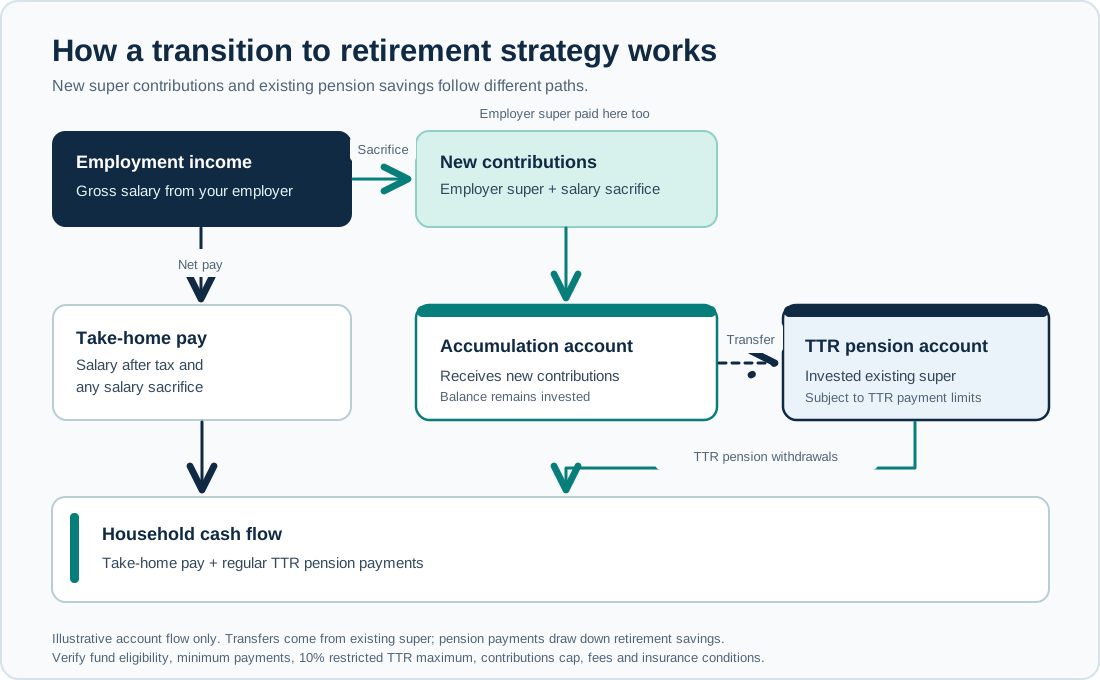
Salary-sacrificed contributions generally count towards the concessional contributions cap alongside employer contributions and are generally subject to 15% contributions tax, with exceptions. The tax treatment of TTR pension payments depends on the member's age and the fund's taxed or untaxed status.
Check the applicable financial-year concessional cap, employer super contributions and any available carry-forward cap amounts before making a sacrifice arrangement. Exceeding your available cap can create additional tax consequences. Compare different pay outcomes using the salary sacrifice super calculator.
How Are TTR Payments and Earnings Taxed?
TTR pension payments from a taxed super fund are generally tax-free to people aged 60 or over, but investment earnings supporting a restricted TTR income stream generally do not receive the retirement-phase earnings tax exemption.
Tax and payment rules differ by pension phase. Scroll sideways to compare all columns on a smaller screen.
| Tax question | Restricted TTR income stream | Retirement-phase account-based pension |
|---|---|---|
| Pension payments from a taxed fund after age 60 | Generally tax-free to the member | Generally tax-free to the member |
| Earnings supporting the account | Generally subject to fund earnings tax | Eligible earnings generally exempt, subject to rules |
| Maximum annual pension payment | Usually 10% of the account balance | No restricted 10% TTR maximum |
| Minimum annual pension payment | Age-based pension minimum | Age-based pension minimum |
Untaxed super components and some public-sector arrangements have different treatment. According to the Australian Taxation Office, the distinction between tax on payments to the member and tax on investment earnings inside the fund is essential.
What Does a TTR Strategy Look Like in Practice?
Consider a hypothetical 60-year-old employee earning $100,000 gross annually with $200,000 transferred into a restricted TTR pension. They salary sacrifice $8,000 of wages and receive $8,000 in TTR payments during a full financial year.
Hypothetical salary-sacrifice example, not a personal tax estimate. Scroll sideways on a smaller screen.
| Item | Illustrative amount | Treatment |
|---|---|---|
| Gross salary before sacrifice | $100,000 | Employment earnings |
| Additional salary sacrifice | $8,000 | Concessional contribution subject to applicable rules |
| Gross salary after sacrifice | $92,000 | Before personal income tax |
| Opening TTR pension | $200,000 | Separately invested pension account |
| Annual TTR payment | $8,000 | 4% of opening pension balance |
The $8,000 pension payment reaches the illustrative 4% annual minimum. Salary sacrifice may reduce assessable salary, while the contribution generally attracts contributions tax and uses concessional cap space. Actual net benefit depends on marginal tax rates, fund costs, contribution limits and how the pension balance changes. This is a mechanics example, not a personalised tax-saving estimate.
TTR Pension vs Retirement-Phase Pension: What Changes?
A restricted TTR pension has limits on withdrawals and generally does not qualify for retirement-phase earnings tax exemption. A retirement-phase account-based pension generally has no 10% TTR ceiling and may receive earnings tax exemption, subject to legislative requirements.
Both account types require minimum annual pension payments based on age. A TTR pension generally enters retirement phase when the member meets an unrestricted condition of release such as turning 65. See the super pension calculator for account-based pension projections.
What Happens to TTR at Age 65?
At age 65, a qualifying restricted TTR pension generally enters retirement phase because turning 65 is an unrestricted condition of release. The restricted 10% withdrawal ceiling ceases and qualifying earnings can receive the retirement-phase exemption.
The value entering retirement phase can affect the individual's transfer balance cap. Ask the fund to confirm the status change, reporting and any adjustments to pension payments.
How Does TTR Affect Insurance Inside Super?
Moving much of an accumulation balance into TTR can affect life, total and permanent disability (TPD) or income protection cover if the remaining account cannot pay premiums or the member no longer satisfies policy conditions.
Before transferring, ask the fund whether cover remains active, how premiums are collected and whether changing work hours affects eligibility. Check the remaining accumulation balance and any cancellation or reinstatement conditions. Read more in insurance through super.
How Can TTR Affect Government Benefits?
A TTR pension can affect means-tested government payments. Services Australia generally assesses an account-based pension as an income stream once payments begin. For relevant payments, its account balance is assessed under the assets test and deemed income is included under the income test, subject to exceptions and pre-2015 transitional rules.
Super retained in an accumulation account is generally exempt from the income and assets tests while its owner is under Age Pension age and is not receiving a pension from that account. Starting TTR can therefore change how funds are assessed before Age Pension age. The outcome depends on the payment type, partner circumstances and other assets. According to Services Australia, Superannuation and Income streams, accessed October 2026, check the treatment before transferring funds.
What Are the Costs and Risks of TTR?
TTR can increase account administration expenses and reduce the super left for later retirement. Early withdrawals decrease the balance remaining invested; market losses during pension drawdowns can intensify the effect.
Review the cost of maintaining an accumulation account alongside a pension account, investment management fees, transaction costs, insurance premiums and advice. For example, withdrawing $10,000 today rather than leaving it invested for 10 years at an illustrative 5% annual net return means forgoing about $6,289 in potential growth (10,000 × 1.05¹⁰ − 10,000). This excludes tax effects, investment volatility and any reinvestment of the payment. Consider the income benefit now against lower projected retirement capital. A TTR strategy is not automatically tax advantageous simply because withdrawals after age 60 are generally tax-free.
What Should You Check Before Starting TTR?
Ask your super fund for a written calculation using your proposed transfer amount, remaining accumulation balance and expected annual pension payments.
Check preservation age, eligibility, payment limits, account fees, insurance, employer contribution arrangements, investments, beneficiary nominations and concessional cap usage. If government benefits are relevant, confirm the means-test treatment. Compare a TTR scenario against continuing without TTR on the same earnings, spending and investment assumptions.
When Does TTR Stop Being Financially Worthwhile?
TTR becomes less attractive when its cash-flow or tax advantages are outweighed by extra fees, reduced investment growth, insurance changes and administration complexity. There is no universal break-even age or super balance.
Compare two projected outcomes using the same assumptions: remaining in accumulation without TTR and adopting TTR with any planned salary sacrifice.
Compare the two approaches using the same assumptions. Scroll sideways on a smaller screen.
| Decision factor | Remain in accumulation | Start a restricted TTR pension |
|---|---|---|
| Income while working | Employment income only unless another permitted source applies | Employment income plus regulated pension withdrawals |
| Future employer super | Paid into accumulation account | Paid into a retained accumulation account |
| Access to preserved savings | Generally restricted until a condition of release | Pension payments subject to the annual minimum and 10% maximum |
| Investment earnings treatment | Ordinary accumulation-phase fund tax rules | Generally the same earnings tax treatment while TTR remains restricted |
| Additional considerations | Existing fund fees and insurance | Possible extra account fees, drawdown risk and insurance changes |
Use the comparison to identify the practical trade-off rather than assume that drawing super and sacrificing salary creates a net tax benefit. Test lower returns and ongoing withdrawals as well as the main projection. The Super Projection Calculator Australia can help compare long-term balance scenarios, while the Superannuation Calculator Australia provides other super planning tools. The correct decision depends on whether the priority is income now, preserving super for later or changing the tax treatment of current income.
The following common questions clarify eligibility, withdrawal restrictions and tax treatment.
Can you use TTR while working full-time?
YES, eligible members can draw a restricted TTR pension while continuing full-time employment. Reducing work hours is not a requirement. Annual TTR limits and ordinary contributions rules still apply.
Can you start a TTR pension at age 59?
NO, a person aged 59 in 2026 has not reached the general preservation age of 60 and cannot start a standard restricted TTR pension solely on age. Specific early-access conditions involve different rules.
Can you withdraw more than 10% from a restricted TTR pension?
NO, a restricted TTR pension generally has a 10% annual maximum payment. The restriction can cease after an unrestricted condition of release is satisfied. Other unrestricted benefits may have different access rules.
Are TTR pension payments generally tax-free after age 60?
YES, payments from a taxed super fund are generally tax-free for recipients aged 60 or over. Untaxed elements and some public-sector schemes have different tax consequences.
Are investment earnings in a restricted TTR account tax-free?
NO, investment earnings supporting a restricted TTR pension generally do not receive the retirement-phase earnings tax exemption, even when payments to a member aged 60 or over are tax-free.
Can you keep receiving employer super contributions while using TTR?
YES, employer contributions can continue into an eligible accumulation super account while a separate TTR pension pays income. Confirm the fund and employer have the correct account details.
Does a TTR pension automatically move to retirement phase when you turn 65?
YES, turning 65 generally causes a qualifying TTR income stream to enter retirement phase for super tax purposes. Ask the trustee to confirm the change, transfer balance cap implications and associated reporting.
Sources and verification (October 2026)
- ASIC MoneySmart, Transition to retirement, 30 September 2026.
- ASIC MoneySmart, Retirement income and tax, 28 July 2026.
- Australian Taxation Office, Transition to retirement and Transition-to-retirement income streams, accessed October 2026.
- Australian Taxation Office, Minimum annual payments for super income streams, accessed October 2026.
- Australian Taxation Office, Pension standards for self-managed super funds, accessed October 2026.
- Services Australia, Income test for Age Pension, September 2026.
- Services Australia, Income streams, 26 May 2026.
- Services Australia, Superannuation, accessed October 2026.
- Services Australia, Deeming, accessed October 2026.
The examples use hypothetical figures. Fund fees, insurance, taxation and means-test outcomes require individual verification. This article provides general information rather than personalised financial advice.
Written by
Superannuation Calculator Australia
Calculation guidance and general information; independent financial advice is not provided.