Superannuation for Temporary Residents: Contributions, DASP Eligibility and Tax
Learn when temporary residents earn Australian super, who qualifies for DASP, how to apply and how withdrawal tax affects payments.
Superannuation Calculator Australia · · 13 min read
Australian temporary residents who work in eligible employment generally receive 12% employer superannuation contributions under the 2026–27 super guarantee rules. Their retirement savings remain in an Australian super fund until a legal release condition is met. Eligible former temporary residents can apply for a Departing Australia Superannuation Payment (DASP) after leaving Australia and after their visa ceases. DASP tax depends on the benefit's components and working holiday maker history.
What superannuation rights do temporary residents have in Australia?
Temporary residents generally have the same minimum super guarantee rights as other eligible Australian employees. Their employer pays compulsory contributions into a complying super fund. The fund invests those contributions and applies fees, applicable taxes and any insurance premiums.
Estimate contributions using the Superannuation Calculator Australia. A temporary visa does not automatically provide access to the balance. Leaving a job does not release super. A former temporary resident must satisfy the separate DASP conditions or another lawful condition of release.
According to the Australian Taxation Office (ATO), citizenship and visa status do not ordinarily remove an eligible employee's right to compulsory employer super. For a broader explanation, see what superannuation is.
When must an employer pay super to a temporary visa holder?
YES, an employer generally must pay the super guarantee for an eligible temporary visa employee. The 2026–27 rate is 12% of qualifying earnings, subject to relevant exceptions and the maximum contribution base.
- Employees aged 18 or older generally qualify regardless of whether they work full-time, part-time or casually.
- Employees under 18 generally qualify when they work more than 30 hours in a week.
- Some contractors paid principally for their labour qualify under super guarantee rules.
- From 1 July 2026, Payday Super rules generally require a contribution to reach the fund within seven business days of payday, subject to exceptions.
For example, $1,000 of eligible qualifying earnings ordinarily generates a $120 compulsory contribution before fund-level deductions. Check your own figures with the Super Contributions Calculator Australia. Compare your payslip against contributions actually received by your fund. See Payday Super rules for payment deadlines.
Who is eligible for a Departing Australia Superannuation Payment (DASP)?
DASP is a withdrawal available to certain former temporary residents who have left Australia and no longer hold an effective Australian visa. It is not a general withdrawal option for all people living overseas.
The key requirements are:
- You accumulated super while working in Australia on an eligible temporary visa under the Migration Act 1958 (excluding subclasses 405 and 410).
- You have departed Australia.
- Your relevant visa has ceased to be in effect.
- You are not an Australian citizen, New Zealand citizen or Australian permanent resident.
Visa information is checked against Department of Home Affairs records. Special situations, including visa histories and other release conditions, require assessment against the current ATO rules. According to the ATO's Departing Australia superannuation payment (DASP) guidance, both departure and visa cessation are essential.
How do temporary residents apply for DASP after leaving Australia?
Apply through the ATO DASP online application system after leaving Australia and after your temporary visa ceases. Collect super account details and identity records before your departure to minimise difficulties retrieving them from overseas.
- Locate each Australian super fund and record your member number.
- Retain your tax file number (TFN), passport information and visa history.
- Leave Australia and confirm that the relevant temporary visa has ceased.
- Complete the official DASP application, identifying each fund or ATO-held amount.
- Supply any additional identity or payment documents requested by the fund or ATO.
- Keep the payment summary and withholding-tax records.
Timing: The ATO states a processing service standard of 28 days from receipt of a completed DASP application, although some claims take longer. If the money remains with your fund, contact that fund after 28 days to check progress. The DASP online system lets you view an application but does not show its processing status. According to the ATO, Temporary residents and superannuation (2026), the online application is free. Paper applications and additional identity verification can involve separate requirements or costs.
The DASP application flow shows when preparation ends and an eligible claim can be submitted. The diagram separates departure, visa cessation and citizenship or residency checks so the application sequence is easier to follow.
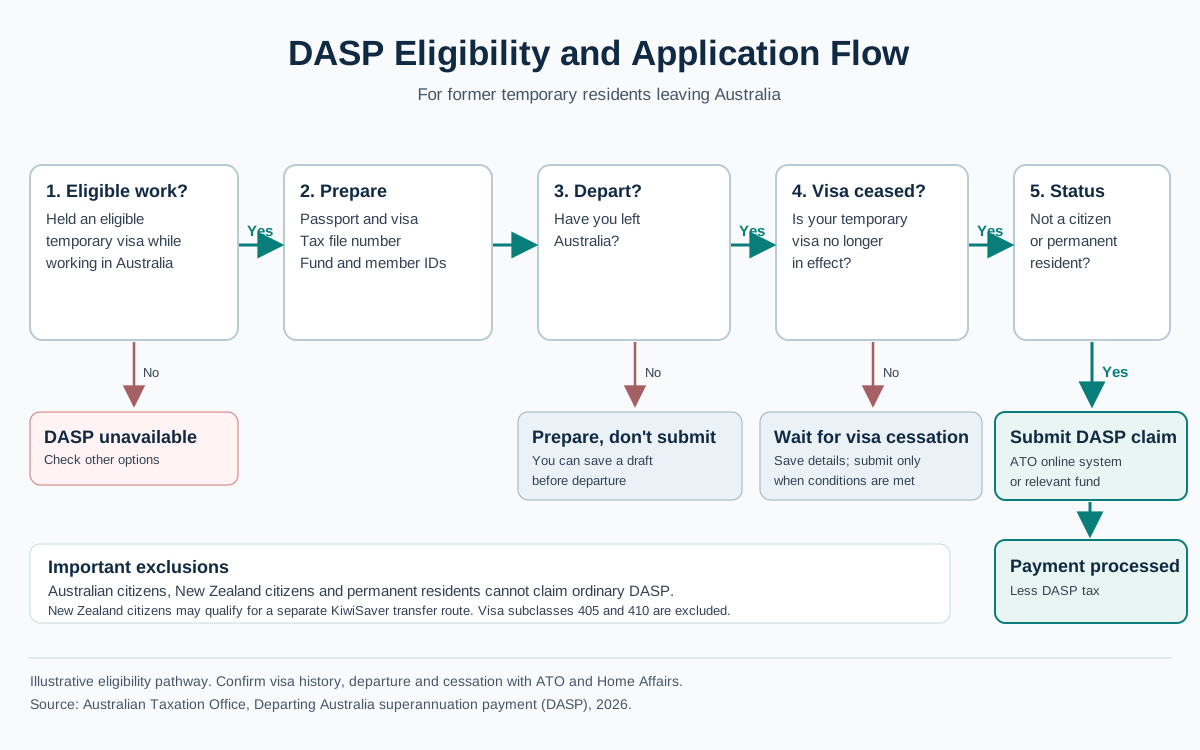
The online service checks visa information. Documentation can differ when applying directly to a fund on paper. A fund may seek certified identity evidence or further information before releasing benefits.
What records should temporary visa holders collect before leaving?
Collect your passport details, TFN, super fund names, member numbers, contact details and visa history before departure. Keep recent super statements, payslips and an accessible email address.
Confirm how your fund will verify identity from overseas. Check whether your Australian bank account remains suitable for receiving an overseas-related payment and whether your contact details can still receive verification codes.
How can temporary residents locate lost super?
Use myGov linked to the ATO or the DASP online service to identify known super accounts and ATO-held balances. Contact previous employers and funds where account information is missing.
A search result is not proof that every account was found. Compare the list with your employment history, payslips and super statements. The guide to finding lost super covers account tracing in more detail.
How much DASP tax will a temporary resident pay?
DASP withholding tax depends on the tax-free and taxable components of the benefit. Ordinary DASP rates are 0% for the tax-free component, 35% for the taxed element and 45% for the untaxed element. The applicable working holiday maker DASP rate is 65% of the taxable component.
| Payment component | Ordinary DASP rate | Working holiday maker rate |
|---|---|---|
| Tax-free component | 0% | 0% |
| Taxable component, taxed element | 35% | 65% |
| Taxable component, untaxed element | 45% | 65% |
These are DASP withholding rates, not ordinary salary income-tax rates. A fund determines the tax treatment of its payment using the relevant information and the ATO rules. According to the ATO's DASP payment instructions, withholding is final and the payer provides a payment summary.
How do DASP tax rates differ for working holiday makers?
The 65% working holiday maker DASP rate applies to taxable components where the statutory working holiday maker rules apply, instead of the ordinary 35% or 45% rates. Working Holiday (subclass 417) and Work and Holiday (subclass 462) visas are relevant.
According to the ATO's I have never worked during my Working Holiday Visa clarification (11 September 2024), a former visa holder who never worked while on a working holiday maker visa is generally subject to the ordinary DASP withholding rates. Holding the visa alone does not establish the 65% rate. Confirm your complete employment and visa history with the paying fund.
How much could a temporary resident receive from a $10,000 super balance?
For a hypothetical $10,000 benefit entirely consisting of a taxable taxed element, ordinary 35% DASP withholding is $3,500, leaving $6,500. At the 65% working holiday maker rate, $6,500 is withheld, leaving $3,500.
| Payment scenario | Tax withheld | Net payment |
|---|---|---|
| Ordinary DASP, taxed element at 35% | $3,500 | $6,500 |
| Working holiday maker DASP at 65% | $6,500 | $3,500 |
This is not a personalised estimate. A real account can contain different tax components and its balance can change due to investment performance, fees and insurance premiums. The Super Projection Calculator Australia estimates potential balance growth, not a guaranteed DASP payment. Request the component breakdown from your fund.
What happens if temporary residents do not claim their super?
Unclaimed super belonging to eligible former temporary residents can be transferred from a super fund to the ATO under the temporary resident unclaimed super rules. The money does not automatically disappear when a person leaves Australia.
According to the ATO, ATO-held super (11 May 2026), where both at least six months have passed since departure and the former temporary visa has ceased, a fund generally transfers eligible unclaimed temporary resident super to the ATO. This does not mean the balance is forfeited. If the ATO holds the balance, an eligible former temporary resident can generally apply for DASP through the ATO. Verify the status of each account before assuming that a previous fund still holds it.
Can permanent residents claim DASP after leaving Australia?
NO, Australian permanent residents do not qualify for ordinary DASP simply because they have left Australia. Permanent residency is an express exclusion from the standard DASP eligibility requirements.
Different rules apply to access based on retirement or another condition of release. An unusual case involving ATO-held former temporary resident benefits and later residency changes requires individual verification.
Can New Zealand citizens transfer Australian super to KiwiSaver?
YES, eligible people can transfer qualifying Australian super savings to a participating New Zealand KiwiSaver scheme under the trans-Tasman retirement savings portability arrangement. This is not a DASP payment.
Transfers are subject to the receiving and transferring schemes' rules. The money remains retirement savings and is not simply paid out as cash. Check fund participation, identity requirements and differences in release rules before arranging a transfer.
How can temporary residents report unpaid employer super?
Report missing compulsory super to the ATO after checking payslips and actual fund transactions. First establish the employer, payment periods, ordinary earnings and contributions that should have been received.
- Check your super fund's contribution history for each payday.
- Compare that record with payslips and eligible earnings.
- Ask the employer to explain any mismatch and supply payment evidence.
- Report unpaid super through the ATO's unpaid super enquiry process where unresolved.
A promised or scheduled contribution is not proof that the fund received it. Preserve payslips, contracts, tax records and employer correspondence. The unpaid employer super guide explains the evidence to gather.
How does a change in visa status affect DASP eligibility?
DASP eligibility is assessed against your visa history and status when you apply. A current effective Australian visa generally prevents an ordinary DASP claim, even if you previously held another temporary visa.
A transition to permanent residency changes ordinary DASP eligibility. The ATO also describes a limited rollover pathway for ATO-held former temporary resident super where the individual subsequently returns to Australia as a permanent resident; this is not the same as an ordinary cash DASP claim. Do not rely solely on the category of the first visa you held. Check Home Affairs records and the ATO's conditions for your full history.
What should temporary residents check before departing Australia?
Before leaving, confirm all super accounts, employer contributions, visa expiry arrangements, identity records and contact details. Applying for DASP occurs after departure and visa cessation, but preparation is easier while Australian records remain accessible.
- Compare each employer's super contributions with your fund transaction history. Check that final employer contributions have reached the fund before submitting a claim; a pending payment may not appear in the account balance yet.
- Record every fund's name, account number and current balance.
- Retain passport, TFN and visa details securely.
- Confirm access to email, mobile authentication and your fund's portal abroad.
- Check that bank details and identity documents satisfy the payer's requirements.
- Confirm the current DASP eligibility and withholding rules against ATO guidance.
Do temporary residents receive employer super while studying in Australia?
YES, eligible international students working as employees can receive compulsory super. Student visa status does not itself remove super guarantee entitlement.
The usual eligibility tests still apply, including the under-18 weekly-hours rule. Check each employer's payroll records and the super fund's actual receipts.
Can you submit a DASP claim while your visa is still active?
NO, an effective Australian temporary visa normally prevents completion of a standard DASP claim. Departure alone does not satisfy both statutory conditions.
Check the visa's cessation date with Home Affairs. According to the ATO's DASP online application system, you can enter details and save an application while in Australia or while the visa remains active, but you cannot submit it to the fund until you have departed and your visa has ceased.
Can a temporary visa holder claim DASP before leaving Australia?
NO, DASP generally requires the applicant to have departed Australia and for the relevant temporary visa to have ceased. Ending employment does not meet the departure requirement.
Collect paperwork before travel and complete the eligible claim from overseas.
Does holding a working holiday visa affect DASP withholding tax?
YES, a subclass 417 or 462 working holiday visa can affect the DASP taxable-component withholding rate. Where the working holiday maker rules apply, the rate is 65%.
The result depends on relevant work and visa circumstances, not just the label on your current visa. Provide complete visa history and seek a component-specific assessment from the fund.
Can a former temporary resident claim ATO-held unclaimed super?
YES, an eligible former temporary resident can apply for ATO-held temporary resident unclaimed super through the DASP process. The ATO applies eligibility checks and the appropriate DASP withholding rules.
Use the official online service to identify ATO-held amounts and follow identity and payment instructions. An ATO-held balance is not exempt from DASP tax simply because a fund previously transferred it.
Are New Zealand citizens eligible for DASP?
NO, New Zealand citizens are excluded from ordinary DASP eligibility. Their potential options include retaining eligible Australian super or arranging a qualifying transfer to KiwiSaver under the trans-Tasman scheme.
New Zealand citizenship is distinct from holding a temporary Australian visa. Confirm the appropriate pathway with the relevant super fund.
Sources and verification (October 2026)
- Australian Taxation Office, Temporary residents and superannuation, accessed October 2026.
- Australian Taxation Office, Departing Australia superannuation payment (DASP), accessed October 2026.
- Australian Taxation Office, Departing Australia superannuation payment summary instructions, accessed October 2026.
- Australian Taxation Office, I have never worked during my Working Holiday Visa, 11 September 2024.
- Australian Taxation Office, DASP online application system, accessed October 2026.
- Australian Taxation Office, Payments from super, 16 September 2026.
- Australian Taxation Office, ATO-held super, 11 May 2026.
- Department of Home Affairs, Before and after you leave Australia, accessed October 2026.
- Australian Taxation Office, About Payday Super and Payment deadlines for Payday Super, 2026.
- Australian Taxation Office, Searching for lost superannuation, accessed October 2026.
- Australian Taxation Office, Unpaid super, accessed October 2026.
- Australian Taxation Office, Trans-Tasman retirement savings portability, accessed October 2026.
Written by
Superannuation Calculator Australia
Calculation guidance and general information; independent financial advice is not provided.