What If Your Employer Does Not Pay Super: Checks, ATO Reporting and Recovery
Employer not paying super? Check 2026 deadlines, verify fund payments, calculate missing contributions and report them to the ATO.
Superannuation Calculator Australia · · 13 min read
If your employer has not paid compulsory superannuation, check your fund's transaction history, confirm the deadline for each pay period and report any unresolved shortfall to the Australian Taxation Office (ATO). From 1 July 2026, employer super generally needs to reach the employee's fund within seven business days after payday, subject to exceptions.
This guide covers eligibility, payment deadlines, checking contributions, calculating a shortfall, contacting payroll and making an ATO report. It distinguishes the current Payday Super rules from the former quarterly arrangements.
What counts as unpaid super from an employer?
Unpaid super is a super guarantee (SG) contribution that an employer was required to pay but did not pay correctly or on time. It includes missing amounts, insufficient contributions and payments made to an incorrect fund. A payroll entry or payslip amount alone does not establish that a super fund received the contribution. According to the Australian Taxation Office, Unpaid super from your employer (accessed October 2026), workers can check contributions against fund records and report unpaid amounts.
Match each contribution to its relevant pay period. A contribution received after its legal deadline remains late even if it subsequently appears in the account. Keep the payroll liability and the fund's received amount as separate records; they answer different questions.
Who is entitled to employer super contributions?
Most employees aged 18 or over are entitled to SG regardless of whether they work full-time, part-time or casually. Employees under 18 generally qualify when they work more than 30 hours in a week. Certain contractors paid mainly for personal labour can also qualify.
The general SG rate is 12% for 2026–27. The earnings basis and eligibility tests depend on the period involved. Earlier years had different rates and, in some cases, different eligibility rules.
For a broader explanation of how employer contributions are calculated and remitted, see how superannuation is paid.
When Should Employers Pay Super Under Payday Super?
Since 1 July 2026, employers have generally been required to pay super on payday and ensure the contribution is received by the fund within seven business days. According to the Australian Taxation Office, Payday Super (2026), the payment is based on qualifying earnings. Longer periods and special arrangements apply in defined circumstances, including certain first contributions for new employees.
| Period | Standard payment timing | What to check |
|---|---|---|
| Eligible earnings before 1 July 2026 | Quarterly rules and corresponding due dates | The applicable quarter and legal deadline |
| Eligible earnings from 1 July 2026 | Usually received by the fund within seven business days after payday | Payday, fund receipt and any exception |
According to the Australian Taxation Office, Payday Super has started: Here's what employers need to know and do (2026), the final quarterly SG payment for earnings paid from 1 April to 30 June 2026 was due by 28 July 2026. Do not apply current Payday Super timing retrospectively. Fund receipt, rather than the date payroll sends an instruction, is central to the new timing requirement.
July 2026 transition: According to the ATO's Payday Super has started: Here's what employers need to know and do (2026), super received from 1 to 28 July 2026 was allocated to outstanding quarterly obligations first. Contributions received from 29 July onwards were allocated to Payday Super amounts. If a July payment appears missing, ask which liability it covered before comparing amounts.
How do you check whether employer super has reached your fund?
The most reliable first check is your super fund's transaction history. Compare the amount and receipt date with the contribution recorded on each payslip and the account information available through myGov and ATO online services.
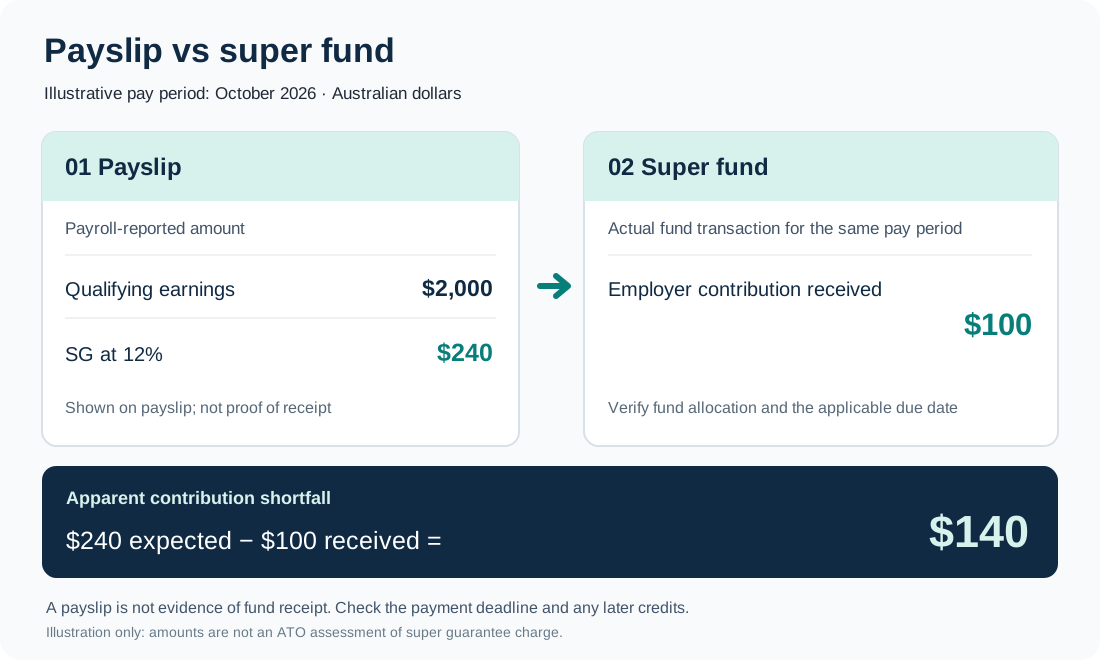
The payslip comparison illustrates why payroll-reported super and fund receipts need to be reconciled for the same pay period.
- Sign in to your super fund and record each employer contribution's amount and receipt date.
- Compare the fund entries with payslips, including the pay period and employer name.
- Check other active or former funds through myGov. Contributions can appear in another account.
- Allow for the legal deadline and relevant processing arrangements, then ask payroll for payment details if an amount remains missing.
For each pay period, make a record with payday, qualifying earnings, expected SG, fund credited amount, actual receipt date and applicable deadline. A payslip indicates what payroll calculated or reported, not necessarily what reached the fund. For related account checks, see how to check your super balance. The Superannuation Calculator Australia helps estimate a contribution from salary, but it cannot prove a fund received the payment.
How much unpaid super could your employer owe you?
Estimate the shortfall by applying the SG rate for the relevant period to qualifying earnings, then subtracting the contributions actually received. For 2026–27 the ordinary SG rate is 12%, subject to applicable earnings limits and exceptions. According to the Australian Taxation Office, Super guarantee (2026–27), the statutory rate is 12%. Use the Super Contributions Calculator Australia to explore contribution amounts; the fund's transaction history remains the evidence of payment.
| Illustrative 2026–27 payday | Amount |
|---|---|
| Qualifying earnings | $2,000 |
| SG at 12% | $240 |
| Contribution received by fund | $100 |
| Apparent unpaid contribution | $140 |
The $140 result is $2,000 × 12% − $100. If the fund later credits another $140 for the same period, update the recorded shortfall rather than treating it as a second liability. This is a contribution comparison, not a statutory SG charge assessment. Employer interest, additional charges and penalties follow separate rules, which changed with Payday Super. Different wage components can have different treatment when determining qualifying earnings.
What should you ask an employer about missing super?
Ask the employer or payroll team to identify the affected pay periods, contribution amounts, receiving fund, payment dates and transaction references. Request evidence of fund receipt rather than accepting an amended payslip alone.
Keep the question and response in writing. If the relevant deadline has passed and the missing payment remains unresolved, gather the records needed for an ATO referral.
How do you report unpaid super to the ATO?
Report unresolved missing, late or incorrectly directed compulsory super through the ATO's Report unpaid super contributions from my employer service. The ATO investigates SG compliance; submitting a referral does not guarantee immediate recovery.
- Identify the employer and pay periods involved.
- Check the payslips against the receiving super fund's history.
- Use the ATO's employee referral service to provide the available employment and contribution details.
- Keep the acknowledgement and supporting documents for later contact.
An online starting point is the ATO's official unpaid super page, Unpaid super from your employer. Avoid sending identity documents through unofficial complaint websites.
What documents should you collect before reporting unpaid super?
Collect the employer's trading or legal name, ABN if known, dates of employment, payslips and super fund statements for the relevant period. Record how much SG you expected, how much was credited and when each payment was due.
When formal records are missing, bank deposits, rosters, employment contracts and written payroll messages can help establish employment dates and pay amounts. Provide what you have rather than inventing unavailable information.
What happens after the ATO investigates unpaid super?
The ATO can examine the employer's SG obligations, assess any shortfall and begin debt collection or enforcement action. According to the ATO's Report unpaid super contributions from my employer (updated 17 February 2025), the referral covers unpaid, late or wrong-fund contributions. The result depends on the facts, the legal period involved and the employer's capacity to pay.
Super guarantee charge (SGC) consequences apply when statutory obligations are missed. The rules differ between the historical quarterly system and Payday Super. A penalty imposed on an employer is not necessarily an amount credited to the employee's super account.
Recovery timing and the amount collected are not guaranteed. The Super Projection Calculator Australia can show the potential long-term impact of different contributions, but it does not predict ATO recovery.
Should unpaid super be reported to the ATO or Fair Work?
For missing compulsory SG payments, the ATO is the primary reporting and enforcement contact. Fair Work deals with separate workplace obligations, including relevant award or agreement conditions and potential employment-law remedies.
| Issue | Starting point |
|---|---|
| Missing compulsory SG contributions | ATO unpaid super referral |
| Minimum wages, payslip requirements or employment conditions | Fair Work Ombudsman |
| Suspected breach of an award or agreement's additional super terms | Review the instrument and seek Fair Work or legal guidance |
| Dismissal or adverse treatment linked to raising an entitlement | Independent workplace advice and the appropriate Fair Work channel |
Super became an entitlement under the National Employment Standards for most covered employees from 1 January 2024, according to the Fair Work Ombudsman, Protecting Worker Entitlements (2023). Most employees covered by the NES can pursue unpaid or underpaid super through court action under the Fair Work Act. This does not replace the ATO's principal responsibility for statutory SG compliance.
What if the employer paid super to the wrong fund?
A payment to another fund differs from no payment anywhere. Ask payroll for the receiving fund's name, the date and transaction reference. Check your current, previous and stapled funds before concluding that no contribution was made.
If the employer failed to use the correct fund, identify the fund you nominated and explain the mismatch in any ATO referral.
Can unpaid super still be recovered if an employer goes bust?
YES, unpaid super can still be pursued after an employer enters insolvency or liquidation, but full recovery is not assured. The ATO's collection options depend on the legal debt, the employer's assets and the insolvency process.
Keep the employer's identifying details, affected pay periods and any liquidator correspondence. Obtain specialist advice when the outstanding amount is substantial.
Can you report a former employer for unpaid super?
YES, a former employee can report unpaid compulsory super from earlier employment. Ending the employment relationship does not erase an outstanding historical SG obligation.
Keep old payslips, fund records and the employer's identity. Apply the law and deadlines relevant to each past period, not the current year's rules.
How Can You Check a Payday Super Deadline With a Worked Timeline?
Start with payday and count the applicable business-day period for the contribution to reach the fund. Exclude weekends and relevant public holidays. First-payment rules and other statutory exceptions can change the deadline.
For example, an ordinary payday on Monday 12 October 2026, with no intervening relevant public holiday, has a seventh following business day of Wednesday 21 October 2026. The seven following business days are 13, 14, 15, 16, 19, 20 and 21 October. This is a calendar illustration; check the legal rule and applicable local public holidays before treating a particular contribution as overdue.
Record three dates together: payday, the applicable fund-receipt deadline and actual fund receipt. If the deadline is disputed, document the business-day count and any applicable extended-timeframe provision.
How can you report unpaid super without payslips or an employer ABN?
You can provide an ATO referral even if some payslips or the employer's ABN are unavailable. Give the employer details, period worked and payment information you can substantiate, and identify what is missing.
Bank deposits, rosters, emails, contracts and fund statements can help reconstruct the timeline. Search the Australian Business Register to identify a trading entity where possible.
What if you are worried about raising unpaid super with your employer?
Keep copies of records and communications somewhere you can access independently of your employer. If raising the issue creates a risk of adverse treatment, seek independent employment-law or workplace advice on the applicable protections.
An ATO referral addresses super guarantee compliance. It does not automatically resolve dismissal, victimisation or other workplace disputes.
What Are Your Next Steps If Super Remains Unpaid?
If contributions remain missing, verify the fund receipt, request a payment trace and make an ATO referral once the relevant deadline has passed and the matter remains unresolved.
- Confirm SG eligibility and the applicable deadline for each period.
- Reconcile qualifying earnings and expected contributions against fund receipts.
- Ask payroll for written proof identifying the receiving fund and transaction.
- Lodge an unpaid super referral with the ATO where necessary.
- Keep the reference and monitor your fund for later payments.
Can an employer choose not to pay compulsory super?
NO, an employer cannot avoid compulsory SG merely because an eligible worker agrees to take additional wages instead. Statutory eligibility rules apply irrespective of the agreement's description.
An amount labelled 'super included' on a payslip is not proof of a contribution received by a complying fund.
Can a casual employee be owed super?
YES, a casual employee aged 18 or over is generally eligible for compulsory employer super. Casual status itself is not an exclusion.
For workers under 18, check the requirement to work more than 30 hours in a week and the rules applying at the time.
Can a contractor be eligible for super?
YES, certain contractors working wholly or principally for their personal labour qualify for SG. Holding an ABN or supplying invoices does not alone determine entitlement.
The ATO's contractor guidance considers the contract's substance, whether payment is for labour and who performs the work.
Can you report super paid into the wrong account?
YES, contributions directed to an incorrect fund can be raised in an ATO employee referral. First ask for the fund name, member details and remittance reference so the payment can be traced.
Confirm whether the amount went to an existing or stapled fund before describing it as completely unpaid.
Does a payslip prove the fund received super?
NO, a super amount on a payslip does not establish that a fund received the money. It can represent a calculated or reported liability.
Compare fund transaction dates and amounts with the payslip, then request payroll evidence for any discrepancy.
Can a former employer still owe you super?
YES, a former employer can still have outstanding SG obligations for historical work periods. The applicable rate, earnings basis and due date depend on the legislation in effect at the time.
Preserve historical payroll records and use the ATO's referral process to report missing amounts.
Can unpaid super always be fully recovered?
NO, full recovery is not assured. An employer's insolvency, insufficient assets, disputed obligations or unsuccessful collection action can prevent full payment.
Keep checking the fund for credits and retain the ATO reference and documents. A referral enables assessment, not a recovery guarantee.
Sources and verification (October 2026)
- Australian Taxation Office, Unpaid super from your employer, accessed October 2026.
- Australian Taxation Office, Payday Super, 2026.
- Australian Taxation Office, Payday Super has started: Here's what employers need to know and do, 2026.
- Australian Taxation Office, Super guarantee, 2026–27.
- Australian Taxation Office, Report unpaid super contributions from my employer, guidance updated February 2025.
- Australian Taxation Office, Work out if you have to pay super, accessed October 2026.
- Fair Work Ombudsman, Tax and superannuation, accessed October 2026.
- Fair Work Ombudsman, Protecting Worker Entitlements, 2023.
- Fair Work Ombudsman, Payday Super: New rules starting 1 July 2026, guidance updated February 2026.
Written by
Superannuation Calculator Australia
Calculation guidance and general information; independent financial advice is not provided.