How Long Will My Super Last in Retirement: Drawdowns, Returns and Age Pension
Find out how long super lasts in retirement with drawdown examples, investment assumptions and Australian Age Pension rules.
Superannuation Calculator Australia · · 12 min read
How long your super lasts in retirement depends on your starting balance, withdrawal amount, investment returns, fees and inflation. An account-based pension continues to be invested after retirement, so its balance changes with withdrawals and market performance. Australian minimum drawdown rules affect the amount you take each year, while Age Pension eligibility can change how much income you need from super. Use scenarios rather than a single guaranteed depletion date.
What determines how long my super lasts in retirement?
Your retirement super lasts until withdrawals and costs exhaust the balance, unless investment returns replenish it sufficiently. Starting savings, annual withdrawals, retirement age, net investment performance and inflation determine how quickly the balance changes.
A $500,000 pension funding $25,000 a year lasts 20 years in a simplified calculation with zero returns, no fees and fixed withdrawals. Actual outcomes differ because markets change, fees apply and living expenses generally increase. An account-based pension does not promise lifetime payments.
How can I calculate how long my super will last?
Calculate super longevity by projecting your account balance year by year, subtracting withdrawals and fees and adding investment returns until the projected balance reaches zero. Use a retirement income model rather than dividing the initial balance by spending alone.
- Enter the balance available when you retire and your retirement age.
- Estimate the annual amount you need to withdraw from super, after other income.
- Select plausible net investment returns and inflation assumptions.
- Apply relevant minimum pension withdrawal rates as your age changes.
- Recalculate under lower returns, higher spending and early market losses.
A simple annual model is closing balance = opening balance + net investment earnings − withdrawals. If the return assumption is already net of investment fees, do not subtract those fees again. State whether returns occur before or after withdrawals and whether your figures use today's dollars or future dollars.
For example, a $500,000 account-based pension starting at age 67, with a 5% annual minimum, a hypothetical 0% net return and no additional withdrawals, begins as follows:
| Financial year | Opening balance | Minimum payment | Closing balance |
|---|---|---|---|
| Year 1, age 67 | $500,000 | $25,000 | $475,000 |
| Year 2, age 68 | $475,000 | $23,750 | $451,250 |
The example uses a constant 5% minimum at ages 67–68, excludes transaction timing, taxes and other income and does not forecast lifetime income. It shows why a percentage-based withdrawal does not equal a fixed $25,000 annual payment.
According to ASIC Moneysmart, Account-based pension calculator (2 July 2026), its calculator estimates pension duration using income, investment return, fees and inflation assumptions. Check its assumptions and exclusions: pension-account models do not necessarily calculate Age Pension entitlements. For a balance projection before retirement, compare results with the Super Projection Calculator Australia. For an initial estimate of future savings, use the Superannuation Calculator Australia.
How do annual withdrawals change the lifespan of my super?
Higher withdrawals generally shorten the life of an account-based pension. When withdrawals exceed net investment earnings, the remaining capital falls over time. The timing and pattern of withdrawals also matter.
A fixed $30,000 annual withdrawal means the same dollar amount each year, whereas an inflation-adjusted withdrawal increases with living costs. A percentage-based drawdown rises or falls with the remaining balance; it does not necessarily deliver a stable income. The amount you withdraw from super is not necessarily the amount you spend. If the mandatory minimum exceeds your expenses, the excess can remain in a bank account or other investment outside super. It still forms part of your wider financial assets and may affect the Age Pension means tests. See the super pension calculator for pension-income planning.
How long will $300,000, $500,000 or $1 million in super last?
There is no fixed retirement lifespan for a given super balance. At $30,000 withdrawn annually with zero investment return, no fees and no inflation adjustment, the following examples show the arithmetic duration.
| Starting super | Annual withdrawal | Arithmetic duration |
|---|---|---|
| $300,000 | $30,000 | 10 years |
| $500,000 | $30,000 | 16 years and 8 months |
| $1,000,000 | $30,000 | 33 years and 4 months |
The depletion chart compares three fixed annual withdrawal amounts against the same $500,000 starting balance. Higher withdrawals shorten the arithmetic duration under identical assumptions.
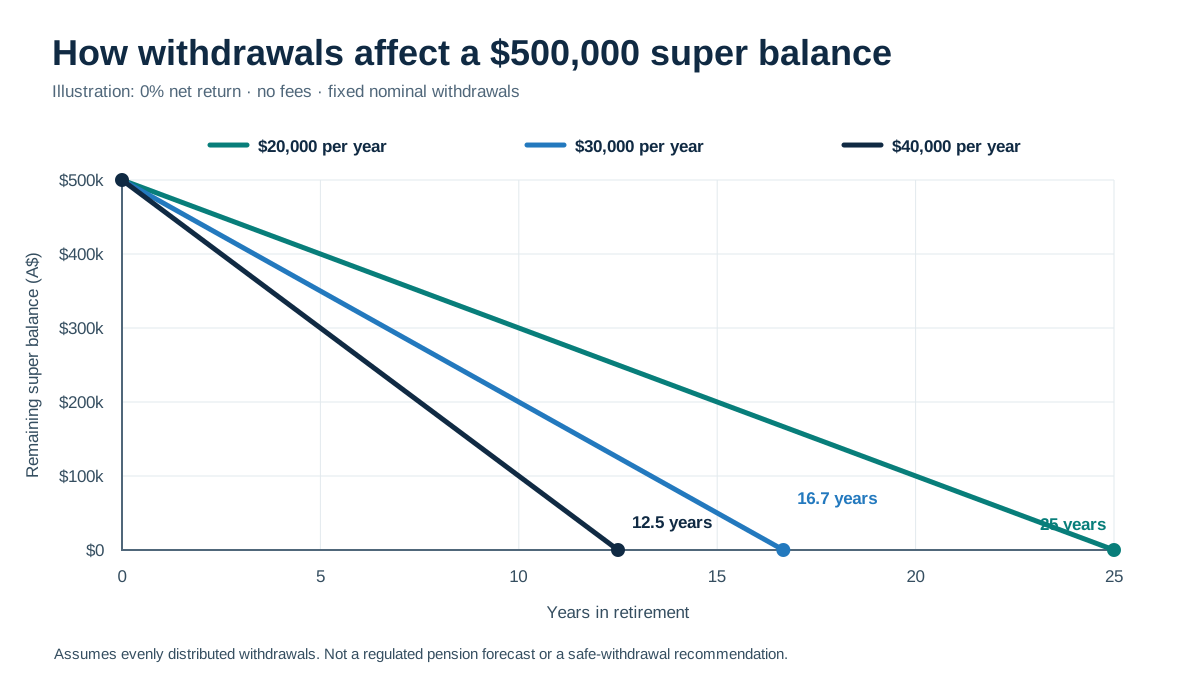
These figures are illustrative simple-division calculations, not year-by-year pension forecasts, and do not model legally required minimum account-based pension drawdowns, which change with age and account balance. A minimum drawdown can change annual payments and the end balance. Investment growth, fees, inflation, taxes and any Age Pension income also change the result. The table is useful for comparing balances under identical assumptions, but it is not a safe-withdrawal recommendation.
How do investment returns, fees and inflation affect how long super lasts?
Investment returns add to the remaining balance, fees reduce it and inflation increases future spending requirements. These effects compound throughout retirement. Returns are uncertain, even for diversified investment options.
At an illustrative 2.5% annual inflation rate, $30,000 of yearly expenses rises to approximately $38,402 after 10 years if the same purchasing power is maintained. A constant nominal withdrawal therefore buys less over time. Review whether a retirement projection uses nominal dollars or today's dollars and whether investment returns are shown before or after fees and tax.
What are the minimum account-based pension drawdown rates?
For a standard account-based pension, the minimum annual withdrawal increases with age. The rates are prescribed under Australian superannuation rules and are based on age and pension account value, generally measured at the start of the financial year.
| Age at 1 July | Minimum annual withdrawal |
|---|---|
| Under 65 | 4% |
| 65–74 | 5% |
| 75–79 | 6% |
| 80–84 | 7% |
| 85–89 | 9% |
| 90–94 | 11% |
| 95 or over | 14% |
For an account balance of $500,000 on 1 July at age 67, the minimum is $25,000 for that financial year. According to ASIC Moneysmart, Account-based pensions (2 July 2026), the calculation uses age and account balance on 1 July. Special first-year calculations apply when an income stream starts partway through a financial year; confirm the payable amount with your fund.
Does a minimum pension withdrawal guarantee super will last?
NO, a minimum account-based pension withdrawal does not guarantee a lifetime income. Minimum rates are legal payment requirements, not a safe withdrawal strategy. Market losses, investment fees and extra withdrawals can cause the balance to fall faster than planned.
Revisit the withdrawal amount, remaining savings and projected costs after substantial changes in investment values or household spending.
How can I stress-test retirement savings against early market losses?
Stress-test retirement savings by comparing a baseline projection with an early investment loss followed by recovery, while keeping the same spending requirements. Early losses can be more damaging when the retiree continues withdrawing funds from a smaller balance.
Model a weak first year, reduced subsequent returns and a realistic spending response. Compare balances after five and ten years rather than looking only at average long-term returns. This tests sequence-of-returns risk and identifies situations where discretionary spending needs review. For a reproducible stress test, compare a 20% first-year investment loss with a 20% first-year gain, using the same starting balance and withdrawals. Then model later returns separately. The outcome depends on when withdrawals occur, not only the average return over the full period.
What changes if I retire at 60 rather than 67?
Retiring at 60 instead of 67 creates seven additional years before reaching the current Age Pension eligibility age. The super balance must cover any income gap during those years if there is no other income.
A retiree also has fewer years of contributions and potentially more years of withdrawals. At 60, eligibility to access super depends on meeting a condition of release; reaching preservation age alone does not always permit unrestricted withdrawals. Compare both retirement dates using the same inflation and return assumptions.
How does the Age Pension change when super may run out?
The Age Pension can reduce the amount withdrawn from super if a retiree is eligible. In Australia, Age Pension age is 67, and actual entitlement depends on residence, income and assets tests.
Do not assume every retiree receives the full pension. According to Services Australia, Income test for Age Pension (20 September 2026), financial assets such as superannuation are assessed using deeming. Account-based pensions are also assessed under the assets test. An estimate that ignores Age Pension can overstate super withdrawals; an estimate that assumes the full pension without eligibility checks can understate them. ASIC Moneysmart's account-based pension calculator excludes Age Pension income from its projections. Estimate Age Pension separately and combine it with the household spending plan; do not assume the pension automatically increases by a fixed amount each year. Check the Age Pension calculator alongside your retirement assumptions.
How can I update my retirement spending after Age Pension eligibility changes?
Update the withdrawal plan by subtracting confirmed pension payments and other net income from the amount required for household spending. Recheck entitlements whenever assets, relationship status or income change.
For example, a household spending $50,000 annually with $20,000 of verified non-super income has a $30,000 funding gap before additional costs. According to Services Australia, Age Pension (21 November 2025), entitlement is subject to eligibility rules and financial circumstances; do not assume a fixed lifetime payment.
Can super last 30 years after retirement?
YES, an account-based pension can last 30 years under some combinations of starting balance, investment returns and spending. No fixed balance ensures that outcome.
Model 30 years of inflation-adjusted expenses, fund charges, pension minimums and potential market downturns. Check both the end balance and whether income remains adequate throughout the period. A retiree beginning at age 60 faces a different Age Pension timeline from someone retiring at 67.
What happens if my super runs out but I still receive the Age Pension?
If super is exhausted, an eligible Age Pension recipient continues to be assessed for Age Pension under the applicable rules. Running out of super does not automatically cancel a pension.
The payment amount depends on the person's ongoing financial circumstances. Reassess the household budget and report relevant changes to Services Australia. Housing costs and additional income sources remain important even without a super balance.
Can super run out before age 85?
YES, super can be exhausted before age 85 when annual withdrawals and fees exceed the amount supported by investment returns. The starting balance alone cannot establish a depletion age.
Compare planned annual withdrawals against projected income and review a downside scenario with higher spending or lower returns. A pension-account calculator helps show a range of possible outcomes rather than an assured date.
Does the Age Pension automatically start when super runs out?
NO, exhausting super does not automatically start Age Pension payments. A person must satisfy age, residence, income and assets requirements and make a claim.
Age Pension age is 67. Services Australia determines eligibility using the person's circumstances, not simply whether their super has reached zero. According to Services Australia, Who can get Age Pension (accessed October 2026), both financial tests and residence rules affect eligibility.
Can I withdraw more than the minimum pension percentage?
YES, you can generally withdraw more than the minimum from a standard account-based pension, subject to the product's terms. Larger withdrawals reduce the amount left invested and can shorten the pension's duration.
Separate any one-off expense from recurring retirement income when calculating how long savings last. A large early withdrawal has both an immediate balance effect and a potential lost-earnings effect.
Is the annual minimum pension percentage the same at every age?
NO, standard account-based pension minimum percentages increase across prescribed age bands, from 4% below age 65 to 14% from age 95. The minimum payment is recalculated using the applicable balance and age rules.
Check the rate at the start of each financial year. A higher percentage does not mean the same dollar withdrawal each year because the remaining account balance also changes.
Can investment losses shorten how long my super lasts?
YES, investment losses reduce the balance available to support future withdrawals. Losses early in retirement can have a larger effect when money is withdrawn before markets recover.
For a clear comparison, show the starting balance, investment return, withdrawals and end balance for each year. Do not treat a long-term average return as a guaranteed annual result.
Does super keep earning investment returns after retirement?
YES, super transferred to an account-based pension generally remains invested and can earn positive or negative investment returns. Its future value depends on the selected investment option and market conditions.
Investment fees and pension payments continue affecting the balance. Compare the fund's current pension investment options with your income requirements and tolerance for market falls. Review the super investment options guide for allocation and risk differences.
Sources and verification (October 2026)
- Australian Securities and Investments Commission (ASIC), Moneysmart, Account-based pension calculator, updated 2 July 2026. Its retirement-income results exclude government Age Pension.
- Australian Securities and Investments Commission (ASIC), Moneysmart, Account-based pensions, updated 2 July 2026.
- Australian Taxation Office, Payments from super: key rates and thresholds, accessed October 2026.
- Services Australia, Age Pension, updated 21 November 2025; Who can get Age Pension, accessed October 2026.
- Services Australia, Income test for Age Pension, updated 20 September 2026.
- Australian Securities and Investments Commission, Moneysmart, Work out how much you need to retire, updated August 2026.
- Services Australia, Deeming, accessed October 2026.
Calculations are educational illustrations, not personalised financial advice. Market returns, taxation, product restrictions, withdrawal timing and eligibility can change actual outcomes.
Written by
Superannuation Calculator Australia
Calculation guidance and general information; independent financial advice is not provided.