Lump Sum vs Account-Based Pension: Tax, Income and Retirement Choices
Compare super lump sums and account-based pensions in Australia, including tax, minimum drawdowns, Age Pension rules and examples.
Superannuation Calculator Australia · · 13 min read
In Australia, a super lump sum provides immediate access to withdrawn savings, while an account-based pension provides ongoing withdrawals from an invested retirement account. The main differences concern minimum payments, future investment earnings, taxation and Age Pension assessment. The right structure depends on access eligibility, spending needs and the treatment of savings after withdrawal.
What Is the Difference Between a Lump Sum and an Account-Based Pension?
A lump sum gives you a one-off withdrawal from super, while an account-based pension keeps money invested inside super and pays a chosen retirement income, subject to annual minimums. Neither option is automatically better. The decision turns on immediate cash needs, tax, investment risk and eligibility for the Age Pension. The Superannuation Calculator Australia estimates super outcomes before choosing a withdrawal strategy.
| Feature | Lump sum | Account-based pension |
|---|---|---|
| Payment | One or more withdrawals | Regular payments plus optional lump sums |
| Investments | Withdrawn cash leaves super | Balance stays invested in a pension account |
| Minimum annual payment | None once withdrawn | Age-based statutory minimum |
| Tax on future earnings | Outside-super rules apply to new investments | Eligible retirement-phase earnings generally tax-exempt within the fund |
| Longevity | Remaining money depends on how it is used or invested | Payments stop when the account balance is exhausted |
For a deeper explanation of what happens after retirement, see what happens to your super when you retire.
When can Australians legally access super as a lump sum or pension?
Most Australians gain unrestricted access to preserved super when they reach age 65 or satisfy another condition of release, such as retiring after reaching preservation age. Preservation age is 60 for anyone born on or after 1 July 1964. Earlier birth cohorts had preservation ages from 55 to 59. Reaching preservation age alone does not establish unrestricted withdrawal rights. Access before meeting a condition is limited to specific statutory grounds.
A transition-to-retirement income stream permits eligible payments before full retirement but has restrictions and is not equivalent to unrestricted cash access. Confirm the condition of release and its classification with the fund before requesting a withdrawal. See transition to retirement super for the separate arrangement.
What tax applies to each option after age 60?
From age 60, both withdrawals from a typical taxed super fund and pension payments sourced from its taxed element are generally tax-free to the member. The tax-free component is also tax-free. An untaxed element, often associated with certain public sector schemes, is subject to different rules and can create income tax.
Tax treatment also differs for members younger than 60, death benefits and some defined benefit income streams. Check the fund's taxable and tax-free component statement before assuming a payment attracts no tax. The super withdrawal tax calculator provides a starting point for checking withdrawal scenarios.
How are investment earnings taxed inside pension phase versus outside super?
Eligible investment earnings on assets supporting a retirement-phase account-based pension are generally exempt from tax within the fund. Accumulation-phase earnings are generally taxed inside a complying fund, commonly at 15% on taxable income, with different capital gains treatment in some circumstances.
Cash withdrawn as a lump sum and invested personally is governed by ordinary income tax and capital gains rules. Tax on the withdrawal and tax on subsequent earnings are separate calculations. The exemption for retirement-phase earnings is also subject to applicable pension and transfer balance rules. Use the Super Projection Calculator Australia to compare illustrative investment and withdrawal assumptions; it is not a personalised tax assessment.
What are the minimum account-based pension withdrawal rates by age?
The standard minimum pension payment percentage depends on the member's age and the account value at the relevant valuation date. A pension commencing part-way through a financial year generally has a pro-rated minimum, subject to special rules near 30 June.
| Age | Annual minimum |
|---|---|
| Under 65 | 4% |
| 65–74 | 5% |
| 75–79 | 6% |
| 80–84 | 7% |
| 85–89 | 9% |
| 90–94 | 11% |
| 95 or over | 14% |
For a $500,000 pension balance at age 67, the full-year minimum at 5% is $25,000. The minimum is a statutory withdrawal requirement, not a guaranteed return or a recommended spending rate. According to the Australian Taxation Office, Income stream (pension) rules and payments (accessed October 2026), a new account-based pension starting on or after 1 June generally has no minimum payment requirement for that financial year. Test a different starting balance or withdrawal rate with the super pension calculator.
Can I take a lump sum and keep the remainder as an account-based pension?
YES, a retiree who satisfies a full condition of release can withdraw part of their super as cash and use the rest to open an account-based pension, subject to fund rules and the transfer balance cap. For example, withdrawing $50,000 from $500,000 leaves $450,000 for pension commencement. At age 67, the 5% full-year minimum on that pension is $22,500.
A lump sum taken before pension commencement differs administratively from a later partial or full commutation of an existing pension. Confirm the classification and reporting with the fund.
How do the Age Pension income and assets tests treat each option?
For most account-based pensions started on or after 1 January 2015, Services Australia counts the pension account balance under the Age Pension assets test and applies deeming under the income test. The amount actually withdrawn as a pension payment is generally not the amount used to calculate deemed income. According to Services Australia, Deeming (updated 20 September 2026), deemed income is calculated using prescribed rates regardless of actual investment earnings. A lump-sum withdrawal usually changes where an asset is held rather than automatically removing its assessable value.
| What happens to withdrawn cash | Potential Age Pension treatment |
|---|---|
| Held in a bank account | Assessable financial asset with deemed income |
| Used to buy shares outside super | Assessable investment with deemed income |
| Spent on qualifying principal-home improvements | Depends on expenditure and principal-home exemption |
| Used to repay a principal-home mortgage | Can reduce assessable financial assets, subject to circumstances |
| Held in super by a person below Age Pension age | Special exemption rules may apply until that person reaches Age Pension age |
| Given away | Gifting and deprivation rules can still apply |
The tests are applied separately and the lower calculated Age Pension rate governs. Some pre-1 January 2015 income streams retain grandfathered income-test treatment if the applicable continuity conditions are met. Grandfathering is not automatic for every older account. Check individual circumstances using the Age Pension calculator and current Services Australia guidance.
How does the transfer balance cap affect pension versus lump sum choices?
The transfer balance cap limits the amount transferred into retirement-phase income streams, not the amount available as an unrestricted lump sum. Each person has a personal cap. Previous pension commencements, commutations and indexation can change remaining cap space.
Before starting a pension, review the ATO transfer balance account, existing pensions and earlier commutations. An excess transfer may trigger an ATO determination and tax consequences. Do not assume that everyone has the full general cap available.
Which option is better for paying off a mortgage in retirement?
A lump sum used to repay a mortgage reduces future loan interest but also reduces invested retirement savings. Compare the mortgage rate, after-tax investment returns, the amount of accessible cash and the household's ongoing pension income.
For example, paying $40,000 towards a mortgage charging 6% avoids about $2,400 in first-year interest if the interest rate and outstanding balance would otherwise have stayed constant. This hypothetical result is not a recommendation: mortgage terms, alternative returns and tax circumstances differ.
What happens if the pension balance runs out?
An ordinary account-based pension stops paying when its account balance is exhausted. Unlike a lifetime annuity, it does not transfer the risk of living longer than the savings last to an insurer. Its duration depends on initial savings, withdrawals, investment performance and fees. It is not a guaranteed lifetime annuity.
Test low returns early in retirement as well as long-term average returns. Lower withdrawal rates and costs improve the chance of preserving capital but do not eliminate investment or longevity risk. See how long will my super last for longevity scenarios.
What happens to remaining money when the member dies?
The remaining account-based pension balance generally forms part of the deceased member's super death benefit. Depending on fund rules and beneficiary eligibility, it may be paid as a lump sum, continued as an eligible death-benefit pension or paid to the estate.
Tax depends on the beneficiary's status under tax law, the components of the benefit and the payment form. A binding nomination or reversionary beneficiary instruction must meet the fund's requirements.
How can a $500,000 super balance be split between cash and pension payments?
For a $500,000 balance, compare a $50,000 cash reserve plus a $450,000 account-based pension against putting the full amount into a pension. The following examples assume a retiree aged 67 and a full pension year.
The withdrawal split illustrates how three cash choices change the opening pension balance and its annual minimum.
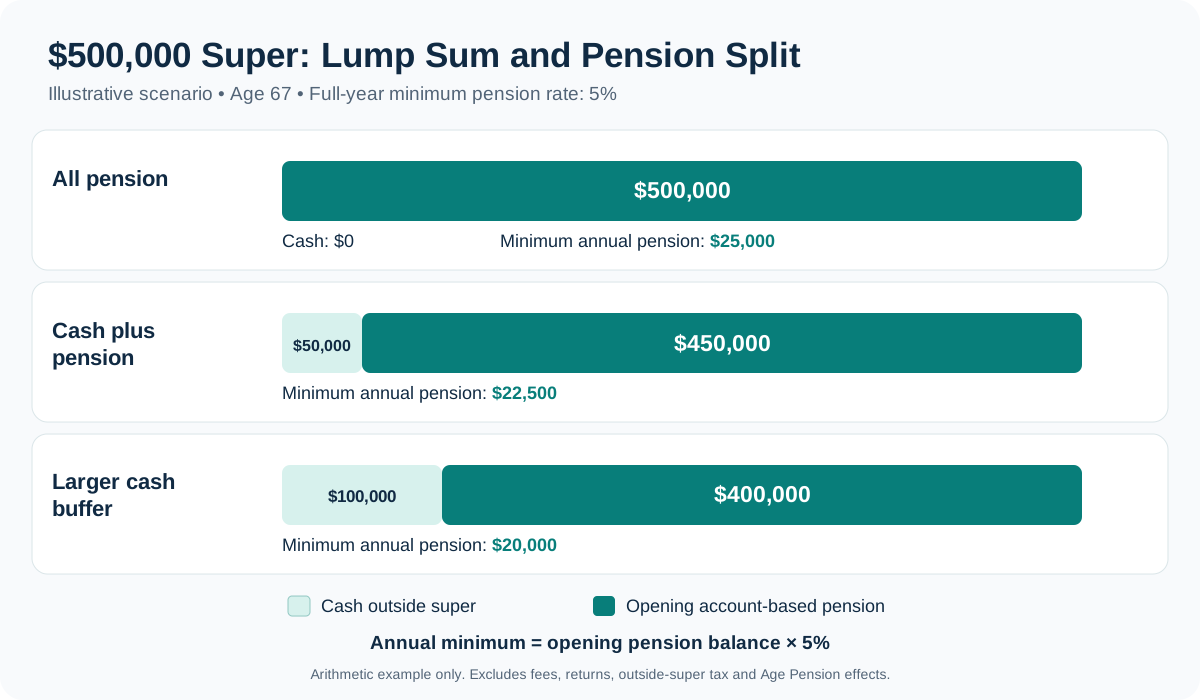
| Illustrative strategy | Cash outside super | Opening pension balance | Annual minimum at 5% |
|---|---|---|---|
| All pension | $0 | $500,000 | $25,000 |
| Cash plus pension | $50,000 | $450,000 | $22,500 |
| Larger cash buffer | $100,000 | $400,000 | $20,000 |
These amounts exclude investment performance, fees, tax on earnings outside super and Age Pension interactions. The annual minimum is a legal floor, not a sustainable spending recommendation. Decision check: Compare the cash left for near-term expenses, income available after the minimum withdrawal and remaining assets exposed to market risk. A cash reserve outside super does not automatically improve Centrelink entitlement or investment returns.
What checks should be completed before withdrawing a super lump sum?
Before withdrawing, verify the fund has recorded a full condition of release and check tax components, pension consequences, Centrelink treatment and insurance.
- Confirm preservation status and withdrawal eligibility with the fund.
- Determine the immediate cash amount and expected spending over the next year.
- Compare tax on the payment and future investment earnings outside super.
- Check minimum pension payments, personal transfer balance cap and fees. If you are still receiving employer contributions, use the Super Contributions Calculator Australia to estimate the contribution component separately.
- Update Services Australia where required and review insurance and beneficiaries.
How might withdrawing and reinvesting outside super change after-tax income?
A tax-free withdrawal of $100,000 from a taxed fund after age 60 does not mean returns earned outside super are tax-free. Bank interest is generally assessable. Share dividends and realised capital gains are governed by their own tax rules.
Compare after-tax results using the individual's marginal rate, investment mix and ownership arrangement. Do not apply one blanket tax rate to every investment.
How do inflation and bad early returns affect a pension versus lump sum plan?
Inflation reduces the purchasing power of a fixed cash withdrawal, while poor early investment returns can force the sale of assets at lower values. Both risks can affect a pension account or a lump sum invested outside super.
For illustration, $30,000 annual spending growing by 3% a year becomes about $40,317 after 10 years. This is hypothetical compounding, not an inflation forecast. Test early market losses and higher withdrawals alongside average-return scenarios.
How are minimum pension payments different from lump-sum commutations?
Ordinary pension payments count towards the statutory annual minimum. A separately recorded lump-sum commutation generally does not count towards that minimum and may have different transfer balance reporting consequences.
Ask the fund to confirm whether a payment is coded as a pension payment or commutation. A commutation does not remove an otherwise applicable annual pension minimum.
Can you take both a lump sum and an account-based pension?
YES, an eligible retiree can combine a partial lump sum with a continuing account-based pension. The invested balance remains subject to pension payment minimums and the fund's pension rules. A partial commutation after pension commencement has different administration and reporting implications. According to the Australian Taxation Office, Income stream (pension) rules and payments (accessed October 2026), partial commutations do not count towards the pension's annual minimum.
Are pension withdrawals always tax-free after age 60?
NO, not every pension withdrawal after age 60 is tax-free. Most payments from taxed super funds are generally tax-free, but untaxed elements, some defined benefit income streams and certain death-benefit arrangements have different rules. Check the payment components.
Does an account-based pension guarantee income for life?
NO, a conventional account-based pension does not guarantee lifetime income. Payments are funded from its remaining investment balance and stop when it is depleted. Guaranteed lifetime income products have different contractual terms.
Can you withdraw more than the minimum pension payment?
YES, an account-based pension holder can generally withdraw more than the annual minimum, subject to pension terms and fund administration. Higher withdrawals reduce invested capital and can shorten the pension's duration. Transition-to-retirement products have additional limits.
Can you add contributions to an existing account-based pension?
NO, new contributions generally cannot be paid directly into an account-based pension after it starts. New eligible contributions enter an accumulation account first. Starting or restructuring an income stream requires eligibility, tax and transfer balance cap checks.
Does a super lump sum automatically increase the Age Pension?
NO, withdrawing a super lump sum does not automatically increase Age Pension entitlement. Services Australia assesses the assets and deemed income according to how the money is subsequently held or used. Cash retained in a bank account may leave the means-test result broadly unchanged.
General information only. Rules and individual circumstances change. This article is not personal financial or tax advice.
Sources and verification (October 2026)
- Australian Taxation Office, Retirement withdrawal: lump sum or income stream (31 March 2026).
- Australian Taxation Office, Income stream (pension) rules and payments (accessed October 2026).
- Australian Taxation Office, Key superannuation rates and thresholds: payments from super (accessed October 2026).
- ASIC Moneysmart, Account-based pensions (2 July 2026).
- ASIC Moneysmart, Super lump sum (accessed October 2026).
- Services Australia, Assets test for Age Pension (accessed October 2026).
- Services Australia, Income test for Age Pension (accessed October 2026).
- Services Australia, Deeming (20 September 2026).
Written by
Superannuation Calculator Australia
Calculation guidance and general information; independent financial advice is not provided.