Payday Super Rules for Employers: Deadlines, Calculations and Compliance
Payday Super employer rules from 1 July 2026: 12% qualifying earnings, seven-business-day deadlines, payroll and late-payment risks.
Superannuation Calculator Australia · · 11 min read
From 1 July 2026, Australian employers calculate 12% super guarantee (SG) on qualifying earnings whenever they pay wages. Contributions generally must reach the employee's super fund within seven business days after payday. The requirement replaces the former quarterly payment cycle for new paydays. Employers must check worker eligibility, calculate qualifying earnings, update payroll reporting and track actual fund receipt.
What is Payday Super and when did it begin?
Payday Super began on 1 July 2026. It requires employers to calculate and arrange SG contributions at each payday, instead of paying under the former quarterly schedule.
The SG rate remains 12%. The new calculation base, qualifying earnings (QE), includes ordinary time earnings (OTE) plus specified additional payments. Submitting a payment on payday does not by itself prove compliance: the fund generally has to receive it within seven business days. According to the Australian Taxation Office (ATO), About Payday Super (2026), the changes affect when employers calculate, pay and report SG.
Which employers and eligible workers are covered by Payday Super?
Employers with a statutory SG obligation are covered, including those employing eligible full-time, part-time and casual workers. Some contractors paid mainly for their labour are also treated as employees for SG purposes.
Determine eligibility from the actual employment relationship and the applicable SG rules, not merely the payroll label. Check contractors individually and use the correct super fund, including a stapled fund when the choice-of-fund rules require it. Refer to the guide to super for self-employed workers for the distinction between personal contributions and employer SG.
When must Payday Super reach an employee's super fund?
For a standard payday, the contribution generally must be received by the employee's super fund within seven business days after payday. This is a receipt deadline, not simply a deadline for pressing 'submit' in payroll software.
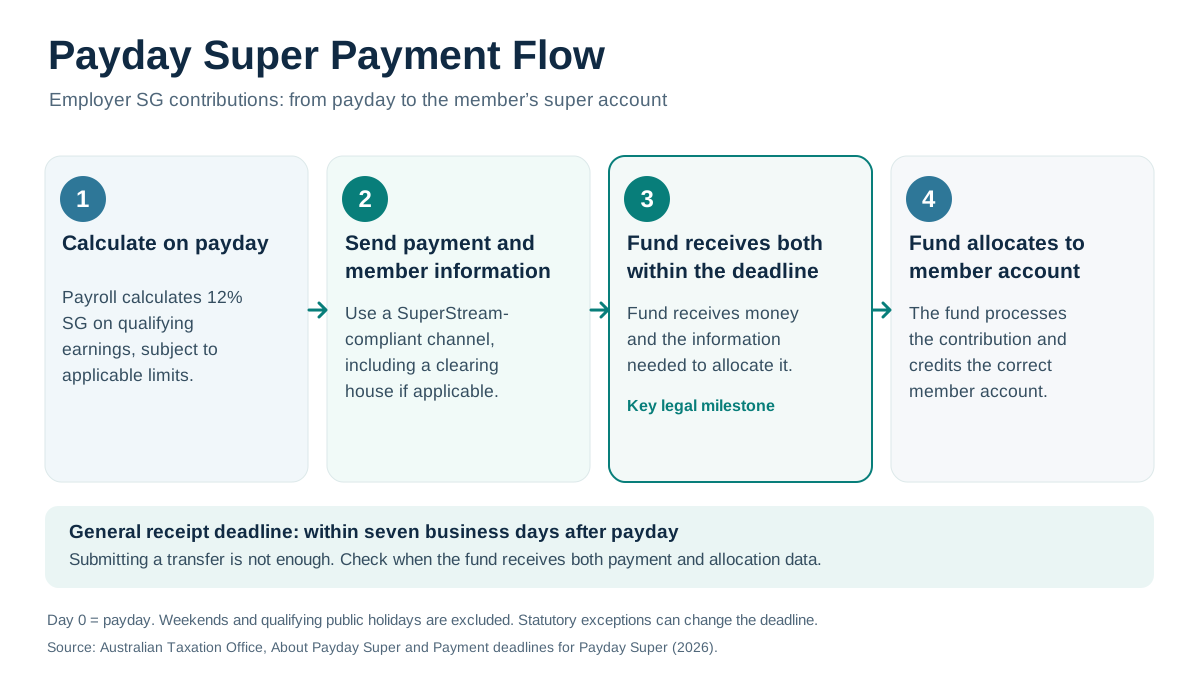
A bank debit or clearing-house acceptance is not the statutory receipt event. The fund needs both the contribution and the information necessary to allocate it within the applicable deadline. The fund's subsequent allocation to the member's account is a separate processing step. Employers need sufficient settlement time and transaction evidence. According to the ATO, Payment deadlines for Payday Super (2026), extended deadlines apply in defined circumstances. The payment flow illustrates the distinction between sending a contribution and the fund receiving the required information.
When do 20-business-day and other exceptions apply?
The 20-business-day extension can apply to the first SG contribution for a new employee and the first contribution following a change of fund, subject to the ATO's conditions. A qualifying out-of-cycle bonus generally has a deadline measured from the next regular QE payday. In exceptional circumstances, such as significant natural disasters or widespread payment-system outages, the Tax Commissioner may exercise statutory discretion.
Record the qualifying event, the date the period begins and the exact due date. A rejected payment does not automatically restart a 20-business-day window. Verify the relevant exception in current ATO guidance before relying on it.
How do employers calculate the 12% super guarantee on qualifying earnings?
Multiply each pay period's qualifying earnings by 12%, subject to applicable SG limits. QE includes ordinary time earnings and certain other specified amounts, such as employee commissions and relevant salary-sacrifice amounts.
Classify allowances, overtime, bonuses and commissions before calculating SG. Genuine separately identifiable overtime performed outside ordinary hours is generally excluded, whereas ordinary-hours shift penalties generally form part of OTE. For classification examples, see super on overtime and super on bonuses.
The following example separates qualifying earnings from genuine overtime. Amounts are illustrative and the SG liability shown is the statutory minimum for these assumptions.
| Illustrative pay-run item | Amount | SG treatment |
|---|---|---|
| Ordinary earnings | $2,000 | Included in QE |
| Separately identified genuine overtime | $250 | Excluded in this illustration |
| QE used for SG | $2,000 | 12% × $2,000 = $240 |
The example assumes no further QE categories, higher contractual SG requirement or maximum contribution base adjustment. Use the Super Contributions Calculator Australia to estimate SG after classifying eligible earnings.
How does the maximum contribution base work under Payday Super?
The maximum contribution base limits earnings on which the statutory minimum SG is calculated for high-income employees. Under the 2026–27 rules, employers need to track qualifying earnings against the relevant annual limit rather than treat each payday in isolation.
According to the ATO's 2026–27 maximum contribution base information, the annual qualifying-earnings threshold is $270,830 per employee per employer. Contractual or award entitlements can require contributions above the SG minimum. Do not confuse this earnings threshold with the employee's separate concessional contributions cap. For basic wages and SG calculations, use the Superannuation Calculator Australia.
How should employers change their payroll and SuperStream process?
Employers need a payroll-to-fund process that calculates QE for each pay run, sends the SG contribution promptly and detects any rejected or unmatched payment before the receipt deadline.
- Confirm SG eligibility and current fund details for each worker.
- Map payroll earnings codes to QE and calculate SG at 12%.
- Include required year-to-date QE and SG liability amounts in Single Touch Payroll (STP).
- Lodge payment instructions through a SuperStream-compliant service with adequate processing time.
- Reconcile provider acceptance, fund receipt and any rejected transactions.
Weekly and fortnightly employers should budget SG cash outflows at the same frequency as wage payments. The Super Projection Calculator Australia estimates longer-term growth from contributions. A provider's submission confirmation is not interchangeable with fund receipt.
What replaced the ATO Small Business Superannuation Clearing House?
The ATO's Small Business Superannuation Clearing House closed permanently on 1 July 2026. There is no single government-operated replacement for all former users.
Employers need a different SuperStream-compliant solution, such as compatible payroll software or a commercial clearing house. Compare fund validation, lead times, rejection handling and downloadable reconciliation records when selecting a service.
What qualifying earnings must be reported through Single Touch Payroll?
Employers are required to report year-to-date qualifying earnings and SG liability using the updated STP reporting approach. These totals connect payroll calculations with the employer's super obligations.
The ATO has provided transitional reporting guidance for employers whose payroll systems did not support the new fields immediately on 1 July 2026. A reporting transition does not remove the separate requirement to pay SG by its applicable due date.
What should employers do when a super contribution is rejected?
Correct and resubmit a rejected SG contribution promptly. A rejected clearing-house or fund transaction is not a contribution successfully received by the member's fund.
- Inspect the rejection message and locate the employee or fund reference.
- Check the member number, fund details, unique superannuation identifier (USI) and payment instruction.
- Correct the source payroll record and resubmit through the appropriate channel.
- Confirm receipt and retain both the rejection and successful processing timestamps.
Recalculate the applicable statutory deadline separately; do not assume rejection creates a fresh deadline. Operational acceptance test: match the corrected member details and payment reference to the remittance report, verify successful fund receipt and close the exception only after the contribution and allocation data have both been accepted.
What happens if a Payday Super contribution is late or underpaid?
An employer who misses the applicable fund-receipt deadline or underpays SG may become liable for the super guarantee charge (SGC) under the Payday Super framework.
The employer should identify the affected payday, recalculated QE and shortfall, verify the actual fund receipt date and follow the ATO's current SGC assessment and reporting requirements. The new SGC regime differs from the former quarterly framework, so older calculators and instructions are not a reliable substitute. Keep a dated correction register and take qualified advice where the liability is material.
How were June quarter contributions handled in July 2026?
Contributions relating to paydays before 1 July 2026 remain subject to the former quarterly framework. The final April–June 2026 quarter generally had a 28 July 2026 SG payment due date.
Paydays on or after 1 July 2026 fall under the new Payday Super system. According to the ATO, Payday Super has started: Here’s what employers need to know and do (2026), contributions received from 1 to 28 July 2026 were allocated to outstanding quarterly SG first, even when intended for a July payday. Contributions received on or after 29 July 2026 were allocated only to Payday Super amounts. Employers needed to reconcile both liability groups by pay period and receipt date. If the final quarterly contribution missed 28 July, the former quarterly SGC statement and payment deadline was 28 August 2026.
How is the ATO approaching compliance in the first year of Payday Super?
The ATO has published a first-year compliance approach for 1 July 2026 to 30 June 2027 recognising employers making genuine efforts to comply during implementation. It does not provide a general exemption from paying contributions on time or from statutory SG charge consequences.
An employer's records should show timely action, accurate QE classification, rejected-payment remediation and fund-receipt reconciliation. Check the ATO's current compliance approach before relying on transitional treatment.
How can employers calculate a seven-business-day deadline around public holidays?
Count the applicable seven business days after payday, excluding non-business days under the statutory definition. State or territory public holidays and bank-processing arrangements can affect the calculation, so verify the employer's circumstances against the ATO rules.
For example, for a payday on Monday 6 July 2026, seven business days later is Wednesday 15 July 2026 where no qualifying public holiday intervenes. The payday is day zero. Under the statutory definition, a holiday observed throughout any Australian state or territory is excluded from the count even if the employer operates in another state; a local-only holiday is not necessarily excluded. Record the payday, business-day count, expected receipt and confirmed receipt. Avoid calculating the deadline from submission date.
What evidence proves a super fund received contributions on time?
The most useful evidence links the payroll run to the member's fund receipt, rather than stopping at a bank debit or clearing-house upload. Use the following fields as a payroll reconciliation checklist:
Retain the payday, employee QE and SG calculation, transaction ID, clearing-house status, fund acknowledgement, correction notices and final receipt date.
- Payroll details: payday, employee or batch reference and qualifying earnings.
- Liability: SG owed, statutory due date and amount submitted.
- Delivery evidence: fund receipt date and remittance reference.
- Exception status: rejection reason, corrected payment and resolution date.
Reconcile these records against STP reporting and the super fund's transaction record. Keep unresolved or rejected transactions in a dated exceptions register.
Does Payday Super apply to casual employees?
YES, casual employees who satisfy SG eligibility rules are covered by Payday Super. Their qualifying earnings attract the applicable SG rate, and payments follow the same general fund-receipt deadline, subject to any relevant statutory exception.
Do employers have to pay super on every payday?
YES, employers generally calculate and arrange SG when they pay qualifying earnings, whether payroll runs weekly, fortnightly or monthly. The fund-receipt deadline and any permitted extended timeframe determine when the payment legally becomes due.
Can an employer rely on clearing-house submission as proof of on-time receipt?
NO, submitting through a clearing house does not alone prove the super fund received the contribution within the required period. Retain provider acknowledgements and evidence of successful fund receipt.
Is the seven-business-day window the same as seven calendar days?
NO, seven business days and seven calendar days are different measurement periods. Apply the statutory business-day rule and check intervening weekends and applicable public holidays.
Does a new employee always have the standard seven-business-day deadline?
NO, qualifying first contributions for a new employee may receive a 20-business-day timeframe. Confirm the starting event and the relevant ATO conditions instead of applying the extension to every later payment.
Can employers still use the ATO Small Business Superannuation Clearing House?
NO, the ATO Small Business Superannuation Clearing House closed on 1 July 2026. Employers formerly using it need another compliant payment service.
Does an employer avoid the super guarantee charge just by correcting a late payment?
NO, making a late corrective contribution does not automatically extinguish potential SGC liability. Apply the current Payday Super charge rules to the affected payday and follow the ATO's prescribed correction and reporting process.
Sources and verification (October 2026)
- Australian Taxation Office, About Payday Super (2026).
- Australian Taxation Office, Payday Super has started: Here's what employers need to know and do (2026); July 2026 transition allocation and final quarterly deadlines.
- Australian Taxation Office, Payment deadlines for Payday Super (2026).
- Australian Taxation Office, What payments are qualifying earnings (updated September 2026).
- Australian Taxation Office, Maximum contribution base (updated August 2026).
- Fair Work Ombudsman, Payday Super: New rules starting 1 July 2026 (December 2025).
The pay-run figures are illustrative. Specific SG classifications, deadline exceptions and employment entitlements depend on statutory conditions and applicable employment arrangements.
Written by
Superannuation Calculator Australia
Calculation guidance and general information; independent financial advice is not provided.