Superannuation on Commissions and Allowances: Australian Rules
See which commissions and allowances attract 12% super in Australia, with Payday Super rules, examples and payslip checks.
Superannuation Calculator Australia · · 12 min read
Employee commissions attract compulsory super in Australia from 1 July 2026, but allowances do not all have the same treatment. Under Payday Super, employers generally calculate the 12% super guarantee (SG) on qualifying earnings (QE). Qualifying earnings include ordinary time earnings (OTE), all employee commissions and specified other payments. For allowances, the payment's real purpose matters more than the payroll label.
What Commissions and Allowances Are Included in Superannuation?
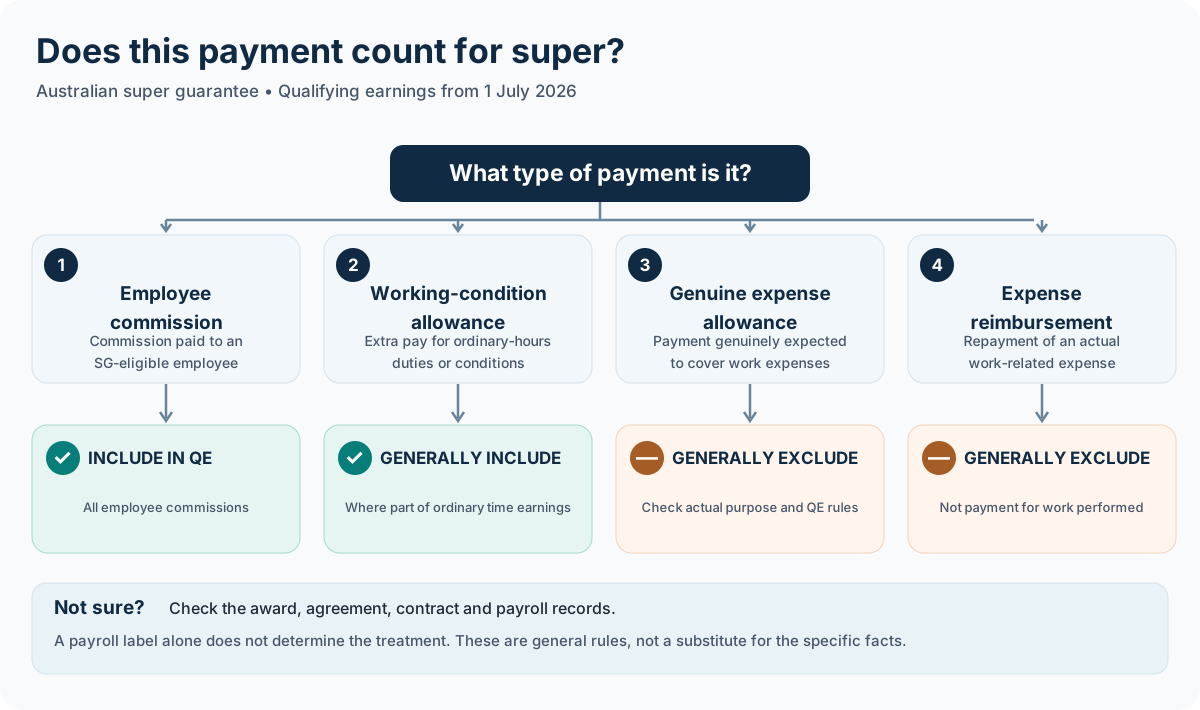
All employee commissions form part of qualifying earnings from 1 July 2026. Allowances paid for working conditions, particular duties or qualifications generally form part of OTE when they relate to ordinary hours. Genuine expense allowances and reimbursements normally do not form part of OTE.
The ATO distinguishes between remuneration for work and money provided to meet employment expenses. Under Payday Super, the qualifying-earnings base includes OTE plus specific extra payment categories. Check the employment arrangement and payment purpose before treating any allowance as exempt.
| Payment | Typical SG treatment from 1 July 2026 | Key test |
|---|---|---|
| Employee sales commission | Included | Employee commission, even when linked to work outside ordinary hours |
| Commission-only remuneration | Included | Worker is an employee for SG purposes |
| Site, danger or dirt allowance | Usually included | Compensation for working conditions during ordinary hours |
| Qualification or first-aid allowance | Usually included | Payment for qualification or special employment duties |
| Genuine car or travel expense allowance | Generally excluded from OTE | Expected to be fully spent meeting work expenses; confirm QE treatment |
| Reimbursement of an actual work expense | Generally excluded | Repaid expense rather than remuneration |
| Separately identified genuine overtime pay | Generally excluded | Payment for hours outside ordinary hours, subject to QE exceptions |
These classifications are general. Awards, enterprise agreements, special worker categories and the exact contractual facts can affect the employer's obligation.
Are All Commissions Included in Qualifying Earnings Under Payday Super?
YES, all commissions paid to an employee are included in QE from 1 July 2026, including commissions earned solely from work performed outside ordinary hours. This is an important change from the earlier OTE-focused rules, under which the connection with ordinary hours could affect commission treatment.
For example, a salesperson receiving $3,000 in commission for an eligible payday has an SG amount of $360 on that commission alone (12% × $3,000), before considering other qualifying earnings and statutory limits. The commission is counted once, not both as OTE and again as an additional QE component.
Which Allowances Count as Qualifying Earnings for Super?
Allowances generally attract SG when they are additional pay for performing employment duties or working in particular conditions during ordinary hours. An allowance genuinely intended to cover expected work expenses is generally outside OTE. Classification depends on what the employee is being paid for, not merely what payroll calls it.
According to the ATO's employee-allowance guidance, working-condition allowances such as danger, dirt and site allowances are typically OTE, while genuine expense allowances can be excluded. The relevant award, contract, payroll instructions and expense evidence help identify the substance of the payment.
The allowance decision diagram shows the main payment categories to check when assessing qualifying earnings. It is a quick guide, not a substitute for reviewing the relevant award or records.
What Is the Difference Between an Expense Allowance and a Reimbursement?
An expense allowance is a set or calculated amount paid with the expectation that the employee will spend it on work-related expenses. A reimbursement repays an expense the employee incurred, usually based on receipts or an approved claim. Neither should automatically be treated as additional remuneration.
For example, repaying an employee's $180 hotel invoice after a business trip is ordinarily reimbursement, not compensation for their labour. By contrast, a $180 weekly 'travel' payment that is actually extra wages for inconvenient work locations may require different SG treatment. Preserve documents showing the actual purpose.
Do Car, Travel, Site and Danger Allowances Attract Super?
YES, some do; others do not. A site or danger allowance for ordinary-hours working conditions generally attracts SG. Genuine car or overnight-travel expense allowances generally do not form part of OTE if they are genuinely expected to cover employment expenses.
| Allowance example | Indicative treatment | Verification |
|---|---|---|
| Danger allowance for hazardous ordinary duties | Generally SG applies | Award and hours worked |
| Site allowance for ordinary-hours work | Generally SG applies | Site conditions and award |
| First-aid qualification allowance | Generally SG applies | Required qualification and ordinary duties |
| Car allowance expected to cover work driving costs | Generally excluded from OTE | Expense purpose, payment method and records |
| Travel allowance intended to cover accommodation or meals | Generally excluded from OTE | Trip, overnight expenses and records |
| Fixed 'travel allowance' that is effectively additional wages | May attract SG | Substance of entitlement, not label |
Do not confuse income-tax reporting of an allowance with whether it attracts SG. Separate ATO rules apply to withholding, deductions, STP reporting and superannuation.
How Is Super Calculated on Salary, Commissions and Allowances?
Add each qualifying payment once, then apply 12% SG to the eligible QE amount. Exclude any genuine non-qualifying reimbursement or allowance and consider the annual maximum contribution base.
Qualifying earnings × 12% = minimum employer SG, subject to statutory limits.
| Pay component | Gross amount | Included in QE for this example |
|---|---|---|
| Ordinary salary | $2,000 | $2,000 |
| Employee sales commission | $750 | $750 |
| Site allowance for ordinary work | $150 | $150 |
| Genuine expense reimbursement | $100 | $0 |
| Total gross payments | $3,000 | $2,900 |
| Minimum SG at 12% | $348 |
This illustration assumes all amounts are paid on the same payday, the employee is SG-eligible, and no maximum contribution base or other special rule applies. SG is calculated on $2,900, not the full $3,000.
For other pay frequencies and contribution estimates, use the super contributions calculator.
How Does the 2026 Qualifying Earnings Rule Differ From Earlier OTE Rules?
From 1 July 2026, Payday Super changed the ordinary SG calculation base from OTE to qualifying earnings, which includes OTE and specified other payments. The SG rate is still 12%, but the payment timetable is payday-based rather than the former quarterly cycle.
| Rule | Until 30 June 2026 | From 1 July 2026 |
|---|---|---|
| Statutory earnings base | OTE | QE: OTE plus specified payments |
| Employee commissions | Ordinary-hours connection could determine inclusion | All employee commissions included |
| Ordinary-hours site or danger allowance | Generally included in OTE | Continues to be included through OTE |
| Genuine reimbursements | Generally excluded | Generally excluded |
| Contribution timing | Generally quarterly | Generally payable on payday, received within seven business days |
The expanded QE definition does not mean every payment is included. For background on ordinary hours and exclusions, see super on overtime and super on bonuses.
When Is Super on a Commission Payment Due?
Under Payday Super, employers must generally pay SG on payday and ensure the contribution is received by the fund within seven business days of that payday. A 20-business-day period applies in specified circumstances, including certain first contributions for a new employee or to a new fund. Other special timing rules can apply to out-of-cycle payments. Do not apply an extension without checking its conditions. A commission earned in one month but paid in a later pay run needs to be reconciled to the actual payment and applicable SG rule.
Employers should record the commission's approval, pay date, QE treatment, SG amount, remittance date and fund receipt confirmation. Read how super is paid for the wider payment process.
How Do Commission-Only Employees and Labour Contractors Qualify?
A commission-only employee can qualify for SG even without a fixed base salary. The employer calculates SG on the employee's qualifying commission earnings. Full-time, part-time and casual status does not itself remove the obligation. Employees aged 18 or over generally qualify regardless of how much they earn. An employee under 18 generally qualifies only if they work more than 30 hours in a week. Check any other applicable eligibility exception.
Some independent contractors are treated as employees for SG purposes when the contract is wholly or principally for their labour. Their contribution base can differ from a standard employee's and must be assessed under the applicable rules. An ABN or a 'contractor' label is not decisive. Do not assume that every commercial commission paid to a business is an employee commission.
How Can Employees and Employers Check or Correct Unpaid Super?
Compare the correct qualifying earnings with the SG liability for each payday, then check whether the amount reached the employee's super fund by the applicable deadline. A payslip entry alone does not prove that the fund received the contribution.
- Collect payslips, commission statements, allowance codes, contracts and any applicable award.
- Identify which amounts are commission, ordinary-hours remuneration, genuine expense allowances or reimbursements.
- Recalculate qualifying earnings without double-counting any commission already included in OTE.
- Multiply the eligible base by 12%, allowing for the applicable contribution limit.
- Compare the expected amount with fund transactions and the applicable receipt deadline.
- Ask payroll to explain discrepancies and correct any underpayment. Where unresolved, use the ATO's unpaid-super reporting channels.
How Should Employers Document Payroll Allowance Classification?
Maintain a record for each pay code stating its purpose, governing award or contract, evidence and SG classification. A practical record has columns for pay-code name, employment condition, ordinary-hours link, expected expenditure, supporting documents, QE inclusion and reviewer/date.
For mixed-purpose payments, avoid an arbitrary split. Identify the basis of entitlement and preserve the records that support the classification.
How Should a Delayed Commission Payment Be Reconciled to Super?
Trace a delayed commission across three events: earning the commission, approving the amount and paying it. Record the payment date and the related SG liability; check whether an out-of-cycle payment rule changes the applicable deadline. Reconcile the liability with STP reporting and the super fund's receipt.
This is particularly important when commission adjustments, clawbacks or corrections span several pay runs. Reversing a payroll line does not by itself establish that a previously paid contribution should be reversed.
When Does the Maximum Contribution Base Affect Commission Earnings?
For 2026–27, the maximum SG contribution base is $270,830 of qualifying earnings per employee per employer for the financial year, as reported in current employer guidance. Statutory minimum SG is generally not required on qualifying earnings above that annual base. This is different from the employee's concessional contributions cap, and awards or agreements may impose extra contributions.
Does Super Apply to Every Sales Commission?
YES, every commission paid to an SG-eligible employee is included in qualifying earnings from 1 July 2026. Check the person's SG status and distinguish employment commissions from unrelated business-to-business payments.
Are All Travel Allowances Included in Qualifying Earnings?
NO, genuine travel expense allowances are generally excluded from OTE. However, a payment described as 'travel allowance' can attract SG if it is actually additional remuneration for ordinary duties. Evaluate the underlying facts.
Is Reimbursing an Employee's Actual Expense Normally Superable?
NO, a genuine repayment of an employee's work expense is normally not remuneration for SG. Preserve receipts, claims and approvals to distinguish reimbursement from a flat payment that may be wages.
Can a Commission-Only Employee Receive Super?
YES, a commission-only employee ordinarily has an SG entitlement on their commissions. The absence of a base salary does not cancel the employer's obligation.
Does a Bonus Always Attract Employer Super?
NO, not every bonus attracts SG. A clearly identified bonus solely for work outside ordinary hours can be excluded; an ordinary-hours performance bonus generally attracts SG. See super on bonuses for examples.
Can a Workplace Award Require Additional Super?
YES, an award or enterprise agreement may require employer contributions beyond the statutory SG minimum. Check the employment instrument rather than relying solely on the 12% calculation.
What Should Employers and Employees Check Before the Next Payday?
Check that every employee commission is included once in qualifying earnings, classify each allowance according to its actual purpose and apply the 12% SG rate to the eligible amount. The employer must then reconcile the contribution against the fund's receipt record and the applicable payment deadline.
For a payroll review, keep the commission statement, allowance pay-code decision, relevant award or agreement, payday record and fund transaction together. These records distinguish a genuine expense reimbursement from remuneration and show whether a delayed commission was included in the correct payday's SG calculation.
Sources and verification (October 2026)
- Australian Taxation Office, What payments are qualifying earnings, updated September 2026.
- Australian Taxation Office, Payday Super and Payment deadlines for Payday Super, 2026.
- Australian Taxation Office, Superannuation Guarantee Ruling SGR 2009/2: Meaning of ordinary time earnings, current guidance.
- Australian Taxation Office, Withholding from allowances and employee allowance classifications, current guidance.
- Australian Taxation Office, Maximum contribution base, updated August 2026.
- Fair Work Ombudsman, Tax and superannuation, accessed October 2026.
- Australian Taxation Office, How to calculate super guarantee, accessed October 2026.
This is general information about Australian superannuation. The employee's award, contract, payment evidence and current ATO guidance determine the specific SG obligation.
Written by
Superannuation Calculator Australia
Calculation guidance and general information; independent financial advice is not provided.