First Home Super Saver Scheme: Eligibility, Tax and Withdrawals
Understand FHSS eligibility, $15,000 annual contribution limits, tax treatment, ATO release steps and home purchase deadlines.
Superannuation Calculator Australia · · 14 min read
The First Home Super Saver (FHSS) scheme allows eligible Australians to save towards a first home using voluntary super contributions. Up to $15,000 per financial year and $50,000 in total eligible contributions can count towards the scheme, plus associated earnings calculated by the Australian Taxation Office (ATO). The amount ultimately released depends on contribution type, ATO calculations and applicable tax.
FHSS is not a general early withdrawal of super. Before relying on the deposit, check your eligible contributions, the ATO determination, the release-request date and the home contract deadline. These are separate checks: making a voluntary contribution does not automatically reserve money for a home purchase.
What is the First Home Super Saver scheme?
The First Home Super Saver scheme is an Australian Government arrangement allowing eligible first-home buyers to make voluntary contributions into super, then ask the ATO to release eligible amounts and associated earnings towards a home.
The ATO administers the determination and release process. Compulsory employer super guarantee contributions do not count. The scheme is separate from a home loan or government purchase grant. You do not have to be an Australian citizen or tax resident to use FHSS, but you must satisfy its property and personal eligibility rules. According to the ATO, First home super saver scheme (reviewed October 2026), check whether your super fund is able to release FHSS amounts before making deposits specifically for this purpose.
Who is eligible for FHSS in Australia?
You generally must be at least 18 when requesting an FHSS determination, have never owned property in Australia and not previously requested an FHSS release. You can make voluntary contributions before turning 18.
Previous ownership of a home, investment property, vacant land, commercial property or certain leasehold interests generally prevents eligibility. An ATO financial hardship provision can apply where a hardship event caused loss of all property interests and its further conditions are met. Each joint purchaser is assessed separately. Your name must appear on the property title, and you must intend to occupy the home as soon as practicable for at least six months of the first 12 months after occupation becomes practicable.
How much can I contribute to FHSS each financial year?
The scheme counts up to $15,000 of eligible voluntary contributions in one financial year, subject to a $50,000 lifetime contribution limit per person. These are limits on contributions counted for FHSS, not an unconditional $50,000 cash payment.
For example, eligible contributions of $15,000 in each of three financial years and $5,000 in a fourth reach the $50,000 total. The releasable amount also depends on the concessional contribution percentage and ATO-associated earnings. Ordinary super contribution caps continue to apply. Estimate the effect of voluntary deposits with the Super Contributions Calculator Australia; the calculator does not replace an ATO determination.
Which super contributions count for FHSS?
Eligible voluntary contributions generally include salary sacrifice, deductible personal super contributions and non-concessional personal contributions. Compulsory employer super guarantee payments are excluded.
For release calculations, the ATO generally includes 85% of eligible concessional contributions and 100% of eligible non-concessional contributions, plus associated earnings. Deductible personal contributions must meet the ordinary notice-of-intent and deduction rules. Check fund records before asking for an FHSS determination.
How do FHSS associated earnings work?
Associated earnings are notional earnings calculated by the ATO, using the shortfall interest charge rate and eligible contribution dates. They are not the super fund's actual investment returns.
An FHSS determination displays the ATO's calculation. Actual investment performance, fees and market changes do not directly set this notional earnings figure. This distinction matters when comparing FHSS with a savings account: the associated earnings calculation is neither your super fund's realised return nor an interest rate paid by a bank.
How does FHSS tax work when contributions are made and released?
Eligible concessional contributions are generally subject to 15% contributions tax in super, with possible exceptions. An FHSS release's assessable component is included in taxable income and generally receives a 30% FHSS tax offset. The ATO withholds tax from the released assessable amount.
Non-concessional contributions themselves are generally not assessable on FHSS release, but associated earnings are. The assessable FHSS amount is reported in the income year in which you requested release, even when the payment arrives in the next income year. Tax outcomes depend on individual circumstances and the ATO's payment summary and return instructions. According to the ATO, Taxation Ruling TR 2024/4 (16 September 2024), the 30% FHSS offset is non-refundable.
How do I apply for an FHSS determination and release in myGov?
Access ATO online services through myGov, select Super → Manage → First home saver, request a determination and check the amount before submitting the release request.
- Confirm the dates, amounts and types of voluntary contributions reported by the fund.
- Obtain an FHSS determination and review contributions, associated earnings and the maximum release amount.
- Resolve omitted contributions or deduction discrepancies before requesting release.
- Submit one release request for the total amount you intend to withdraw.
- Allow for processing before relying on the money for a deposit.
According to the ATO, funds typically take 15–20 business days to reach your account after a release request. A release request is generally a one-off request, even if you choose less than the maximum. For contribution preparation, see personal super contributions.
When must I request an FHSS determination relative to buying property?
Obtain a valid FHSS determination before a property or land interest transfers into your name, including settlement. For determinations made on or after 15 September 2024, a release request can occur before a purchase contract or within 90 days after signing it.
A late release request after signing can affect FHSS eligibility and tax outcomes. Earlier determinations have different contract-related rules. Keep the determination, contract, release-request and settlement dates together; an eligible contract does not eliminate the requirement to complete the ATO notification.
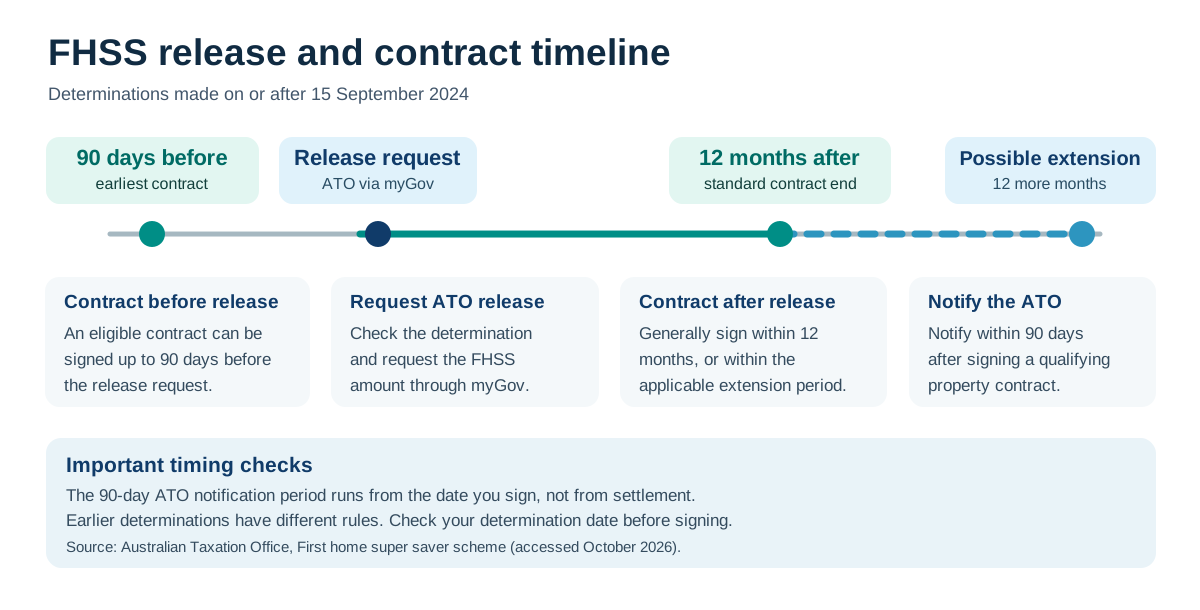
The FHSS timeline shows the 90-day pre-request contract window, the standard 12-month period after requesting release and the separate ATO contract-notification requirement.
How long do I have to buy after FHSS money is released?
For determinations dated from 15 September 2024, the permitted contract period generally starts 90 days before the release request and ends 12 months after it. An additional 12-month period is generally available under the ATO's extension rules, taking the total to 24 months.
For a purchase or construction contract under these rules, notify the ATO within 90 days of signing, unless a longer period has been allowed. Earlier determinations have different timing rules. Verify the applicable determination date before acting.
What happens if I do not buy a home after release?
If no qualifying contract is signed within the permitted period, you generally must recontribute the specified amount to super or retain the release and incur FHSS tax of 20% of the assessable released amount.
The recontribution obligation is based on the assessable released amount less tax withheld, not necessarily the full gross amount. The amount can be recontributed through multiple payments, classified as non-concessional and not claimed as a tax deduction. Complete the recontribution and notify the ATO within the applicable purchase period. Keep fund receipts. According to the ATO, Guidance Note GN 2024/1 (2024), a valid home purchase also requires a purchase or construction price at least equal to the gross FHSS release requested.
Is FHSS worth it compared with saving outside super?
YES, FHSS can produce a tax advantage for eligible savers when the combined contributions and withdrawal tax treatment is more favourable than saving from after-tax income. The advantage varies with marginal tax rate, contribution classification and individual circumstances.
| Factor | FHSS via super | Ordinary savings account |
|---|---|---|
| Eligible contributions | Voluntary super only, with FHSS limits | No FHSS contribution limit |
| Tax | Contribution and release rules apply | Interest generally taxable |
| Access | ATO determination and release request | Usually available under account terms |
| Earnings | ATO notional associated earnings for FHSS | Actual account interest |
| Main risk | Eligibility, super fund investment risk and contract deadlines | Savings interest rate changes and inflation |
Compare net savings, liquidity and expected purchase timing rather than treating the $50,000 limit as guaranteed cash. See the salary sacrifice super calculator to estimate the effect of salary sacrifice on take-home pay, then use the Super Projection Calculator Australia to explore the longer-term balance effect. Neither result is an FHSS release determination.
Can couples each use FHSS to buy the same home?
YES, two eligible purchasers can each use their own FHSS arrangements towards the same jointly purchased property. The $50,000 total eligible contribution limit applies per person, not per property.
Each person requires their own eligible contributions, determination and release request. For deposit planning, add the net amounts each person expects to receive, not two $50,000 headline limits. Concessional contribution treatment, associated earnings and withholding differ between buyers.
How do I calculate FHSS tax savings with a worked example?
Calculate FHSS outcomes by separating contributions, the eligible release percentage, associated earnings and withdrawal tax. Do not treat the $50,000 lifetime contribution cap as a net withdrawal guarantee.
| Contribution category | Voluntary contribution | Eligible releasable contribution |
|---|---|---|
| Concessional (salary sacrifice) | $10,000 | $8,500 (85%) |
| Non-concessional (after-tax) | $10,000 | $10,000 (100%) |
| Combined | $20,000 | $18,500 before associated earnings and release tax |
This arithmetic example assumes the contributions are eligible and within both FHSS and ordinary super caps. It shows the contribution component only, not the net money received. The ATO determines notional earnings and withholding; your tax return establishes the final tax position. For broader super balance modelling, use the Superannuation Calculator Australia. Its result is not an FHSS determination. A practical check is to compare the ATO's estimated release with the deposit needed on the contract date, leaving other purchase costs and any shortfall outside this illustrative calculation.
Can I use FHSS alongside other first-home buyer schemes?
YES, FHSS is a savings mechanism that is generally separate from Australian Government and state or territory first-home buyer assistance. Each separate scheme has its own property value, residency, income and eligibility requirements.
Assess first-home guarantees, grants or transfer duty concessions independently before assuming any combination applies. The FHSS release does not itself establish eligibility for a low-deposit guarantee or transfer duty exemption.
What if I have previously owned property or experienced financial hardship?
Previous Australian property ownership generally disqualifies a person from FHSS, including certain investment property and vacant land interests. The ATO can assess an exception for someone who has suffered financial hardship and lost property ownership.
Apply for an ATO hardship assessment where relevant. Previous ownership is not automatically disregarded because the property was sold or lost.
Can self-employed people use FHSS?
YES, self-employed Australians can participate when they meet the personal FHSS eligibility rules and make qualifying voluntary contributions. Eligible personal deductible and non-deductible contributions have different FHSS release percentages and ordinary contribution cap treatment.
Keep contribution receipts and deduction acknowledgements. A self-employed person using a deductible personal contribution must complete the notice-of-intent process correctly; an undeducted personal contribution is assessed under the non-concessional rules. See super for self-employed for the related contribution rules.
Does FHSS affect the concessional contributions cap?
YES, eligible salary sacrifice and deducted personal amounts are concessional contributions and count towards the ordinary concessional cap. The FHSS annual and total limits do not replace normal super contribution caps.
Compulsory employer SG also uses concessional cap space even though those compulsory payments are not FHSS-eligible. Check the relevant cap and any carry-forward eligibility before contributing.
What documents and dates should I check before signing a contract?
Check your super fund's contribution history, the ATO FHSS determination, proposed release date, contract signing date, settlement date and proof of the required notice to the ATO.
The date of your determination decides which contract and notification rules apply. For determinations on or after 15 September 2024, notify the ATO within 90 days of the contract date. You must also intend to occupy the property for at least six months during the first 12 months after it is practicable to do so. Confirm available deposit funds independently of the ATO's release-processing timeframe.
What errors delay FHSS releases or affect purchase timing?
Common problems include missing contribution records, incorrect personal deduction notices, requesting release before all intended contributions are reflected in a determination and assuming the ATO pays instantly.
Request a corrected or new determination before release when appropriate. The ATO may be unable to alter a release request after processing begins.
Can I use compulsory employer super contributions for FHSS?
NO, compulsory super guarantee contributions are not eligible voluntary FHSS contributions. Additional employer salary sacrifice arrangements can qualify when correctly reported and otherwise eligible.
Check whether a payment is compulsory SG, salary sacrifice or a personal contribution rather than relying on the name shown on a payslip.
Can two eligible buyers each use the FHSS scheme?
YES, each eligible buyer has an individual FHSS limit and requires an individual release request. Joint ownership does not transfer unused FHSS capacity between partners.
The extra check for joint buyers is timing: each person submits their own determination and release request, so one payment may arrive later than the other. Build the deposit schedule around the funds actually received, rather than expecting a single combined ATO payment.
Can I use FHSS if I previously owned an investment property?
NO, previous ownership of an Australian investment property generally prevents FHSS eligibility. A relevant ATO financial hardship determination is a possible exception where the statutory conditions are met.
Do not assume that never having lived in the property makes you a first-home buyer for FHSS.
Does the FHSS scheme guarantee investment returns?
NO, FHSS does not guarantee a return on investments held in your super fund. The ATO's associated earnings component is calculated using a statutory notional method rather than your fund's actual market performance.
A determination amount and fund account value can differ. Investment and fee risks remain within the super fund.
Can I apply for an FHSS determination before signing a contract?
YES, obtaining an FHSS determination before signing is generally the safer sequence. A valid determination must exist before a property or land interest transfers to you.
For post-14 September 2024 determinations, the ATO permits a contract signed within 90 days before the release request, subject to the scheme's conditions. Keep the settlement deadline in view.
Can self-employed Australians participate in FHSS?
YES, self-employed people qualify under the same general first-home ownership and release conditions when making eligible voluntary contributions.
The contribution-type distinction matters for sole traders: a personal contribution is not automatically deductible because it came from business earnings. Where a tax deduction is claimed, use the eligible concessional release percentage and keep the fund's acknowledgement; where no deduction is claimed, apply the eligible non-concessional treatment.
Sources and verification (October 2026)
- Australian Taxation Office, First home super saver scheme, updated 8 July 2026; checked October 2026.
- Australian Taxation Office, About the FHSS scheme, updated 8 July 2026; checked October 2026.
- Australian Taxation Office, Taxation Ruling TR 2024/4: First home super saver scheme, 16 September 2024; checked October 2026.
- Australian Taxation Office, Guidance Note GN 2024/1: First home super saver scheme, 2024; checked October 2026.
- Australian Government, First Home Buyers: First Home Super Saver Scheme, accessed October 2026.
- Australian Taxation Office, Eligibility for the FHSS scheme, updated 8 July 2026; checked October 2026.
- Australian Taxation Office, About FHSS release amounts, updated 8 July 2026; checked October 2026.
Written by
Superannuation Calculator Australia
Calculation guidance and general information; independent financial advice is not provided.