Downsizer Contributions to Super: Eligibility, Limits and Rules
Learn Australian downsizer contribution eligibility, $300,000 limits, deadlines, tax treatment and Age Pension effects.
Superannuation Calculator Australia · · 12 min read
A downsizer contribution lets eligible Australians aged 55 or older put up to $300,000 from selling a qualifying home into super. Couples can contribute up to $600,000 combined, provided both qualify and contributions do not exceed the relevant sale proceeds. The rules depend on age, property ownership, capital gains tax (CGT) treatment, timing and correct fund paperwork.
The contribution does not use ordinary contribution caps. Adding sale proceeds to super can still affect Age Pension means testing and retirement savings decisions. Check these consequences before paying money into a fund.
What are downsizer contributions to super?
A downsizer contribution is a special after-tax super payment made using proceeds from the sale of an eligible Australian residential property. Unlike an ordinary personal non-concessional contribution, it does not use the annual non-concessional contribution cap.
Despite the name, you do not need to buy a smaller home. The requirement is an eligible home sale, not a particular next housing arrangement. The Australian Taxation Office (ATO) administers eligibility and reporting.
Who is eligible for a downsizer contribution?
You must be 55 or older at the time of contribution and meet the property, ownership, CGT and notification conditions. According to the ATO's Downsizer super contributions guidance, the main tests include:
- You or your spouse held an ownership interest in the Australian home for at least 10 years before disposal, subject to specific ownership rules.
- The property is an eligible Australian residential property, not a caravan, houseboat or other mobile home.
- The property qualifies wholly or partly for the main residence CGT exemption, or would qualify except for specified circumstances.
- The sale contract was exchanged on or after 1 July 2018.
- You have not previously made a downsizer contribution in relation to another property's sale.
- You supply the approved downsizer contribution form to the receiving fund by the required time.
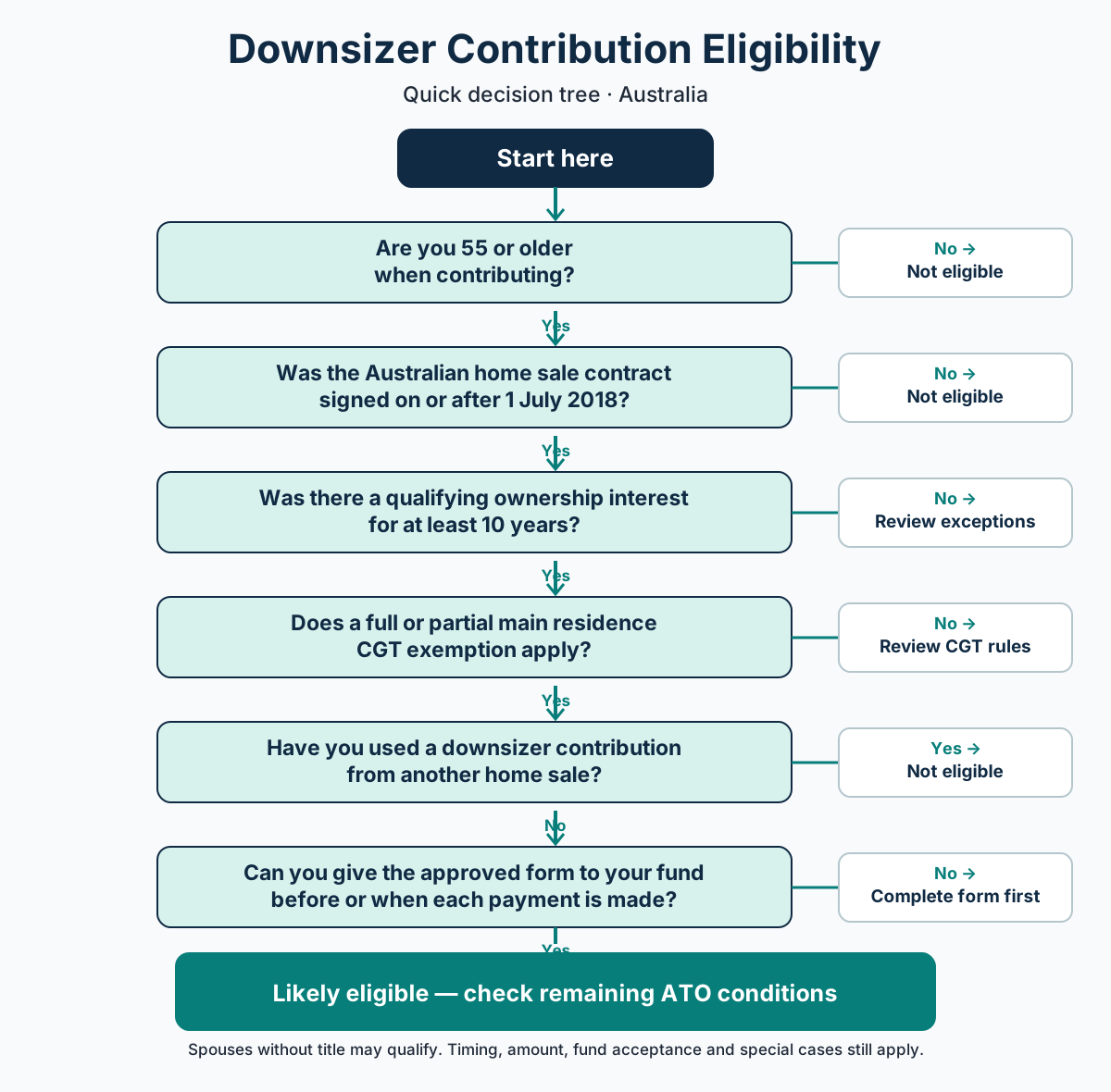
The age threshold applies when contributing, not necessarily when signing the sale contract. According to the ATO, Housing affordability measures: contributing the proceeds of downsizing to superannuation (LCR 2018/9), the 10-year ownership period generally runs between the original acquisition and disposal settlements. Ownership can pass between a person and their spouse or former spouse during that period without necessarily breaking the test. Inherited dwellings still require checking the deceased estate and CGT circumstances.
How much can an individual or couple contribute?
Each eligible individual can contribute up to $300,000. Two eligible spouses can contribute up to $600,000 in total, but the combined amount must not exceed the proceeds of the qualifying sale.
| Sale proceeds | Eligible contributors | Illustrative maximum |
|---|---|---|
| $250,000 | One | $250,000 |
| $500,000 | Two | $500,000 combined, for example $300,000 and $200,000 |
| $900,000 | Two | $600,000 combined, up to $300,000 each |
How to read the table: the figures are combined limits based on the qualifying sale proceeds, not an annual allowance. These examples assume all other requirements are met. According to the ATO, Housing affordability measures: contributing the proceeds of downsizing to superannuation (LCR 2018/9), the statutory limit uses gross capital proceeds, so an outstanding mortgage and selling costs do not reduce the limit. The contributed money does not have to be the identical money received at settlement. However, a household must still have funds or eligible assets available to make the contribution. For example, if a home sells for $500,000 and $350,000 repays the mortgage, eligible spouses can still have a combined statutory downsizer limit of $500,000, but the remaining $150,000 is the cash available from that sale before other expenses.
When must the downsizer contribution be made?
The contribution must generally be made within 90 days of receiving the sale proceeds, ordinarily at settlement, unless the ATO grants an extension. The ATO's legal guidance also links the period to disposal of the ownership interest. Record the settlement date rather than counting from contract exchange, and verify unusual settlement or part-sale arrangements.
An extension can be requested from the ATO in qualifying circumstances, but approval is not automatic. Confirm the receiving fund's processing cut-offs before transferring funds and retain evidence of actual receipt.
How do you make a downsizer contribution?
Confirm eligibility, complete the prescribed form and transfer the contribution using your fund's approved process. The approved form must reach the fund before or when each payment is made, not after the contribution is processed.
- Check your age, residential ownership history and main residence CGT position.
- Ask the receiving super fund to confirm that it accepts downsizer contributions and obtain its payment instructions.
- Note the settlement or other relevant receipt-of-proceeds date and calculate the 90-day period.
- Give the fund the approved Downsizer contribution into super form before or when making each contribution.
- Transfer the amount, verify its fund receipt date and check its downsizer classification.
- Retain the settlement statement, form, transfer receipt and fund acknowledgement.
For background on ordinary deposits and caps, see personal super contributions and super contribution caps. For estimated contribution scenarios, see the Super Contributions Calculator Australia. The downsizer classification must not be assumed from the bank transfer description alone.
What tax and super caps apply to downsizer contributions?
A valid downsizer contribution is not tax-deductible and does not count towards concessional or non-concessional contribution caps. It is not generally subject to the standard contributions tax on entry to a taxed super fund. Investment earnings after receipt are subject to the rules of the relevant super phase.
| Attribute | Downsizer contribution | Ordinary after-tax contribution |
|---|---|---|
| Special eligibility | Qualifying home sale and age 55 or over | General contribution eligibility and acceptance rules |
| Contribution limit | Up to $300,000 per eligible person per qualifying sale | Annual non-concessional cap and possible bring-forward rules |
| Tax deduction | No | Not when treated as a non-concessional contribution |
| Ordinary contribution cap impact | Excluded | Counts towards relevant cap |
| Total super balance | Included when subsequently calculated | Included when subsequently calculated |
An otherwise eligible person can make a downsizer contribution even if their total super balance prevents ordinary non-concessional contributions. However, when money is transferred into a retirement-phase income stream, the person's transfer balance cap remains relevant. See concessional versus non-concessional contributions.
How do downsizer contributions affect the Age Pension?
Selling an exempt principal home and investing proceeds in super can increase assessable assets and reduce Age Pension entitlement. For people of Age Pension age, superannuation interests are generally included under the assets and income tests, subject to the applicable rules.
According to Services Australia, Real estate assets (accessed October 2026), eligible proceeds intended to secure a new principal home can receive a temporary assets-test exemption for up to 24 months, with a possible further 12 months in qualifying circumstances. The exemption applies to the eligible replacement-home portion, not automatically to the whole sale price. Services Australia's Deeming guidance explains that eligible earmarked proceeds held as financial assets may receive a lower deeming rate. Moving proceeds into super does not automatically preserve the principal-home proceeds exemption.
Before contributing, compare the effect on Centrelink entitlements with the benefits of additional super savings. Tell Services Australia about a principal-home sale or relevant assets change, normally within 14 days. Use the Age Pension Calculator for an initial estimate, not a formal assessment.
Are downsizer contributions worth making?
The benefit depends on your available sale proceeds, retirement objectives, Age Pension position, housing plans and access to super. The contribution can increase retirement savings within the superannuation system, but investment returns and retirement income are not guaranteed. Use the Super Projection Calculator Australia to model possible balance changes, with its assumptions and uncertainty in mind.
Compare the contribution's investment and tax treatment against changes in means-tested benefits, liquidity, fees and inheritance arrangements. The following questions cover situations that can change the decision or the validity of a payment.
Can a spouse contribute when only one spouse owns the home?
YES, an eligible spouse can contribute even if the qualifying ownership interest was held by the other spouse. Both must satisfy the relevant individual requirements, including age, previous contribution history and the property sale conditions.
Do you need to buy a smaller home?
NO, the rules do not require a smaller or cheaper replacement home. You can purchase a larger property, rent or make another housing decision, provided the original property sale and contribution satisfy the scheme requirements.
Can a partially rented home qualify?
YES, a partly rented property can qualify if the disposal meets the whole or partial main residence CGT exemption condition. In the ATO's Law Companion Ruling LCR 2018/9, an example of a home rented out for part of the ownership period still satisfies the downsizer main residence test because a partial exemption applies. Check the actual occupation, rental period and CGT position; the contribution limit is not automatically reduced in proportion to the exempt period.
What happens if a downsizer contribution is rejected?
If a contribution does not qualify, the fund must follow the applicable acceptance and reporting rules. A payment treated as an ordinary personal contribution can create non-concessional cap problems, particularly for people whose total super balance prevents further ordinary contributions. Do not assume a rejected downsizer payment becomes valid by resubmitting the same amount. Ask the fund how it was classified and check the outcome with the ATO before taking corrective action.
Can you request more than 90 days?
YES, the ATO can allow an extension where qualifying circumstances justify additional time. The extension is discretionary. Request it promptly and retain evidence explaining why the standard contribution period was missed.
How does the transfer balance cap differ from the downsizer cap?
The downsizer cap limits the eligible contribution to $300,000 per person. The transfer balance cap instead limits amounts transferred into retirement-phase income streams, taking account of each person's transfer balance account. The general cap for 2026–27 is $2.1 million, but earlier pension commencements can produce a different personal cap.
How are multiple fund payments documented?
Each separate downsizer payment needs its own completed approved form, supplied to the receiving fund before or when that payment is made. Keep separate records of fund details, payment amounts, form submissions and receipt dates. Combined qualifying contributions cannot exceed the individual and sale-proceeds limits.
How should couples allocate unequal home sale proceeds?
Couples can allocate unequal contribution amounts where both qualify and each stays within the $300,000 individual maximum. For example, proceeds of $450,000 can support $300,000 for one spouse and $150,000 for the other. Review each person's retirement needs, means-test position and existing super before selecting an allocation.
Which records should you keep before settlement and after payment?
Retain the property sale contract, settlement statement, ownership history, relevant main residence CGT records, submitted downsizer forms, transfer confirmations and fund transaction statements. These records help establish eligibility, classification and the 90-day timing requirement.
What if a home was inherited or owned through a spouse?
Inherited and spouse-owned homes require checking both the 10-year ownership test and the main residence CGT condition. The ATO's Housing affordability measures: contributing the proceeds of downsizing to superannuation (LCR 2018/9) explains that ownership during the 10-year period can be held by a combination of the individual, spouse or former spouse. A deceased spouse's ownership period and certain deceased-estate holding periods can count. Inheritance alone does not establish eligibility: verify the ownership sequence and CGT treatment.
Can you make a downsizer contribution without buying another home?
YES, buying a replacement home is not required for downsizer eligibility. However, the housing decision changes how much cash remains available and may affect Age Pension means testing or other entitlements.
Can someone aged 55 but still working contribute?
YES, continuing to work does not prevent an otherwise eligible person aged 55 or older from making a downsizer contribution. There is no separate work test for this special contribution, though preservation and withdrawal rules still apply.
Can a spouse contribute if their name is not on the title?
YES, the property ownership requirement can be satisfied through a spouse's qualifying ownership interest. The contributing spouse must independently satisfy all other contribution conditions. A relationship alone does not establish that the property sale qualifies.
Can you contribute after 90 days without an extension?
NO, a payment made outside the applicable 90-day period generally does not qualify without an ATO extension or another applicable statutory exception. A late transfer is not automatically accepted as a downsizer contribution.
Do downsizer contributions count towards ordinary contribution caps?
NO, a valid downsizer contribution does not use ordinary concessional or non-concessional cap space. The additional funds are nevertheless included in total super balance calculations at the relevant time and can affect later contribution eligibility.
Are downsizer contributions tax deductible?
NO, downsizer contributions are not personal deductible super contributions. They are made from qualifying home sale proceeds and are not ordinarily subject to contributions tax on entry to a taxed fund.
Can you make another downsizer contribution after a second home sale?
NO, the downsizer concession is available only once in an individual's lifetime in relation to one qualifying property sale. The rules can allow more than one payment associated with the same qualifying sale, subject to the contribution requirements and limits.
Sources and verification (October 2026)
- Australian Taxation Office, Downsizer super contributions, accessed October 2026.
- Australian Securities and Investments Commission, Downsizer super contributions, Moneysmart, updated 29 September 2026.
- Australian Taxation Office, Downsizer contribution into super form (NAT 75073) and Downsizer contributions (fund reporting guidance, updated 2026).
- Australian Taxation Office, Housing affordability measures: contributing the proceeds of downsizing to superannuation (LCR 2018/9), including examples involving partial CGT exemptions.
- Services Australia, Real estate assets, Deeming and Change of circumstances when you get Age Pension, accessed October 2026.
- Australian Taxation Office, Transfer balance cap, 2026–27 general cap guidance.
This article provides general information, not personal financial or tax advice. Eligibility and means-testing outcomes depend on individual circumstances.
Written by
Superannuation Calculator Australia
Calculation guidance and general information; independent financial advice is not provided.