Early Access to Super in Australia: Eligibility, Applications and Risks
Learn who qualifies for early super access in Australia, how to apply, approval rules and the tax and retirement risks.
Superannuation Calculator Australia · · 13 min read
Early access to super means withdrawing preserved retirement savings before you ordinarily qualify to retire, only when a lawful condition of release applies. In Australia, the main pathways involve severe financial hardship, specified compassionate expenses and certain medical conditions. The approval authority, evidence requirements, payment limits and tax treatment depend on the pathway. Before applying, check the rules and the effect on your remaining balance, insurance and retirement savings.
What is early access to super?
Early access to super is a legal exception to the normal restriction on withdrawing superannuation savings. A condition of release must apply, and the fund must be permitted to pay the benefit. According to the Australian Taxation Office (ATO), releasing super without a condition of release is unlawful.
Common exceptional grounds include severe financial hardship, approved compassionate expenses, terminal medical conditions and incapacity. These have different eligibility tests. Ordinary withdrawals after retirement, the First Home Super Saver scheme and payments to departing temporary residents follow separate rules; they are not interchangeable routes to cash.
When can super be accessed before retirement?
You must meet a recognised release condition. The diagram summarises common pathways and the authority to contact; the tests vary by circumstance.
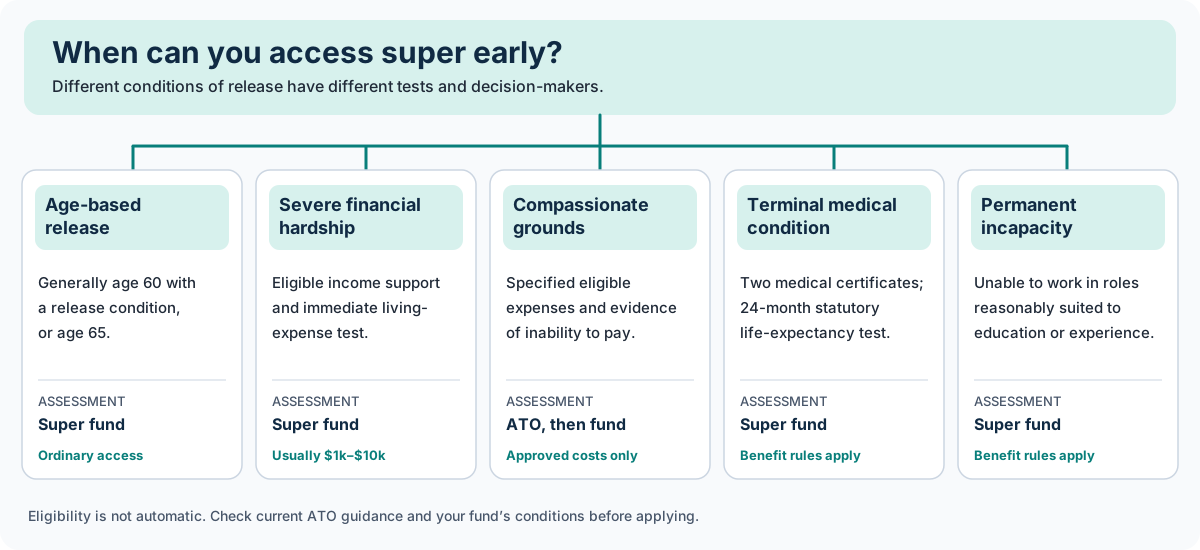
You can generally access super from age 60 after retirement or after leaving an employment arrangement, subject to the applicable release condition. From age 65, you can access super whether or not you are working. Before those ordinary release points, a limited exception must apply. ASIC MoneySmart distinguishes hardship, compassionate expenses and illness or injury as the main early-access circumstances.
| Pathway | Typical test | Approver |
|---|---|---|
| Ordinary release | Age 60 with relevant retirement or cessation condition, or age 65 | Fund |
| Severe hardship | Income support and essential-expense test | Fund trustee |
| Compassionate grounds | Specific eligible unpaid expenses | ATO then fund |
| Terminal condition or incapacity | Applicable medical evidence and fund rules | Fund trustee |
For ordinary preservation-age rules see when you can access super.
What qualifies as severe financial hardship?
Severe financial hardship is not simply having debt. For the standard pre-retirement hardship test, an applicant generally must have received eligible Commonwealth income support continuously for 26 weeks and be unable to meet reasonable and immediate family living expenses. The super fund trustee assesses eligibility, using income-support evidence from Services Australia where relevant.
Under the standard hardship condition, the permitted lump sum is $1,000 to $10,000 once in a 12-month period. A payment below $1,000 is permitted when the person's eligible preserved and restricted non-preserved benefits total less than $1,000. A separate hardship condition applies after reaching preservation age plus 39 weeks and requires different income-support and employment evidence. According to the ATO, the super fund decides whether the applicable hardship test is satisfied.
Which expenses may qualify on compassionate grounds?
The ATO considers compassionate release for specific unpaid expenses where applicants cannot meet the costs by other means. Eligible categories include necessary medical treatment or transport, home or vehicle modifications for severe disability, palliative care, a dependant's funeral or burial and measures to prevent foreclosure or forced sale of a principal home.
Invoices, quotes and evidence specific to the expense are required. Ordinary personal spending, credit-card repayments and discretionary purchases are not compassionate grounds by themselves. The approved amount is linked to eligible costs, not a general cash entitlement.
Which compassionate and medical conditions allow early release?
Compassionate medical release concerns qualifying treatment or transport costs for the member or a dependant. It differs from early release for permanent incapacity, temporary incapacity or a terminal medical condition, which involve separate medical assessments and fund processes.
For a terminal medical condition, two registered medical practitioners, including at least one specialist practising in the relevant field, must certify that the member has an illness or injury likely to result in death within 24 months of certification. The fund applies the legal certification and timing rules. Permanent incapacity concerns inability to work in employment for which the member is reasonably qualified. Temporary incapacity commonly involves a relevant income-protection benefit rather than unrestricted access to the entire balance.
Who approves each type of early super access?
The ATO determines applications for compassionate release, while the super fund assesses severe financial hardship and most incapacity or terminal-condition claims. An ATO compassionate approval does not itself transfer money: the super fund must also process a permitted payment.
The table identifies which organisation assesses each claim and which organisation arranges the payment.
| Ground | Assessment | Payment |
|---|---|---|
| Compassionate expense | ATO | Super fund after its checks |
| Severe hardship | Fund trustee | Super fund |
| Terminal medical condition | Fund trustee | Super fund |
| Permanent or temporary incapacity | Fund and insurer where applicable | Fund or insurance benefit |
Which office should I contact first for my specific early release reason?
For severe financial hardship, contact your super fund first and ask for its current eligibility test and evidence requirements. For compassionate grounds, check the fund can pay after an ATO approval, then apply through the ATO using the appropriate process. For incapacity or terminal illness, ask the fund about medical evidence and any linked insurance claim.
Services Australia can confirm qualifying income-support history but is not the hardship-release decision-maker. With the member's permission, some funds verify this through Centrelink Confirmation eServices; others request a Services Australia confirmation letter. Neither form of evidence guarantees approval. Record the decision-maker, required documents and fund conditions.
How do I apply for early release?
There is no universal early-release application. First identify the applicable legal ground, then follow that ground's approval route. An applicant can use this sequence:
- Identify the legal release ground and check eligibility with the super fund or ATO.
- Ask the fund whether the benefit can be released under its rules and whether insurance could be affected.
- Gather the applicable evidence: Services Australia payment confirmation, medical certificates, itemised quotes or invoices.
- Lodge with the correct decision-maker. For compassionate grounds, apply to the ATO before requesting payment from the fund.
- Keep the decision notice, complete fund identity and payment checks and confirm tax withholding before receiving the funds.
How much super can be released under each pathway?
The amount available depends on the release condition. The standard severe-hardship pathway is ordinarily limited to $1,000–$10,000 once in 12 months, while compassionate release is linked to specific approved eligible expenses. Terminal illness and permanent incapacity may permit a greater payment depending on the condition, account and fund rules.
| Release ground | How the amount is determined |
|---|---|
| Standard severe hardship | $1,000–$10,000, normally once in 12 months; exceptions for smaller balances |
| Compassionate grounds | Specific costs accepted by the ATO, subject to evidence and fund release |
| Terminal condition or incapacity | Individual condition, balance, benefit type and fund terms |
The quoted amount is not necessarily the bank deposit. Tax withholding, eligible components and any remaining balance need checking before the member authorises payment. Different hardship criteria can apply after preservation age plus 39 weeks.
Is an early super payment taxable?
YES, an early super payment can be taxable. According to the ATO, severe-financial-hardship payments have no special tax rate; they are treated as ordinary super lump-sum benefits. For people under 60, tax on a taxable component is commonly relevant. Payment amounts, tax-free components, untaxed elements and specific grounds can change the result.
For a terminal medical condition, the ATO's tax-free lump-sum treatment depends on the qualifying medical certifications and the timing of the payment. A compassionate-ground approval does not automatically mean the withdrawal is tax-free. Ask the fund for a component breakdown and withholding estimate before accepting a payment. For additional background see superannuation tax.
How could withdrawing super now affect retirement later?
Withdrawing super reduces the amount invested for retirement and the potential future returns on that amount. The longer the remaining investment horizon, the larger the possible compounding effect, although future returns are not guaranteed.
For example, a hypothetical $10,000 withdrawal today removes $10,000 from the invested balance. At an illustrative 5% annual net return for 15 years, the amount left invested would grow to approximately $20,789 ($10,000 × 1.05^15). This is not a forecast; the example assumes a constant return, no further contributions and no withdrawals, and does not adjust for inflation. Actual investment returns and fees vary. Compare the immediate need with possible longer-term effects using the Super Projection Calculator Australia, with its assumptions checked before relying on an estimate.
Can an early withdrawal change insurance in super?
YES, an early withdrawal can affect insurance held through super if the payment leaves insufficient funds for premiums or causes the account to close. Life, total and permanent disability and income-protection cover have distinct policy terms.
Ask the fund whether coverage remains active after the proposed withdrawal, how premiums are paid and whether a related disability or income-protection claim is available before withdrawing savings. See insurance through super for the policy distinctions.
How do I recognise unlawful early-access advice?
An unlawful early-access offer may promise immediate access for any personal expense, encourage a transfer to a self-managed super fund or charge substantial intermediary fees. The ATO warns that illegal withdrawals can result in additional income tax, penalties and interest, as well as identity theft risk.
Do not provide identity documents or sign transfers on the strength of an advertised shortcut. Confirm a legal condition of release with the ATO and the fund. A self-managed super fund does not eliminate preservation rules.
What alternatives should be checked before withdrawing super?
Before taking super, check assistance that addresses the underlying expense without reducing retirement savings. For debts and rent, contact creditors or the landlord about hardship arrangements and speak with a free financial counsellor through the National Debt Helpline. For urgent income needs, check Services Australia eligibility and emergency relief.
For medical expenses, ask the provider about available public treatment, payment arrangements and evidence of clinical necessity. Do not borrow at high cost merely to create an application expense.
What should I do if an application is refused?
If an early-release application is refused, read the decision notice and identify whether the refusal relates to eligibility, evidence, the expense category or the fund's payment conditions. Ask the actual decision-maker about its review or complaints process and the documents needed to correct an omission.
An ATO compassionate decision and a fund-trustee decision have different review routes. For a fund complaint, use the fund's internal dispute resolution process and consider the Australian Financial Complaints Authority where the dispute falls within its jurisdiction. Do not assume every refusal can be appealed through the same body.
How does DASP differ from early access?
A departing Australia superannuation payment (DASP) is a separate scheme for eligible former temporary residents who have left Australia and whose qualifying visa has ceased. It is not an alternative hardship or compassionate release application for people still living in Australia.
According to the ATO, eligible applicants use the DASP process to claim super held by a fund or the ATO; specific withholding tax rules apply. Visa and residency eligibility should be confirmed before applying. See super for temporary residents.
Can I access super early just because I have debts?
NO, personal debt alone does not give an automatic right to withdraw super early. A debt-related applicant must independently satisfy a lawful release condition, such as severe financial hardship. The separate compassionate mortgage rule concerns a qualifying threat of foreclosure or forced sale of a principal home, not ordinary repayments or consumer loans.
Seek hardship arrangements and free debt advice before using retirement savings.
Can I access super early to pay rent?
YES, rent arrears can be part of the reasonable and immediate family living expenses considered under the severe-financial-hardship test, but rent debt alone does not establish eligibility. The fund checks income-support eligibility, immediate living expenses and the applicable supporting evidence.
Ask the landlord for a repayment arrangement while you check your eligibility and alternative housing assistance.
Can I withdraw super early to pay for dental treatment?
YES, dental treatment can qualify on compassionate medical grounds when it meets the ATO's medical necessity and evidence tests. A cosmetic preference alone is not a qualifying ground.
Obtain independent clinical advice, costed treatment documents and any required practitioners' reports. Do not rely on a clinic's promise that ATO approval is guaranteed. ASIC MoneySmart cautions against pressure from dental providers to withdraw super.
Can I access my super early if I am unemployed?
NO, unemployment by itself does not automatically unlock super. It may be relevant to the severe-hardship eligibility test when accompanied by the required eligible income-support history and inability to meet immediate living expenses. Other ordinary age-based release conditions may apply independently.
Ask your fund to check the precise release condition; Services Australia can provide income-support evidence where required.
Can I access super early without ATO approval?
YES, some lawful grounds do not require an ATO compassionate-release approval. Severe financial hardship and many incapacity or terminal medical-condition claims are considered by the fund trustee. Compassionate grounds generally require an ATO decision followed by fund processing.
Avoid treating 'without ATO approval' as 'without eligibility checks': the fund must establish the legal release condition.
Can I get early release if I have already reached preservation age?
YES, reaching preservation age can change the conditions of release, but preservation age alone does not necessarily permit unrestricted withdrawal. At 60, retirement or ceasing an employment arrangement may satisfy an ordinary release condition; age 65 permits access regardless of employment.
The separate severe-hardship rules may also differ after preservation age plus 39 weeks. Check the specific release condition rather than relying solely on age.
Sources and verification (October 2026)
- ASIC MoneySmart, When you can access your super early (updated 23 October 2026).
- ASIC MoneySmart, Getting your super (updated 6 August 2026).
- Australian Taxation Office, When you can access your super early and Early access to super (July 2026; checked 28 October 2026).
- Australian Taxation Office, Illegal early access to super (April 2025).
- Australian Taxation Office, Access due to severe financial hardship (July 2026).
- Australian Taxation Office, Access on compassionate grounds and Eligible expenses for compassionate release of super (July 2026).
- Services Australia, Early release of superannuation and How to apply to release your superannuation early (accessed October 2026).
- Australian Taxation Office, Departing Australia superannuation payment (DASP) guidance (checked 28 October 2026).
Verification date: 28 October 2026. Rules described apply as at verification; check future legislative changes before relying on them. This article provides general education, not personal financial, tax or legal advice.
Written by
Superannuation Calculator Australia
Calculation guidance and general information; independent financial advice is not provided.